|







| File 1 | File 2 | File 3 | File 4 | File 5 |
| File 6 | File 7 | File 8 | File 9 | File 10 |
| File 11 | File 12 | File 13 |
| General Index |
| Longer entries | ||||
| W. B. Yeats | Stanislaus Joyce | Samuel Beckett | ||
L. A. G. Strong (‘James Joyce and the New Fiction’, 1935): ‘[...] Here, from angles so widely different that each would recoil in indignation, Joyce and Yeats meet: Yeats with his magic, Joyce with his superstition. / Over Ulysses, as over the earlier work, broods the sense of sin, that terrific spiritual legacy which the Catholic Church irrevocably leaves her children. Ulysses is a great Catholic novel. The blasphemies that turn the short-sighted against it are the desperate gestures of a man doomed to accept, with his spiritual entrails if not with his intellect, certain Last Things. The whole book is the agonised attempt of an artist to bring all life within his scope, aware that his effort is also a religious effort, and agonised because, while his genius bids him accept his own interpretation, he cannot escape from the interpretations of others. The Catholic artist knows that none other is better equipped to face and portray life in all its aspects, but he is tortured by the problems of expediency. Joyce’s words, then, are his ritual, his incantation, and he is as serious in their use as any priest. In many of the scenes in Ulysses they are governed by theory, as where, in the lying-in hospital, the language moves to the New World to celebrate the arrival of the new life. This variation in language, and the Graeco-German combinations of words, and the boldness of association, are the main contributions of Ulysses to the art of the novel. Joyce’s avowed purpose is so to reconstruct Dublin, in the compass of a single day of June, 1904, that if the city were swallowed in an earthquake a reader of the book would find a perfect record of what had gone. More than photographic description is needed for such a reconstruction. Magic is necessary: and magic proceeds by incantation. / How Joyce’s technique of incantation may be used is shown in Anna Livia Plurabelle, particularly in the closing paragraphs. [...] The appeal is not to the conscious mind, but to the mind in dream, which is reached by a series of gentle, inadequate calls to the lulled senses. No image is so sharp as to project from the silvery twilight: each makes its faint tinkling impact, and fades blurred into the dream, into the music of the whole crepuscular incantation.’ (in American Mercury, XXXV, 140 (August 1935), pp.434-37 [also as pub. ‘What is Joyce Doing with the Novel?’, in John O’London’s Weekly, XXXIV, 881, 29 Feb. 1936, pp.821-26]; rep. in Robert Deming, ed., James Joyce: The Critical Heritage, London: Routledge & Kegan Paul 1970 [Vol. 2]., p.636-39.)
L. A. G. Strong, review of Finnegans Wake (1939): ‘[...] It is essential, if we are going to understand Finnegans Wake, to listen to its paragraphs as if they were music, to repeat them over many times to ourselves, before we attempt to subject them to logical prose analysis. The appeal is less to the conscious waking mind than to the subconsscious mind, the mind in dream. It is the appeal of poetry rather than that of prose: and we can completley defeat our powers of comprehension if we start pulling these paragraphs to pieces before we have listened to them and allowed them to make their half-hypnotic effect upon that part of our mind to which music speaks.’ (John O’London’s Weekly, 5 May 1939, p.168; rep. in Robert Deming, ed., James Joyce: The Critical Heritage, London: Routledge & Kegan Paul 1970 [Vol. 2], p.661-62.)
G. B. Shaw: ‘In 1876 I had had enough of Dublin. James Joyce in his Ulysses has described, with a fidelity so ruthless that the book is hardly bearable, the life that Dublin offers her young men, or if you prefer it the other way, the life its young men offer to Dublin [...] a certain futile derision and belittlement that confuses the noble and serious with the base and ludicrous seems peculiar to Dublin.’ (Preface to Immaturity, 1931; quoted [in part] in Peter Costello, The Heart Grown Brutal, 1977, where it is called ‘a peculiarly wrongheaded judgement’, p.55.) Note: the same passage was previously quoted in Richard Ellmann, James Joyce (1965 Edn.), p.522, ftn.; with additional references in the text remarking that Shaw refused to subscribe to the Egoist edition on the grounds that he found the novel a repulsive but accurate picture of Dublin and would like to force every male Irishman to read it, to see if any of them could bear looking at himself in this mirror, typifying the city as being full of ‘slackjawed blackguardism’.
G. B. Shaw: Shaw to Archibald Henderson, speaking of Ulysses in The Little Review: ‘I was attracted to it by the fact that I was once a young man in Dublin, and also by Joyce’s literary power, which is of classic quality. I do not see why there should be any limit to the frankness of sex revelation; but Joyce does not raise that question. The question he does raise is whether there should be any limit to the use in literature of blackguardedly language [.../] I could not write the words Mr Joyce uses: my prudish hand would refuse to form the letters; and I can find no intereset in his infantile clinical incontinences, or in the flatulations which he thinks worth mentioning [...] Ulysses is a document, the outcome of a passion for documentation that is as fundamental as the artistic passion - more so, in fact; for the document is the root and stem of which the artistic fancyworks are the flowers. Joyce is driven by his documentary demon to place on record the working of a young man’s imagination for a single day in the environment of Dublin. The question is, the document authentic? [...] I [...] reply that I am afraid it is [.../] The Dublin “Jackeens” of my day, the medical students, the young bloods about town, were very like that. Their conversation was dirt; and it defiled their sexuality, which might just as surely have been represented to them as poetic and vital. I should like to organise the young men of Dublin into clubs for the purposes of reading Ulysses; to that they should debate the question “Are We Like That?” [...] You cannot carry out moral sanitation any more than physical sanitation without indecent exposures. [.... &c.]’ (Quoted in Ellmann, op. cit., p.588, ftn.). Ellmann also cites a testimonial on Joyce from Shaw in response to a misreporting of his supposed burning of his copy of Ulysses made by Geoffrey Grigson in Picture Post in 1939 (idem.). See further on Ulysses under G. B. Shaw, infra.]
[ top ]
| For remarks on Joyce’s first meeting with Yeats, see Eric Bulson, (Introduction to James Joyce, Cambridge 2006) under Commentary - infra. |
W. B. Yeats (I) - Joyce meets Yeats: ‘[...] I went out into the street and there a young man came up to me and introduced himself. he told me he had written a book of prose essays and poems, and spoke to me of a common friend [Russell; ...] I asked him to come with me to the smoking room of a restaurant in O’Connell Street, and read me a beautiful though immature and eccentric harmony of little prose descriptions and meditations. He had thrown over metrical form, he said, that he might get a form so fluent that it would respond to the motions of the spirit. I praised his work but he said, “I really don’t care whether you like what I am doing or not. It won’t make the least difference to me. Indeed I don’t know why I am reading to you.” / Then, putting down his book, he began to explain all his objections to everything I had ever done. / Why had I concerned myself with politics, with folklore, with the historical setting of events and so on? Above all why had I written about ideas, why had I descended to making generalisation? These things were all the signs of the cooling iron [...] I had been puzzled, but now I was confident again. He is from the Royal University, I thought, and he thinks that everything has been settled by Thomas Aquinas, so we need not trouble about it. I have met so many like him. [...] But the next moment he spoke of a friend of mine [Oscar Wilde] who after a wild life had turned Catholic on his deathbed. He said that he hoped his conversion was not sincere. He did not like to think that he had been untrue to himself at the end. No, I had not understood him yet. / I had been doing some litle plays for our Irish theatre, and had founded them all on emotions or stories that I had got out of folklore. He objected to these particularly and told me I was deteriorating. I had told him that I had written these plays quite easily and he said that made it quite certain; his own little book owed nothing to anything but his own mind which was much nearer to God than folklore.’ {102} [Cont.]
Cont. [Yeats here recounts his speech to Joyce about the merits of folk imagination - see note.] ‘In the country, on the other hand, I mean in Ireland and in places where the towns have not been able to call the tune, you find people who are hardly individualised to any great extent [...] Everything seems possible to them, and because they can never be surprised, they imagine the most surprising things. The folk life, the country life, is nature with her abundance, but the art life, the town life, is the spirit which is sterile if it is not married to nature. The whole ugliness of the modern world has come from the spread of the towns and their ways of thought, and to bring back beauty we must marry the spirit and nature again. When the idea which comes from individual life marries the image that is born of the people, one gets great art, the art of Homer, and of Shakespeare, and of Chartres Cathedral.” / I looked at my young man. I thought, “I have conquered him now,” but I was quite wrong. He merely said, “Generalizations aren’t made by poets; they are made by men of letters. They are no use.” / Presently he got up to go, and, as he was going out, he said, “I am twenty. How old are you?” I told him, but I am afraid I said I was a year younger than I am. He said with a sigh, “I thought as much. I have met you too late. You are too old.”’ (Quoted fully in Richard Ellmann, James Joyce, OUP 1959, 1965, pp.107-08; 1982 Edn., pp.102-03 [bow brackets, supra]; and [in part] in Frank Tuohy, Yeats: An Illustrated Biography, Macmillan 1976, p.117.)
Note: Slocum and Cahoon refer to this conversation and quote Joyce as saying to Yeats that his own mind was ‘much nearer to God than to folklore.’ (See John J. Slocum and Herbert Cahoon, Foreword to the revised and re-set edition of Stephen Hero [1944], London: Jonathan Cape 1956 , p.11; no citation.)
W. B. Yeats (II): Richard Ellmann discusses fully the authenticity or otherwise of the received version - ‘You are too old for me to help you’ [actually circulated by Padraic Colum], supplying a] an account of Joyce’s response to it in conversation with Herbert Gorman when looking over the proofs of the biography [‘though he did say the words something to the effect attributed to him they were never said in the tone of contempt which is implied in the story’ - Gorman papers; Ellmann, James Joyce, 1959 Edn. pp.105-06 [ftn.]; 1982 edn. p.102); b] a transcription of George Russell’s telling of the story in “Some Characters of the Irish Literary Movement” [typescript], ending ‘We have met too late. You are too old for me to have any effect on you.’ (Ellmann, idem.; see under Russell, infra); c] remarks from Yeats’s Autobiographies which speak of Joyce anonymously (‘a young poet, who wrote excellently but had the worst manners ...’); d] remarks by L. A. G. Strong reflecting similar remarks by Yeats to him; and e] the sense of an interview with Stanislaus Joyce containing Joyce’s own account as retaled to him, which appears to provide the mainstay of Ellmann’s own narration.
[Ellmann notes that Yeats wrote an account of the interview which he quotes fully - as attached - at first intending it for use as a preface to Ideas of Good and Evil (Richard Ellmann, James Joyce, 1959, pp.106-08; Ellmann here cites his own Identity of Yeats, 1954, pp.86-89.)]
See further, Richard Ellmann in Joyce > Commentary - as infra; also the account of the Yeats-Joyce meeting in R. F. Foster, W. B. Yeats - A Life, Vol. I: “The Apprentice Mage”, OUP 1997, pp.275-78 - which sets the date in Nov. 1902 as distinct from the date implied in Ellmann’s narrative (Oct. 1902) - viz., ‘In October Russell told him that WBY would be in Dublin the following month and would like meet him (he had already dined at the Nassau Hotel on 4 November with Gregory and JBY). There was accordingly a rendezvous outside the National Library, followed by an awkward encounter in an O’Connell Street café.’ (Foster, p.276.) Note however the different chronology given in William Martin Murphy’s Prodigal Father: John Butler Yeats (1978) - as infra.
Foster writes of the encounter: ‘More immediately apparent was the mutual suspicion between an established Irish Protestant aesthete and a Jesuit-educated Catholic Dubliner with a preternaturally mordant eye for social pretensions.’ (Foster, W. B. Yeats - A Life, Vol. I, OUP 1997, p.276; see full-text copy in RICORSO Library, “Criticism / Major Authors” - W. B. Yeats > R. F. Foster, via index or attached.)
[ top ]
W. B.Yeats and young-man Joyce (IV): In the Preface to the second edition of The Tables of the Law and The Adoration of the Magi (London: Elkin Mathews 1905), Yeats wrote of ‘a young man in Ireland the other day, who liked them very much and nothing else that I have written’ by way of explaining his reasons for reprinting the collection. (See Tables of the Law & The Adoration of the Magi [rep. of 1905 edn.], London: Routledge 1910, p.[4].) Note that Joyce’s title, A Portrait of the Artist as a Young Man actually echoes this formula - and that it is again ‘a young man’ who comes up to Yeats and introduces himself in his memoir of the encounter in Nov. 1902, and that Yeats calls his work ‘the poetry of a young man [...] who is practising his instrument’ in the letter of Dec. 1902. George Russell wrote to Lady Gregory, ‘I think I will try this young man looking for a young man’. [BS]
Note: Yeats praised “I Hear an Army Charging” (Chamber Music, XXXVI) for its particular merit, calling it ‘a tecnical & emotional masterpeice [sic]’ in a letter of 29 July [1915] (CL Intelex 2734).
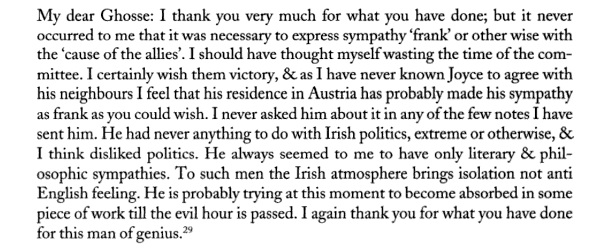
W. B. Yeats (V) - writing to Edmund Gosse regarding an application for Joyce’s inclusion in the Civil List: ‘It never occurred to me that it was necessary to express sympathy “frank” or otherwise with the “cause of the allies”. I should have thought myself wasting the time of the committee. I certainly wish them victory, & as I have never known Joyce to agree with his neighbours I feel that his residence in Austria has probably made his sympathy as frank as you could wish.’ (James Longenbach, Stone Cottage: Pound, Yeats and Modernism,OUP 1988, pp.182-83; quoted in Roy Foster, ‘Hearts with one Purpose Alone: Yeats’s Poetic Strategy & Political Reconstruction, 1916-1918’, in Hearts and Minds: Culture and Society in Ireland Under the Act of Union, ed Bruce Stewart [Princess Grace Irish Library Ser.] Gerrards Cross: Colin Smythe 2001, p.311.)
Further: ‘“He had never anything to do with Irish politics, extreme or otherwise, & I think disliked politics. He always seemed to me to have only literary & philosophic sympathies.”’ (Foster, W. B. Yeats: The Arch-Poet, Vol. II 2003, p.14.)
See R. F. Foster, W. B. Yeats - A Life, II: The Arch-Poet 1915-1939, Oxford: OUP 2003, p.14; available on Google Books - title & page; accessed 13.04.2017.
W. B. Yeats (VI): ‘We need not consider Mr. Padraic Colum’s Castle Conquer, nor Mr. James Joyce’s Ulysses, nor Mr. George Moore’s Conversations in Ebury Street, as, like Mr. Bernard Shaw, they have not been resident in Ireland. We feel, however, that it is our duty to say that Mr. James Joyce’s book, though as obscene as Rabelais, and therefore forbidden by law in England and the United States, is more indubitably a work of genius than any prose written by an Irishman since the death of Synge.’ (Quoted in Richard Ellmann, James Joyce, 1965 Edn., p.578, ftn.)
W. B. Yeats (VII) - Yeats at first called Ulysses ‘A mad book!’, but later corrected himself in conversation with L. A. G. Strong: ‘I have made a terrible mistake. It is a work perhaps of genius. I now perceive its coherence.’ [Richard Ellmann, James Joyce, 1965 Edn., p.545; quoting interview with Strong.] He soon wrote: ‘It is an entirely new thing - neither what the eye sees nor the ear hears, but what the rambling mind thinks and imagines from moment to moment. He has certainly surpassed in intensity any novelist of our time.’ (Letter to John Quinn, 23 July 1918; Ellmann, idem.; CL Intelex 3465; L, 651; Schuchard op. cit., 2013, infra, p.121-22)
Note: When he had read the published book in hand, Yeats wrote to Olivia Shakespear: ‘It has our Irish cruelty and also our kind of strength and the Martello Tower pages are full of beauty. A cruel playful mind like a great soft tiger cat.’ (8 March, 1922; quoted in Ellmann, idem.); finally, he confessed to Shakespear in June that he had given up reading it. (Ellmann, idem.).
[Var. - in Yeats’s orthography: ‘I am reading the new Joyce [...] I hate it when I dip here & there but when I read it in the right order I am much impressed. [...] It has our Irish cruelty & also our kind of strength & the Martello Tower pages are full of beauty.’ (8 March [1922]; quoted in Ronald Schuchard, ‘The Tower: Yeats’s anti-Modernist Monument’, in Yeats Annual, No. 18, 2013, p.121, citing CL, InteLex, 4085; L, 679 .)
Also: Yeats had just settled into Thoor Ballylee in Co. Galway where he wrote patricianly in a letter to John Quinn: ‘If I had this tower when Joyce began I might have been of use, have got him to meet those who might have helped him. (Quoted in Schuchard, ‘Yeats’s anti-Modernist Monument’, The Living Stream: Yeats Annual 18 (2013), p.121, citing Wade, ed., Letters, p.651; Kelly & Schuchard, Letters, as InteLex, 3465 - available online.) See also Schuchard, op. cit., p.138 - for discussion of the citation of Joyce in A Vision (1925).
Further: Yeats wrote to John Quinn in 1918, ‘I think him [Joyce] a most remarkable man’ - a sentence inadvertantly omitted in Wade’s edition of the latters (without elipsis), and quoted in Joseph M. Hassett, ‘What Rafferty Built’, in The Living Stream: Yeats Annual, [Special Derry Jeffares Iss.] No. 18 (2013), pp.97-106; p.102n. - citing L, 651; CL, InteLex, 34650; YA, 18, 102.
[ top ]
W. B. Yeats (VIII): ‘James Joyce differs from Arnold Bennett and Galsworthy, let us say, because he can isolate the human mind and its vices as if in eternity. So could Synge, so could O’Casey till he caught the London contagion in The Silver Tassie and changed his mountain into a mouse.’ (Pages from a Diary written in Nineteen Hundred and Thirty, 1944 [q.pp.]; rep. in Richard Finneran, ed., The Yeats Reader, NY: Scribner 1992, p.342.)
W. B. Yeats (IX) - A Vision, 1925 [1926]:‘Personality is everywhere spreading out its fingers in vain, or grasping with an always more convulsive grasp a world where the predominance of physical science, of finance and economics in all their forms, of democratic politics, of vast populations, of architecture where styles jostle one another, of newspapers where all is heterogenous, show that mechanical force will in a moment become supreme.’ (A Vision [A] 1925, pp.206-07; quoted in Foster, op. cit., p.289 [above the proceeding].) ‘I find at this 23d Phase which is it is said the first where there is hatred of the abstract, wher the intellect turns upon itself, Mr. Ezra Pound, Mr Eliot, Mr Joyce, Signor Pirandello, who either elminate from metaphor the poet’s phantasy and substitute a strangeness discovered by historical or contemporary research or who break up the logical processes of thought by flooding them with associated ideas or words that seem to drift into the mind by chance; or who set side by side as in Henry IV, The Waste Land, Ulysses, the physical primary - a lunatic among his keepers, a man fishing behind the gas works, the vulgarity of a single Dublin day prolonged through 700 pages and the spiritual primary, delirium, the Fisher King, Ulysses’ wandering. It is as though myth and fact, united until the exhaustion of the Renaissance, have now fallen so far apart that man understand for the first time the rigidity of fact, and calls up, by that very recognition, myth.’ (A Vision, 1925, pp.211-12; quoted in Richard Ellmann, James Joyce [ 1959] 1965 Edn., p.608, ftn. [no ref.; with ellipses for the names of Pound, Eliot, Joyce & Pirandello; also for physical primary and spiritual primary - as infra.]; also in R. F. Foster, W. B. Yeats - A Life, Vol. II: “The Arch-Poet”, OUP 2003, p.289 [as given in W. B. Yeats, Quotations, infra].) |
|
W. B. Yeats (X) - acc. Richard Ellmann, in James Joyce (1959, &c.), p.608, n.:
| ‘Joyce takes the occasion to refer to another attack upon him [Joyce], a more refined one, by Yeats in the first edition of A Vision, which (though dated 1925) appeared at the beginning of 1926. [for Ellmann’s subsequent recantation of this view in the revised edition, see infra.] Yeats treated Joyce, along with Eliot, Pound, and Pirandello, as examples of the disintegration of the unified consciousness of earlier artists. In them, he said, “There is hatred of the abstract. [...] The intellect turns upon itself.” He had in mind Joyce’s hatred of generalizations, as expressed to him in 1902. Then, he went on, they “either eliminate from metaphor the poet’s phantasy and substitute a strangeness discovered by historical or contemporary research or ... break up the logical processes of thought by flooding them with associated ideas or words that seem to drift into the mind by chance; or ... set side by side as in Henry IV, The Waste Land, Ulysses ... a lunatic among his keepers, a man fishing behind the gas works, the vulgarity of a single Dublin day prolonged through 700 pages - and ... delirium, the Fisher King, Ulysses’ wandering. It is as though myth and fact, united until the exhaustion of the Renaissance, have now fallen so far apart that man understands for the first time the rigidity of fact, and calls up, by that very recognition, Myth.”’ (A Vision, 1925, pp.211-12; quoted more fully in R. F. Foster, W. B. Yeats: The Apprentice Mage, OUP 1997; see also further under Yeats, Quotations, supra.) |
| Cont. [Ellmann, James Joyce, 1959]: ‘It is curious that Joyce’s comment on A Vision, as recorded by Eugene Jolas, bears out part of Yeats’s picture of him and recalls their old argument. Jolas says, “He was deeply absorbed by the colossal conception”, only regretting that “Yeats did not put all this into a creative work.” To Joyce, Yeats was still a man of letters, theorising when he should have been creating. To Yeats, Joyce was too concerned with the commonplace, and unable to effect an adequate union between new material and a heroic, mythical background. / As John V. Kelleher points out, the diagram Shaun uses in Finnegans Wake (p.293) is one of the many places where Joyce is parodying Yeats’s A Vision. (Ellmann, op. cit, p.608n.; but see Note 2 - infra.) |
| Notes |
|
[ top ]
W. B. Yeats (XI) - Introduction to The King of the Great Clock Tower (1934): ‘[...] Dublin had once been a well-mannered, smooth-spoken city. I know an old woman who had met Davis constantly and never knew he was in politics until she read his obituary in the newspaper. Then came agrarian passion; Unionists and nationalists ceased to meet, but each lived behind his party wall an amiable life. This new dispute [Parnell’s removal form leadership of the Irish Parliamentary Party] broke through all walls. There were old men and women I avoid because they have kept the day’s bitter tongue. Upon the other hand, we began to value truth. According to my memor and the memory of others, free discussion appeared among us for the first time, beinging the passion for reality, the satiric genius that informs Ulysses, The Playboy of the Western World, The Informer, The Puritan and other books, and plays; the accumulated hatred of years was suddenly transferred from England to Ireland. James Joyce has no doubt described something remembered from his youth in that dinner table scene in The [sic] Portrait of an Artist as a Young Man, when after a violent quarrel about Parnell and the priests, the host sobs, his head upon the table; “My dead king”. [334] / We had passed through an initiation like that of the Tibetan ascetic, who staggers half dead from a trance, where he has seen himself eaten alive and has not yet learned that the eater was himself.’ (Intro., The King of the Great Clock Tower, 1934, q.p.; quoted in A. N. Jeffares, A New Commentary on the Poems of W. B. Yeats, London: Macmillan 1984, pp.334-35.)
W. B. Yeats (XII) - Intro. to J. M. Hone & M. M. Rossi, Bishop Berkeley: Life and Writings, 1931): ‘The romantic movement with its turbulent heroism, its self-assertion, is over, superseded by a new naturalism that leaves man helpless before the contents of his own mind. One thinks of Joyce’s Anna Livia Plurabelle, Pound’s Cantos, works of an heroic sincerity, the man, his active faculties in suspense, one finger beating time to a bell sounding and echoing in the depths of his own mind; of Proust who, still fascinated by Stendhal’s fixed framework, seems about to close his eyes and gaze upon the pattern under his lids. This new art which has arisen in different countries simultaneously seems related, as were the three telegrams to the three bodies, to that form of the new realist philosophy which thinks that the secondary and primary [405] qualities alike are independent of consciousness; that an object can at the same moment have contradictory qualities. This philsophy seems about to follow the analogy of an art that has more rapidly completed itself, and after deciding that a penny is bright and dark, oblong and round, hot and cold, dumb and ringing in its own right, to think of the calculationss it incites, our distaste or pleasure at its sight, the decision that made us pitch it, our preference to head or tail, as independent of a consciousness that has shrunk back, grown intermittent and accidental, into the looking-glass. Some Indian Buddhists would have thought so had they pitched pennies instead of dice. / If you ask me why I do not accept a doctrine so respectable and convenient, its cruder forms so obviously resurrected to get science down from Berkeley’s roasting-spit [406] I can but answer like Zarathustra, “Am I a barrel of memories that I should give you my reasons?” Somewhere among those memories something compels me to reject whatever - to borrow a metaphor of Coleridge’s - drives mind into the quicksilver. And why should I, whose ancestors never accepted the anarchic subjectivity of the nineteenth century, accept its recoil; why should men’s heads ache that never drank? I admit there are, especially in America, such signs of prophetic afflatus about this new movement in philosophy, so much consonant with the political and social movements of the time, or so readily transformable into a desire to fall back or sink in on some thing or being, that it may be the morning cock-crow of our Hellenistic Age.’ (pp.405-07.) [Cont.]
W. B. Yeats (XIII) - Intro. to Hone & Rossi, Bishop Berkeley (1931) - cont: ‘[Footnote:] This definition is taken from M. W. Catkin’s ‘Introduction’ to her selection from Berkeley. Moore in his Refutation of Idealism, the manifesto of modern realism, merely affirmed the objectivity of the sense-data, the raw material from which mind fabricates the objects of sense. Of recent years he has, however, suggested that judgment may be a form of perception, and McTaggart has incorporated the suggestion in his idealistic system. Future philosophy will have to consider visions and experiences such as those recorded in [J. W. Dunne’s] An Experiment with Time [vide p.402, supra], and in Osty’s Supernormal Faculties. Events may be present to certain faculties, distant in time to others. Certain investigators are convinced that they obtained through the mediumship of Mrs. Crandon the fingerprints of a man dead some twenty years; and the terms idealist and realist may be about to lose their meaning. If photographs that I saw handed round in Paris thirty years ago can be repeated and mental images photographed, the distinction that Berkeley drew between what man created and what God creates will have broken down.’ (“Bishop Berkeley” in Essays & Introductions, London: Macmillan 1961 [pp.396-411], pp.405-07.)
W. B. Yeats (XIV) - In Becoming George: The Life of Mrs W. B. Yeats (Oxford: OUP 2002), Ann Saddlemyer writes: ‘Encouraged by George, he [Yeats] was beginning to see the tower not as an adjunct but a complement to the work done in Coole by Lady Gregory: “I am making a setting for my old age, a place to influence lawless youth, with its severity & antiquity. If I had had this tower of mine when Joyce began to write I dare say I might have been of use to him, have got him to meet those who might have helped him.’ (WBY to John Quinn, 23 July 1918, NYPL; Saddlemyer, op. cit, p.171.) Saddlemyer also quotes Yeats to Olivia Shakespear: ‘George brings back much news of Dorothy and little of Ezra and under her incitement I have asked Joyce to come and stay [at 82 Merrion Sq.] for a few days. If he comes I shall have to use the utmost ingenuity to hide the fact that I have never finished Ulysses.’ (28 June 1923 [ftn. err. for 1924?]; Wade, Letters, London: 1954, p.698-99; Saddlemyer, op. cit., p.318.) Further: Yeats wrote to Pound on 17 June 1924, with an invitation to the Taillteann Games, indicating inter al. that he would ‘hear Joyce sufficiently commended, I hope, though certainly not crowned, for he is excluded by the terms of reference’ [not living in Ireland]. Saddlemyer adds, ‘Although the invitations were officially backed, neither Joyce nor Pound came.’ (Ibid., p.319.)
W. B. Yeats (XV): Richard Ellmann quotes Yeats on Joyce in 1923 in a footnote of James Joyce [1959]: ‘James Joyce, the son of a small Parnellite organiser, had begun to write [in 1902] though not yet to publish; he was an exile, at first in Zurich, then in Paris, in flight from the objects of his hatred, bearing in mind always in minute detail, even to the names over shops, the Dublin that he hated but would never forget.’ (James Joyce, [1959] 1965, p.706, n.; no reference given.)
W. B. Yeats, letter of rejection of two plays by Gerhart Hauptmann in Joyce’s translations, Oct. 1904: ‘I gave them to a friend who is a German scholar to read some time ago, and she say, what indeed you know yourself, that you are not a very good German scholar [...] Nor do I think it very like we could attempt German work at present. We must get the ear of our public with Irish work.' (See the entry on Gerhart Hauptmann in A. Nicholas Fargnoli, et al., James Joyce A to Z: The Essential Reference to the Life and Work (Oxford UP 1995), p.101; citing Ellmann, James Joyce, Oxdord 1982, p.178.)Yeats’s rejection, in 1904, of Joyce’s translations of two Hauptmann plays for performance at the Abbey, explaining “we must get the ear of our public with Irish work”, confirmed his sense of Yeats’s myopic insularity and created a personal reason for hostility.’ [See also reference to the same in Joseph Andrew Sutcliffe, James Joyce’s Dubliners and Celtic Twilight Spirituality [PhD thesis] (Glasgow Univ. 2006, p.43 - available online; accessed 15.09.2021, and note that Sutcliffe implies that the plays were rejected in the same year as they were translated.)
[ top ]
George Yeats [Mrs. W. B. Yeats] to Lady Ottoline Morrell: ‘[...] I think Joyce lingers too much over all the indignities of the flesh; if he were a french [sic] writer he would linger with gaiety as in satire, but being an Irish Catholic he lingers with mingled fascination and disgust. The Irish Catholic is the very devil & Joyce having exploded out of it like a rocket cant forget the delighted surprise of freedom. Willie continues in admiration. I think a great deal is very fine but I want a large hot bath after each reading & that’s a bore.’ ([11 March 1922]; Harry Ransom Humanities Research Centre [HRHC], Austin, Texas; Saddlemyer, op. cit., p.294.) Saddlemyer notes that GY continued reading Ulysses and smuggled a copy back to Ireland. Also quotes Mrs Yeats to Allan Wade: ‘[...] About the Joyce letters. Would it be any use my offering the Joyce letters I have to Yale if they will send copies of WBY to Joyce? If you think it would, let me know.’ (Ibid., p.634.)
Lily Yeats [on Dubliners]: ‘[A] never-to-be-forgotten book, a haunting book. At first I thought, how grey, how sordid, can such lives be lived even in the grey old houses about the north side of Dublin, built long ago for people who had leisure and money and talk, and now lived in by drab people. I saw the elderly women coming out and slipping into the city chapels for mouthfuls of prayer, seedy men coming out and slipping into greasy public houses for mouthfuls of porter. But of their lives I knew nothing, what went on behind the dirty windows, windows like those behind which James Stephens’s charwomen lived, which were so dirty anyone wishing to look out had to open them. Since I read Dubliners I feel I know something of their lives.’ (Letter to John Quinn, 1 June 1917).
Lady Gregory (1) [Diary, 15 Nov. - having dined Joyce with John B. Yeats on 4 Nov. 1902]: ‘I have seen Joyce who came up to see me last night. His mind is quite made up for Paris. I think from any ordinary standpoint his action is wild, but with boys like Joyce there is always the overshadowing powers to consider. I think he has genius of a kind and I like his pride and waywardness [...] The more I know him the better I like him, and though I wish he could remain in Ireland still I would like to see him prosper somewhere. I am sure he will make a name somewhere.’ (Seventy Years, Being the Autobiography of Lady Gregory, ed. Colin Smythe, Gerrards Cross, Colin Smythe, 1974, pp.425-26; quoted in Ann Saddlemyer, ‘James Joyce and the Irish Dramatic Movement’, in James Joyce: A Joyce International Perspective, ed. Suheil Bushrui & Benstock, Gerrards Cross: Colin Smythe 1982, p.196.) [Q. var.: with W. B. Yeats and his father John B. Yeats.]
Lady Gregory (2) [letter to W. B. Yeats, then in London]: ‘I wonder if Joyce has written to you? Poor boy, I am afraid he will knock his ribs against the earth, but he has grit and will succeed in the end. You should write and ask him to breakfast with you on the morning he arrives, if you can get up early enough, and feed him and take care of him and give him dinner at Victoria before he goes, and help him on his way. I am writing to various people who might possibly get him tuitions, and to Synge who could at least tell him of cheap lodgings.’ (Quoted in Elizabeth Coxhead, Lady Gregory, London, Secker & Warburg 1966, p.124; also cited in Ann Saddlemyer, op. cit., 1982, p.209 [n. 27].)
Lady Gregory (3) [correspondence with J. M. Synge, then in Paris]: ‘Poor Joyce! The funny thing is that Longworth of the Express whom I had asked for work for Joyce has sent him my Poets & Dreamers to review, as a kindness to us both! I wonder what the review will be like!’ (Letter of 29 March; in Theatre Business, ed. Ann Saddlemyer, Gerrards Cross, Colin Smythe, 1982, p.38; quoted in Saddlemyer, op. cit. 1982, p.209 [n.31].) [For the answer, see under Lady Gregory supra.]
For Joyce’s letter to Lady Gregory, see under Quotations - infra.
[ top ]
J. M. Synge [letter to Lady Gregory]: ‘He seems to be pretty badly off, and is wandering about Paris rather unbrushed and rather indolent, spending his studious moments in the National Library reading Ben Jonson. French literature I understand is beneath him! Still he interested me a good deal and as he is being gradually won over by the charm of French life his time in Paris is not wasted. He talks of coming back to Dublin in the summer to live there on journalism while he does his serious work at his leisure. I cannot think that he will ever be a poet of importance, but his intellect is extraordinarily keen and if he keeps fairly sane he ought to do excellent essay-writing.’ (Theatre Business, ed. Ann Saddlemyer, Gerrards Cross, Colin Smythe, 1982, p.36; quoted in Saddlemyer, op. cit. 1982, p.209 [n.33].) [Cont.]
J. M. Synge - Ann Saddlemyer’s account of Joyce’s reaction to the Dublin Playboy Riots of 1907: ‘Synge was the most difficult of the mummers to exorcise, despite his early death. From his remote perch on the continent, Joyce had anxiously observed the notoriety accompanying The Playboy of the Western World on its first production in January 1907. ‘This whole affair has upset me,’ he wrote to Stanislaus. ‘I feel like a man in a house who hears a row in the street and voices he knows shouting but can’t get up to see what the hell is going on. It has put me off the story I was going to write - to wit, “The Dead”. Could it be that “him who sober all the day / Mixes a naggin in his play” [?“Gas from a Burner”] had in truth turned to stronger stuff, unnoticed and unpresaged? Synge had publicly defied the trolls, asserting his right as an artist to write about anything he chose. Perhaps, too, it needled that Yeats’s critical judgment may have been more accurate than Joyce’s own, in which case rejection of his own translations rankled further.’ (Saddlemyer, op. cit., 1982, p.201.)
| Note given at James Joyce Centre - On This Day [Joyce Calendar] - 8 March. |
|
| Available online; accessed 20.09.2021. |
| For remarks on Joyce’s first meeting with Synge, see Eric Bulson, (Introduction to James Joyce, Cambridge 2006) under Commentary - infra. |
[ top ]
George [“Æ”] Russell (1): “Some Characters of the Irish Literary Movement” [Russell’s tyescript with an account from memory of the meeting of Joyce and Yeats:] ‘[...] When Yeats returned to Dublin the famous poet and the unknown youth met. Yeats asked Joyce to read him some of his poems. “I do so since you ask me,” said Joyce, “but I attach no more importance to your opinion than to anybody one meets in the street.” Yeats made him some compliments on the verses, which were charming. But Joyce waived [sic] aside the praise. “It is likely both you and I will soon be forgotten.” He then questioned Yeats about some of his later poetry. Yeats began an elaborate and subtle explanation the essence of which was that in youth he thought everything should be perfectly beautiful but now he thought one might do many things by way of experiment. “Ah”, said the boy, “that shows how rapidly you are deteriorating.” He parted from Yeats with a last shaft, “We have met too late. You are too old for me to have any effect on you.”’ (Quoted in Richard Ellmann, James Joyce, OUP 1959, 1965 Edn., p.105; on information of Alan Denson.] (See also Ellmann’s more extensive narrative, deriving from the same, in Ricorso Library, “Criticism / Major Authors” - James Joyce, infra.)
George [“Æ”] Russell (2) - Letter to Lady Gregory: ‘I am not going to touch [Philip] Little.... I think I will try this young man looking for a Messiah, who is quite as good a man as Little. The play might end by his discovery of himself.’ (n.d., Emory University; quoted in R. F. Foster, W . B. Yeats: A Life - I: “The Apprentice Mage”, OUP 1997, p.270.)
George [“Æ”] Russell (3) - Letter to Yeats: ‘He is an extremely clever boy who belongs to your clan more than to mine and more still to himself. But he has all the intellectual equipment, culture and education which all our other clever friends here lack.’ (Quoted in Frank Tuohy, Yeats: An Illustrated Biography, Macmillan 1976, p.116.) Also: ‘The first spectre of the new generation has appeared. I have suffered from him and would like you to suffer.’ (Quoted in Tuohy, op. cit., p.116-17; presum. from Richard Ellmann, James Joyce, 1959, 1965, pp.103ff. - which Tuohy quotes at some length in connection with Yeats.)
George [“Æ”] Russell (4): ‘Dear Joyce, / Could you come on Monday evening [18 Aug. 1902] to see me? I think it would be better than Sunday. No one will disturb us and I want to have a good talk with you. Please let me know if you can come then. I am threatened with an invasion of other folk on Sunday evening and it is impossible to talk while there is a general gathering of odds and ends of acquaintances. / Yours sincerely, Geo. W. Russell.’ (In Alan Denson, ed., Letters from AE, London: Abelard Schuman 1961, p.42; date supplied by Dension in n.)
George [“Æ”] Russell (5): ‘My dear Joyce, / Yeats will be in Dublin all this week and will be at the Antient Concert Rooms every night. He would like to meet you, and if you could come here on Tuesday at 5. o’c. I will bring you to his hotel. I told him I would try to get you to come at that hour if possible. If this will not suit you you could call some other time on him yourself with this letter. He is staying at Nassau Hotel, South Frederic [sic] Street. He will be glad to see you. Geo. W. Russell.’
George [“Æ”] Russell (7): ‘Dear Joyce, / I have written to Miss Gonne and Lady Gregory, and will let you know anything further I may hear from them. George Moore is useless. I saw him today and he was in one of his bad moods, irritable about everything, and as I expected before I went, he said his friends in Paris would wonder why the devil he sent anyboyd to see them who was not in their craft. I think Miss Gonne is more hopeful as an acquaintance there. Yeats may know more people in Paris than I and I think you should write to him now and give him time to meet people before you go to London. If I can think of anybody or anything likely to help you then I will write to you and hope to see you again before you go. Yours sincerely Geo. W. Russell. / P.S. There was a M. Dubois who wrote an article in the Revue des 2 Mondes (I think about Irish literature modern writers, who is a professor in some College. Could you get a letter to him?’ ( Denson, ed., op. cit., 1961, p.44; conject. date Nov. 1902.)
[See also Russell’s letter to Sarah Purser of 15 Aug. 1902 [22 Lincoln Place]: ‘[...] I expect to see my young genius on Monday and will find out more about him. I wouldn’t be his Messiah for a thousand million [42] pounds. He would always be criticising the bad taste of his deity. Yours ever, Geo. W. Russell.’ (Denson, op. cit., p.42-43.)]
George [“Æ”] Russell (6) - to Yeats: ‘I want you very much to meet a young fellow named Joyce whom I wrote to Lady Gregory about half jestingly. He is an extremely clever boy who belongs to your clan more than to mine and more still to himself. But he has all the intellectual equipment, culture and education which all our other clever friends lack. And I think writes amazingly well in prose though I believe he also writes verse and is engaged in writing a comedy which he expects will occupy him five years or thereabouts as he writes slowly. Moore who say an article of this boy’s says it is preposterously clever. Anyhow I think you would find this youth of 21 with his assurance and self-confidence rather interesting. He is I think certainly more promising than Magee [John Eglinton].’
George [“Æ”] Russell (8) - The Living Torch (1938): ‘He [Joyce] is creating a psychological following who are trying each to evolve a language of his own, as he is doing. I wonder do master and pupils ever meet? Do they ever speak to each other in the language they use when speaking to the public? How enchanting it would be to listen to such a conversation[!] I feel a little sadly about Joyce, who has an astonishing talent, which, in spite of my chastening recollection of unintelligibles of the past who became merely obvious to a generation who succeeded them, I feel he is burying in a jungle of words; and the burying is none the less effective because all the weeds in that jungle of words, which spread so prolifically over the grave, have been carefully selected. One suspects with Joyce some truly profound idea, some dark heroism of the imagination burrowing into the roots of consciousness, the protoplasmic material for literature, where there are strange blurrings and blendings of words, moods, passions, thoughts in a mysterious mush. Normally these are transfigured into the intelligible by their manifestations in speech or literature. But Joyce does not desire in his later work to allow that transfiguration to take place or allow the murky chaos to lose its formlessness. He desires to give us that murky chaos itself [...] I wish he had tried to penetrate into the palace chambers rather than into the crypts and cellars and sewers of the soul, and written after Ulysses the effort of his hero to rise out of that Inferno through a Purgatorio to a Paradiso.’ (pp.139-40; rep. in Robert Deming, ed., James Joyce: The Critical Heritage, London: Routledge & Kegan Paul 1970 [Vol. 2], p.653.)
[ top ]
George Moore (Letter to Edward Marsh [Asquith’s secretary], supposedly recommending Joyce for the Civil List): ‘The only book of Joyce’s that I have read is a collection of stories called Dubliners, some of them are trivial and disagreeable, but all are written by a clever man, and the book contains one story, the longest story in the book and the last story which seemed to me perfection whilst I read it I regretted that I was not the author of it [“The Dead”]. But this story, which I am sure you would appreciate as much as I did, does not prove that Joyce will go on writing and will end by writing something like a masterpiece. A talent, musical, literary or pictorial, is a pale fluttering thing that a breath will extinguish. I will get Dubliners from Heinemann to whom I lent the book and you will see for yourself. Of the novel I know nothing. Joyce left a disagreeable reputation behind him in Dublin, but he came back after some years a different man and everything I heard of him is to his credit. Of his political views I know nothing. He was not in Ireland during the sowing of the Sinn Féin seed and I hope he is not even a home ruler. [...] The Irish like discipline, and if Mr. Asquith would treat the Irish as the Pope does he would be the most popular man in Ireland. / Yours .&c. GM. PS: I am sure that from the literary point of view Joyce is deserving of help.’ (Letter to Edward Marsh [Asquith’s secretary], 3 Aug. [1916]; quoted in Richard Ellmann, James Joyce, 1965 Edn., pp.418-19; see further under George Moore, Quotations, infra; and note that Ellmann erroneously dates the letter 1917 in his references, ibid., p.789.)
George Moore (in conversation with Barret H. Clark at Restaurant Voltaire, 25 April, 1922): ‘Take this Irishman Joyce, a sort of Zola gone to seed. Some recenty sent me a copy of Ulysses. I was told I must read it, but how can onel plow [sic] through such stuff? I read a little here and there, but, oh my God, how bored I got! Probably Joyce things that because he prints all the dirty little words he is a great novelist. You know, of course, he got his ideas from Dujardin? What do you think of Ulysses [...] Joyce, Joyce, why he’s nobody - from the Dublin docks; no family, no breeding. Someone else once sent me his Portrait of the Artist as a Young Man, a book entirely without style or distinction; why, I did the same thing, but much better, in The Confessions of a Young Man. Why at tempt the same thing unless you can turn out a better book? [He allowed there was merit in “The Dead”.] ‘But Ulysses is hopeless; it is absurd to imagine that any good end can be served by trying to record every single though and sensation of any human being. That’s not art, it’s like trying to copy the London Directory. Do you know Joyce? He lives here in Paris, I understand. How does he manage to make a living. His books don’t sell. Maybe he has money? You don’t know? I’m curious. As someone that question.’ (See Clark, ‘George Moore’, in Intimate Portraits, 1951, p.110; quoted in Richard Ellmann, James Joyce, 1959, p.543-44 [and Do., new & rev. edn. 1982; 1983, p.529]; quoted [in part] in Michael Groden, ‘The Complex Simplicity of Ulysses’, in James Joyce, ed. Sean Latham, Dublin: IAP 2010, p. 106; also in Robert Deming, ed., James Joyce: The Critical Heritage, London: Routledge & Kegan Paul 1970, Vol. 1, p.80; and note similar reference to the London Directory in the notorious review of ‘The Scandal of Ulysses’ by “Aramis” [pseud.] in The Sporting Times, 1 April 1922 [as supra].)
George Moore (Letter to Louis Gillet, 20 Aug. 1931): ‘[...] I am lost in admiration of the thought that you have put into this article and it required thought and consideration and reading and re-reading to disentangle Joyce’s metaphysics. I say metaphysics for Joyce’s book has nothing to do with art, nor yet science, so I suppose it must be metaphysics. Art is concerned with what the eye sees and not with the thinking mind. To the mind life is but the dreaming of a shade, but our actions arise from the belief that it is a great deal more than a shade and history will continue to be written notwithstanding Mr. Joyce’s protest. I am by temperament an artist, that is to say by temperament one who is interested on appearance; a metaphysician only in the belief that the appearance may be illuminated faintly by a moral conception, but oh so faintly! With Joyce it is just the opposite. There are no appearances in Joyce; it is all syllogism. I am not quite sure of the meaning of the word syllogism, but I hope it will serve my present purpose.’) [For a longer extract, see under Moore, Quotations, infra.]
[ top ]
Oliver St John Gogarty: ‘This arch-mocker in his rage would extract the Logos, the Divine Word or reason from its tabernacle, and turn it muttering and maudlin into the street.’ (Review of Finnegans Wake, in Observer [London], 7 May 1939; rep. in James Joyce: Critical Heritage, ed. Robert Deming, 1970, Vol 2, p.675; see longer extract under Gogarty, infra.)
Oliver St. John Gogarty (‘The Joyce I Knew’, 1941): ‘[...] when all is said, the choice between the Logos, the Divine Word, “this godlike Reason”, and the large discourse and senseless mutterings of the subliminal mind’s low delirium, yet remains to be taken. / There is room in this world of ours for every form of literature. But those whose gaze is clear and undimmed and steadfastly fixed on the Vision Beautiful as Yeats’s was, must see what a waste of ingenuity and what nonsense this vast concordance [Finnegans Wake] represents. / To me it is like a shattered cathedral through the ruins of which, buried deep and muted under the debris, the organ still sounds with its stops pulled out [all] at once. [...]’ (In Saturday Review of Literature, XXIII (25 Jan. 1941), pp.3-4, 15-16; rep. in James Joyce: The Critical Heritage, ed. Robert Deming, London 1970 [Vol. 2], pp.673-75.) [For further extracts see under Gogarty, supra.]
Oliver St. John Gogarty, ‘They Think They Know Joyce’, in The Saturday Review of Literature, XXXIII (18 March 1950): ‘[...] From Flushing I received a postcard with a photograph of Joyce dressed to resemble Arthur Rimbaud. Rimbaud’s revolution against established canons made him a god to Joyce. We must not leave Rimbaud out of the reckoning; if we do, we fail to understand the influence that fashioned Joyce. Rimbaud, disgusted with mankind, had withdrawn from the world. The logical end was for him to withdraw from all authorship because his kind of private writing would lead only to talking to himself. Joyce did not withdraw, so he ended by listening to himself talking in his sleep - “Finnegans Wake”.’ (p.9; quoted in Phillip Herring, ‘Joyce and Rimbaud: An Introductory Essay’, in James Joyce: An Joyce International Perspective, ed. Suheil Bushrui & Benstock, Gerrards Cross: Colin Smythe 1982, p170.) Not that Ulick O’Connor reflects Gogarty’s view in writing: ‘When Joyce started to adopt Rimbaud’s custom of deliberately reviling those who helped him, Gogarty found himself unable any longer to stomach his friend’s Latin posturing.’ (The Times I’ve Seen: Oliver St. John Gogarty - A Biography, NY: Ivan Obolensky 1963, p.86; quoted in Herring, op. cit. 1982, p.171.) Note: Herring remarks, ‘For once Gogarty was right ... [as infra.]’
Dermot Freyer read and rejected Joyce’s Dubliners stories for Elkin Mathews with the remarks that the writing was ‘smooth flowing’, the narratives ‘often subtly and skillfully evolved’ and the dialogue ‘easy and natural’ but that the stories treated ‘very lower-middle class Dublin life’ and were ‘never enlivening, and often sordid and disgusting’, with nearly all characters ‘physically repulsive [...] a dismal and depressing world, this’, and two stories - “Boarding House” and “Gallants” - ‘almost obscene’. (See Critical Heritage; also Florence L. Watzl, ‘Dubliners’, in Zack Bowen & James Carens, A Companion to Joyce Studies, 1984, pp.162-63.)
[ top ]
D. H. Lawrence: ‘I am sorry, I am one of the people who cannot read Ulysses. Only bits, but I am glad I have seen the book, since in Europe they usually mention us together - James Joyce and D. H. Lawrence, and I feel I ought to know in what company I creep to immortality.’ (Letters, IV.)
D. H. Lawrence: ‘Ulysses wearied me: so like a schoolmaster with dirt and stuff in his head: sometimes good, though: but too mental.’ (Ibid.)
D. H. Lawrence: ‘The last part [of Uysses] is the most indecent, obscene thing ever written. Yes it is, Frieda. It is filthy ... this Ulysses muck is more disgusting than Casanova and I must show it [can] be done without Muck.’ (Ibid.)
D. H. Lawrence [critizing Joyce’s eye for everyday detail]: ‘Did I feel a twinge in my little toe, or didn’t I? Through thouands of thousands of pages [his characters] tears themselves to pieces, strip their smallest emotions to the finest threads, till you feel you are sewed inside a wool mattress that is being strongly shaken up, and you are turning to wool along with the rest of the wooliness.’ (Lawrence, Criticism, ed. Anthony Beale; also Phoenix: The Posthumous Papers, ed. Edward M. MacDonald, London: Heinemann 1936,p.517; also cited in Richard Ellmann, James Joyce, notes, p.628 & 808; cited .) [The foregoing citations from the Letters quoted in Paul Crawford, UG Essay, UU 2004.)
Note variant [without source other than an allusion to Lawrence’s essay on Joyce] in Karl Ove Knausgård, ‘the imperialism of the absolute’, in The New Statesman (28 Oct. 2022), pp.36-38: ‘Is Ulysses in his cradle? Oh dear! What a grey face! ... And M Proust? Alas! You can hear the death-rattle in their throats. They can hear it themselves. They are listening to it with acute interest, trying to discover whether the intervals are minor or major fourths ... ‘Did I feel a twinge in my little toe, or didn’t I?’ asks every character of Mr Joyce .. or M Proust.’ (Knausgård, pp.37-38.)
[Knausgård comments: Before introducing the quotation, he writes: ‘Ulysses was serialised between 1918 and 1920, some years before Lawrence wrote his essay about the novel, and one would thing that he would have approved of James Joyce’s total dismantling of the absolute, But Lawrence hated Ulysses, just as much as he hated Marcel Proust’s In Search of Lost Time. To him, these works occupied the novel’s deathbed.’ (ibid., p.37.) Afterwards he adds, ‘Joyce, Proust, Virginia Woolf and Lawrence strove to get as near to reality as possible in their novels. But while Lawrence made use of narrative to that end, for the three others, ‘story’ was an obstacle, something that shut the novel off from reality and which therefore had to be overcome, triggering the explosion of form.’ (ibid., p.38.)]
D. H. Lawrence: ‘One has to be self-conscious at seventeen; still a little self-conscious at twenty-seven; but if we are going it strong at thirty-seven then it is a sign of arrested development, nothing else. And if it is still continuing at forty-seven, it is obviously senile prococity.’ (Quoted in Donagh MacDonagh, ‘The Reputation of James Joyce: From Notoriety to Fame’, in University Review, 3, 2, Summer 1963, p.15.)
D. H. Lawrence [on Ulysses]: ‘My God, what a clumsy olla putrida James Joyce is! Nothing but old fags and cabbage stumps of quotations from the Bible and the rest, stewed in the juice of deliberate journalistic dirty-mindededness - what old and hard-worked staleness, masquerading as the all-new!’ (Q. source; possible. MacDonagh, as supra; and see olla pudrida in Finnegans Wake.)
Note that Joyce spoke of Lady Chatterley’s Lover as ‘propaganda in favour of something which outside of D. H. Lawrence’sf country at any rate, makes all the propaganda for itself.’ (Joyce, Selected Letters, Faber 1975.)
[ top ]
Samuel Beckett - 1: ‘To Joyce reality was a paradigm, an illustration of a possibly unstatable rule.’ (Interview with Richard Ellmann, 1953; quoted [as paraphrase] by Ellmann in James Joyce, 1959, Edn. 1965, p.562). ‘I realised that Joyce had gone as far as he could in the direction of knowing more, [being] in control of one’s material. He was always adding to it; you only have to look at his proofs to see that. I realised that my own way was in impoverishment, in lack of knowledge and in taking away, in substracting rather than adding.’ (Quoted in Knowlson, op. cit., 1996, p.352; cited in Pattie, op. cit.,2000, p.30.)
Samuel Beckett - 2: ‘[T]he difference is that Joyce was a superb manipulator of material - perhaps the greatest. [...] the kind of work I do is one in which I’m not master of my material. The more Joyce know the more he could. He’s tending towards omniscience and omnipotence as an artist. I’m working with impotence, ignorance. I don’t think ignorance has been exploited in the past. There seems to be a kind of aesthetic axiom that expression is achievement - must be an achievement. My little exploration is that whole zone of being which has always been set aside by artists as something unusable - as something by definition incompatible with art.’ (Israel Shenker, ‘Moody Man of Letters’ [interview with Beckett], in New York Times (6 May 1956): Rep. in Lawrence Graver & Raymond Federman, eds., Critical Heritage,London: Routledge & Kegan Paul 1974; quoted in Vivian Mercier, Beckett/Beckett, OUP 1977, p.8; also in Antony Roche, Contemporary Irish Drama, 1994, p.14, and Declan Kiberd, Irish Classics, London: Granta 2001, p.591.)
Samuel Beckett - 3: ‘When I first met Joyce, I didn’t intend to be a writer. That only came later when I found out that I was no good at all at teaching. When I found I simply couldn’t teach. But I do remember speaking about Joyce’s heroic achievement. I had a great deal of admiration for him. That’s what it was; epic, heroic, what he achieved. But I realised that I couldn’t go down that road.’ (Quoted in James Knowlson, Damned to Fame,1996, p.105; cited in David Pattie, Samuel Beckett, 2000, p.12.)
Samuel Beckett - 4: ‘I welcome this occasion to bow once again, before I go, deep down, before his heroic work, heroic being. Samuel Beckett / Paris 29.9.80’ (MS lines reprographic produced in James Joyce: An International Perspective, ed. Suheil Bushrui & Bernard Benstock, Gerrards Cross: Colin Smythe 1982, p.vii.) [The collection was published on 16th June 1982.]
Samuel Beckett - 5: Extracts from “Dante... Bruno. Vico.. Joyce”, in Work in Progress: A Symposium - Our Exagmination [... &c.] (1929): ‘The danger is in the neatness of identifications. The conception of Philosophy and Philology as a pair of nigger minstrels out of the Teatro dei Piccoli is soothing, like the contemplation of a carefully folded ham-sandwich. Giambattista Vico himself could not resist the attractiveness of such coincidence of gesture. He insisted on complete identification between the philosophical abstraction and the empirical illustration, thereby annulling the absolutism of each conception - hoisting the real unjustifiably clear of its dimensional limits, temporalising that which is extratemporal. And now here am I, with my handful of abstractions, among which notably: a mountain, the coincidence of contraries, the inevitability of cyclic evolution, a system of Poetics, and the prospect of self-extension in the world of Mr. Joyce’s “Work in Progress”. There is the temptation to treat every concept like ‘a bass drops neck fuss in till a bung crate’, and make a really tidy job of it. Unfortunately such an exactitude of application would imply distortion in one of two directions. Must we wring the neck of a certain system in order to stuff it into a contemporary pigeon-hole, or modify the dimensions of that pigeon-hole [3] for the satisfaction of the analogymongers? Literary criticism is not book-keeping.’ (pp.3-4.) [Cont.]
Samuel Beckett (“Dante... Bruno. Vico.. Joyce”, in Our Exagmination [... &c.] (1929) - cont.: ‘It is first necessary to condense the thesis of Vico, the scientific historian. In the beginning was the thunder: the thunder set free Religion, in its most objective and unphilosophical form - idolatrous animism: Religion produced Society, and the first social men were the cave-dwellers, taking refuge from a passionate Nature: [...] (p.5.) The maximum of corruption and the minimum of generation are identical: in principle, corruption is generation. And all things are ultimately identified with God, the universal monad, Monad of monads. From these considerations Vico evolved a Science and Philosophy of History, It may be an amusing exercise to take an historical figure, such as Scipio, and label him No. 3; it is of no ultimate importance. What is of ultimate importance is the recognition that the passage from Scipio to Caesar is as inevitable as the passage from Caesar to Tiberius, since the flowers of corruption in Scipio and Caesar are the seeds of vitality in Caesar and Tiberius. Thus we have the spectacle of a human progression that depends for its movement on individuals, and which at the same time is independent of individuals in virtue of what appears to be a preordained cyclicism. It follows that History is neither to be considered as a formless structure, due exclusively to the achievements of individual agents, nor as possessing reality apart from and independent of them, accomplished behind their backs in spite of them, the work of some superior force, variously known as Fate, Chance, Fortune, God. Both [6] these views, the materialistic and the transcendental, Vico rejects in favour of the rational. Individuality is the concretion of universality, and every individual action is at the same time superindividual. The individual and the universal cannot be considered as distinct from each other. History, then, is not the result of Fate or Chance - in both cases the individual would be separated from his product - but the result of a Necessity that is not Fate, of a Liberty that is not Chance (compare Dante’s “yoke of liberty”).’ (pp.5-6.) [Cont.]
Human/divine (Samuel Beckett - “Dante... Bruno. Vico.. Joyce”, in Our Exagmination [... &c.] 1929): ‘This force he called Divine Providence, with his tongue, one feels, very much in his cheek. And it is to this Providence that we must trace the three institutions common to every society: Church, Marriage, Burial. This is not Bossuet’s Providence, transcendental and miraculous, but immanent and the stuff itself of human life, working by natural means. Humanity is its work in itself. God acts on her, but by means of her. Humanity is divine, but no man is divine. This social and historical classification is clearly adapted by Mr. Joyce as a structural convenience - or inconvenience. His position is in no way a philosophical one. It is the detached attitude of Stephen Dedalus in Portrait of the Artist ... who describes Epictetus to the Master of Studies as ‘an old gentleman who said that the soul is very like a bucketful of water.’ The lamp is more important than the lamp-lighter. By structural I do not only mean a bold outward division, a bare skeleton for the housing of material. I mean the endless substantial variations on these three beats, and interior intertwining of these three themes into a decoration of arabesques - decoration and more than decoration.’ (Ibid., p.6.)
Samuel Beckett (“Dante... Bruno. Vico.. Joyce”, in Our Exagmination [... &c.] (1929) - cont.: ‘[...] Such is a painful exposition of Vico’s dynamic treatment of Language, Poetry and Myth. He may still appear as a mystic to some: if so, a mystic that rejects the transcendental in every shape and form as a factor in human development, [12] and whose Providence is not divine enough to do without the cooperation of Humanity. (pp.11-12.)
Samuel Beckett (“Dante... Bruno. Vico.. Joyce”, in Our Exagmination [... &c.] (1929) - cont.: ‘Here form is content, content is form. You complain that this stuff is not written in English. It is not written at all. It is not to be read - or rather it is not only to be read. It is to be looked at and listened to. His writing is not about something; it is that something itself. (A fact that has been grasped by an eminent English novelist and historian whose work is in complete opposition to Mr Joyce’s). When the sense is sleep, the words go to sleep. (See the end of “Anna Livia”) When the sense is dancing, the words dance. Take the passage at the end of Shaun’s pastoral: ‘To stirr up love’s young fizz I tilt with this bridle’s cup champagne, dimming douse from her peepair of hideseeks tight squeezed on my snowybreasted and while my pearlies in their sparkling wisdom are nippling her bubblers I swear (and let you swear) by the bumper round of my poor old snaggletooth’s solidbowel I ne’er will prove I’m untrue to (theare!) you liking so long as my hole looks. Down.’ The language is drunk. The very words are tilted and effervescent. How can we qualify this general esthetic vigilance without which we cannot hope to snare the sense which is for ever rising to the surface of the form and becoming the form itself? St. Augustine puts us on the track of a word with his ‘intenders’; Dante has: ‘Donne ch’avete intelletto d’amore’, and ‘Voi che, intendendo, il terzo ciel movete’; but his ‘intenders’ suggests a strictly intellectual operation.’ (p.14; see full-text copy in RICORSO Library, “Critical Classics”, via index or direct.)
Rabblement (Samuel Beckett - “Dante... Bruno. Vico.. Joyce”, in Our Exagmination [... &c.] 1929): ‘For those who enjoy a parenthetical sneer, we would draw attention to the fact that when Mr Joyce’s early pamphlet The Day of the Rabblement appeared, the local philosophers were thrown into a state of some bewilderment by a reference in the first line to The Nolan.’ They finally succeeeded in identifying this mysterious individual with one of the obscurer ancient Irish kings.’ Beckett, in ‘Dante, Bruno, Vico, Joyce’ [ quoted in John Harrington, The Irish Beckett, 1991, p. 19]
Samuel Beckett (“Dante... Bruno. Vico.. Joyce”, in Our Exagmination [... &c.] (1929) - cont.: ‘On turning to the “Work in Progress” we find that the mirror is not so convex. Here is direct expression - pages and pages of it. And if you don’t understand it, Ladies and Gentlemen, it is because you are too decadent to receive it. You are not satisfied unless form is so strictly divorced from content that you can comprehend the one almost without bothering to read the other. This rapid skimming and absorption of the scant cream of sense is made possible by what I may call a continuous process of copious intellectual salivation. The form that is an arbitrary and independent phenomenon can fulfil no higher function than that of stimulus for a tertiary or quartary conditioned reflex of dribbling comprehension. [...] Here form is content, content is form. You complain that this stuff is not written in English. It is not written at all. It is not to be read - or rather it is not only to be read. It is to be looked at and listened to. His writing is not about something; it is that something itself. (A fact that has been grasped by an eminent English novelist and historian whose work is in complete opposition to Mr Joyce’s). When the sense is sleep, the words go to sleep. (See the end of “Anna Livia”) When the sense is dancing, the words dance.’ (pp.13-14.) [Cont.]
Giambattista Vico (Samuel Beckett - “Dante... Bruno. Vico.. Joyce”, in Our Exagmination [... &c.] 1929): ‘His treatment of the origins and functions of poetry, language and myth, as will appear later, is as far removed from the mystical as it is possible to imagine. For our immediate purpose, however, it matters little whether we consider him as a mystic or as a scientific investigator; but there are no two ways about considering him as an innovator’. (“Dante... Bruno. Vico.. Joyce”, in Our Exagmination [1929], rep. in Disjecta [... &c.] Calder 1983, p.20; quoted in Kingsley Hepburn, “The Early Samuel Beckett: An Un-philosophical Approach” [MA Diss.] QUB 2010.)
Samuel Beckett (“Dante... Bruno. Vico.. Joyce”, in Our Exagmination [... &c.] (1929) - cont.: ‘This writing that you find so obscure is a quintessential extraction of language and painting and gesture, with all the inevitable clarity of the old inarticulation. Here is the savage economy of hieroglyphics. [...; 15] There is an endless verbal germination, maturation, putrefaction, the cyclic dynamism of the intermediate. This reduction of various expressive media to their primitive economic directness, and the fusion of these primal essences into an assimilated medium for the exteriorisation of thought, is pure Vico, and Vico, applied to the problem of style. But Vico is reflected more explicitly than by a distillation of disparate poetic ingredients into a synthetical syrup. We notice that there is little or no attempt at subjectivism or abstraction, no attempt at metaphysical generalisation. We are presented with a statement [16] of the particular. [...]’ (pp.16-17.) [Cont.]
[ See also Beckett’s remarks on Giordano Bruno under Notes [“People in Joyce [I] - Literary Figures (2)”], as attached. ]
Samuel Beckett (“Dante... Bruno. Vico.. Joyce”, in Our Exagmination [... &c.] (1929) - cont.: ‘‘On reading his [Dante’s] De Vulgari Eloquentia we are struck by his complete freedom from civic intolerance. He attacks the world’s Portadownians: ‘Nam quicumque tans obscenae rationis est, ut locum suae nationis delitosissimm [sic] credat esse sub sole, huic etiam pra, cunctis propriam volgare licetur, idest maternam locutionem. Nos autem, cui mundus est patria... etc.‘ When he comes to examine the dialects he finds Tuscan: ‘turpissimum. fere omnes Tusci in suo turpiloquio obtusi ... non restat in dubio qiod aliud sit vulgare quod quaerimus quam quod attingit populus Tuscanorum.’ His conclusion is that the corruption common to all the dialects makes it impossible to select one rather than another as an adequate literary form, and that he who would write in the vulgar must assemble the purest elements from each dialect and construct a synthetic language that would at least possess more than a circumscribed local interest: which is precisely what he did. He did not write ir Florentine any more than in Neapolitan. He wrote a vulgar that could have been spoken by an ideal Italian who had assimilated what was best in all the dialects of his country, but which in fact was certainly not spoken nor ever had been. Which disposes of the capital objection that might be made against this attractive parallel between Dante and Mr. Joyce if the question of language, i.e. that at least Dante wrote what was being spoken in the streets of his own town, whereas no [18] creature in heaven or earth ever spoke the language of “Work in Progress”.’ (p.18.) [Cont.]
Samuel Beckett (“Dante... Bruno. Vico.. Joyce”, in Our Exagmination [... &c.] (1929) - cont. [on the origi of language in Scripture]: ‘[... I]t is explicitly stated that the choice of names was left entirely to Adam, so that there is not the slightest Biblical authority for the conception of language as a direct gift of God, any more than there is any intellectual authority for conceiving that we are indebted for the “Concert” to the individual who used to buy paint for Giorgione).’ (p.20.) [Cont.]
Samuel Beckett (“Dante... Bruno. Vico.. Joyce”, in Our Exagmination [... &c.] (1929) - cont.: ‘A last word about the Purgatories. Dante’s is conical and consequently implies culmination. Mr. Joyce’s is spherical and excludes culmination. In the one there is an ascent from real vegetation - Ante-Purgatory, to ideal vegetation - Terrestial Paradise: in the other there is no ascent and no [21] ideal vegetation. In the one, absolute progression and a guaranteed consummation: in the other, flux - progression or retrogression, and an apparent consummation. In the one movement is unidirectional, and a step forward represents a net advance: in the other movement is non-directional - or multi-directional, and a step forward is, by definition, a step back. Dante’s Terrestial Paradise is the carriage entrance to a Paradise that is not terrestial: Mr. Joyce’s Terrestial Paradise is the tradesmen’s entrance on to the sea-shore. Sin is an impediment to movement up the cone, and a condition of movement round the sphere. In what sense, then, is Mr. Joyce’s work purgatorial? In the absolute absence of the Absolute. Hell is the static lifelessness of unrelieved viciousness. Paradise the static lifelessness of unrelieved immaculation. Purgatory a flood of movement and vitality released by the conjunction of these two elements. There is a continuous purgatorial process at work, in the sense that the vicious circle of humanity is being achieved, and this achievement depends on the recurrent predomination of one of two broad qualities. No resistance, no eruption, and it is only in Hell and Paradise that there are no eruptions, that there can be none, need be none. On this earth that is Purgatory, Vice and Virtue - which you may take to mean any pair of large contrary human factors - must in turn be purged down to spirits of rebelliousness. Then the dominant crust of the Vicious or Virtuous sets, resistance is provided, the explosion duly takes place and the machine proceeds. And no more than this; neither prize nor penalty; simply a series of stimulants to enable the kitten to catch its tail. And the partially purgatorial agent? The partially purged.’ (pp.21-22; end.) [See full-text copy in RICORSO Library, “Critical Classics”, via index or direct.]
Samuel Beckett, “Someone To Walk With Him Before Dinner”, memoir of Joyce in Beckett Remembering, Remembering Beckett: A Centenary Celebration: Uncollected Interviews with Samuel Beckett and Memories of Those Who Knew Him, ed. James & Elizabeth Knowlson (London: Bloomsbury; NY: Arcade 2006), pp.44ff.: ‘[...] He was a great exploiter. Not perhaps an exploiter of his friends. In the Adrienne Monnier book, it’s told how he did the translation of ‘Anna Livia Plurabelle’, Peron and I. And Joyce liked it. But he organised a committe of five, which used to meet in Paul Leon’s house to revise it, including Adrienne Monnier (who was quite unqualified) so that he could talk about his septante, those five and Peron and myself. Why he wanted to talk about his septante devoted to him I don’t know. I remember at Adrienne Monnier’s a reading of our fragment of ‘Anna Livia Plurabelle’, Peron’s and mine, as corrected, so-called, by the Joyce clan. But there was a reading of this with Joyce in Adrienne’s bookshop, a public reading. I remember being there and Joyce was there, Soupault read it, I think.’ (p.45.) [Cont.]
Samuel Beckett, “Someone To Walk With Him Before Dinner” (memoir of Joyce in Beckett Remembering, Remembering Beckett [...] (2006) - cont. [Joyce to James Knowlson]: ‘It was Maurice Nadeau who said it was an influence ab contrario. I realized that Joyce had gone as far as one could in the direction of knowing more, in control of one’s material. He was always adding to it; you only have to look at his proofs to see that. I realised that my own way was impoverishment, in lack of knowledge and in taking away, subtracting rather than adding. When I first met Joyce, I didn’t intend to be a writer. That only came later when I found out that I was no good at all at teaching. When I found I simply couldn’t teach. But I do remember speaking about Joyce’s heroic achievement. I had a great admiration for him. That’s what it was: epic, heroic, what he achieved. I realized that I couldn’t go down that same road.’ (q.p.; available at This Recording - online; accessed 03.01.2013; for full-text copy, see under Beckett, as attached.)
[ top ]
Elizabeth Bowen, ‘In Praise of Shem the Penman’, March 1941 [in The Irish Times]; rep. in The Irish Times (12 Jan. 1991), Weekend/Books): ‘The death of James Joyce was felt by few in his own land as a personal tragedy [.../] Yet he was before all an Irishman. All the cerebral complexity of his later art went to reproduce the physical impressions that he had received in Ireland, in youth. These obsessed him - and all the more, perhaps, becase he had withdrawn from them, as though in fear.’ Further, ‘It is not Joyce’s fundamental Irishness that has defeated, and in some cases antagonised, the critics forced into pronouncement by his death [sic] The English can never know us - and are we ready to know ourselves? To challenge our view of ourselves, I should say that it is more academic than we realise. Our talk and writing, and most of all when it is about ourselves, is full of conventions that we know. Joyce was unacademic, and by not a single convention did he save himself from his awareness of life. What he laid bare, or what he scorned to conceal, has been repugnant first of all to his countrymen. He was a great buffooner, a great scorner - in that, is he not like most of us. Only, his scorn and buffoonry admitted no stop. His early work is inundated with pity - and it is in our power to feel pity that wem as humans, are at our greatest. If there seems in the later work to be less pity, that came, I believe, in Joyce from a natural human refusal to suffer too much - to suffer, in fact, to that extent to which he was capable. (For the thing about pity is that it does make us suffer; it is much more than an imaginative act.) Pity for the frustrated dreams of the living, pity for the unfinished dreams of the dead.’ Here Bowen quotes at length the ending of “The Dead”. ‘This could not be gentler [...] In the foreign countries he was to live in, his home life was dear to him. But as a writer he was, too, to develop that wayward and jeering cruelty that is either the inverse of pity or a reaction against it - cruelty that is a rigid abstention from feeling of any kind. It is never brutality: it is too full of nerves. I do not say we are often cruel, but when we are, is it not like this? Joyce’s portraits - some of the figures in A Portrait of the Artist and Ulysses - are drawn with a mercilessness more shocking to many people than any of his obscenities. At last he turned from character: in Finnegans Wake all human forms disappear.’ [Cont.]
Elizabeth Bowen (‘In Praise of Shem the Penman’, March 1941) - cont.: ‘And Joyce had another gigantic faculty - laughter. His laughter, after some rumbles and false starts in Dubliners, after a check throughout the taut and burning Portrait, breaks out in the course of Ulysses into a sustained roar, and it sobs and wheezes and almost dies of itself behind the obscurities of Finnegans Wake. His laughter is disconcerting: people have edged away from it, as from a man laughing all by himself [...] Joyce’s attempts to tell us what he was laughing at produced the more confused passages of Ulysses and the almost lunatic reaches of Finnegans Wake. he pounded language to a jelly in his attempts to make it tell us what he was laughing at. One may say that he ended by laughing so much that he could not speak. At the end of his solitary burning first phase, at the end of the racking ordeal of his long adolescence, the joke of the universe suddenly dawned on him and, adult, he broke out into laughter so adult that it has been too much for most of us. He was, most of all, solitary in his mirth. And yet, it is in Joyce’s own country that this cosmic devouring laughter is most heard. A door swings, and it hutrles out in a gust. Remember, in John Bull’s Other Island, how shocked the Englishman was when they all laughed when the poor pig died in the motor-crash. / In short, the contradictions of Joyce’s nature ought not to perplex his own countrypeople: we have tell all in ourselves. In the state of uneasy politeness caused by his death British critics, these last weeks, have been circling round him. Was the man kidding? Was was he getting at? Had he, for the last twenty years and more been leading young intellectuals up the garden path? [...] Joyce has, by implication, been accused of having imposed himself craftily on the inter-war neurosis and disorientation of the young, of being a writer purely about the limbo for the too-willing and desperate dwellers in it. [...] Wartime England is in a state of reation against what seems to her febrile and over-cerebral; she has only room, now for primary feelings, for plain speech and properly drilled thought. France is, at the moment, tragically silent, and slow mails hold up, for us, what America has to say. / An article in the Times Literary Supplement most fairly puts into words the general charge against Joyce. It speaks of him as “shirking his job of communication”. Did he? Or was it that, as his years went on, he increasingly overstrained language, himself and us in the very efforts he made to communicate?’ [Cont.]
Elizabeth Bowen (‘In Praise of Shem the Penman’, March 1941) - cont.: Bowen makes a defence of “Work in Progress”: ‘Almost all of Finnegans Wake is, in the ordinary sense, unintelligible. It is unintelligible to the part of the mind that expects statement or narration. We are used to receive from a page of print, information, of one or another kind, information that we could, if necessary, pass on to a friend in our own words [...] we do not on the other [hand], expect information from a symphony or the sound of a waterfall. Finnegans Wake, like music or a long natural sound, acts on us. We are affected, profoundly, instead of being informed. Sense has been sacrificed to sensation. Is this wrong? - To the greater number of people it offends every morality of the mind. There seems to be no doubt that Joyce, in writing Finnegans Wake, used the hole of his, by then, complete mastery not only of language but of its associations agains the defences of mere intelligence. The assocation that reinforce his language are super-intellectual and sub-infantile. The esoteric levity of the scholar fuses with the trance of the young child chanting non-words to itself in the half dark. The punning is packed with intellect; the schoolman swoops off into Jabberwocky tongue. [.../] In fact what happens in Finnegans Wake is that Joyce does communicate, but does not inform. [...].’ Bowen examines the mind of Stephen Dedalus and declares: ‘When Joyce perceived in himself and immortalised Stephen Dedalus, he defined not only the burning of one spirit, the desperate revolutions of one brain; he defined and seemed to create a type. He gave to male intellectual adolescence its lasting prototype in art.’ But she adds: ‘[T]o be truly Stephen one must be born Catholic, and Irish city-bred. / “Crying aloud in the rain on the top of the Howth tram” - Stephen is undetachable from his place.’
She concludes: ‘Europe and America have acclaimed Joyce. But it is in our power, as his people, to know him, as other countries do not. His death, since he went away so long ago, need not estrange him from us, but rather bring him back. We have given to Europe, and lost with Europe her greatest writer of prose ... In Ireland we breed the finest of natures, then, by out ignorance, our prejudice and our cruelty drives those finest of natures from our shores. Let us strip from Joyce the exaggerations of foolish intellectual worship he got abroad and the notoreity he got at home, and take him back to ourselves as a writer out of the Irish people, who received much from our tradition and was to hand on more.’ (Rep. in The Irish Times, 12 Jan. 1991, Weekend/Books).
[ top ]
J. F. Byrne, The Silent Years: An Autobiography with Memoirs of James Joyce and Our Ireland (NY: Farrar, Straus & Young 1953)| [...] |
|
Joyce was fond of music and at that time I was even fonder of it than he was. During the far-flung visits of the Rouseby, and carl Rosa Opera Companies, we went to as many operas as we could afford. In our very youthful days we enjoyed such popular favorites as “Trovatore” “Maritana” “The Bohemian Girl” “Lily of Killarney,” and such like, but as we grow older, it was Wagner who attracted us — especially by such of his music dramas as “Tristan and Isolde,” and “Lohengrin.” |
| See longer extract in RICORSO Library, ‘Criticism > Major Authors’ > Joyce - via index or as attached. |
Stanislaus Joyce, Dublin Diary (Sept. 1903): ‘Jim is a genius of character. When I say “genius” I say just the least little bit in the world more than I believe; yet remembering his youth and that I sleep with him, I say it [...] Jim is perhaps a genius though his mind is minute[ly] analytic. He has, above all, a proud wiful vicious selfishness out of which by times now he writes a poem or an epiphany, now commits the meanness of whim and appetite, which was at first protestant egoism, and had perhaps, some desperateness in it, but which is now well-rooted - or developed? - in his nature, a very Yggdrasil. / He has extraordinary moral courage - courage so great that I have hoped that he will one day become the Rousseau of Ireland. [...] His great passion is a fierce scorn of what he calls the “rabblement” - a tiger-like, insatiable hatred. He has a distinguished appearance and bearing and many graces; a musical singing and especially speaking voice (a tenor), a good undeveloped talent in music, and witty conversation. He has a distressing [142] habit of saying quietly to those with whom he is familiar the most shocking things about himself and others, and, moreover, of selecting the most shocking times for saying them, not because they are shocking merely, but because they are true. They are such things that, even knowing him as well as I do, I do not believe it is beyond his power to shock me or Gogarty with all his obscene rhymes. His manner however is generally very engaging and courteous with strangers, but, though he dislikes greatly to be rude, I think there is little courtesy in his nature. [...]’ (Quoted in Richard Ellmann, James Joyce [1959], 1965 Edn., pp.142-43; see original in The Complete Diary of Stanislaus Joyce [1971], rep. Anna Livia Press 1994, p.3-4.)
For quotations about Stephen Hero - the inception and naming of, &c. - see under Stanislaus Joyce [as infra].) See further quotations under A. Walton Litz, James Joyce (Boston: Twayne Publ. 1966) [as infra].
Stanislaus Joyce, My Brother’s Keeper (London: Faber 1957) - on Epiphanies: ‘Another experimental form which his literary urge took while we were living at this address [Glengarriff Parade, viz., 1901] consisted in the noting of what he called ‘epiphanies’ - manifestations or revelations. Jim always had a contempt for secrecy, and these notes were in the beginning ironical slips and little errors and gestures - mere straws in the wind - by which people betrayed the very things they were most careful to conceal. ‘Epiphanies’ were always brief sketches hardly ever more than some dozen lines in length, but always very accurately observed and noted, the matter being slight. The revelation and importance of the subconscious had caught his interest. The epiphanies became more frequently subjective and included dreams which he considered in some way revelatory.’ (p.134; cf. Richard Ellmann’s variant dating of epiphany in James Joyce [rev. edn.], p.87).
Further: ‘And I could see what he was driving at: the significance of unreflecting admissions and unregarded trifles, delicately weighed, in assaying states of mind for what is basic in them.’ (p.137; quoted [with the foregoing in part] in C. H. Peake, James Joyce: The Citizen and the Artist London: Edward Arnold 1977, p.9.)
Note: acc. to Stanislaus, the “Vilanelle of the Temptress” [in A Portrait] was composed ‘a few years before the supposed date of the chapter [in A Portrait], Joyce’s first departure from Dublin, and belonged to one or other of the earlier collections.’ (Ibid., p.158). [Cont.]
Stanislaus Joyce, My Brother’s Keeper (London: Faber 1957) - cont. [on Stephen Hero]: ‘This evening, sitting in the kitchen, Jim told me his idea for a novel. It is to be almost autobiographical, and naturally as it comes from Jim, satirical. He is putting a large number of his acquaintances into it, and those Jesuits whom he has known. I don’t think they will like themselves in it. He has [sic] not decided on a title, and again I made most of the suggestions. Finally a title of mine was accepted: Stephen Hero from Jim’s own name in the book, “Stephen Dedalus”.’ (My Brother’s Keeper, 1958; q.p.)
Stanislaus Joyce, My Brother’s Keeper (London: Faber 1957) - on A Portrait: ‘In A Portrait of the Artist, Dedalus speaks of a certain disadvantage at which Irish writers find themselves in using the English language. The very slight differences in the shades of meaning which English words may have for Englishmen can give pause, I fancy, only to Irishmen like Yeats or my brother whose sensibility to words applies extreme tests [...]. In Ireland, a country which has seen revolutions in every generation, there is properly speaking no national tradition. Nothing is stable in the country; nothing is stable in the minds of the people. When the Irish writer begins to write, he has to create his moral world from chaos by himself for himself. Yet, though this is an enormous disadvantage for a host of writers of average talent, it proves to be an enormous advantage for men of original genius, such as Shaw, Yeats or my brother.’ (p.88.)
Stanislaus Joyce [on Finnegans Wake]: According to Stanislaus, Finnegans Wake was ‘the beginnings of softening of the brain’ (quoted in Ellmann, James Joyce, [rev. edn.] 1982, p.577; cited in Margot Norris, ed., A Companion to James Joyce’s Ulysses, NY: Bedford Books 1998, [“Biographical and Historical Contexts”], p.16.) Also: ‘I confess I have no better explanation to offer of [his brother’s] triumphant struggle to preserve his rectitude as an artist in the midst of illness and disappointment, in abject poverty and disillusionment, than this, that he who has loved God intensely in his youth will never love anything less. The definition may change, the service abides.’ (Kevin Sullivan, op. cit., p.59; Litz, p.30; end Chap. 1; and Cf. My Brother’s Keeper, NY 1958 - viz.,‘the definition may change but the sense of service due to something outside himself sub specie aeternitatis abides’ [quoted in Litz, op. cit., in The Art of James Joyce: Method and Design in Ulysses and Finnegans Wake [OUP 1961], p.121.)
Stanislaus Joyce, My Brother’s Keeper (London: Faber 1957): ‘My brother’s purpose was different and his angle of vision new. The revelation and importance of the subconscious had caught his interest. The epiphanies became more frequently subjective and included dreams which he considered in some way revelatory. some of these “epiphanies” he introduced here and there into A Portrait of the Artist where the occasion offered and some into the imaginary diary at the end.’ (p.135; quoted in Helene Cixous, The Exile of James Joyce, London: Calder 1976, p.617.) [See also further remarks under Stanislaus Joyce, Quotations, infra.]
Stephen Spender, ‘All Life was Grist for the Artist’, in The New York Times (25 Oct. 1959) - Book Reviews: ‘Mr. Ellman’s book thoroughly bears out an observation T.S. Eliot once made to me - that Joyce was the most completely self-centered man he had ever known. Even Joyce, modestly comparing himself with Ibsen, calls himself the lesser “egoarch.” But to say that genius, which can turn the observed material of a lifetime into a world of art, is egotistic is not the same thing as to make the same judgment on anyone else. / A person can be egotistic because he is too little or because he is too great for his surroundings. Stephen Dedalus and Leopold Bloom are double aspects of consciousness brooding over humanity in the isolation of greatness. In Finnegans Wake, the ego of Earwicker becomes the universal of geography and history. As Bernard Shaw, another Dubliner, well understood, Joyce’s esthetic egocentricity was largely the result of his early life of feckless poverty and uprootedness in Dublin. / The tragedy of the artistic genius, who through circumstance becomes an enforced egocentric, is that he can only achieve his prime task- his art- through living his life and through entering into other lives with which he is always in an unequal relation. With Joyce, this tragedy began as farce: the long tears of poverty in Dublin and teaching English in Trieste- years of not being recognized, of censorship and persecution. There followed a decade or so as a visited literary figure in Paris. / In the last years of his life, when he was already tormented by the operations he has to undergo for his iritis, Joyce’s family began to pay the price of their past of wandering, misery and uprootedness, when his daughter, Lucia, went mad. Lucia’s mental condition occasioned the last, the most terrible, and perhaps the most reasonable of Joyce’s self-identifications. For years, he refused to believe that she was ill, and when at last he had to admit it, he saw in her hallucinations insights of the kind he was putting into Finnegans Wake. [...]’(See full-text copy in RICORSO Library, “Criticism > Major Writers > James Joyce”, via index, or as attached.)
[ top ]
Francis Stuart (in Black List, Section H [1971], 1975 London Edn.): ‘He started reading Ulysses. From the first page he felt the new impact, though it wasn’t till Bloom appeared at his moring chores that H experienced a similar shift in his angel of vision to that which had taken place when he’d filled the turn from the mountain stream and had a baptismal bath. / No write, as far as he knew, had ever before stooped low enough through the portal of sense in order to register the tangible feel of life. At the other end of the scale, Dostoevsky kept his characters at the highest levels of consciousness, constantly in a spiritual crisis, while existing in a a kind of vacuum, sketchily housed and inadequately fed and clothed, without earning a living, washing, shopping, or making love. / Not that H found in Ulysses what he was seeking. Joyce’s central nerve was a marvellous compound of the physical and intellectual, but in its pulsations H didn’t find what he was listening for. [...] certain waves of disturbance traveling through outer space and echoing in the psyche, such as, at one point in history, the Gospels had seemed to record. / Joyce had a beautiful flexible style forged, in the first place no doubt, as his own interior communication system, with which to explore familiar but (till then) largely unrecorded [155] areas of consciousness. But, however much H admired him, they were not the areas to which H’s own inner nerve responded with the kind of excited beat that he craved to have set in motion.’ (pp.155-56). Further [in parenthesis]: ‘Joyce fascinated and repelled H. He felt that at the heart of Joyce was a pool of acidity in which certain fragile treasures, prized by H for their very insubstantiality, were completely destroyed.’ (p.156.)
Francis Stuart: ‘A Portrait of the Artist created no such other world, was not visually evocative, but had a direct impact on my nerves, or so it seemed. It excited and made me feel uneasy as did some of my youthful sexuality I shared with one in particular of my girl cousins.’ (‘A Minority Report’, in Irish University Review, XII, Spring 1982, pp.17-22; quoted in S. J. Caterson, ‘Joyce, the Künstlerroman and Minor Literature: Francis Stuart’s Black List, Section H’, in Irish University Review, Spring/Summer 1997, p.89). Caterson adds a quotation from Black List, Section H: ‘It turned out that Aunt Jenny had bought it at the Amiens Street bookstall on Grimble’s [adive?] while they’d waited for the suburban train.’ (p.9.)
[ top ]
William T. Noon, S.J., Joyce and Aquinas (Yale UP 1957) writes: Joyce’s uses of Aquinas’s triad was ‘a misunderstanding, if not a wilful distortion of the Aquinatian point of view.’ (p.17). Further, ‘The principle of Aquinian themes which make their presence felt in the writings of Joyce come to focus sooner or later, unless this study is very much mistaken, in the question of the meaning of language and the mystery of words.’ (p.29). ‘The Joycean epiphany in literature may be described as a formulation through metaphor or symbol of some luminous aspect of individual human life, some highly significant facet of the most intimate and personal reality, some particular radiant point to the meaning of existence.’ (p.39.) Noon also cites the tria requiruntur in Summa Theologica I. q. 39 a. 8: Nam ad puchritudinem tria requiruntur. Prima quidem integritas, sive perfectio; (quae enim diminuta sunt hoc ipso turpia sunt), et debita proportio, sive consonantia; et iterum claritas habent colorem nitidus, pulchra esse dicuntur (ST, 1, q.39, a. 8; Noon, 29; see also commentary in Kenner, Dublin’s Joyce , 1955, p.144ff.) [Check pag. in Noon.]
Mitchell Morse: ‘[The Portrait aesthetic] is internally consistent but does not conform with the facts, for even in his own case the enjoyment of beauty was no so limited. His theory of art, which was classic and ascetic, denied his own aesthetic experience which was largely romantic and integrated with his total enjoyment of life.’ (The Sympathetic Alien, 1959, p.125.)
Frank Kermode: ‘If you were ever flushed and excited by Ulysses you are probably now over forty; if you ever tried to live by it, over thirty. Under thirty, people seem to be a little bored by Joyce’s endless experimentation, and also by the setting up of a polarity between prose and poetry which is rendered in terms of straight talk about the genitals or swooning pre-Raphaelite rhythms.’ (Review of Richard Ellmann, James Joyce, 1959; rep. in Kermode, Puzzles and Epiphanies, 1963, p.86; quoted in Robert Deming, ed., James Joyce: The Critical Heritage, London: Routledge & Kegan Paul 1970 [Vol. 1], Introduction, p.25.)
Karl Radek, “James Joyce or Socialist Realism?” (1934): ‘[...] We will not dwell on the extraneous matter that is woven into Joyce’s work, on how he encircles the actions and thoughts of his heroes with an intricate cobweb of allegories an dmythological allusions, on all these phatasmagoria of the madhouse. We will examine only the essence of the “new method” by which naturalism is reduced to clincial observation, and romanticism and symbolism to delirious ravings’. ‘But these Blooms and Daedaluses, whom the author relentlessly pursues into the lavatory, the brothel, the pothouse, did not cease to be petty bourgeois when they took part in the Irish insurrection of 1916. The petty bourgeois is a profoundly contradictory phenomenon, and in order to give a portrayal of the petty bourgeois, one must present him in all his relations of life. / Joyce, who is alleged to give an impartial presentation of the petty bourgeois, who is alleged to follow every movement of his hero, is not simply a register of life: he has selected a piece of life and depicted that. His choice is determined by the fact that for him the whole world lies between a cupboardful of mediaeval books, a brothel and a pothouse. For him, the national revolutionary movement of the Irish petty bourgeois does not exist; and consequently the picture which he presents, despite its ostensible impartiality, is untrue.’ (Contemporary World Literature and the Tasks of the Proletariat [Report delivered at the Congress of Soviet Writers, Aug. 1934], rep. in A. Zhdanov, et al., eds., Problems of Soviet Literature, 1935; rep. in Robert Deming, ed., James Joyce: The Critical Heritage, 1970, Vol. 2, pp.624-25.)
Further: ‘The “new method” by which naturalism is reduced to clinical observation, and romanticism and symbolism ot delirious ravings [has as its basic feature] the conviction that there is nothing big in life - no big events, no big people, no big ideas; and the writer can give a picture of life by just taking “any given hero on any given day”, and reproducing him with exactitude. A heap of dung, crawling with worms, photographed by a cinema apparatus through a microscope - such is Joyce’s work. (‘Contemporary World Literature and the Task of Proletarian Art’, in Problems of Soviet Literature, ed. H. G. Scott, London 1935, p.153; quoted in Jeremy Hawthorn, ‘Ulysses, Modernism and the Marxist Criticism’, in James Joyce and Modern Literature, ed. W. J. McCormack & Alistair Stead, London: Routledge & Kegan Paul 1982, p.113.)
John Cowper Powys, Obstinate Cyrmic ([1947] 1973), p.9: ‘[...] the mingling of that almost ecstatic sense of word-play - word-implications, word-conjuring, word-coining, word-marrying, word-murdering, word-melting, word-hypostasising - which takes up the basic facts of sex and perpetually ravels them and unravels them, with passages of almost Shakespearean imagination. The mischief is that the obscurity - for the average person - of the Work in Progress retards and perplexes us in our approach to this amazing tour de force , where a superhuman and inspired scholarship is so evidentally at work.’ (Quoted in Jerome McCann, review of Porius, in Times Literary Supplement,1 Jan. 1996, p.5.)
F. R. Leavis, The Great Tradition (London: Chatto & Windus 1948); Do., 2nd impression (NY: George W. Stewart 1950): ‘[...] It is this spirit, by virtue of which he can truly say that what he writes must be written from the depths of religious experience, that makes him [D. H. Lawrence], in my opinion, so much more significant in relation to the past and future, so much more truly creative as a technical inventor, an innovator, a master of language, than James Joyce. I know that Mr. T. S. Eliot has found in Joyce something that recommends Joyce to him as positively religious in tendency (see After Strange Gods). But it seems plain to me that there is no organic principle determining, informing, and controlling into a vital whole, the elaborate analogical structure, the extraordinary variety of [25] technical devices, the attempts at an exhaustive renderning of consciouness for which Ulysses is remarkable, and which got it accepted by a cosmopolitan literary world as a new start. It is rather, I think, a dead end, or at least a pointer to disintegration - a view strengthened by Joyce’s own development (for I think it significant and appropriate that Work in Progress - Finnegans Wake, as it became, should have engaged the interest of the inventor of basic English. / It is true that we can point to the influence of Joyce in a line of writers to which there is no parallel issuing from Lawrence. But I find here further confirmation of my view. For I think that in these writers, in whom a regrettable (if minor) strain of Mr. Eliot’s influence seems to me to join with that of Joyce, we have, in so far as we have anything significant, the wrong kind of reaction against liberal idealism. I have in mind writers in whom Mr. Eliot has expressed an interest in strongly favourable terms: Djuna Barnes of Nightwood, Henry Miller, Lawrence Durrell of The Black Book. In these writers - at any rate in the last two (and the first seems to me insignificant) - the spirit of what we are offered affects me as being essentially a desire, in Laurentian phrase, to “do dirt” on life.’ (pp.25-26.) [This edition of 1950 is available at Internet Archive - online; or, read on screen.]
James T. Farrell, ‘One of the ideological and social backgrounds of Joyce’s work is Irish nationalism, to which we find him antagonistic. His revulsion goes back to the Parnell episode, which shook Irish history and bitterly split the nation. Instead of condemning Joyce, however, it would be more fruitful for us to investigate this antagonism as it is refracted through his work,by making a genetic approach to its sources. Such an approach would provide us with an emotional awarenes of this feature of Irish life and it would furnish us with much illustrative information. / A second ideological sources in Joyce is Roman Catholicism, which connects closely with Irish nationalism. Ireland is a Church-ridden country, and the clergy played an important - and infamous - role in the Parnell case. Ireald si strongly Catholic, belligerently Catholic, furiously Catholic; and, wherther or not the reactionary elements of the [44] petty bourgeoisie appealed to Joyce, his attach on Catholicism in Ireland has banned his works fom his own country and made him a pariah. / Has a Marxist, then, any right to take a position like Karl Radek’s on Joyce? Is a Marxist warranted in judgging from so philistine a viewpoint while failing to consider the relation of Irish Catholicism and nationalism to Joyce’s work?’ (Extract from a Note on Literray Criticism, 1936, pp.83-85; rep. in Robert Deming, ed., James Joyce: The Critical Heritage, Vol. 2., 1928-1941, Routledge & Kegan Paul 1970, p.644-45.)
Evelyn Waugh, ‘Fan-fare’, 1946): ‘The failure of modern novelists since and including James Joyce is one of presumption and exorbitance [... They try to represent the whole human mind and soul and yet omit its determining character - that of being God’s creatures with a defined purpose. So in my future books there will be two things that make them unpopular: a preoccupation with style and the attempt to represent man more fully, which, to me, meanings only one thing, man in his relation to God.’ (The Essays, Articles and Reviews of Evelyn Waugh, ed. Donat Gallagher, Boston: Little, Brown 1983, p.302; quoted in Jesse Matz, The Modern Novel: A Short Introduction, Blackwell Publ. 2004, p.96.)
William Peery, ‘The Hamlet of Dedalus’, in Studies in English, Vol. 31 (Univ. of Texas 1931), pp.109-19: ‘According to my count, Joyce in Ulysses refers to or alludes to Shakespeare or his works, or quotes from the latter, 321 times - once every other pages. of these 321 references, 107 - exactly one third - are to Hamlet. Forty-nine of the 107 are more or less evenly distributed throughout Ulysses; the other 58 are concentrated in the thirty-three pages of the Scylla and Charybdis episode, a discussion of Shakespeare and Hamlet between Stephen and some Irish literati in the National Library. What most need to be said about these Hamlet references can be conveniently said under two headings: Stephen’s interpretation of the character of Hamlet and Joyce’s use of the Hamlet myth. I would make a distinction which has not always been made, between the Hamlet matter proper and the Shakespeare matter exclusive of Hamlet. Here I am concerned with the former.’ (Available at JSTOR - online; accessed 28.02.2022.)
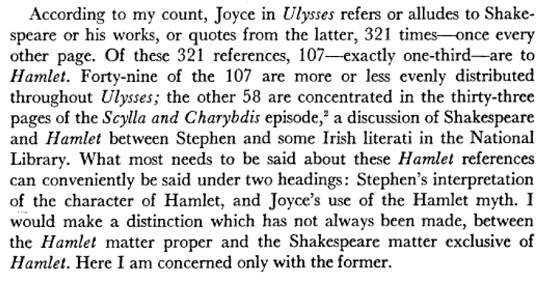 |
|
[ previous ] |
[ top ] |
[ next ] |