|
|







| File 1 | File 2 | File 3 | File 4 | File 5 |
| File 6 | File 7 | File 8 | File 9 | File 10 |
| File 11 | File 12 | File 13 |
| General Index |
|
||||||||||||||||||||||||
London Illustrated News (1, Aug. 1914): ‘[..] ‘Larry’s most damaging charge against the Irish in [Shaw’s] John Bull’s Other Island is that they were a mean-spirited nation. He rent asunder the veil from their dreaming, and pointed out that it was a pernicious, drugging thing, far removed from the lofty vision of the idealist. Dubliners (Grant Richards) could give him powder and shot. Mr. James Joyce’s studies are not, strictly speaking, fiction. They are facts shifted [sic] and sorted in the kaleidoscopic of a novelist’s brain - not at all the same thing. The impression they leave is sordid, unilluminated, circumscribed. He draws a sharp picture of narrow and ignoble lives. The sentimental Irishman of the English fancy is, of course, absent: by this time he should be dead as a dodo. Mr. Joyce’s Dubliners are drab, rather dirty-minded, rather suspicious, and superstitious materialists. They are, in fact, a people who have lost the self-respect of freemen - a people, to put it clearly, ripe for Tammany. They furnish a very strong reason for the Celtic revival, for if they are as they are drawn here their case is desperate and only the prophet or the seer can hope to mend them. Handled by politicians for their own ends, they do not bear thinking about. The bright spot in the book is “Maria” - and a nation is not saved by the virtues of its aged virgins. We should prefer not to believe in Mr. Joyce’s dreary realism: but, unfortunately, he has the touch of genius. Dubliners, whether you like it or not, is a book to be reckoned with.’ (Quoted John McCourt, James Joyce: A Passionate Exile, London: Orion 2000, p.50. Note ill. on p.29 showing the photograph of James Joyce on front of a green-house [taken by C. P. Curran] with the caption, ‘every inch the young man about town’; front. Louis le Brocquy, ‘James Joyce’, 1983; note author remarks in adjoining caption that Dubliners is reviewed ‘glowingly’ in LIN, as here.)
Irish Book Lover [review of Dubliners], Vol. VI, No. 4 (Nov. 1914), pp.60-61: ‘Dublin, like other large cities, shelters many peculiar types of men and women, good, bad and indifferent; in fact some, whose knowledge of it is extensive and peculiar, would say more than its fair share. Of some of these Mr. Joyce here gives us pen portraits of great power, and although one naturally shrinks from such characters as are depicted in “An Encounter” or “Two Gallants”, and finds their descriptions not quite suited virginibus puerisque, one cannot deny the existence of their prototypes, while wishing that the author had directed his undoubted talents in other and pleasanter directions.’ (Quoted in Chris Hopkins, ‘“James Joyce is an Irish Edition of Mr. Caradoc Evans”: Two Celtic Naturalists’, in Irish Studies Review, Autumn 1995, pp.23-26, note 7.)
Further [Irish Book Lover], the review notices ‘language unprinted in literature since the days of Swift and Sterne’ and adds, ‘no clean-minded person could possibly allow it to remain within reach of his wife, his sons or daughters.’ (Robert Deming, ed., James Joyce: The Critical Heritage, London: Routledge & Kegan Paul 1970 [Vol. 1], pp.68-69; quoted in Maurice Beja, ed., James Joyce: A Casebook, Macmillan 1973, pp.79-80; also in Joe McMinn, ‘A Likely Pair: Joyce and Swift’, in Irish Studies Review, Spring 1997, p.33.) See further reviews of Joyce in the Irish Book Lover, Vols. 6, 8, 11, 13, 27, incl. James Stephens’s contemporary opinion on the appearance of the Dubliners stories that Joyce was a poet not a prose writer.
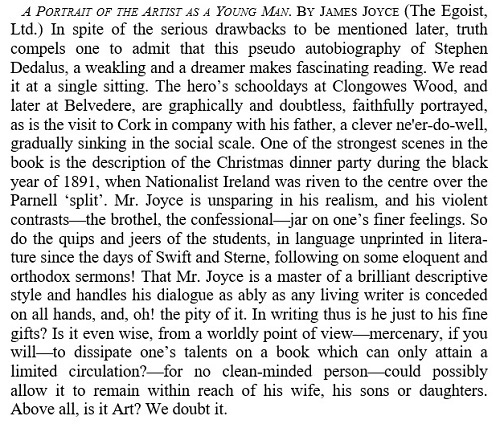
The Irish Book Lover, unsigned review of A Portrait of the Artist as a Young Man (April-May 1917): ‘In spite of the serious drawbacks to be mentioned later, truth compels one to admit that this pseudo-autobiography of Stephen Dedalus, a weakling and a dreamer, makes fascinating reading. We read it at a single sitting. The hero’s schooldays at Clongowes Wood, and later at Belvedere, are graphically and doubtless, faithfully portrayed, as is the visit to Cork in company with his father, a clever ne’er-do-well, gradually sinking in the social scale. One of the strongest scenes in the book is the description of the Christmas-dinner party during the black year of 1891, when Nationalist Ireland was, riven to the centre over the Parnell “split”. Mr. Joyce is unsparing in his realism, and his violent contrasts - the brothel, the confessional - jar on one’s finer feelings. So do the quips and jeers of the students, in language unprinted in literature since the days of Swift and Sterne, following on some eloquent and orthodox sermons. That Mr. Joyce is a master of a brilliant descriptive style and handles dialogue as ably as any living writer is conceded on all hands, and, oh! the pity of it. In writing thus, is he just to his fine gifts? Is it even wise, from a worldly point of view - mercenary, if you will - to dissipate one’s talents on a book which can only attain a limited circulation? - for no clean-minded person could possibly allow it to remain within the reach of his wife, his sons or daughters. Above all, is it Art? We doubt it.’ (Anon.; IBL, April-May 1917, viii, Nos. 9-10, p.113; rep. in Robert Deming, ed., James Joyce: The Critical Heritage, London: Routledge & Kegan Paul 1970 [Vol. 1], p.102; quoted in Clare Hutton, ‘The Dubliners Fiasco Revisited’ [lecture], “The Irish Book Lover”, symposium at Princess Grace Irish Library, Monaco, Oct. 2002.)
 |
 |
| Reprinted in Bruce Stewart, ed., The Irish Book Lover: An Irish Studies Reader: [...] The Irish Book Lover (1909-1957) [Princess Grace Irish Library: 14] (Gerrards Cross: Colin Smythe 2004), p.120. |
[ top ]
Arnold Bennett, ‘Concerning James Joyce’, in The Bookman (Aug. 1922), pp.567-70: “The fame of James Joyce was founded in this country mainly by H. G. Wells, whose praise of A Portrait of the Artist as a Young Man had very considerable influence upon the young. For although the severe young spend much time, seated upon the floor, in explaining to each other that H. G. Well is and must be a back number, he can do almost what he likes with them. I read A Portrait of the Artist as a Young Man under the hypnotic influence of H. G. Wells. Indeed, he commanded me to read it and to admire it extremely. I did both. I said: “It is great stuff.’ But in the horrid inaccessible thickets of my mind I heard a voice said: “On the whole the book has bored you.’ And on the whole it had; and with the efflux of time I began to announce this truth. There are scenes of genius in the novel; from end to end it shows a sense of style; but large portions of it are dull, pompous, absurd, confused, and undirected. The author had not quite decided what he was after, and even if he had decided he would not have known how to get it. He had resources, but he could no t use them. He bungled the affair, then threw his chin up and defied anyone ot assert that he had not done what he did in the way he did solely because he wanted to do precisely that thing in precisely that way. A post facto [sic] pose with which all creative artists, and some others, are experientially acquainted!’
Further (Bennett, in The Bookman, Aug. 1922): ‘A year or two later one of the intellectual young exhibited to be a copy of The Little Review, which monthly was then being mentioned in the best circles. I think this must have been in the period when even Middleton Murry was young. The Little Review contained an instalment of Joyce’s Ulysses. I obediently glanced through the instalment and concluded that it was affected triviality which must have been planned in what the French so delicately call a chalet de necessité. I expressed this view and the intellectual young concurred therein; but I seemed to detect in the concurrence a note of mere politness to the grey-haired. Hence, recalling the time I laughed at Cezanne’s pictures, I wondered whether there might not be something real in the pages after all.
‘And the the other day, opening La Nouvelle Revue Française, I beheld bla[z]ing on its brow an article by Valery Larbaud entitled “James Joyce”. I was shaken. La Nouvelle Revue Française is in my opinion the finest literary periodical in the world. Valery Larbaud is a critic whom it is impossible ot ignore. He is neither young nor old. He is immensely experienced in imaginative literature and a novelist himself. He has taste. His knowledge of the English language and English literature is only less peculiar and profound than his knowledge of the French language and French literature. He is indeed a devil of a fellow. [...]’ (p.567; available online; also in Robert Deming, Critical Heritage [q.pp.].
Arnold Bennett, ‘Books and Persons: The Oddest Novel Ever Written”, in Evenng Standard [London] (8 Aug. 1929), p.7: ‘On the Continent the most discussed English author is James Joyce. And perhaps rightly so. The Dubliners [sic] and A Portrait of the Artist as a Young Man both show genius. Ulysses contains the grossest obscenity. It may not be a great whole. But it is a work distinguished by much greatness and still more originality. It has pages which no novelist in any country has ever surpassed. Its influence has been and is enormous.’ [493]
Further (Bennett, in London Evening Standard, 8 Aug. 1929): ‘And now, after five years of hard labour, it has been integrally translated into French by Auguste Morel and Stuart Gilbert. That the translation has been revised from start to finish by Valéry Larbaud is sufficient guarantee, not merely of the excellence of the translation but of the artistic value of the work [....]
‘Miss Beach has just published in English, a book by a dozen more or less young authors about Joyce’s new and still unfinished novel at present provisionally called Work in Progress. The title of the explanatory volume is to absurd to be quoted [i.e., Our Exagmination]. And some of the contents are absurd. On the other hand some of the contents are not. Mr. Stuart Gilbert and Mr. John Rodker write well enough about it to compel respect for it. / Work in Progress is understood to be a novel about heroes. It may be. I read (I should say, examined) various excerpts from it when portions of the book appeared serially in Transition [sic], and I must say I haven’t the least idea what the story is about.
‘For this work James Joyce has invented, concocted, and conjured up a sort of superportmanteau language of his own. He obviously has a vision of the possible evolution of the English tongue. None but a man of very remarkable gifts of imagination and pure brain could have had such a vision. it does immense credit to his brain and his imagination. But little ot his common sense. [...]
‘Work in Progress will never be respectably imitated. I think it ought to rank as the oddest novel written. It will probably be unique. [...] To me the entire business is queer in a high degree. Indeed I do not hesitate to give my opinion that James Joyce has been culpably wasting his time (and other people’s), and his genius. Also I regard it as a bad sign that an unfinished work should be the subject of [494] an exegetical volume (200 pages) by twelve ardent disciples [...] Of ardent disciples the sane person should always be beware. I recommend the discipular book solely to those with a passion for the curiosities of literature. [...]’ (Available on Google Books - online; accessed 01.07.2014.)
See also Bennett’s his review of Anna Livia Plurabelle [afterwards FW, 1.viii] in the Evening Standard (19 Sept. 1929) ‘Arnold, comment, in London Evening Standard (19 Sept. 1929), p.7. Here are a few words from one page: limpopo, sar, icis, seints, sezere, hamble, blackburry, dwyergray, meanam, meyne, draves, pharphar, uyar. It ought to be published with a Joyce dictionary. [...] Human language cannot be successfully handled with such violence as he has here used to English. And Anna Livia Plurabelle will never be anything but the wild caprice of a wonderful creative genius who has lost his way.’ [Deming, Vol. 2, p.404].
Note: The review was reprinted in Bennett, Things that Have interested Me (London: H. Doran & Co. 1936). See also Bennett, ‘The Progress of the Novel’, in Realist (April 1929). In fact, the majority of the purely Joycean words cited by him are the actual names of rivers.
[ top ]
|
It is extremely difficult to say exactly what place in literature will be occupied by Mr. James Joyce. That his position is unique there can be very little doubt; but that statement helps us virtually no more than the pronouncement of many on the appearance of Ulysses that the book was “European”, and that in writing it Mr. Joyce had made the entry into European literature. Anything may be unique - in fact, most things are - but the mere giving it that label does not thereby make it of any particular worth. That Mr. Joyce’s work is of particular worth. That Mr. Joyce’s work is of particular worth is the firm opinion of many; but, probaby, for the next generation or so people will differ very strongly upon that question. Nearly everybody was able to accept Dubliners. The Portrait of the Artist as a Young Man, even his play Exiles, possibly with a shake of the head as being rather advanced; but, at any rate, ther were accepted. The correct mind, however, found that Ulysses was more than a large mouthful; it was a large stomachful. It was almost as if somebody was speaking in a language hitherto unheard, even unthought. Thousands of people who love the delightful humour of Mr. Stephen Leacocke will remember that in one of his sketches he speaks of the language of “Saloonio” as being “a trifle free”: the language of Ulysses is not a trifle free - it is freedom itself. It is questionable whether any word forbidden in polite society is not to be found somewhere in its pages.
There is in his poetry unrestrained gentleness and feeling, an air of dignified beauty which is not often surpassed. |
|
|
—rep. in The Irish Times (24 March 2012), Weekend Review, p.9. |
|
|
Irish Book Lover (q. iss.; 1940), reviewing Finnegans Wake (1939), finds that it contains ‘a world of language which seems to have the strange minuteness, the cloying consistency and the rapacious spread of duckweed’. Further: ‘Stephen Dedalus has kept his word and his silence, exile and cunning has, in Finnegan’s Wake, produced what must be regarded as one of the most extraordinary books ever produced in any language [...] for the moment we wonder why so great a talent, gifted with prodigious memory, a mastery of English and of other languages, a poet’s ear for the beauty of vowel, and an artist’s fastidiousness in form, should bend itself to a task in which no mind save its own can enjoy or appreciate the grotesque output of its labour?’ (Quoted in Nicholas Allen, ‘The Irish Book Lover’ [keynote lecture], symposium at Princess Grace Irish Library, Monaco, Oct. 2002.)
[ top ]
Freeman’s Journal, ‘A Dyspeptic Portrait’ (review of A Portrait of the Artist, 1916), ‘[...] Had it been a description of the desolation of No Man’s Land on the Somme or the Yser, the horror could hardly have been laid on more thickly, and all through the book food is scarcely mentioned without the same shudder of disgust, which is more reminiscent of the pangs of dyspepsia than of the joy of art. Had the author confined himself to this particular form of ugliness it would not have been so bad, but, as Whistler said of Oscar Wilde, that he could not keep out of the area, so Mr. Joyce plunges and drags his readers after him into the slime of foul sewers. He is not, indeed, like Mr. George Moore, who points to the iridiscence as a proof of the beauty of corruption. Mr. Joyce knows better, but despite his repulsion his pen, instead of pointing to the stars overhead, is degraded into a muck-rake. This is due in a measure to a false theory of aesthetics, but it springs even more from temperamental defects [...] The great masters have not been blind to the aspects of life that Mr. Joyce exploits, but they see them in their true perspective and do not dwell on them to the exclusion of everything else. They know the value of proportion and the importance of sanity and clear judgment and realise that to see life steadily one must see it whole. It is an accident that Mr. Joyce’s book should have Dublin as its background. A youth of the temperamental quality of his Stephen Dedalus was [98] bound to react as sharply against any other environment; had he been brought up in an English cathedral town or an American industrial centre he would have pillioried [sic] them in just as repellant a fashion. Yet English critics, with a complacency that makes one despair of their intelligence, are already hailing the author as a typical Irishman, and his book as a faithful picture of Irish life. It would be just as accurate to declare that De Quincey’s Opium Eater embodied the experience of the average English youth [...].’ (FJ, 7 April 1917; rep. in Robert Deming, ed., James Joyce: The Critical Heritage, London: Routledge & Kegan Paul 1970 [Vol. 1], pp.98-99.)
Freeman’s Journal (J.W.G., ‘Ibsen in Ireland’, review of Exiles, 1918): ‘Ibsen’s genius that shows the most signs of wear and tear. His greatness did not he in the fact that his characters were adepts in the analysis of their emotions, but that this analysis was so presented as to strengthen the impression of dramatic personality. This is exactly what Mr. Joyce fails to do, and his failure is the more curious because it is due to no lack of power. The appalling discussion at the dinner party, in the opening chapters of Portrait of the Artist as Young Man, crams into a single page more dramatic reality than is to be found in the three acts of Exiles. In his play, where one looks for men and women one finds instead states of mind loosely personified. Vital energy seems to have been drained out of the characters, and they impress one less as individuals than as Aolian harps vibrating to the waves of emotions they are powerless to direct or control. Subtlety is possible in the theatre, but to be effective it must be expressed in terms of the theatre. Mr. Joyce scarcely makes a pretence of attempting to hold the interest of his audience, and though he introduces, as Ibsen certainly would not have done, a suburban sitting-room equipped with no less than four doors, he disdains to conjure up a single dramatic situation in the real sense of the word. The plot of Exiles is not unlike that of [Shaw’s] Candida, with the humour left out. Betha [sic] Rowan is in much the same plight as Mr. Shaw’s heroine was between Marchbanks and Morell, only in Mr. Joyce’s play all the three principals see themselves and are presented by their author from the Marchbanks’ point of view. Dramatically it is a case of great cry and little wool; and while Exiles contains, as one expects from Mr. Joyce, some dialogue that is wonderfully subtle and effective, good dialogue is the beginning, and not the end, of play-making.’ (FJ, 15 June 1918; rep. in Robert Deming, ed., James Joyce: The Critical Heritage, London: Routledge & Kegan Paul 1970 [Vol. 1], pp.135-36.)
[ top ]
Sunday Chronicle (1922): ‘The foulest book that has ever found its way into print [...] What concerns us all and most earnestly demands consideration is the appalling fact that our Metropolitan criticism should have been treating such works as those of Mr. Joyce seriously as works of genius.’ (Alfred Noyes, reviewing Ulysses; quoted in Patricia Hutchins, James Joyce’s World, Methuen 1957, p.176, n.1.)
Sunday Express ([q.d.] Dublin 1922)- review of Ulysses by James Douglas: ‘I say deliberately that it is the most infamously obscene book in ancient or modern literature. The obscenity of Rabelais is innocent compared with its leprous and scabrous horrors. All the secret sewers of vice are canalised in its flood of unimaginable thoughts, images and pornographic words. And its unclean lunacies are larded with appalling and revolting blasphemies directed against the Christian religion and against the name of Christ. [...] The book is alread the bible of beings who are exiles and outcasts in this and every civilised country. It is also adopted by the Freudians as the supreme glory of their dirty and degraded cult.’ (Quoted in Stan Gébler Davies, James Joyce: A Portrait of the Artist, Davis-Poynter 1975, p.247; n.d.; earlier quoted in James Liddy, ‘The Reputation of James Joyce: From Notoriety to Fame’, in University Review, 3, 2, Summer 1963, p.16). Note: Joyce insisted that the review be included in publicity material.)
The Sporting Times, 34 (1 April 1922) - ‘The Scandal of Ulysses’, by “Aramis” [pseud.] ‘[Ulysses] appears to have been written by a perverted lunatic who has made a speciality of the literature of the latrine... I have no stomach for Ulysses. [...] James Joyce is a writer of talent, but in Ulysses he has ruled out all the elementary decencies of life and dwells appreciatively on things that sniggering louts of schoolboys guffaw about. In addition to this stupid glorification of mere filth, the book suffers from being written in the manner of a demented George Meredith. There are whole chapters of it without any punctuation or other guide to what the writer is really getting at. Two-thirds of it is incoherent, and the passages that are plainly written are devoid of wit, displaying only a coarse salacrity [sic] intended for humour.’ (p.4; see Wikipedia entry on The Sporting Times (aka “The Pink ‘Un”- online; accessed 01.07.2014.)
| ‘The Scandal of Ulysses’ | |
|
“Aramis” [pseud.], ‘The Scandal of Ulysses’, in The Sporting Times (1 April 1922), called Joyce a ‘perverted lunatic who has made a specialty of the literature of the latrine.’ (p.4; rep. in Robert Deming, ed., The Critical Heritage, Vol. I, 1970, p.192; quoted by Michael Groden, in ‘The Complex Simplicity of Ulysses’, James Joyce, ed. Sean Latham, Dublin: IAP 2010, p. 106.) The reviewer goes on to say that Ulysses would ‘make a Hottentot sick’ (Deming, op. cit. p.193), giving an account of the Little Review trial in New York and especially the ‘Freudian’ defence’ offered of the lawyer Phillip Moeller:
—‘[...] to which the one of the judges objected that he ‘might as well talk Russian.’ (Ibid., 193.) “Aramis” concludes: ‘I fancy that it would also have the very simple effect of an ordinary emetic. Ulysses is not only sordidly pornographic, but it is intensely dull. As the volume is about the size of the London Directory, I do not envy anyone who reads it for pleasure’ (end; Deming, op. cit., p.194.) |
|
|
[ top ]
Time: The Weekly New Magazine (29 Jan. 1934) - inside review, with cover-port of James Joyce: ‘[...] Is it dirty? To answer the man in the street in his own language, Yes. With the exception of medical books and out & out pornography, the only book of modern times that can compare with it for outspokenness in barnyard and backhouse terms is the late D. H. Lawrence’s Lady Chatterley’s Lover. But Ulysses is far from being just another dirty book.’ Judge Woolsey decided that its purpler passages are “emetic,” rather than “aphrodisiac”; that the net effect of its 768 big pages is “a somewhat tragic and very powerful commentary on the inner lives of men and women.”
Guardian [Manchester], review of Finnegans Wake (1939): ‘[...] The work is not written in English, or in any other language, as language is commonly know. I can detect words made up out of some eight or nine languages, but this must be only a part of the equipment employed. This polyglot element is only a minor difficulty, for Mr. Joyce is using language in a new way. [...] the easiest way to deal with the book would be to become “clever” and satrical or to write off Mr. Joyce’s latest volume as the work of a charlatan. But the author is obviously not a charlatan, but an artist of very considerable proportions. I prefer to suspend judgement [...] What Mr. Joyce is attempting, I imagine, is to employ language as a new medium, breaking down all grammatical usages, all time space values, all ordinary conceptions of context. Compared with this, Ulysses is a first-form primer. In this volume the theme is the language and the language is the theme, and a language where every association of sound and free association is exploited. [...] The clearest object in time in the book is the Liffey, Anna Livia, Dublin’s legendary stream, and the most continuous character is H. C. Earwicker, “Here Comes Everybody”: the Liffey as the moment in time and place, and everything, everybody, all time as th terms of reference, back to Adam or Humpty Dumpty, but never away from Dublin. [...] Who, it may be asked, was Finnegan? Again, I should have been unable to tell, unaided, from Mr. Joyce’s book. But I gather there is an Irish story of a contractor who fell and was stretched out for dead. When his friends toasted him he rose at the word “whiskey” and drank with them. In a book where all is considered, this legend, too, has its relevance.’ The reviewer adds some remarks on the role of Jung and Freud (‘Tung-Toyd’) in Finnegans Wake and concludes: ‘One might imagine that Mr. Joyce had used his great powers deliberately to show the language of a schizophrenic mind. He alone could explain his book and, I suppose, he alone could review it.’ (Contemp. review of Finnegans Wake, 1939; rep. [anon.] in Guardian Review; accessed online, 16 Aug. 2002.)
The Times [London]- James Joyce [obituary] (14 Jan. 1941): ‘James Augustine Joyce was born in Dublin on February 1882, one of a large and poor family. He went to the National University of Ireland and graduated in 1902. Joyce had strong literary tendencies in adolescence. For Ibsen he had such a passion that he learnt Norwegian so as to read the original. In his student days he was so self-opinionated and vain that he said to W. B. Yeats: ‘We have met too late; you are too old to be influenced by me’, to which the poet made answer: ‘Never have I seen so much pretension with so little to show for it.’ There was, indeed, not much to show for 12 or 14 years. Joyce was in Paris during 1903-04, engaged first in medical studies and later in having his voice trained for the concert platform, and in 1904 he returned to Dublin He published a few stories, but could not make a living, so he and his wife went off to Trieste, where he taught English. He had a great talent in that he was able to contribute for languages and learnt Italian so well articles on Irish politics to the Piccolo della Sera. In 1912 he went back to Dublin to start the Volta cinema theatre, but on its failure he resumed his teaching in Trieste. Thus far his only book had been one of lyrics called Chamber Music. In 1914 appeared Dubliners, delayed nine years by haggling with publishers owing to their demand that he should make certain excisions.’ (See ensuing sentences: ‘Joyce’s next task ... &c.’, as infra.) [Cont.]
The Times - James Joyce [obituary] (1941) - cont.: ‘Joyce’s book Ulysses purports to relate the whole mental and physical life of Leopold Bloom, Jewish advertisement canvasser, and Stephen Dedalus, during one single day in Dublin. Its settled principle is to omit nothing, however trifling or scabrous and it makes extensive use what has been called the ‘interior monologue’, a literary device which Joyce claimed to have discovered in Edouard Dujardin’s forgotten novel, Les Lauriers sont coupés (1888): Proust, of course, used it, as did Miss Dorothy Richardson and others in this country, and it has had a far-reaching influence on the technique of many modern writers. Ulysses has many repellent or boring passages. It is steeped and soaked in the rough life of Dublin city. It is, however, intensely alive, fundamentally Irish, full of Rabelaisian ‘humour’, with a highly developed sense of time and a fantastic imaginative faculty.’ Further: ‘Joyce’s next task was a large work, which he entitled “Work in Progress”, which began to appear in 1927, in sections under various titles. In it the word-coinages that were a feature of Ulysses were multiplied to the point of unintelligibility.’ [see full-text copy in RICORSO Library, “Criticism / Major Authors” - James Joyce, via index or direct.)
New York Times, ‘James Joyce Dies; Wrote Ulysses’ [obituary] (13 Jan. 1941): ‘[...] The status of James Joyce as a writer never could be determined in his lifetime. In the opinion of some critics, notably Edmund Wilson, he deserved to rank with the great innovators of literature as one whose influence upon other writers of his time was incalculable. On the other hand, there were critics like Max Eastman who gave him a place with Gertrude Stein and T. S. Eliot among the “Unintelligibles” and there was Professor Irving Babbitt of Harvard who dismissed his most widely read novel, Ulysses, as one which only could have been written “in an advanced stage of psychic disintegration.” [...; quotes Judge Woolsey’s decision:] On the passages dealing with sex, Judge Woolsey paused to remark that the reader must not forget that “the characters are Celtic and the time is Spring.” His decision was hailed as one of the most civilized ever propounded by an American judge. After he had admitted Ulysses to the country, there was a rush to but the almost immediately available authorized and uncensored edition published by Random House. Since then the book, unlike many another once banned by the censor and then forgotten, has been read widely; less for the passages once objected to than for the book as a whole. [...; recounts Dublin stories of Joyce’s encounters with Yeats and George “AE” Russell.] Joyce was in continuous rebellion against Ireland and its life and said: “When the soul of a man is born in this country there are no nets flung at it to hold it back from flight.” / The words are Stephen Dedalus’s in A Portrait of the Artist as a Young Man, but it was Joyce speaking, and, at the age of 20, he left Ireland for Paris where he intended, and for a time pretended, to study medicine. [...] He knew seventeen languages, ancient and modern, including Arabic, Sanskrit and Greek.’
Further (NY Times, Obituary): ‘While living in Zurich [during WWI] Joyce began to suffer from severe ocular illness and eventually underwent at least ten operations on his eyes. For years he was almost totally blind and much of his later writing was done with red crayon on huge white sheets of paper. / “Ulysses” was begun under this difficult situation. Much of it was published by Margaret Anderson in The Little Review, the magazine which Otto Kahn, New York banker, once subsidized for his Greenwich Village friends. Chapters appeared between March, 1918, and August, 1920, when the Society for the Suppression of Vice had The Review stopped by court order. / After the war the Joyces returned to Trieste, where they lived with Stanislaus Joyce, the author’s brother. Then, in 1919, they went to Paris, where they made their home until the next war sent them again to Zurich to occupy the house they had known in 1914. / In 1922 Joyce’s greatest book, Ulysses, was published in Paris. Great Britain, Ireland and the United States banned the book. / For many years after Ulysses was done Joyce worked on what he called “Work in Progress”. Much of it appeared in Transition [sic], the magazine published in the Nineteen Twenties in Paris by Eugene Jolas. In May, 1939, it was published as Finnegan’s Wake, a book “distinguished” by such “words” as Goragorridgeorballyedpuhkalsom, to name one of the simpler ones, and many puns. In it Mr. Joyce suggested the book was the work of “a too pained whitelwit laden with the loot of learning.” / During all his years as a writer Joyce was carefully protected by his wife, who once said she cared for him despite “his necessity to write those books no one can understand.” His conversation was clear, never anything like his writing, and his wit as keen. / Joyce’s son, George Joyce, married the former Miss Helen Castor of Long Branch, N.J. They had one son, Stephen James Joyce. James Joyce and his wife made their home with his son for many years before the present war [i.e., WWII].’ (For full text, see RICORSO Library > Criticism > Major Writers > James Joyce - via index, or as attached.]
Thomas Kettle, review of Chamber Music (Freeman’s Journal, 1 June 1907): ‘Those who remember University College life of five years back will have many memories of Mr. Joyce. Wilful, fastidious, a lover of elfin paradoxes, he was for the men of his time the very embodiment of the literary spirit. [...] The title of the book evokes that atmosphere of remoteness, restraint, accomplished execution chraracteristic of its whole contents. There is but one them behind the music, a love, gracious, and, in its way, strangely intense, but fashioned by temperamental and literary moulds, too strict to permit it to pass over into the great tumult of passion. The inspiration of the book is almost entirely literary. There is no trace of the folklore, folk dialect, or even the national feeling that have coloured the work of practically every writer in contemporary Ireland. Neither is there any sense of that modern point of view which consumes all life in the language of problems. It is clear, delicate, distinguished playing, of the same kindred with harps, with wood birds, with Paul Verlaine. [...] Mr. Joyce’s book is one that all his old friends will, with that a curious pleasure, add to their shelves, and that will earn him many new friends.’ (Quoted [in part] in Richard Ellmann, James Joyce [1959] 1965, p.271; rep. in Robert Deming, ed., James Joyce: The Critical Heritage, London: Routledge & Kegan Paul 1970, Vol. 1., p.37.)
Note: Colm Tóibín writes that Joyce did not strike ‘the Celtic note’ in his stories - as Little Chandler dreams of doing in “A Little Cloud” (Dubliners) - and that Kettle noted this in stern review of his first [poetry] collection: ‘There is no trace of the folklore [...&c.])’ (See further, infra.)
[ top ]
H. G. Wells (reviewing A Portrait in Nation, 24 Feb. 1917): ‘Like Swift and another living Irish writer, Mr. Joyce has a cloacal obsession. He would bring back into the general picture of life aspects of modern drainage and modern decorum have taken out of ordinary discourse and conversation. [...] if the reader is squeamish upon these matters, then there is nothing for it but to shun this book.’ (Rep. in Deming, ed., Critical Heritage, 1970 [Vol. 1], p.86; also quoted in Jeri Johnson, Introduction to A Portrait of the Artist as a Young Man, [World Classics] OUP 2000, p.vii.)
Further: ‘Sterne could not have done the Christmas dinner scene better. I recommend this most memorable novel for its quintessential and unfailing reality.’ (Quoted in Donagh MacDonagh, ‘The Reputation of James Joyce: From Notoriety to Fame’, in University Review, Summer 1963, pp.12-20; p.13.)
Note: Johnson also quotes his calling A Portrait: ‘a mosaic of jagged fragments’ (Johnson, op. cit., p.xvi; citing Deming, op. cit., p.87.)
H. G. Wells, letter of 23 Nov. 1928 to Joyce on “Work in Progress”: ‘I have enormous respect for your genius dating from your earliest books and I feel now a great personal liking for you but you and I are set upon absolutely different courses. Your training has been Catholic, Irish, insurrectionary; mine, such as it was, was scientific, constructive and, I suppose, English. The frame of my mind is a world wherein a big unifying and concentrating process is possible (increase of power and range by economy and concentration of effort), a progress not inevitable but interesting and possible. The game attracts me and holds me. For it, I want language and statement as simple and clear as possible. You began Catholic, that is to say you began with a system of values in stark opposition to reality. Your mental existence is obsessed by a monstrous system of contradictions. You may believe in chastity, purity and the personal God and that is why you are always breaking out into cries of cunt, shit and hell. As I don’t believe in these things except as quite personal values my mind has never been shocked to outcries by the existence of waterclosets and menstrual bandages - and undeserved misfortunes. And while you were brought up under the delusion of political suppression I was brought up under the delusion of political responsibility.’ [...; cont.]
H. G. Wells (letter to Joyce, 23 Nov. 1928) - cont.: ‘Now with regard to this literary experiment of yours. It’s a considerable thing because you are a very considerable man and you have in your crowded composition a might genius for expression which has escaped discipline. But I don’t think it gets anywhere. You have turned your back on common men, on their elementary needs and their restricted time and intelligence [...] What is the result? Vast riddles. Your last two works have been more amusing an exciting to write than they will every be to read. [...] Do I get much pleasure from this work? No. Do I feel I am getting something new and illuminating as I do when I read Anrep’s dreadful translation of Pavlov’s badly written book on Conditioned Reflexes? No. So I ask: Who the hell is this Joyce who demands so many waking hours of the few thousand I have still to live for a proper appreciation of his quirks and fancies and flashes of rendering? .../] Your work is an extraordinary experiment and I would go out of my way to save it from destructive or restrictive interruption. [...] I can’t follow your banner any more than you can follow mine. But the world is wide and there is room for both of us to be wrong.’ (Letters of James Joyce [Vol. I], pp.274-75; quoted in Ellmann, James Joyce, 1965 Edn., pp.620-21; also [in part] in Stan Gébler Davies, James Joyce: A Portrait of the Artist, Poynter-Davis 1975, pp.270-71.)
Francis Hackett, ‘Green Sickness’, review of A Portrait, in New Republic (3 March 1917): ‘[...] It is quite true that the Irish literary revival was beginning to be recognised at precisely the period of Mr. Joyce’s novel, and it is also true that his protagonist is a student in Dublin at the hour of the so-called renaissance, a writer and poet and dreamer of dreams. So perverse is life, however, there is scarcely one glimmer in this landscape of the flame which is supposed to have illuminated Dublin between 1890 and 1900. If Stephen Dedalus, the young man portrayed in this novel, had belonged to the Irish revival, it would be much easier for outsiders to “place” him. The essential fact is, he belonged to a more characteristic group which this novel alone has incarnated. One almost despairs of conveying it to the person who has conventionalised his idea of Ireland and modern Irish literature, yet there is a poignant Irish reality to be found in few existing plays and no pre-existent novel, presented here with extraordinary candour and beauty and power [...] It is only when a person with the invincible honesty of James Joyce comes to write of Dubliners as they are, a person who is said to be mordant largely because he isn’t mushy, that the discrepancy between the people and the myth [that the southern Irish are a ‘bright and witty people’] is apparent.’ [Cont.]
Francis Hackett (‘Green Sickness’ in New Republic, 3 March 1917) - cont.: [Calls George Birmingham an ‘an amiable fabulist’.] ‘But there is the whole of the exquisite Portrait of the Artist as a Young Man to substantiate the assertion that a proud, cold, critical, suspicious, meticulous human being is [94] infinitely more to be expected among educated Catholic Irishmen than the sort of squireen whom Lever once glorified. If this is a new type in Ireland, come into existence with the recent higher education of Catholics, one can only say that it is now by far the most important type to recognise. [...] Mr. Joyce’s power is not show in any special inventiveness [...] The thing he writes about is the thing he knows best [...] He has sought above everything to reveal those circumstances of his life which had poignancy, and the firmest claim on him to being written was not that a thing should be amenable to his intentions as a sophisticated novelists, but that a thing should have complete personal validity. [...] To have the truth one must have a man’s revelation of that which was really significant to himself. [...]’. (Cont.]
Francis Hackett (‘Green Sickness’ in New Republic, 3 March 1917) - cont.: Hackett gives some thought to the effect of ‘mortal sin of masturbation that preys most terribly on this youth’ and to his subsequent transition from ‘a private specialising in mortification to the acceptance of nature and the earth.’ (Deming, p.94; as in ref., infra). ‘The last chapter [...] gives one the esprit of the Catholic nationalist students in University College. It is a marvelous version of scurrilous, supercilious, callow youth. Mr. Joyce’s subject is not in sympathy with the buzzing internationalist any more than the arcane Irishman whom he compares to Ireland [sic], “a batlike soul waking to the consciousness of itself in darkness and secrecy and loneliness.” Stephen walks by himself, disdainful and bitter, in love and not in love, a poet at dawn and a sneerer at sunset, cold exile of “this stinking dunghill of a world”. / A novel in which a sensitive, critical young man is completely expressed as he is can scarcely be expected to be pleasant. [...] But no one can miss [...] the tenacity fidelity of James Joyce he has made a rare effort to transcend every literary convention as to his race and creed, and he has had high success. Many people will furiously resent his candour, whether about religion or nationalism or sex. But candour is a nobility in this instance.’ [End] (Rep. in Robert Deming, ed., James Joyce: The Critical Heritage, Routledge & Kegan Paul 1970 [Vol. 1], pp.94-97.) Note that Jane Heap later questions Hackett’s remark that A Portrait ‘reveals the inevitable malaise of serious youth’ (‘James Joyce’, Little Review, April 1917, pp.8-9; see also under Hackett, supra.)
[ top ]
Padraic Colum, ‘James Joyce’, in Pearson’s Magazine (May 1918), pp.38-42: ‘[...] Portrait of the Artist as a Young Man is a biography in [164] which all inessentials are suppressed and people and incidents only stand out as a background for the emergence of a soul. It is a confession in which there are things as ignominious as the things in Rousseau’s Confessions. But there is heroism in the book, and in spite of corruption and precocity there is youth in it also. Halfway in the life that is shown to us Stephen Dedalus comes to a spiritual morass. He wins through it by virtue of a power of spiritual vision backed by the discipline of the Catholic Church. Later he loses his faith in the sanctions of that Church and at the end of the story he is leaving his country. He is going to discover a mode of life or art whereby his spirit may express itself in unfettered freedom. / What really makes Portrait of the Artist as a Young Man strange to English and American people is that it gives a glimpse into a new life - into the life that has been shaped by Catholic culture and Catholic tradition. James Joyce’s book is profoundly Catholic. I do not mean that it carries any doctrine or thesis: I mean that, more than any other modern book written in English, it comes out of Catholic culture and tradition - even that culture and tradition that may turn against itself. Even in the way the book is written there is something that makes us think of the Church - a sense of secrecy, of words being said in a mysterious language, of solidity breaking into vision. Stephen Dedalus is unable to analyse his ideas or to shape his life except in terms of the philosophy that the Catholic Church has evolved or adopted. His ideal of beauty is the ideal that has been attained to in the masterpieces of Catholic art. It is the speech of the Church that fills his soul with apprehension because of his secret sins, and it is the absolution of the Church that gives him peace and the way to a new life. [...] / And this city, so thwarted on the side of culture, is low in material circumstances. The misery that comes from low wages and few opportunities pervades the Portrait of the Artist as it pervades Dubliners. Stephen’s bread-and-butter life is not merely sordid, it is on the verge of being squalid. [.../] Against this background of economic decay and incomplete culture and of shut-in sin Stephen Dedalus makes his spiritual assertion. He will win towards freedom and the power to create. He will strive, too, to give a soul to this people [... &c.]’ (rep. in Robert Deming, ed., James Joyce: The Critical Heritage, London: Routledge & Kegan Paul [Vol. 1], 1970, pp.163-66; p.165.)
Padraic Colum (‘James Joyce’, 1918) [cont.]: ‘Stories were told about his arrogance. Did not this youth say to Yeats, “We have met too late: you are too old for me to be influenced by me”? And did he not laugh in derision when a celebrated critic spoke of Balzac as a great writer? [...] he gave me his poems to read - they were in a beautiful manuscript. he used to speak very arrogantly about these poems of his, but i remember his saying something that made me know how precious these beautifully wrought lyrics were to him - he talked about walking the streets of Paris, poor and tormented, and about what peace the repetition of his poems had brought him. / His poems were perfect in their form But could one who expressed himself so perfectly at twenty really go far? Yeats had said of him, I do not know whether you are a fountain or a cistern’ had remarked, “I do not see in your beginnings the chaos out of which a world is created ...”. It was then that he told me the name of the book he was writing [note] - the book that was being referred to in Dublin as “Joyce’s Meredithian novel” - it was Portrait of the Artist as a Young Man. It was not Meredithian at all.’ (Ibid.; rep. in Deming, op. cit., p.1970, p.166.) [See Yeats letter in full under Joyce > Commentary > Yeats - infra] and A.E [George “Æ” Russell]
Note: Colum begins this section - ‘Joyce was ten years writing the book. I saw him in Dublin when he was mid-way in it and he told me there were parts that gave him physical nausea to write. &c.’
Padraic Colum, Preface to Anna Livia Plurabelle (1928): ‘Much should be said, and some time much will have to be said, about the de-formations and re-formations of the words in James Joyce’s later work [..] There are other innovations in the langauge that are really difficult to explain. Or, rather, that would require the exposition of a theory to be properly explanatory. Let us say that words are always taking on new meanings, that they take on new meanings more quickly than we realise, and that, in the case of English, as the language becomes more and more wide-spread, the change is being accelerated [...]’ (pp.vii-xix; prev. printed as ‘River Episode from James Joyce’s Uncompleted Work’, in The Dial, April 1928, pp.318-22; rep. in Our Friend James Joyce (1958, pp.139-43; extract in Robert Deming, ed., James Joyce: The Critical Heritage, London: Routledge & Kegan Paul 1970 [Vol. 2], pp.388.)
Padraic Colum, ‘From a Work in Progress’, in New Republic (17 Sept. 1930): ‘In his late thirties James Joyce recast the most used of literary mediums, the novel; he recast it with Ulysses. He is now recasting the novel more radically, and he is recasting language as the medium of wrtiters wh know that what they write should tend towards poetry.’ [542] ‘But why, it will be asked, has James Joyce found it necessary to use this arcane language? Briefly, because “Work in Progress” deals with the night life of humanity, that dream life which is the one-third of our mortal career. The language of the day cannot be the language of the night; another language has to be found to render this state. [...] Joyce finds his language in words in which a number of meanings are telescoped [...’; 543] The effect that James Joyce is working for can only be realised in a complete work; he cannot achieve it by introducing such passages of poetry or humour into writing that close to our norm. It is heroic of him and it is right on his part to make a complete departure and to put all his discoveries in one integral work.’ Colum goes on to counsel ‘prudence’ in the light of Joyce’s inclusion of so much information that only Dubliners could know, such as the phrase ‘tellforth’s glory’ [FW, 522.26] in Here Comes Everybody, which contains the name of Telfords, the builders of the Dublin organ-builders. (pp.131-32; rep. in Robert Deming, ed., James Joyce: The Critical Heritage, London: Routledge & Kegan Paul 1970 [Vol. 2], pp.pp.542-44.)
Padraic Colum, introduction to Exiles (London: Jonathan Cape 1952): ‘Among Joyce’s works his single play has never been given a fair show. Exiles comes after A Portrait of the Artist and before Ulysses, and critics have recorded their feeling that it has not the enchantment of the first nor the richness of the second, and they have neglected to assess what quality it actually has.’ (p.7; quoted in Miranda Hickman, ‘“Not love verses at all, I perceive”: Joyce’s Minor Works’, in James Joyce [Visions and Revisions ser.], ed. Sean Latham, Dublin: IAP 2010, pp.83-104; p.88.)
[ top ]
Ezra Pound (1) - letter [Between 6 & 12] September 1915 / ‘5, Holland Place Chambers, Kensington. W. Dear Joyce: I have just read the splendid end of The Portrait of the Artist, and if I try to tell you how fine it is, I shall only break out into inane hyperbole. / I think the Chapter V. went straight to the Egoist, or came when I was away and had to be forwarded at once ... anyhow I have been reading it in the paper. / I have been doing nothing but write 15 page letters to New York about the new magazine and my head is a squeezed rag, so don’t expect le mot juste in this letter. / However I read your final instalment last night when I was calm enough to know what I was doing, and I might have written then with more lucidity. / Anyhow I think the book hard, perfect stuff. I doubt if you could have done it in “the lap of luxury” or in the whirl of a metropolis with the attrition of endless small amusements and endless calls on one’s time, and endless trivialities of enjoyment (or the reverse). / I think the book is permanent like Flaubert and Stendhal. Not so squarish as Stendhal, certainly not so varnished as Flaubert. In English I think you join on to Hardy and Henry James (I don’t mean a resemblance, I mean that there’s has been nothing of permanent value in prose in between. And I think you must soon, or at least sooner or later get your recognition. / Hang it all, we dont get prose books that a man can reread. We don’t get prose that gives us pleasure paragraph by paragraph. I know one man who occasionally buries a charming short chapter in a long ineffective novel ... but that’s another story. / It is the ten years spent on the book, the Dublin 1904, Trieste 1904, [44] that counts. No man can dictate a novel, though there are a lot who try to. / And for the other school. I am so damn sick of energetic stupidity. The “strong” work .... balls! And it is such a comfort to find an author who has read something and knows something. This deluge of work by suburban counter-jumpers on one hand and gut-less Oxford graduates or flunktuates on the other bah! And never any intensity, not in any of it. / The play [Exiles] has come, and I shall read it as soon as I can be sure of being uninterrupted.’ (Rep. in Forrest Read, Pound/Joyce, NY: New Directions 1967, pp.44-45.) [Ensuing remarks at the second date of writing are on Exiles.]
Ezra Pound (2): ‘Joyce has fled to Trieste and into the modern world [...] He writes as a European, not as a provincial [32; ...] Let us presume that Ireland is ignorant of Mr. Joyce’s existence and that if any copy of his work reaches that country it will be reviled and put on the index. For ourselves, we can be thankful for clear, hard surraces, for an escape from the softness and mushiness of the neo-symbolist movement, and from the fruitier school of neo-realists, and in no less a degree for the phantasists who are the most trivial and most wearying of the lot. All of which attests the existence of Mr. Joyce, but by no means the continued existence of Ireland.’ (‘The Non-Existence of Ireland’, in The New Age, XVI, 17, 25 Feb. 1915, p.452; rep. in Forrest Read, ed., Pound/Joyce, New Directions 1970, p.32-33; quoted with sundry other excerpts [in part], in Emer Nolan, James Joyce and Irish Nationalism, Routledge 1995, p.3ff.; also quoting Pound on Joyce: ‘the one man calling himself Irish who is in any sense part of the decade’ (q.p.).]
Ezra Pound (3): ‘[...] James Joyce produces the nearest thing to Flaubertian prose that we have now in English, just as Wyndham Lewis has written a novel which is more like, and more fitly compared with, Dostoievsky than is the work of any of his contemporaries. In like manner Mr. T. S. Eliot comes nearer to filling the place of Jules La Forgue in our generation. (Doing the “nearest thing” need not imply an approach to a standard, from a position inferior.’ (‘At last the Novel Appears’, in The Egoist, IV, 2, Feb. 1917, pp.21-22; rep. in Forrest Read, ed., Pound/Joyce, New Directions 1970; pp.88-91; p.89.)
Ezra Pound (4): ‘The Portrait is very different from L’Education Sentimentale, but it would be easier to compare it with that novel of Flaubert’s than with anything else. Flaubert pointed out that if France had studied his work they might have been saved a good deal in 1870. If more people had read The Portrait and certain stories in Mr. Joyce’s Dubliners there might have been less recent trouble in Ireland. A clear diagnosis is never without its value. [...] The hell of contemporary Europe is caused by the lack of representative government in Germany and by the non-existence of decent prose in the German language. [...] A nation that cannot write clearly cannot be trusted to govern, nor yet to think.’ (Ibid., p.90.)
Ezra Pound (5): ‘I have yet to find in Joyce’s published works a violent or malodorous phrase which does not justify itself not only by its verity, but by its heightening of some [a]pposite effect, by the poignancy which it imparts to some emotion or to some thwarted desire for beauty. Disgust with the sordid is but another expression of a sensitiveness to the finer thing. There is no perception of beauty withoout a corresponding disgust. It is the price for such artists as James Joyce is exceeding heavy, it is the artist himself who pays. / If Armageddon has taught us anything it should have taught us to abominate the half-truth, and the tellers of the half-truth, in literature.’ (‘Joyce’, in The Future, II, 6, May 1918, pp.161-63; rev. & rep. in Instigations, 1920, and later in Literary Essays, 1954; rep. in Forrest Read, ed., Pound/Joyce, New Directions 1970, pp.133ff.)
Ezra Pound (6): ‘[Joyce] has done what Flaubert set out to do in Bouvard et Pecuchet, done it better, more succinct. An epitome.’ (Idem; under heading “Ulysses”). Note that Pound earlier writes of H. G. Wells as one whose ‘style is always a bit greasy in comparison with the metallic cleanness of Joyce’s phrasing’, but adds that Wells ‘came out with a fine burst of admiration for a younger and half-known writer.’ (Ibid., p.134.)
Ezra Pound (7): ‘The excuse for parts of Ulysses is the WHOLE of Ulysses.’ (Pound/Joyce: The Letters of Ezra Pound to James Joyce with Pound’s Essays on Joyce, ed. Forrest Read (NY: New Directions 1967), p.185.
Ezra Pound (8): ‘It is surprising that Mr. Joyce is Irish. One is so tired of the Irish or “Celtic” imagination (or “phantasy” as I think they call it) flopping about. Mr. Joyce does not flop about. He defines. He is not [28] an institution for the promotion of Irish peasant industries. He accepts an international standard of prose writing and lives up to it. / He gives Dublin as it presumably is. [...] Erase the local names and a few specifically local allusions, and a few historic events of the past, and substitute a few different local names, allusions and events, and these stories could be retold in any town. [...] He does not bank on “Irish character”. Roughly speaking, Irish literature has gone through three phases in our time, the shamrock period, the dove-grey period, and the Kiltartan period. I think there is a new phase in the works of Mr. Joyce. He writes as a contemporary of continental writers. [...] He is not ploughing the underworld for horror. He is not presenting a macabre subjectivity. He is classic in that he deals with normal things and with normal people. A committee room, Little Chandler, a nonentity, a boarding house full of clerks - these are his subjects and he treats them all in such a manner that they are worthy subjects of art.’ (‘Dubliners and Mr. James Joyce’, in The Egoist, I, 14 (July 15, 1914), p.267; Literary Essays, pp.399-402; rep. in Forrest Read, ed., Pound/Joyce, New Directions 1970, p.27-30; pp.28-29.)
Ezra Pound (9): ‘These correspondences are part of Joyce’s mediaevalism and are chiefly his own affair, a scaffold, a means of construction, justified by the result, and justifiably by it only. The result is a triumph of form, in balance, a main schema, with continuous inweaving and arabesque.’ (“Paris Letter”, 1922, in Forrest Read, ed., Pound/Joyce, New Directions 1970, p.197; quoted in Stephen Heath, ‘Ambiviolences: Notes for reading Joyce’, in Post-structuralist Joyce: Essays from the French, ed. Derek Attridge & Daniel Ferrer, Cambridge UP 1984, p.47.)
[ top ]
Ezra Pound (10) - to Joyce: ‘Bloom is a great man, and you have almightily answered the critics who asked me whether having made Stephen, more or less autobiography, you could ever go on to create a second character.’ (Letter, 22 Nov., 1918; quoted in Ellmann, James Joyce, [1965 Edn.] p.457.)
Ezra Pound (11) - to Joyce: ‘Also even the assing girouette of a postfuturo Gertrudo Steino protetopublic dont demand a new style per chapter. If a classic author “shows steady & uniform progress” and from one oeuvre to ensanguined next, may be considered ample proof of non-stagnation of cerebral Rodano - flaming Farinatas included -.’ (Letter, 10 June 1919, in Pound/Joyce, ed. Forrest Read, London: Faber & Faber 1968, p.157; quoted in Stephen Heath, ‘Ambiviolences’, in Derek Attridge & Daniel Ferrer, Poststructuralist Joyce: Essays from the French, Cambridge UP 1984, p.33.)
Ezra Pound (12) - “Paris Letter”, in The Dial [72, 6] (June 1922): ‘all men should “Unite to give praise to Joyce”; those who do not may content themselves with a place in the lower intellectual orders. I do not mean that they should all praise it from the same viewpoint; but all serious men of letters, whether they write a critique or not, will certainly have to make one for their own use.’ (Pound/Joyce, ed. Forrest Read, p.194; quoted [in part] in Margot Norris, A Companion to James Joyce’s Ulysses, Bedford Books 1988, p.28; also quoted in See Sam Slote, Catalogue Notes, Buffalo Univ. Library [SUNY] “Bloomsday” Centennial Exhibit, 2004 [online; 31.12.2008].) Further: ‘Joyce has taken up the art of writing where Flaubert left it .... Ulysses has more form than any novel of Flaubert’s’ (Read, idem; quoted in Norris, idem.) Also: ‘And the book is banned in America, where every child of seven has ample opportunity to drink in the detals of the [Fatty] Arbuckle case.’ (Read, p.200; Norris, idem.)
Ezra Pound (13) - in reponse to the “Shaun” typescript, sent by Joyce to Rapello: ‘I will have another look at it, but up to the present I make nothing of it whatever. Nothing so far as I make out, nothing short of divine vision or a new cure for the clapp can possibly be worth all that circumambient peripherisation / Doubtless there are patient souls who will wade through anything for the sake of the possible joke ... but ... having no inkling whether the purpose of the author is to amuse or to instruct ... in somma ...’ (Letter, 15 Nov. 1926; rep. in Forrest Read, ed., & intro., Pound/Joyce, NY: New Directions 1970, p.228; also quoted in Ellmann, James Joyce [rev. edn.] 1982, p.584.)
Ezra Pound (14): ‘I respect Mr. Joyce’s integrity as an author in that he has not taken the easy part. I never had any respect for his commonsense or for his intelligence, apart from his gifts as a writer.’ (New Review, 1931, quoted in Richard Ellmann, James Joyce, 1965 Edn. p.495.)
[ top ]
Valery Larbaud, ‘James Joyce’ [1922], in Robert Deming, ed. James Joyce: The Critical Heritage (Routledge Kegan Paul 1970), 252-62 [prev. printed in Nouvelle Revue Française, XVII (April 1922), pp.385-405; trans. & rep. in Criterion, 1, 1, Oct. 1922, pp.94-103, and as preface to Gens de Dublin [i.e., Dubliners], Paris 1926; prev. Nouvelle Revue Française, Jan. 1923; orig. a séance for Ulysses at Shakespeare and Company, 7 Dec. 1921); also in Ce vice impuni, la lecture [writings]: ‘[...] In sum, he does not please them [i.e. those who want him be nationalist]. One must note, however, that in writing Dubliners, Portrait of the Artist and Ulysses, he did as much as did all the heroes of Irish nationalism to attract the respect of intellectuals of every other country toward Ireland. His work restored Ireland, or rather gave to young Ireland, an artistic countenance, an intellectual identity; it did for Ireland what Ibsen’s work did in his time for Norway, what Strindberg did for Sweden, what Nietzsche did for Germany at the end of the nineteenth century, and what the books of Gabriel Miró and Ramón Gomez have just done for contemporary Spain. The fact that Joyce’s work is written in English should not trouble us: English is the language of modern Ireland [...] which shows how little nationalistic a literary language can be [...] In short, one might say that with the work of James Joyce and in particular with this Ulysses which is soon going to appear in Paris, Ireland is making a sensational re-entrance into high European literature. [...; /] I would like to speak to you now about Ulysses, but I believe that it would be better to follow a chronological order. Furthermore, Ulysses, which is by itself a difficult book, would be almost inexplicable without the knowledge of the earlier works of Joyce [...]’ (p.255). ‘The world of Dubliners is already the world of Portrait of the Artist and of Ulysses. It is Dublin and the men and women of Dublin [...] Never has the atmosphere been better rendered [...; 255] But it is not the city which is the principal character, and the book does not have any unity: each story is a separate unit, it is a portrait, or a group, and there are some well-marked individualities which Joyce makes live. [...]’ (p.256.) [See further remarks of Larbaud in Ellmann, James Joyce (1959), under Notes, infra.]
Valery Larbaud (‘James Joyce’ [1922], in Deming, ed. James Joyce: The Critical Heritage, 1970) - on A Portrait: ‘The hero - the artist - is called Stephen Dedalus. And here we approach one of the difficulties of Joyce’s work: his symbolism, which we will encounter again in Ulysses and which will actually be the plot of that extraordinary book. / First of all, the name of Stephen Dedalus is symbolic [...] But, according to the author, he also has two other names; he is the symbol of two other persons. One of these is James Joyce [...] But he is also - we shall see it again in Ulysses - Telemachus [...] the artist who remains apart from the mêlée of interests and desires which motivate men of action; he is the man of science and the man of dreams who remains on the defensive, all his forces absorbed by the task of knowing, of understanding, of expressing. / Thus the hero of the novel is both a symbolic character and a real one, as will be all the characters of Ulysses. [...] From the Portrait of the Artist forward, Joyce is himself and nothing but himself. [...] The style of the Portrait is a great advance over that of Dubliners; the interior monologue and dialogue are substituted more and more for narration. We are more frequently carried to the essence of the thought of the characters: we see these thoughts forming, we follow them, we assist at their arrival at the level of conscience and it is through what the character thinks that we learn who he is, what he does, or where he is and what happens to him.’ (p.257.)
Valery Larbaud (‘James Joyce’ [1922], in Deming, ed. James Joyce: The Critical Heritage, 1970) - on Ulysses: ‘The reader who approaches this book without the Odyssey clearly in mind will be thrown into dismay [...] for he is plunged into the middle of a conversation which will seem to himincoherent, between people whom he cannot distinguish, in a place which is neither named nor described; and form this conversation he is to learn little by little where he is and who the interlocut[o]rs are. Furthermore, here is a book which is entitled Ulysses, and no character in it bears this name; the name of Ulysses only appears four times. But gradually the reader begins to find his way [...; 258] all the elements are constantly melting into each other, and the illusion of life, of the thing in the act, is complete: the whole is movement. [...] It must be acknowledged that, although each of these eighteen parts differs from all of the others in form and language, the whole forms none the less an organism, a book. / As we arrive at this conclusion, all sorts of coincidences, analogies, and correspondences between different parts come to light; [...; 259] We begin to discover and to anticipate symbols, a design, a plan, in what appeard to us at first a brilliant but confused mass of notations, phrases, data, profound thoughts, fantasticalities, splendid images, absurdities, comic or dramatic situations [...] But where is the key? I venture to say, in the door, or rather on the cover. It is the title: Ulysses. [...] Joyce extricated Ulysses from the text [i.e., the Odyssey], and still more from the mighty fortifications which criticism and learning have erected about the text,and instead of trying to return to Ulysses in time, to re-ascend the stream of history, he made Ulysses his own contemporary, his ideal companion, his spiritual father.’ [Cont.]
Valery Larbaud (‘James Joyce’ [1922], in Deming, ed. James Joyce: The Critical Heritage, 1970) [cont.] ‘What, then in the Odyssey, is the moral figure of Ulysses? [...] He is a man, the most completely human of all the heroes of the epic cycle: it is this characteristic which first endeared him to the schoolboy. [260] Then, little by little, always bringing Ulysses nearer to himself, the young poet recreated this humanity, this human, comic, and pathetic characer of his hero. [...] There is no explanatory heading, or sub-heading. It is for us to decipher [the Homeric parallel], if we care to take the trouble. [...] This plan, which cannot be detached from the book, because it is the very web of it, constitutes one of its most curious and fascinating features. [...] one asks oneself how it can be that out of such a formidable labour of manipulation so living and moving a work could issue. / The manifest reason is that the author has never lost sight of the humanity of his characters, of their whole composition of virtues and faults, turpitude, and greatness; man, the creature of flesh, living out his day. And this is what one finds in rading Ulysses. [...] In Ulysses Joyce wanted to dispaly moral, intellectual, and physical man enire, and in order to do so he was forced to find a place, in the moral sphere, for the sexual [261] instinct in its various manfiestions and peversions; and, in the psychological sphere, for the reproductive organs and their functions. He does not hesitate to handle this subject any more than the great casuists do, and he handles it in English in the same way that they have handled it in Latin, without respect for the conventions and scruples of the laity. His intention is neither lascivious nor lewd; he simply describes and represents. [...] The other point is this: why is Bloom a Jew? [...] All that I can say is that if Joyce has made his chosen hero, the spiritual father of this Stephen Dedalus who is his second self, a Jew - it is not because of anti-Semitism.’ (p.262; end.) Note that Larbaud’s first name is sometimes erroneously given as Valéry.
[ top ]
T. S. Eliot (1) - speaking of A Portrait: ‘Mr Joyce’s mind is subtle, erudite, even massive; but it is not like Stendhal’s, an instrument continually tempering and purifying emotion; it operates within the medium[,] the superb current, of his feeling. The basis is pure feelings, and if the feelings of Mr. Yeats’s were equally powerful, it would also justify his thought.’ (Review of W. B. Yeats, The Cutting of an Agate, in Athenæum, 4 July 1919; rep. in Robert Deming, ed., James Joyce: The Critical Heritage, London: Routledge & Kegan Paul 1970 [Vol. 1], p.17 [Introduction].)
Further, the ‘crudity and egoism’ characteristic of Yeats was ‘justified by exploitation to the point of greatness, in the later work of Mr. James Joyce.’ (Idem; and see further under W. B. Yeats, Commentary > T. S. Eliot, infra.)
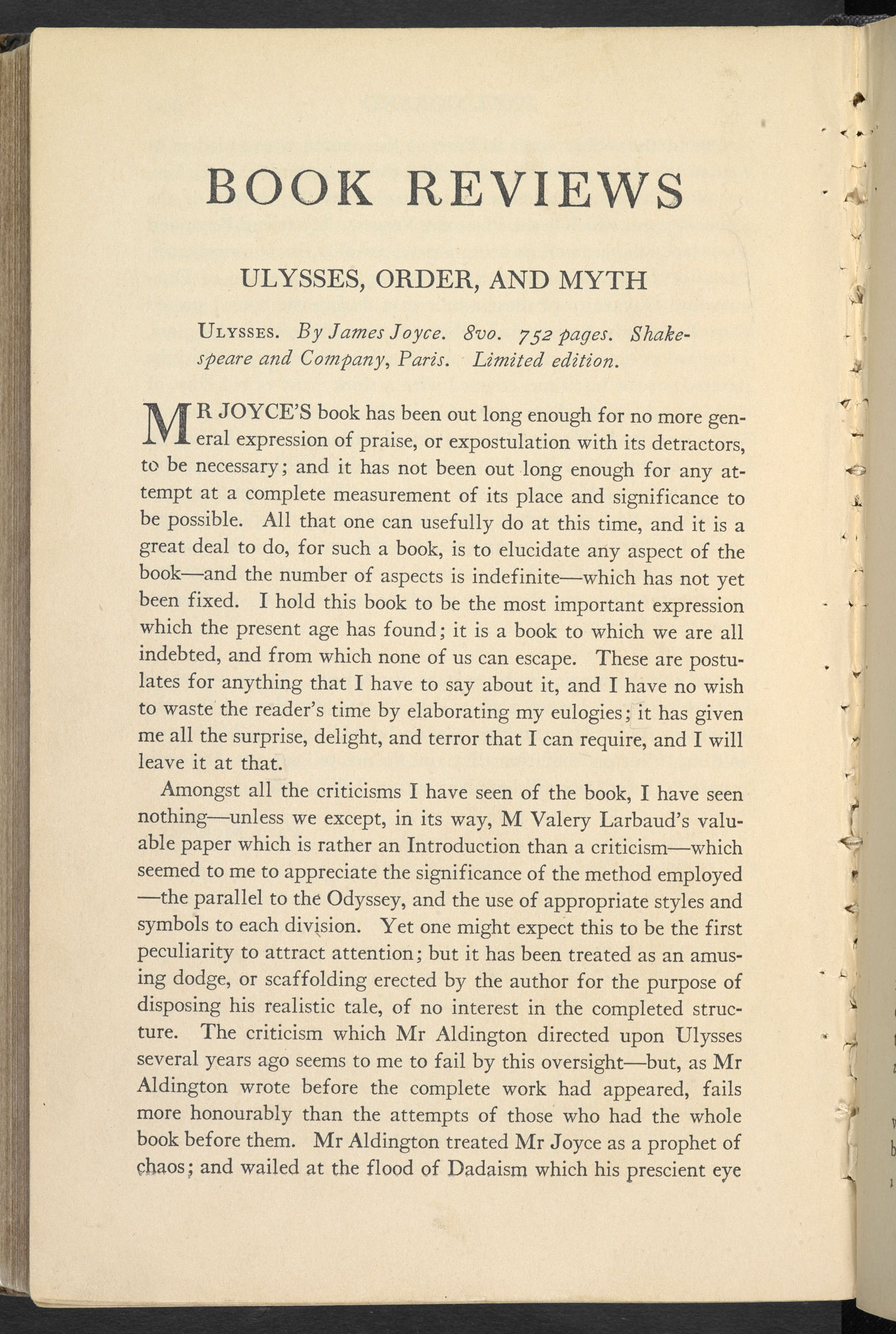
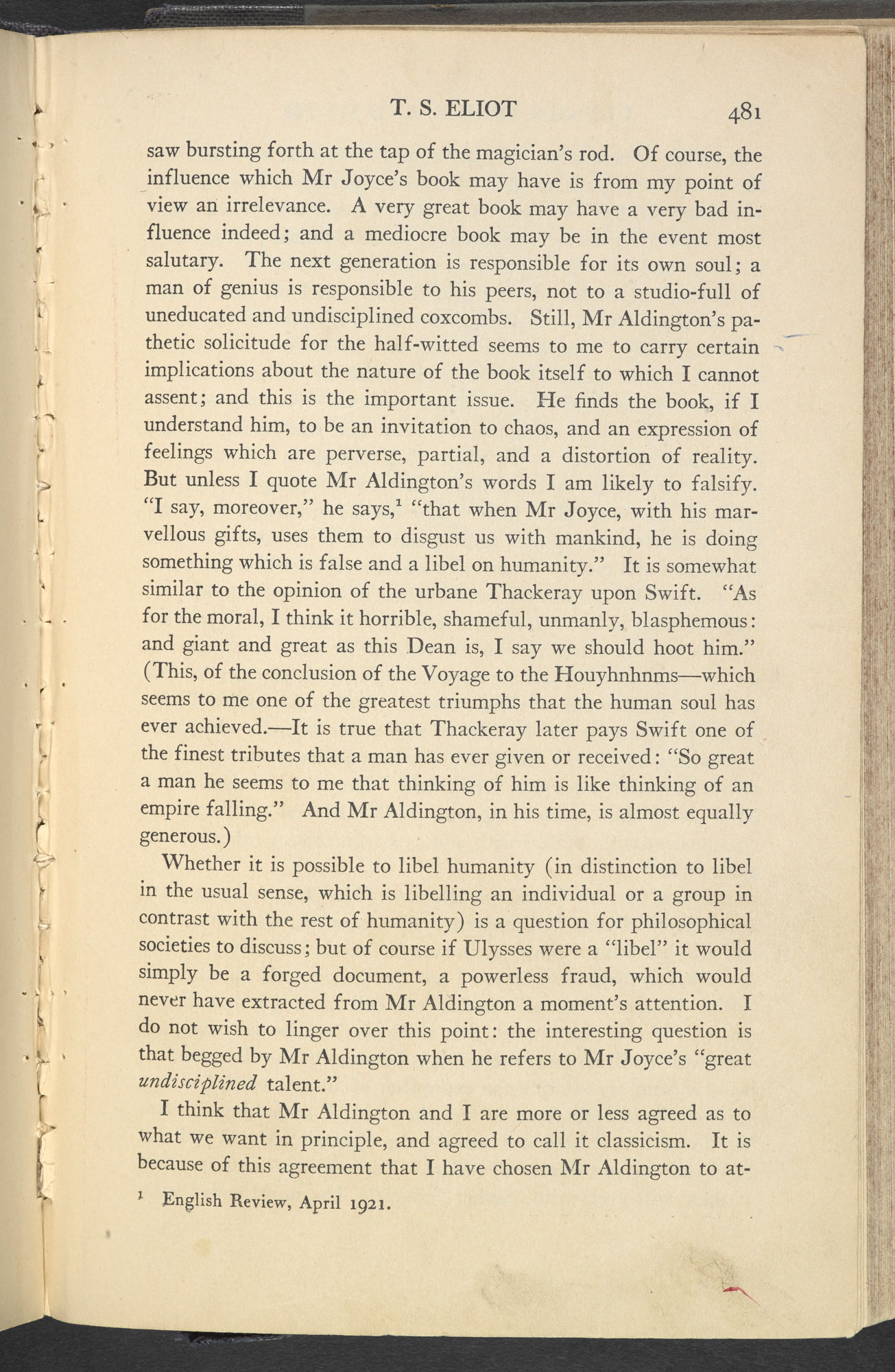
T. S. Eliot (2) - ‘Ulysses, Order and Myth’, in The Dial (Nov. 1923): ‘Among all the criticisms I have seen of the books I have seen nothing - unless we except M. Valery Larbaud’s valuable paper [Nouvelle revue] which is rather an Introduction than a criticism - which seemed to me to appreciate the significance of the method employed - the parallel to the Odyssey, and the use of appropriate styles and symbols to each division. Yet one might expect this to be the first peculiarity to attract attention; but it has been treated as an amusing dodge, or scaffolding erected by the author for the purpose of disposing his realistic tale, of no interest in the complete structure.’ (Rep. in Robert Deming, ed., James Joyce: The Critical Heritage, London: Routledge & Kegan Paul 1970, Vol. 1, pp.268-71; p.268.) Eliot then cites Richard Aldington’s account of Joyce novel as ‘a prophet of chaos’, bewailing ‘the flood of Dadaism which his [Aldington’s] prescient eye saw bursting forth at the tap of a magician’s wand’. (Ibid., p.269.) [Cont.]
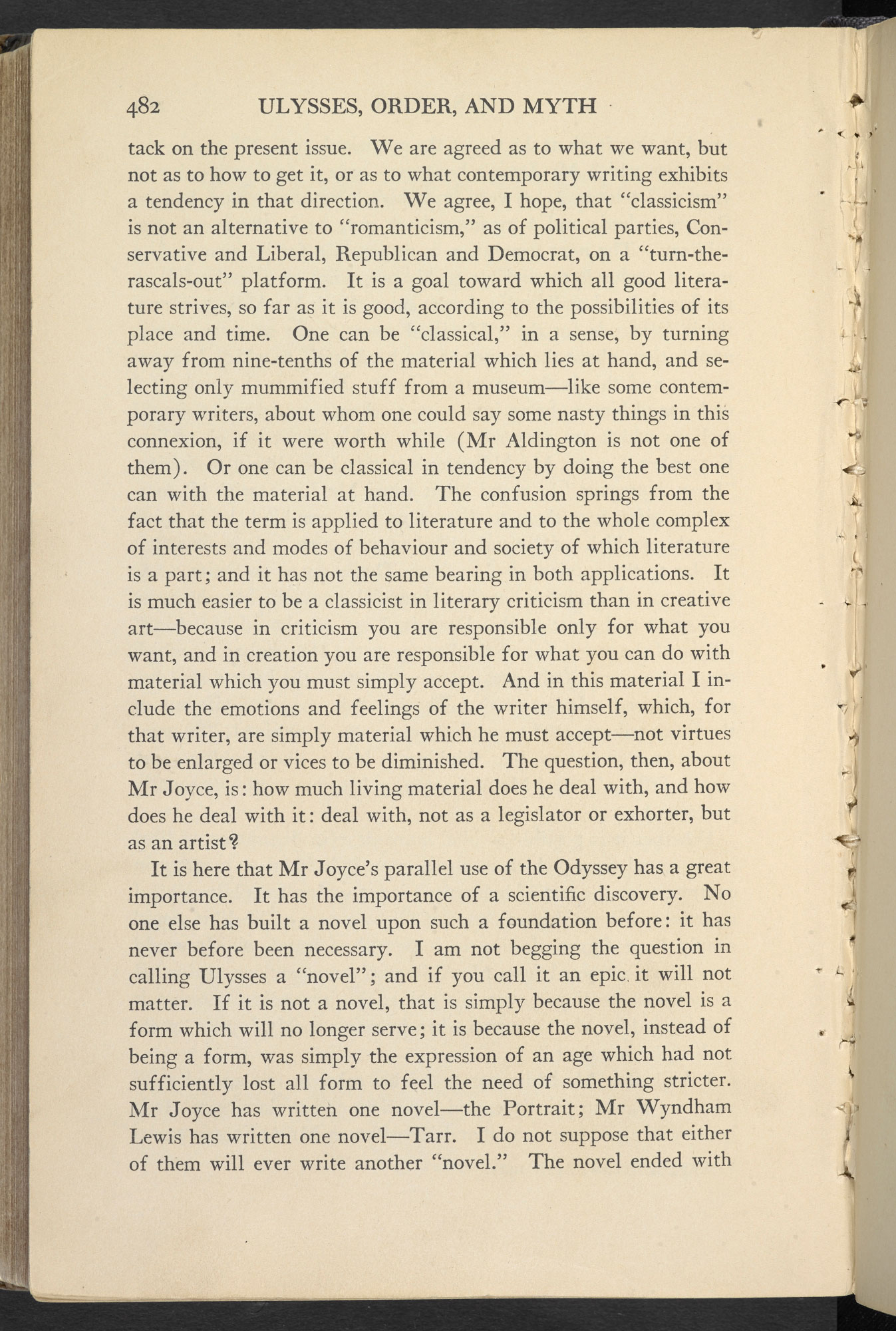
Cont.: ‘[...] One can be “classical” in a sense, by turning away from nine-tenths of the material which lies at hand, and selecting only mummified stuff from the museum [...] Or one can be classical in tendency by doing the best one can with the material at hand. The confusion springs from the fact that the term is [269] applied to literature and to the whole complex of interests and modes of behaviour and society of which literature is a part; and it has not the same bearing in both applications. It is much easier to be classicist in literary criticism than in creative art - because in criticism you are responsible only for what you want, and in creation you are responsible only for what you can do with material which you must simply accept - not virtues to be enlarged or vices to be diminished. The question, then, about Mr Joyce, is: how much living material does he deal with, and how does he deal with it: deal with, not as a legislator or exhorter, but as an artist? / It is here that Mr Joyce’s parallel use of the Odyssey has a great importance. It has the importance of a scientific discovery. No one else has built a novel upon such a foundation before: it has never been necessary. I am not begging the question in calling Ulysses a novel; and if you call it an epic it will not matter. If it is not a “novel”, that is simply because the novel is a form which will no longer serve; it is because the novel, instead of being a form, was simply the expression of an age which had not sufficiently lost all form to feel the need of something stricter. [...] Mr. Joyce has written one novel - the Portrait; Mr Wyndham Lewis has written one novel - Tarr. I do not suppose that either of them will ever write another “novel”’. The novel ended with Flaubert and James. It is, I think, because Mr Joyce and Mr Lewis, being “in advance” of their time, felt a conscious or probably unconscious dissatisfaction with the form, that their novels are more formless than those of a dozen clever writers who are unaware of its obsolescence.’ (Ibid., pp.269-70.) [Cont.]
[Cont.]): ‘In using the myth, manipulating a continuous parallel between contemporaneity and antiquity, Mr. Joyce is pursuing a method which others must pursue after him. They will not be imitators, any more than the scientists who use the discoveries of Einstein in pursuing their own, independent, further investigations. It is simply a way of controlling, of ordering, of giving a shape and a significance to the immense panorama of futility and anarchy which is contemporary history. It is a method already adumbrated by Mr. Yeats and of the need for which I believe Mr. Yeats to have been the first contemporary to be conscious. [See note.] It is a method for which the horoscope is auspicious. Psychology (such as it is, and whether our reaction to it be comic or serious), ethnology, and The Golden Bough have concurred to make possible what was impossible [270] even a few years ago. Instead of narrative method, we may now use the mythical method. It is, I seriously believe, a step toward making the modern world possible for art, toward that order and form which Mr Aldington so earnestly desires. And only those who have won their own discipline in secret and without aid, in a world which offers very little assistance to that end, can be of any use in furthering this advance.’ (pp.270-71) [End].)
 |
 |
 |
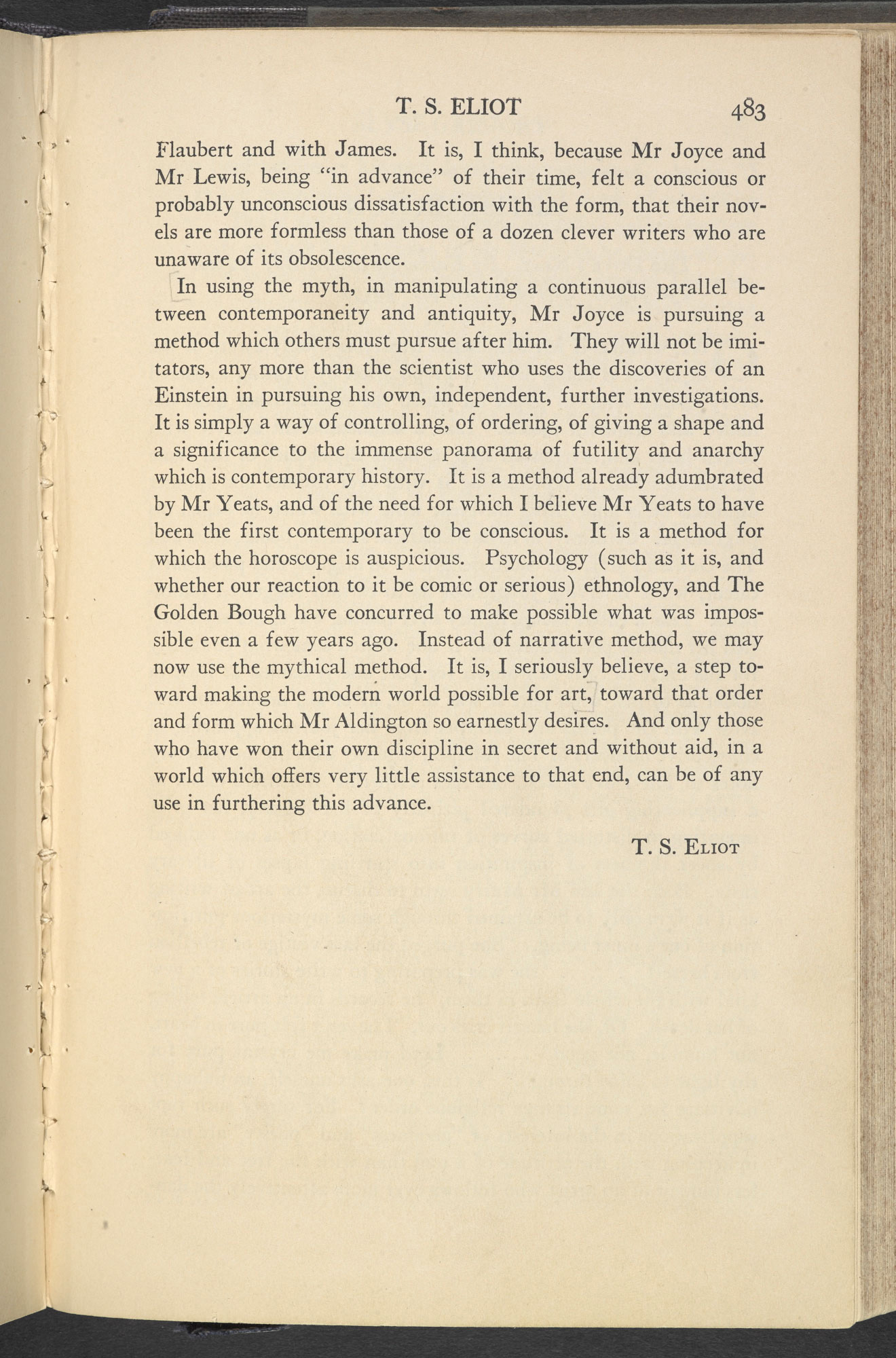 |
(Text rep. in Deming, James Joyce: Critical Heritage, 1970, Vol. 1, pp.270-71; quoted [in part] in Richard Ellmann, James Joyce, Oxford; Clarendon Press [1957] 1965 Edn., p.541; also in Ronald Schleifer, ‘Yeats’s Postmodern Rhetoric’, in Yeats and Modernism, ed. Leonard Orr, Syracuse UP 1991, p.16.) The whole is reprinted in Richard Ellmann & Charles Feidelson, eds., The Modern Tradition (NY: OUP 1965), [cp.681]; also in Frank Kermode, ed., Selected Essays of T. S. Eliot (NY: Harcourt 1975), pp.177-78. Image available at British Library website - online; accessed 02.02.2022. There is a pdf copy online at J. Matthew Huculak webpages - online; accessed 02.02.2022 - with a copy in RICORSO - as infra.]
See full text version - as a PDF in this frame, or in a new window. Bibl.: For a modern reaction to ‘Ulysses, Order and Myth’, see Lidia Vianu, ‘Eliot’s Hidden Agenda: Joyce?’, in The European English Messenger, 19.1 (2010), pp.43-46 [as infra].
Note: Denis Donoghue remarks that Richard Ellmann cites the first sentence in James Joyce (1959, 1986) but that he omits the second in which Yeats is accredited with the first use of the method. Donoghue goes on to write: ‘Did he mean Yeats’s juxtaposition of ancient and modern motifs, of Helen of Troy and Maud Gonne as in “A Woman Homer Sung” and “No Second Troy”? Or had Eliot something else in mind as marking the relation between Yeats’s poems and Ulysses?’ (‘On the Text of Ulysses [review of Hans Walter Gabler, Ulysses [rev. edn.], Ellmann, James Joyce [rev. edn.], et al., in London Review of Books, 20 Sept.-3 Oct. 1984; rep. in We Irish: Selected Essays of Denis Donoghue [Vol.1], Brighton: Harvester Press 1986, p.117.)
T. S. Eliot (3): Eliot interpreted the manner of “Oxen of the Sun” as a revelation of the ‘futility of all styles’ - as reported by Virginia Woolf [diary entry for 26 Sept. 1922], in A Writer’s Diary, ed. Leonard Woolf, London 1954, p.50; quoted in Richard Ellmann, James Joyce, p.490.)
Note: Eliot wrote to Joyce of Ulysses: ‘I wish for my own sake, that I had not read it’ (letter of 21 May 1921) - and asked Woolf, ‘How could anyone write against after achieving the immense prodigy of the last chapter?’ (Woolf, op. cit., p.363; quoted in Richard Ellmann, James Joyce, 1965 Edn., p.542). Ellmann adds that Eliot ‘thought Joyce had killed the nineteenth century, exposed the futility of all styles, and destroyed his own future [since t]here was nothing left for him to write another book about’ (Op. cit., p.542.) [Note, pag. 363 and 50 in Woolf recte as given in Ellmann.]
T. S. Eliot (4): ‘James Joyce was the greatest non-stylists, the master of the vacuum of personal style into which all things rush.’ (‘A Note on Monstre Gai’, in Hudson Review, VII, 1955, p.526; quoted in Christopher Ricks, T.S. Eliot and Prejudice (London: Faber & Faber 1988) p.172 [as infra].
Christopher Ricks: ‘In 1955 Eliot praised Wydnam Lewis as “the greatest prose master of style of my generation,” and then turned to a favourite resource and recourse, brackets: (“James Joyce was the greatest non-stylist, the master of the vacuum of personal style into which all things rush.)” [Hudson Review, vii, 1955, p.526]; quoted thus in Christopher Ricks, ‘The master of the vacuum’, in T. S. Eliot and Prejudice, Berkeley: California UP 1988 [[Sect. V: The English Accent], p.172.
Further [Ricks quotes Eliot]: ‘In this book [Ulysses] Joyce had arrived at a very singular and perhaps unique literary distinction: the distinction of having, not in a negative but a very positive sense, no style at all. I mean that every sentence Mr Joyce writes is peculiarly and absolutely his own, that his work is not a pastiche; but that nevertheless, it has none of the marks by which a “style” may be distinguished.’ [here simply dated 1923 in text - viz., ‘Ulysses, Order and Myth’, in The Dial, Nov. 1923.] Ricks continues, quoting Eliot again: ‘No art, and particularly and especially no literary art, can exist in a vacuum.’ (The Bookman, lxx, 1930, p.598) - and remarks: ‘True: but the unexpected truth is that a vacuum can exist in art.’ (idem.)
T. S. Eliot (5): ‘The influence of [the style of] Walter Pater culminates and disappears, I believe, in the work of James Joyce ... In Ulysses this influence, like the influence of Ibsen and every other influence to which Mr. Joyce has submitted, is reduced to zero. It is my opnion that Ulyses is not so distinctly a precursor of a new epoch as a gigantic culmination of an old. In this book Joyce has arrived at a very single and unique literary distinction: the distinction of having, not in a negative but a very positive sense, no style at all. I mean that every sentence Mr. Joyce writes is peculiarly and absolutely his own, that his work is not a pastiche; but that nevertheless, it has none of the marks by which a “style” may be distinguished. / Mr. Joyce’s work puts an end to the tradition of Walter Pater, as it puts an end to a great many other things ...’ (‘Contemporary English Prose’, in Vanity Fair, No. 20, July 1923, p.51; first publ. in Nouvelle Revue Française, No. 19, Dec. 1922, pp.751-56; quoted in Louis Menand, ‘Problems about Texts’, in T. S. Eliot’s the Waste Land, intro. by Harold Bloom, NY: Chelsea House Publishers 1986; update edn. 2007, pp.109-30; p.124.) [Menand notes that the article was solicited for Vanity Fair by the magazine’s young editor Edmund Wilson.]
T. S. Eliot (6) - Preface to My Brother’s Keeper (1957): ‘In the case of James Joyce we have a series of books, two of which at least as so autobiographical in appearance that further study of the man and his background seems not only suggested by our own inquisitiveness, but almost expected by the author himself. / We want to know who are the originals of his characters, and what were the origins of his episodes, so that we may unravel the web of memory and invention and discover how far and in what ways the crude material has been transformed. / Our interest extends, therefore, inevitably and justifiably, to Joyce’s family, to his friends, to every detail of the topography and life of Dublin, the Dublin of his childhood, adolescence and young manhood.’ (Stanislaus Joyce, My Brother’s Keeper, London: Faber & Faber 1957, pp.11-12; given as epigraph to Peter Costello, James Joyce: The Years of Growth 1882-1915, London: Kyle Cathie 1992 [no ref.]). [Cont.]
T. S. Eliot (Preface to My Brother’s Keeper [1957], NY 1958) - cont.: ‘It is difficult to believe that greater knowledge about the private life of Shakespeare could much modify our judgment or enhance our enjoyment of his plays; no theory about the origin or mode of composition of the Homeric poems could alter our appreciation of them as poetry. With a writer like Goethe, on the other hand, our interest in the man is inseparable from our interest in the work; and we are impelled to supplement and correct what he tells us in various ways about himself, with information from outside sources; the more we know about the man, the better, we think, we may come to understand his poetry and his prose.’ (pp.vii; quoted in A. Walton Litz, James Joyce, Boston: Twayne 1966, p.15; see Litz’s remarks, infra.)
[ top ]
Virginia Woolf: ‘I [...] have been amused, stimulated, charmed interested by the first 2 or 3 chapters-to the end of the Cemetery scene; & then puzzled, bored, irritated, & disillusioned as by a queasy undergraduate scratching his pimples. And Tom, great Tom, thinks this on a par with War & Peace! An illiterate, underbred book it seems to me: the book of a self-taught working man, & we all know how distressing they are, how egotistic, insistent, raw, striking, & ultimately nauseating. When one can have cooked flesh, why have the raw? But I think if you are anaemic, as Tom is, there is glory in blood. Being fairly normal myself I am soon ready for the classics again. I may revise this later. I do not compromise my critical sagacity. I plant a stick in the ground to mark page 200. (Deming, James Joyce: The Critical Heritage, [1972], Vol. 2, pp.188-89); quoted in James Heffernan, ‘Woolf’s Reading of Joyce’s Ulysses, 1918-1020; 1922-1941’, in Dartmouth College Campus Press [Modernism Lab Blog ], q.d. [1918-22 - online; 1922-41 - online]; also quoted in Luísa de Freitas, ‘Rubbish Heaps, Tiny Pearls: Woolf, reader of Joyce’, at ABEI Sul America Conference, 29 Sept. 2021 [Brazil] - available on YouTube - online; accessed 29.09.2021].)
Further: ‘I finished Ulysses, & think it is a mis-fire. Genius it has I think; but of the inferior water. The book is diffuse. It is brackish. It is pretentious. It is underbred, not only in the obvious sense, but in the literary sense. A first rate writer, I mean, respects writing too much to be tricky; startling; doing stunts. I’m reminded all the time of some callow board [sic] schoolboy, say like Henry Lamb, full of wits & powers, but so self-conscious and egotistical that he loses his head, becomes extravagant, mannered, uproarious, ill at ease, makes kindly people feel sorry for him, & stern ones merely annoyed; & one hopes he’ll grow out of it; but as Joyce is 40 this scarcely seems likely. I have not read it carefully; & only once; & it is very obscure; so no doubt I have scamped the virtue of it more than is fair. I feel that myriads of tiny bullets pepper one & spatter one; but one does not get one deadly wound straight in the face-as from Tolstoy, for instance; but it is entirely absurd to compare him with Tolstoy. (Deming, op. cit., Vol. 2: 199-200) [Note that Harriet Weaver brought the first four episodes of Ulysses in the Little Review to Woolf in April 1918.]
Further (Journal for 23 Sept. 1922): ‘Tom [T. S. Eliot] said, “He is a purely literary writer. He is founded upon Walter Pater with a dash of Newman.” I said he was virile-a he-goat; but didn’t expect Tom to agree. Tom did tho’; & said he left out many things that were important. The book would be a landmark, because it destroyed the whole of the 19th Century. It left Joyce himself with nothing to write another book on. It showed up the futility of all the English styles. He thought some of the writing beautiful. But there was no “great conception”: that was not Joyce’s intention. He thought Joyce did completely what he meant to do. But he did not think that he gave a new insight into human nature - said nothing new like Tolstoi. Bloom told one nothing. Indeed, he said, this new method of giving the psychology proves to my mind that it doesn’t work. It doesn’t tell as much as some casual glance from outside often tells. I said I had found [Thackeray’s] Pendennis more illuminating in this way.’ (Deming, Vol. 2, pp.202-03.)
Alessandro Francini-Bruni, ‘Joyce Stripped Naked in the Piazza’ (Trieste 1922): ‘At that time Joyce talked a strange species of Italian. It is better to say archaic than strange, a crippled Italian full of ulcers. It was, if you can imagine such a thing, like an only-child language, and that child the deformed daughter of a buxom wet nurse and a diseased old dwarf. At any rate, it was a dead language, which joined the babble of living languages coming out of that pit of poor devils at the school. / Joyce was not aware of the ulcerations but, on the contrary, spoke them with great naturalness. The beautiful thing was the confidence with which he uttered those heresies. He came out with certain abortions that, as God is true, could not be allowed either in heaven or on earth. In heaven God in all his mercy could not have accepted them. On earth they existed only because Joyce did and because he kept them alive. He spoke them with brazen indifference to people’s opinions. This virtue was not lacking in that spirited man. It is true that five years later the Italian language - the real language& - was much more familiar to him than to me. He was a valuable and powerful contributor to our newspapers. And even though Benco,8 with false humility, exaggerated in saying that Joyce had taught him Italian, it is certain that many of us would have been happy to write Italian as skillfully as that Irishman did. But at first, I assure you, it was another story.’ [See longer extract in RICORSO Library, Criticism > “Major Authors”, via index or direct.]
Eugene Jolas, ‘The Revolution of Language and James Joyce’, in Our Exagmination Round His Factification for an Incamination of Work in Progress: A Symposium, ed. Samuel Beckett [1929] (NY: New Directions 1972: ‘The Real metaphysical problem today is the word. The epoch when the writer photographed the life about him the mechanics of words redolent of the daguerreotype, is happily drawing to its close. The new artist of the word has recognized the autonomy of language and, aware of the twentieth century current towards universality, attempts to hammer out a verbal vision that destroys time and space.’ (p.79; quoted in Christine van Boheemen-Saaf, ‘Joyce in Theory/Theory in Joyce’, in James Joyce, ed. Sean Latham [Visions & Revisions Ser., gen. ed. Stan Smith], Dublin: IAP 2010, p.155.) [Cont.]
Eugene Jolas (‘The Revolution of Language and James Joyce’, in Our Exagmination [... &c., 1929], 1972 edn.): ‘Modern life, with its changed mythos and transmuted concepts of beauty makes it imperative that words be given new compositions and relationships. / James Joyce, in his new work published serially in transition, has given a body blow to the traditionalists. As he subversts the orthodox meaning of words, the upholders of the norm are seized with panic, and all those who regard the English language as a static thing, sacrosanct in its position, and dogmatically defended by a crumbling hierarchy of philologists and pedagogues, are afraid. Epithets such as “the book is a nightmare,” “disgusting, distorted rubbish,” “utterly bad,”, &c., have been poured on the author and his work.’ (Ibid., p.80; for Jolas’s extensive response to Sean O’Faolain’s Criteria review-critique of ALP in this article, see under O’Faolain, infra.) [Cont.]
Eugene Jolas (‘The Revolution of Language and James Joyce’, in Our Exagmination [... &c., 1929], 1972 edn.): ‘We are not interested in romantic “passé-ism,” nor in infantile parallelisms. / The most cursory glance at the evolution of English, or other languages, shows that speech is not static. It is in a constant state of becoming. Whether the organic evolution of speech is due to external. conditions the people themselves bring about, or whether it is due to the forward-straining vision of a single mind, will always remain a moot question. I imagine there is an element of both working simultaneously at this process. Renan once accused Saint-Paul of “audaciously violating, if not the genius of the Greek language, at least the logic of human language.” The reason for Saint-Paul’s heresy lies in the fact, - as pointed out by the Rev. Marcel Jousse - that he tried to follow the laws of spoken human language. There is no logical reason why the transmutation of language in our day should not be as legitimate as it was throughout the ages. While painting, for instance, has proceeded to rid itself of the descriptive, has done away with the classical perspective, has tried more and more to attain the purity of abstract idealism, and thus led us to a world of wondrous new spaces, should the art of the word remain static? Is it not true that words have undergone radical changes throughout the centuries? Should James Joyce, whose love of words and whose mastery of them has been demonstrated in huge creations, be denied the right (which the people themselves hold) to create a vocabulary which is not only a deformation, but an amalgamation of all the languages in the so-called English-speaking world? The English language, after all, has been an amalgamation from [82] the very beginning of its existence. Why should the unilingual Englishman feel worried, when in the British Isles alone, there are five languages still in common use: Manx, English, Irish, Gaelic and Welsh! With what right can the “unilingual” Englishman demand that the well of the English language remain undefiled ? It is a very muddy well, at best.’ (pp.82-83.) [For longer extracts, see RICORSO Library, “Major Authors > James Joyce”, infra.)
Eugene Jolas, The Man from Babel [1998]: ‘[Joyce] seemed to be constantly on the look-out, listening rather than talking. ‘Really, it is not I who am writing this crazy book’, he said in a whimsical way. ‘It is you and you and that girl over there and that man in the corner.’ One day I found him in a Zurich tea-shop laughing quietly to himself “Have you won the gros lot?” I asked. He explained that he had asked the waitress for a glass of lemon squash. The somewhat obtuse Swiss girl looked puzzled. Then she had an inspiration: “Oh, you mean Lebensquatsch?” she stammered. (Her German neologism might be translated as “life’s piffle”.)’ (The Man from Babel, ed. Andreas Kramer & Rainer Rumbold, Yale UP 1998, p.166; quoted by Tim Conley, ‘Finnegans Wake: Some Assembly Required’, in James Joyce, ed. Sean Latham, Dublin: IAP 2010, p.141.) [Actually from “My Friend James Joyce”, rep. in Eugene Jolas: Selected Writings, Northwestern UP 2009), pp.393-404, sect.: “Literary Encounters”, pp.400-01.]
Note - Conley remarks: ‘Sure enough, the waitress’s lovely invention appears in the Wake: “I’ll go for that small polly if you’ll such up to your lebbensquatch”’ - adding ‘It’s worth noting that the judgement “obtuse” is Jolas’s and not necessarily Joyce’s.’
[ top ]
Eugene Jolas, “My Friend James Joyce” (March-April 1941), in Eugene Jolas: Critical Writings, 1924-1951, ed. & intro. by Klaus H. Keifer & Rainer Rumold (Northwestern UP 2009), sect.: “Literary Encounters”, pp.393-404]: ‘“This book,” he sometimes says, “is being written by the people I have met or known.” Sometimes he hardly seems to be listening to the conversation around him. Yet nothing escapes his prodigious memory, whether the dialogues be in English, French, German or Italian. It may be a slip of the tongue, a phantantic verbal deformation, or just a tic of speech, but it usually turns up later in its proper place.’ (p.392.) [Cont.]
Eugene Jolas, “My Friend James Joyce” (1941) - cont.: ‘All his friends collaborated then in the preparations of the fragments destined for transtion: Stuart Gilbert, Padraic Colum, Elliot Paul, Robert Sage, Helen and Giorgio Joyce, and others. He worked with painstaking care, almost with pedantry. He had invented an intrictate system of synbols permitting him to pick out the new words and paragraphs he had been writing down for years, and which referred to the multiple characters in his creation. He would work for weeks, often late at night, with the help of one or other of his friends. It seemed almost a collective composition in the end, for he let his friends participate in his inventive zeal, as they searched through numberless notebooks with mysterious reference points to be inserted in the text. When finished, the proof looked as if a coal-heaver’s sooty hands had touched it. Once the work was done, we would dine with him at his favourite restaurant, the Trianons, where he liked the atmosphere and the cuisine, and where he was sure to find his dry, golden Chablis, or, if the evening grew more hilarious, an excellent Pommery champagne. His nearly whispered conversations never had any nuance of scatology, and whenever one of the more Rabelaisian of his companions would indulge in some too robust galoiserie, he would deftly, almost impatiently, lead the dialogue into other channels. Sometimes he would bring a page he had written and hand it around the table with a gesture of polite modesty. He never explained his work, save through indirection.’ (p.396.) [Available at Google Books- online.]
Eugene Jolas, “My Friend James Joyce” (1941): ‘I might easily have written this story in the traditional manner. It is not very difficult to follow a simple chronological scheme which every critic will understand. But I am, after all, am trying to tell the story of this Chapelizod family in a new way. Time and the river and the mountain are the real heroes of my book. Yet the elements are exactly what every novelist might use; man and woman, birth, childhood, night, sleep, marriage, prayer, death. There is nothing paradoxical about this. Only I am trying to build up many planes of narrative with a single esthetic purpose. Did you ever read Laurence Sterne?’ (My Friend James Joyce [1941] pp.11-12; quoted in Wolfgang Iser [trans. by David Henry Wilson], Sterne: Tristram Shandy [Landmarks of World Literature (Cambridge UP 1988), p. 128. Note: Iser remarks: ‘What Joyce saw in Sterne was the linguistic capture of what is eclipsed by the representative character of language.’ (Iser, op. cit., idem.)
Note that the Wikipedia article on Finnegans Wake includes a copy of Margot Norris’ transcription with ellipses omitting part of the above but including the sentence: ‘traditional manner [...] Every novelist knows the recipe [...] It is not very difficult to follow a simple, chronological scheme which the critics will understand.’ (Norris, The Decentered Universe of “Finnegans Wake”: A Structuralist Analysis (Johns Hopkins UP 1976), p.2; see Wikipedia - online; accessed 27.10.2017.)
Eugene Jolas, Critical Writings, 1924-1951, ed. & intro., Klaus H. Kiefer & Rainer Rumold (Northwestern UP 2009)
Literary Encounters”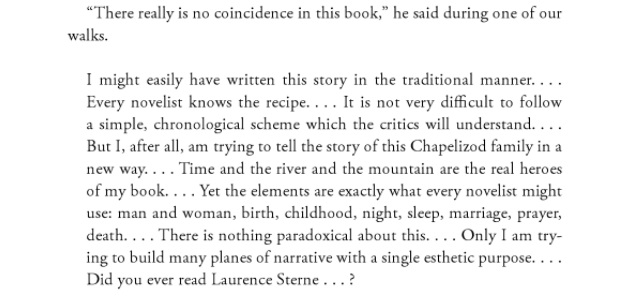
p.399; available online. Eugene Jolas (“My Friend James Joyce”, 1941) - cont.: ‘There was a famous Jesuit school in the town [‘a little frontier border twon in the mountains of Austria, on the River Ill, nr. mountains - where the Jolases spent ‘several months’ with the Joyce’s in summer-fall 1931 [recte 1932?; presum. at Feldkirch], and he would reminisced about his Dublin days with the fathers. But his anti-religious convictions were unshakable. I had come back from a talk with his daughter, who seed [399] to be interested in knowing something about Catholic dogma. Joyce, on hearing this, grew suddenly quite violent and said: “Why should a young woman bother her head about such things? Buddha and Confucius and all the others were not able to understand about it. We know nothing, and never shall know anything.” He discussed Vico’s theory of the origin of language. The conception of the cyclical evolution of civilizations born from each other like the phoenix from the ashes haunted him. He began to speculate on the new physics, and the theory of the expanding universe, and while walking with him [in the mountains], I had the impression that he was not really in an Austrian fronter town, but in Dublin, and that everything he thought and wrote was about his native land. / He completed the “Mime” in Zurich, after our return there.’ [Cont.]
Eugene Jolas (“My Friend James Joyce”, 1941) - cont.: ‘A British clipping came saying that Joyce was trying to revive Swift’s little language to Stella. “Not at all,” said Joyce to me. “I am using a Big Language.” He said one evening: “I have discovered that I can do anything with language I want.” His linguistic memory was extraordinary. He seemed constantly à l’affût, always to be listening rather than talking. “Really, it is not I who am writing this crazy book,” he said in his whimsical way one evening. “It is you, and you, and you, and that man over there, and that girl at the next table” [Tells the story of the waitress who mistakes lemon squash for the neologism Lebensquatch - viz., life’s piffle.] (p.400.)
Eugene Jolas (“My Friend James Joyce”, 1941) - cont. [on Yeats]: “Literary Encounters”]: ‘Back in Paris [in 1932] he became more and more absorbed by meditations on imaginative creation. He read Coleridge and was interested in the distinction he made between imagination and fancy [...] As the political horizon in Europe grew more threatening, his high Olympian neutrality asserted itself more and more. In those days I remember reading to him a German translation from a speech by Radek in which the Russian attacked Ulysses, at the Congress in Kharkov, as being without a social conscience. “Well,” said Joyce, “all the characters in my books belong to the lower middle classes, and even the working class; and they are all quite poor.” He began to read Wuthering Heights [by Charlotte Brontë]. “This woman has pure imagination,” he said. “Kipling had it too, and certainly Yeats.” His admiration for the Irish poet was very great. A recent commentator asserting that Joyce lacked reverence for the logos in poetry [prob. Oliver St. John Gogarty], inferred that he had little regard for Yeats. I can assure the gentleman that this was not true. Joyce often recited Yeats’s poems to us from memory. “No Surrealist poet can equal this for imagination,” he once said. Once, when Yeats spoke over the radio, he invited us to listen in with him. I read A Vision to him, and he was deeply absorbed by the colossal conception, only regretting that “Yeats did not put all that into his creative work.” At Yeats’s death he sent a wreath to his grave in Antibes, and his emotion on hearing of the poet’s passing was moving to witness. he always denied, too, that he had said to Yeats that he was too old to be influenced by him.’ (Jolas, Critical Writings, ed. Keifer & Rumold, Northwestern UP 2009, p.401.)
[Note: “My Friend James Joyce”, 1941 is also rep. in Seon Givens, ed., James Joyce: Two Decades of Criticism (NY: Vanguard Press, Inc. 1948) [item 1], [cp.14; cited in Ellmann, James Joyce, rev. edn. 1982, p.660-61, & Notes, p.805]. The radio broadcast referred to here was probably the one given in July 1937 - Yeats’s last in a series directed by George Barnes for the BBC.]
Dates relating to Jolas’s memoir: Joyce’s trip to Zürich when he stayed with the Jolases in Feldkirch fell in the winter of 1931-32; Yeats died in January 1939. The radio talk that Jolas mentions must have been one of those transmitted by the BBC in 1937 [1], while an egregious critique of Ulysses by Karl Radek, also mentioned (but omitted here) was given at the Congress of Soviet Writers in 1934 and published in 1935 [2].
Yeats made four broadcasts on modern poetry for George Barnes of the BBC during 1937, these being ‘In the Poet’s Pub’ (2 April 1937), ‘In the Poet’s Parlour’ (22 April 1937), “My Own Poetry” (3 July 1937) and “My Own Poetry Again’ (29 Oct. 1937). His play The Words Upon the Window-Pane was broadcast during “Experimental Hour” on 22 Nov. 1937. A comprehensive study of Joyce and radio is overdue.
Karl Radek, “James Joyce or Socialist Realism?” (1934), in Contemporary World Literature and the Tasks of the Proletariat [Report delivered at the Congress of Soviet Writers, Aug. 1934], rep. in A. Zhdanov, et al., eds., Problems of Soviet Literature, 1935; also in Robert Deming, ed., James Joyce: The Critical Heritage (London: Routledge, 1970), Vol. 2, pp.624-25. [See Radek under Commentary > infra.]
[Note: For Karl Radek’s critique of Joyce cited here, see under Joyce > Commentary - as infra.]
See also “Homage to the Mythmaker” (April-May 1938), pp.388-92 - quotes Observatore di Roma: ‘[...] e infine James Joyce, di fama europea, iconoclasta e rebelle, che dopo aver cercato di ringiovanire il vecchio naturalismo, tenta nell’ Ulyxes di tradurre plasticamente la realtà interiore, e nell’ Opera in Corso attraverse una esperienza onirica et insieme linguistica si sforza di aprire altre vie all’ espressionne del sentimento umane.’ Jolas remarks, ‘The Catholic Church is apparently far removed from the philistimism and hypocrisy of some of the orthodox literary critics of Dublin, London, and New York. [... and finally, James Joyce, of European fame, iconoclast and rebel, who after having sought to renovate the old Naturalism, attempted in Ulysses to translate plastically the inner reality and, who in Work in Progress, in an experiment, both oneiric and linguistic, is seeking to open up new paths for the expression of human sentiments.’ (Ibid., “Lit. Encounters”, p.391.)
[ top ]
Eugene Jolas, “Elucidation of James Joyce’s Monomyth: Explication of Finnegans Wake” (July 1948), pp.405ff.; ‘In the second chapter, the children have retired to their rooms, where they are doing their homework. we are confronted with one of the most inscrutable chapters in the book. Joyce intensifies the moment through an image that encompasses all schoolchildren of the world and magnifies their little tasks in representations of grand tasks of all professors throughout history. We recognize many references to the trivium and quadrivium, as well as to the esoteric doctrines of the Kabbala. In the margins of this description, Joyce adds little notes: those on the left (Shem) express ridiculous and farcical opinions, while those on the right (Shaun) are more solemn.’ [Cont.]
‘The chapter [2.ii] opens with a description of the student’s perplexity and of the problems they face. First there is an allegorical review of the processes of creation. Twenty-six pages are used to described the descent of the spirit in time and space. The creative will incites the father to engender the universe. The world becomes possible and acquires form. Man appears with his primitive passions and taboos and is then placed in HCE’s tavern. The whole human comedy is played out in the children’s room. The boys work while their sister looks at letters. The good child Kev (Shem) has difficulties solving his geometry problems. The bad boy Dolph (Shaun) simultaneously helps him and scoffs at him. Kev slaps him but they then reconcile. It is time for bed.
‘The Third chapter’s opening is constituted by an introduction of the people who are present in the tavern, [...] the radio emits nasal sounds, and HCE leans on the his elbow at the bar. Everyone listens to the radio broadcasts, which are based on the old story of HCE’s sin. There is a general brouhaha. Nine stories intersect [...’; gives list.] (p.416.)
[ top ]
Stuart Gilbert, James Joyce’s Ulysses: A Study [1930] (Harmondsworth: Penguin Books 1963): ‘At a first reading of Ulysses the average reader is impressed most of all by the striking psychological realism of the narrative [...] But the realism of Ulysses strikes far deeper than the mere exercise of verbal frankness; apart from the author’s extreme, almost scientific, precision in his handling of words, there are two factors which place Joyce’s work in a class apart from all its predecessors, even the most meticulously realistic: firstly, the creator’s standpoint to his theme, the unusual angle from which he views his creatures, and, secondly, his use of the ‘silent monologue’ as the exponent not only of their inner and hardly conscious psychological reactions but also of the narrative self.’ (p.19.)
Stuart Gilbert (James Joyce’s Ulysses: A Study, 1930 Edn.) - cont.: ‘There is, in Ulysses, a background of political preoccupations, which is frequently visible behind the texture of the narrative or soliloquies. The betrayal of Parnell is, in fact, one of the themes of the work and there are many allusions to such national leaders as O’Connell, Emmet, Wolfe Tone. But the author of Ulysses, in this as in other matters, shows no bias; he introduces political themes because they are inherent in the Dublin scene, and also because they illustrate one of the motifs of Ulysses, the betrayal or defeat of the man of mettle by the treachery of the hydra-headed rabble. As far as his own outlook on these matters can be appraised, it is that of weariness and disgust. “Ireland is the old sow that eats her farrow.” “No honourable and sincere man has given up to you his life and his youth and his affections from the days of Tone to those of Parnell but you sold him to the enemy or failed him in need or reviled him and left him for another.” / It would, however, be unsafe to draw from the embittered aphorisms of young Stephen Dedalus any absolute inference regarding his creator’s subsequent attitude to politics. The title of the work whence these quotations are made is A Portrait of the Artist as a Young Man; in Ulysses, young Dedalus is but a year older and has not yet outgrown his rancour and disillusionment. In 1904 he is only twenty-two years of age; Ulysses was written in Trieste-Zurich-Paris between the years 1914 and 1921, when its author was remote both in time and place from the experiences of his adolescence and could exercise the detachment which remoteness gives. This ironical indifference is well illustrated by the Cyclops episode where, by a technique of exaggeration, chauvinism of all kinds is distended to bursting-point and beyond, till, exploding, it betrays the void within. Moreover, by way of counterpoise to the fanaticism of most of the Dubliners and the bitterness of young Stephen, who cannot forgive his church or country for his loss of faith in them, we have the placid commentary of sensible Mr Bloom, whose considered opinion seems to be that one government is, in general, as good or bad as another.’ (p.30.)
Stuart Gilbert (James Joyce’s Ulysses: A Study, 1930 Edn.) - cont: ‘It is, of course, no defence of obscenity to say that nature is obscene [...] But obscenity has its place in the scheme of things and a picture of life in which this element was ignored or suppresed would be incomplete, like the home without Plumtree’s Potted Meat. / “What is home without / Plumtree’s Potted Meat? / Incomplete.” [U72] / In practice we find that nearly all great works, from the Bible onwards, which treat of the universe as a whole and discover a coherence in all God’s works, include some obscenity in their presentatioin of the phenomena of life. / It cannot be too strongly emphasized that the object of the author of Ulysses was to present an aesthetic image of the world, a sublimation of that cri de coeur in which the act of creation begins. [32; quotes “The personality of the artist, at first a cry or a cadence ... refined out of existence, indifferent, paring its fingernails”: AP252] / Aesthetic emotion is static.’
[Quotes “The mind is arrested and raised above desire and loathing ... The feeling excited by improper art are kinetic, desire and loathing. Desire urges us to abandon, to go from something. The arts which excite them, pornographical or didactic, are therefore improper arts.”]
Stuart Gilbert (James Joyce’s Ulysses: A Study, 1930 Edn.) - cont: ‘Such a conception of the function of artist presided over the creation of Ulysses. The instant when the supreme quality of beauty, the clear radiance of the aesthetic image, “is apprehended luminously by the mind which has been arrrested by its wholeness and fascinated by its harmony is the luminous stasis of aesthetic pleasure, a spiritual state very like to that cardiac condition which the Italian physiologist Luigi Galvani, using a phrase almost as beautiful as Shelley’s, called the enchantment of the heart.’ [A Portrait.] / The artist’s aim, then, is to ban kinetic feelings from his reader’s minds, and in Ulysses we find the ideal “silent stasis of the artist” nearly realized, his personality almost impersonalized. Nearly - but not entirely. The feeling of desire, which urges us to possess, is absent; there is not the least pornographical appeal; but the loathing, which urges us to abandon - that aversion from the sordid which made of Stephen Dedalus an exile in his own country - is, one cannot but feel, latent in certain passages. One of the influences which may be discerned in Ulysses is that of Swift, “the great hater of mankind”, to whom there are many allusions. In those passages where certain physical processes or sensual appetites are minutely described a rapprochement with the Swiftian attitude may probably me made, that point of disgust which has been admirably depicted by a French biographer of the Dean of St. Patrick’s.’ [Quotes Émil Pons; see Swift, supra] (p.33.)
Stuart Gilbert, James Joyce’s Ulysses: A Study [1930]: ‘A Neapolitan critic has said of Ulysses that its true protagonist is neither Mr Bloom nor Stephen but the language’ (Ibid. p.76.) [On “Oxen of the Sun”:] ‘The technique and the subject of this episode are both “embryonic development” and the styles of prose employed follow an exact historical order.’ (1963 Edn., p.140; quoted in Laurie Magowan, UG Dissertation, UUC 2006.) On “Penelope”: ‘[Molly is] not a degenerate modern playing at a “return to nature”, phallus-worship, the simple life and what not: she is the voice of Nature herself, and judges as the Great Mother, whose function is fertility [...] whose pleasure is creation [...]’ (Vintage Edn., 1955; p.400; quoted in Daryl Clarke, UG Diss., UU 2006). [On the technique of “Circe”:] ‘All these hallucinations, however, are amplifications of some real circumstances, they have a logic of their own and are not mere empty visions descending from a cuckoocloudland of befuddlement and exhaustion.’ (Ibid., p.319.)
Stuart Gilbert, in Reflections on James Joyce: Stuart Gilbert’s Paris Journal, ed. Thomas Staley & Randolph Lewis (Texas UP 1993): Gilbert calls the punning method of Finnegans Wake - which he witnessed in action - ‘easy to do and hard to understand’ (p.21; quoted in Eric Bulson, Cambridge Companion to James Joyce, Cambridge UP 2006, [q.p.]).
[ top ]
Edmund Wilson, “James Joyce” [Chap. VI], Axel’s Castle: A Study in the Imaginative Literature of 1870-1930 [1931] (London: Fontana Books 1984), pp.188-89 [1931] (Flamingo 1984) - on “Work in Progress” [Finnegans Wake]: ‘This new production of Joyce’s exaggerates the qualities we have noted in Ulysses. There is even less action than in Ulysses. Joyce has set out with certain definite themes and the themes are evidently all to have their developments, but these developments take a long time. We make progress - we pass from night to mornings - and no doubt, when the whole book is before us, we shall see that some sort of psychological drama has been played out in Earwicker’s mind - but, as we progress, we go round and round. And whereas in Ulysses there is only one parallel, in this new book there are a whole set: Adam. and Eve, Tristan and Isolde, Swift and Vanessa, Cain and Abel, Michael and Lucifer, Wellington and Napoleon. The multiplication of references does, to be sure, deepen and extend the significance of Farwicker: he and Anna Livia are the eternal woman and the eternal man, and during the early hours of heaviness and horror of Earwicker’s dream, he is an Adam fallen from grace - to be redeemed, Joyce is said to have announced, with the renewal of the morning light. And it would seem that Joyce has provided plausible reasons for the appearance of all these personages in his hero s dream: Napoleon and Wellington have got in by way of the Wellington monument in the Phoenix Park, near which one of Earwicker’s misdemeanours has been committed; and Michael and Lucifer - it appears from the last instalment published, in which Earwicker is partly waked up toward morning by the crying of one of his children - by a picture on the bedroom wall. Yet the effect of the superposition, one upon the other, of such a variety of parallels seems sometimes less to enrich the book than to give it a mere synthetic complication. Joyce is again, we come to the conclusion, trying to do too many things at once. The style he has invented for his purpose works in the principle of a palimpsest: one meaning, one set of images, is written over another. Now we can grasp a certain [187] number of suggestions simultaneously, but Joyce, with his characteristic disregard for the read, apparently works over and over his pages, packing in allusions and puns. This appears clearly from the different versions which have been published in various places of the Anna Livia Plurabelle section (I have given in an appendix three stages of the same passage from this). Joyce has improved in making the texture denser, but this enrichment also obscures the make outlines and somewhat oversolidiies and impedes the dim ambiguous fluidity of the dream - especially when it takes the form of introducing in the final version puns on the names of some five hundred reivers. And as soon as we are aware of Joyce himself systematically embroidering on his text, deliberately inventing puzzles, the illusion of the dream is lost.
Edmund Wilson ( “James Joyce” [Chap. VI], Axel’s Castle [1931], Flamingo 1984) - cont. [new para.]: ‘Yet on the whole, this illusion is created and kept up with extraordinary success. There is a curious fascination about becoming gradually acquaintedwith a character whom we know only from the inside and from his dreams. And without the complications of his vocabulary, Joyce would no doubt never be able to paint for us with swo sensitive and sure a hand the turbid life of that mental half-world where the unconscious is merged with the conscious - as without his machinery of history and myth, he would not be able to give his subject any poetic freedom of significance beyond the realistic framework which holds it firm. We are to see in H. C. Earwicker Everyman (he imagines his initials standing for Here Comes Everybody). We are to find in his dream all human possibilities - for out of that human nature, all psychological plasm, which swims dark and deep beneath the surface of the meagre words, the limited acts, the special mask, of one man’s actual daytime career, all history and myth have arisen - victim and conqueror, lover and beloved, childhood and old age - all the forms of human experience. And what humour, what imagination, what poetry, what psychological wisdom, Joyce has put into Earwicker’s dream! I have offered the criticisms above only tentatively and without assurance; when we come to think about what we take at first to be the [188] defects of Joyce’s work, we find them so closely involved with the depth of his thought and the originality of his conception that we are obliged to grant them a certain necessity. And whatever difficulties we may have with this book in its fragmentary and incomplete state, I feel confident that, when we read it as a whole, we shall find, not only that it is no unworthy - as the snappers at the heels of genius hae been so eager and prompt to assert - of the great master of letters who wrote it, but that he is still at the height of his power.’ (pp.187-89.) [See also Wilson on “stream of consciousness” in Joyce > Notes > People > infra.
News Review [London production of 1945; slipped into copy of Herman S. Gorman, James Joyce: His First Forty, Geoffrey Bles 1926)]: ‘Exiles: for the first time, the late James Joyce’s only play is produced in London’ [London] (20 Sept. 1945), p.21 [unsigned]: ‘Engrossed in his famed Ulysses, the late James Joyce hardly noticed that Europe was at war. In 1915 living modestly in Trieste (then in Austria-Hungary) he was completely unaware that Italy and Austria would soon be fighint, woke up to the fact only when frontiers began to close. / A Greek friend (superstitiously Joyce believed that Greeks brought him good luck) wangled permission for him to leave for Switzerland though Italy. He caught the last train. Each time he passed a station on the frontier it was dynamited behind him. / At Zurich Joyce was happy. He taught at the Berlitzer school, drank white wine with English painter Frank Budgen, worked hard on Ulysses. Budgen asked how long he had been working on the novel. Said Joyce: “About five years. But in a sense all my life.” But at Zurich he took time off from his vast task. Concerned about his perpetual poverty, a group of admirers (including Edmund Gosse and William Butler Yeats) got him £100 from the Privy Purse, hinted that Joyce might do something to help the Allies. / Responding in the only way he could, Joyce formed an acting group, the English Players, wrote for them his only play Exiles. Last week, 27 years after its publication, it was performed for the first time in England at London’s small dingy Torch Theatre. / Concerned wit the intricate relations between an artist, his intelleutally inferior wife, a much-loved sympathetic woman, the piece has many typical Joyce ingredients, harks back to the situations mirrored in his sensitive A Portrait of the Artist as a Young man, foreshadows incidents in Ulysses. / Although hampered by a small stage and untidy sets, the Torch cast did a difficult job well. Main acting honours go unreservedly to Hermione Hannen as the artist’s wife. Subtly she allowed indications of her origins to seep through the part.’ [End; file photo of JAJ in profile and caption: ‘The late James Joyce wrote his only play to help the Allies in World War I; ]
| [ previous ] | [ top ] | [ next ] |