|







| File 1 | File 2 | File 3 | File 4 | File 5 |
| File 6 | File 7 | File 8 | File 9 | File 10 |
| File 11 | File 12 | File 13 |
| General Index |
Declan Kiberd, ‘Story-Telling: The Gaelic Tradition’, in Terence Brown & Patrick Rafroidi, eds., The Irish Short Story, Gerrards Cross: Colin Smythe 1979): ‘[...] the greatest collection of short stories to come out of Ireland, Joyce’s Dubliners, bears positively no trace of the oral tradition. Where the oral tradition took the spectacular as its subject, Joyce finds poetry in the commonplace. Where the oral tales climaxed in blood-baths and supernatural reversals, Joyce’s epiphanies describe nothing more momentous than the passing of a coin. Nor is Joyce alone in this proud immunity to the Gaelic tradition. George Moore and John McGahern might also be cited as writers of real class whose work bears no trace of the folklore of the rural Ireland in which they grew up. One reason for this may lie in the [21] fact that tales which had previously been told in the Irish language passed over into English only to a very small extent.’ (p.21; note: Kiberd’s footnote at this point refers to Seán O’Sullivan, The Folklore of Ireland, London 1974, p.15.)
Declan Kiberd, Inventing Ireland (London: Jonathan Cape 1995): ‘Joyce’s Stephen Hero, noting the willingness of the Catholic clergy to support the [Gaelic] League, said that the priests hoped to find in Irish a bulwark against modern ideas, keeping “the wolves of unbelief” at bay and the people frozen in a past of “implicit faith”. This was rather sour response from a Joyce whose experience of the League had been fatally narrowed by his attendance at the Irish classes of Patrick Pearse [who] in his youthful days found it impossible to praise Irish without virulent denunciations of English (...; p.141.) ‘Finding himself nowhere, Stephen attempts to fabricate an environment: “signature of all things I am here to read”. But the problem is that his learning is more dense than his setting. He is a dire example of the provincial intellectual weighted down by the learning of the European tradition. (...; 346.) Yet what he finds, almost at once, is that there is no “society” to report, even within Bloom’s own household in Eccles Street. A few pages of interior monologue are sufficient to make clear that the Blooms can never [know] one another as the reader will come to know them. Indeed the tragedy of the interior monologue will be revealed to lie in the counterpoint between the richness of a person’s thoughts and the slender opportunities for sharing those thoughts with others in conversation. What is depicted in the ensuing chapters can hardly be called a society in the conventional sense, being rather a gathering of fugitives, of submerged groups, of clamorous competing voices and of speakers who do not often listen to one another. If the traditional European novel has a plot which hinges on a number of crucial dialogues, then this is not such a narrative at all, being constructed more around monologues, soliloquys and reveries.’ (pp.346-47.) ‘Joyce concludes that there can be no freedom for his characters within that society: they exist in their interior monologues with a kind of spacious amplitude which proves impossible in the community itself. So his refusal to provide a “satisfactory climax” [...] is his reject of the obligation felt by realists to present a coherent, stable, socialised self.’ (p.354).
Declan Kiberd, Introduction to Ulysses: Annotated Student Edition (London: Penguin 1992; 2000) - of the Ulysses schema published by Stuart Gilbert in James Joyce’s Ulysses (1930): ‘For all the apparent rigour of this plan, most first-time, readers of Ulysses remain only dimly aware of the Homeric analogies and do not find them greatly colouring their experience. To many of its earliest students, Gilbert’s diagram came as something of a shock. Most contended that the Homeric tale was of more value to the writer than it could ever be to the reader caught up in the immediacies of an episode. Harry Levin suggested that, as a structuring device, it had the same usefulness to the writer as scaffolding does for a builder, but that in the end the frame must fall away to reveal the true magnificence of the edifice beneath. It was for such a reason that Joyce (after some hesitation) removed the Homeric titles from his chapters, while continuing to employ them in private discussions. Having done this, however, he felt a sharp disappointment when few of the book’s first readers seemed able to elaborate the detailed analogies. So, after eight years of fruitless waiting, his patience broke and he authorized Stuart Gilbert’s book. / This may have been ill-advised. For a long time, criticism of Ulysses became little more than a detective game of literary Cluedo. [...] None of this had been Gilbert’s intention. He, in 1930, had good reason for emphasizing the deliberate symmetries of a book which, by then, had won for Joyce the dubious reputation of a heedless improviser or an autistic surrealist. But Gilbert’s very success robbed later readers of a certain innocence. Thereafter, the hilarious moment Barney Kiernan’s pub, when Bloom shakes a cigar at the chauvinist citizen, would be incomplete without the additional knowledge that this is a parody of the Homeric scene in which Odysseus launches a burning stake of olive wood and blinds the Cyclops. [...; xxiv].’
Declan Kiberd, on the Penguin Joyce publishing project, gen Ed. Seamus Deane (UCD): ‘The task is to situate Joyce in his immediate context before returning him to the wider modernist world ... to historize him.’ (Q. Source; Irish journalism.) Note: introductions in the series were provided by Deane, Kiberd, Terence Brown, et al. See further quotations from the Introduction to Ulysses (1992, 2000) under Kiberd - as attached.
Declan Kiberd, Ulysses and Us: The Art of Everyday Living (London: Faber & Faber 2009): ‘It is time to reconnect Ulysses to the everyday lives of real people. [...]. Whereas other modernists feared the hydra-headed mob, Joyce used interior monologue to show how lovable, complex and affirmative was the mind of the ordinary citizen.’ (p.11.) Further: ‘Ulysses is an epic of the bourgeoisie. [...] The bourgeois saw that even a modest income carried social obligations - to one’s neighbours, fellow citizens, even to one’s nation. Accordingly, Bloom doesn’t just help a blind stripling to cross the street or gives beyond his [12] means to the fund for the fund for the bereaved Dignam family. He also frets about how to improve transport systems in Dublin and how to combat cruelty to animals. It is even suggested that he may have given the idea for Sinn Féin to Arthur Griffin. In so far as he identifies with the Jewish people, it is less with their suffering sense of victimhood and more with their achievements, those of Mendelssohn in music and Marx in social thought. / One of the most attractive features of Bloom is his blend of imagination and practicality, of theory and practice. He sees no contradiction whatever between bohemian and bourgeois. This is the meaning of the climactic meeting with Stephen Dedalus [...]’ (pp.12-13.)
Declan Kiberd, Ulysses and Us (2009) - cont.: ‘Calling Ulysses a central text of the Gaelic revival sounds preposterous, but only because current definitions of that revival are so narrow. Joyce’s early stories had appeared in the Irish Homestead, and their exposure of “paralysis” to its victims was intended as a contribution to that journal’s programme for revitalising Irish agriculture and industry. His work, placed in that context, presented itself as part of the self-help movements which renovated Ireland after the failure of Westminster to ratify Home Rule in 1893 - Gaelic League, Agricultural Co-operation. National Theatre (the Abbey) and, ultimately, Sinn Fein (which means “ourselves”)’. [For, longer extract, see under Kiberd, Quotations, infra.]
Declan Kiberd, Ulysses and Us (2009) - cont.: ‘Bloom is at his most vital in the world of process, in motion between two fixed points. A committed wanderer, he knows that movement is better than stasis. The dream of the exoticv East is resisted by Bloom, who will later warn himself against equally quaint idealisations of Ireland. Whereas romantic English liberals like Haines were seeking an answer to the Irish question, the Irish themselves (including Bloom) were still trying to find the meaning of that question. Like him, the Irish were works in progress. They were each seeking a dream of which they could not speak - they could only speak of having sought it. If Bloom endures the disadvantage of being a Jewish image while lacking the solidarity of membership in the actual community, he is an outsider even more than a Jew. In that, however, he has much in common with a people who belong to a nation which does not exist, except in perpetual potential.’ (p.82.)
Declan Kiberd, Ulysses and Us (2009) - cont.: ‘Commentators sometimes say that Bloom’s isolation, unlike Stephen’s, is enforced because of his Jewish background rather than actively chosen. The truth is that he rather likes to live at an angle to the community. His inner life offers rich compensations for the poverty of social intercourse in a city whose denizens are often more fluent than articulate.’ (p.89.)
Declan Kiberd, Ulysses and Us (2009) - cont.: ‘Joyce’s answer to the refuse-of-history question is to reinstate the everyday as the dignified basis of all life. The ordinary, in danger of being forgotten in the intensity of the Great War, is the middle range of experience vindicate [96] here. By simple actions, such as careful tea-making, thoughtful meat-buying, or sensuous street-strolling, Bloom repossesses on a lazy Edwardian day the lost sacrament of everyday life. Because he can really relax and release his being in these moments, he has little need of the deeper narcotics [...] His musings on the plantations in the East raise also the wider possibility that missionary activity or colonial conquest may be just another type of addiction. Those addictions may be driven not just by a desire for raw materials and markets overseas but also by the need to escape an unutterable boredom back home.’ (pp.96-97.)
Declan Kiberd, Ulysses and Us (2009) - cont.: ‘Stephen in “Proteus” is anything but healthy in its level of self-obsession; and “Aeolus”, by mocking Bloomian telegraph-language, opened the possibility that even his monologues may contain a satiric element. [...] If the tragedy of interior monologue is the poverty of its social occasions, then it might be better not to have quite so rich an inner life. / The very fluency and depth of Bloom’s inner consciousness may work against a fuller participation in the social world [...] Admirers of the interior monologues as one of Joyce’s great technical achievements have overlooked the element of self-repression which they contain. Franco Moretti has suggested that there is a necessary link between [127] advertising and the stream of consciousness [...] but it may well be that advertising is itself an agent of repression, driving tractable persons back even deeper into themselves. [...] The satiric potential of interior monologue may arise from our sense of the comical nature of the compulsive babbler [...]’ (Ibid., pp.127-28; quoted [in part] in Jonathan McCreedy, PhD [draft], UU 2009.) Note: Kiberd goes on to discuss Emma’s similar ‘performance’ in Jane Austen’s novel.)
Declan Kiberd, Ulysses and Us (2009) - cont.: ‘If the nineteenth-century novelist often wrote omnisciently, Joyce seems less concerned to stake such a claim than to create an equivalent figure inside the text. Whatever the limitations, Bloom knows far more about what is going on than anybody round him. if he is accepting of Boylan’s tryst with Molly, where then does the notion of Bloom as victim come from? If he refuses to be possessive of his wife, then he may have more agency than anyone else in Ulysses. Yet again, out of a moment of disadvantage and discouragement [on seeing Boylan’s boater and tan shoes at the National Library], he suddenly appears as a man possessed of a secret power. The art of everyday living demands that a person has the wisdom to process a potentially negative experience in a different way, transcending the problem rather than being limited by it. Organ by organ, page by page, Joyce is intent upon his creation of a new species of man.’ (p.136.)
Declan Kiberd, Ulysses and Us (2009) - cont.: ‘The patterning of the episode [“Wandering Rocks”can be seen at once systematised and chancy, jut like Ulysses as a whole. For example, John Parnell is depicted playing chess in the Dublin Bakery Company, but he disdains to look up from [165] the board at the Viceroy, for he can recall how the English destroyed his brother. Of course, all the people in this episode are like figures and pawns making circumscribed moves on a chess board. Conmee, like a bishop, moves diagonally. The Viceroy is like a king-piece caught up in an endgame, on no account to be moved in a way that would expose him to attack, but given protection at every turn. Now, hoever, beauce he has been foolishly placed out in the centre of things, he may have to take the consequences. Ordinary people are, of course, the pawns. / Joyce “knows” the near future in a book set in the recent past. Just as the Books of Moses telescope future and past time into their own moments, so the Rising of 1916 may be seen as latent in the conditions of 1904.’ (pp.165-66.)
[ top ]
Vincent Cheng, Joyce, Race and Empire (Cambridge UP 1995): ‘Joyce [chose] to reject the Celticism within Irish Nationalism, founded as it was on this binary trap. As I have suggested, his argument that the Irish should look beyond their narrow provincialism and their affairs with England and develop a more international consciousness was an attempt to break out of such constricting dynamics and terms, in which an Irish essence could be defined only on the conqueror’s terms (such as [55] those posited by [Matthew] Arnold) and in reaction/response to English claims. For Joyce rejected wholesale the Celticist argument for racial purity and national characteristics, which he found to be as specious as the English stereotyping of the Irish character as the “baboon-faced figures” (SH 64) and “the unbalanced helpless idiots we read about” (CW 171) in the English papers and magazines. [...; here Cheng quotes, ‘Our civilisation is a vast fabric [...] the race now living in Ireland’ [CW165-66]), also quoted at paragraph-length on p.217.]
Vincent Cheng, op. cit. - cont [new para.:] In rejecting the argument that the “race now living in Ireland” has somehow remained “pure and virgin”, Joyce is rejecting the ideological foundation behind the Citizen’s, the Gaelic League’s and the Literary Revival’s motivations. In arguing that in Irish civilisation [“]the most diverse elements are mingled”, Joyce is acknowledging the hybridity and collaboration of discoursive influences and cultural formations. His works, as we shall see, become increasingly informed by his sensitivity towards the nature of hybridity, ambivalences, and interpetrations involved in hegemonic and discursive formations. This is, of course, the understanding of discourses that Foucault advanced in The Order of Things when he suggested that the histories of the Same (Self) and the Other were [56] inextricably implicated and interpenetrated [...] as Shem/Mercius would say to Shaun/Justius in Finnegans Wake, “the days of youyouth are evermixed minine” [FW194.04].’ (pp.55-57.) [Cont.]
Vincent Cheng (Joyce, Race and Empire, 1995) - cont.: ‘For the pacifist, exiled, and multilingual Joyce, the “spiritual liberation” of Ireland and the creation of the “conscience of my race” involved getting out of the binary structure and into an internationalist, multilingual, and multiculturalist perspective.’ (p.52; quoted in Rozanne Dunbar-Ortiz, ‘Joyce and the Tradition of Anti-Colonial Revolution’, Working Papers Ser., Washington State Univ. 1999, p.11.) Further, ‘Stephen’s resentment at the English [sic] occupation of the tower for which he pays the rent is suggested, not only in his opening question to Mulligan [“... How long is Haines going to stay in this tour?”] but again in his response to Mulligan’s Wildean witticism about Stephen’s face in the mirror being “the rage of Caliban at not seeing his face in the mirror” [U 1.143]. While Buck may be willing to condone the English racialisation and simianisation of the Irish as native “Caliban”, the Irish response [...] was often the rage of the Irishman precisely at seeing his face represented in the English mirror as Caliban, and the parallel rage of not seeing in one’s reflection oneself as one’s own master. For Stephen’s response to Buck is that the mirror is “a symbol of Irish art. The cracked lookingglass of a servant” [U 1.146], a comment which voices and reasserts the [152] resentment of the Irish at being forces (and racialised) into the servitude of Caliban. (...; p.153.)
Vincent Cheng (Joyce, Race and Empire, 1995) - cont. Cheng quotes: “Tell that to the oxy chap downstairs and touch him for a guinea [...]”, and remarks: ‘This is the delighted response of the native informant who has discovered something else he can peddle to the ethnographer [...] a touch of local colour, a native witticism.’ (p.153.)
Vincent Cheng, op. cit. - cont [On Bloom’s postcolonial hybridity]: [...] ‘It is inevitable that Bloom is both a consumer and a product/propagator of the dominant (and racist) cultural discourse about otherness; but - perhaps because he is himself repeatedly being typed by his fellow Irish as just such a reified Other - he is repeatedly sceptical of such images and sensitive to the cultural processes by which they are erected. / Bloom, we discover, has an intense fascination with and awareness of the viewpoint of the other, of cultural difference - as evidenced in his interest in the customs of other peoples. [...; 176] Not only does Bloom repeatedy show an interest in foreign customs and cultural difference, be he seems always to accept them without having to label or type them as barbaric, perverse, or unacceptable - in stark contrast to the way we repeatedly see his xenophobic fellow Irishmen, fearing foreignness, label him with the stigmatised marks of an absolute difference. Bloom is able to hold sumultaneous perspectives, to imagine being other and thus to transcend the monologic narrowness of a single, cycloptic perspective [...] This is a multivalent perspective (and imaginative courage) in which many of his fellow Irishmen (such as those he will encounter later in the “Cyclops” episode) are lacking.’ (pp.176-77; see further extracts in Ricorso Library, “Criticism”, infra.)
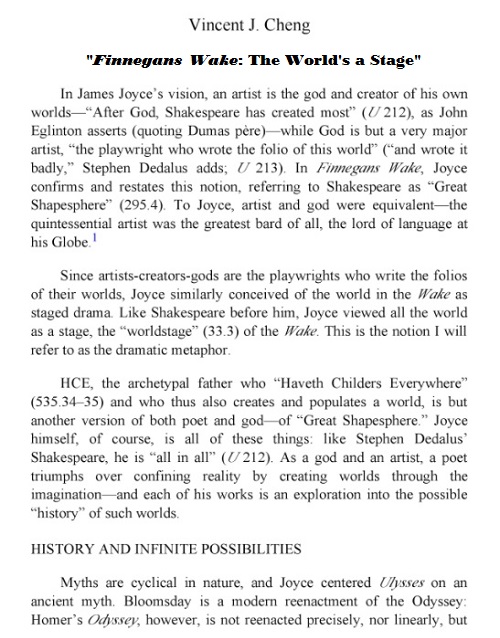
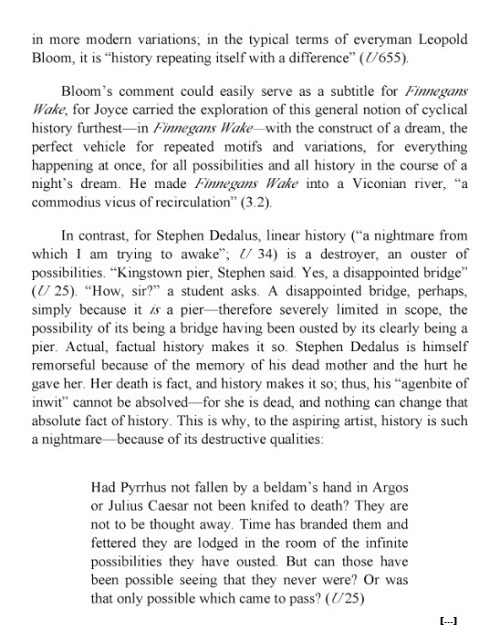
See also Vincent Cheng, ‘Finnegans Wake: All the Worlds’s a Stage’, in John Harty, III, ed., James Joyce’s Finnegans Wake: A Casebook (NY: Garland Press 1991), rep. edn. (London: Routledge 2015), 234pp.; pp.99-[114] [Source: Google Books - online; accessed 02.12.2017; longer extracts in image-form available at Ricorso > Library > Authors > Joyce > Crticism - as attached.]
[ top ]
Thomas C. Hofheinz, Joyce and the Inventions of Irish History: Finnegans Wake in Context (Cambridge UP 1995): ‘The Free State thereby enshrined as law the predicament that appears again and again throughout Joyce’s fiction: Irish homes in which fathers crippled with alcoholism, impotence, and rage beat, neglect, or drive their wives into states of enervation and despair and throw their children to the wolves. Joyce agreed with De Valera that the foundation of Ireland is the patriarchal family, but that concept for him was one laced with horror and outrage. / The awakening of Ireland into modernity is thus wedded in Joyce’s last novel to a resurgence of patriarchy, the primary organising principle of metaphysics and social formation in the Western world. An Irish father’s accountability or lack of it, evoked in jagged edges of narrative expressing the patriarchal order’s knots of contradiction and pain, laces upward through the blindness of Irish habit into the historiography of Finnegans Wake, an anamorphosis waiting to materialise behind the screen of historical discourse. [... &c.]’ (p.38.) [Cont.]
Thomas C. Hofheinz (Joyce and the Inventions of Irish History, 1995) - cont.: ‘Irish historians of the late colonial era, in their question to resurrect a lost Ireland that would clarify their living present, sought to decipher the epitaph of an Ireland buried alive. The crytology involved in topological history - the working backwards from the scattered topoi of a shattered past - depends upon the logic of a crypt, a hidden space where one seeks to wake the dead. The writing of history, though, obviates such a question. Writing cuts the epitaph for the past’s translation into the present. Whether Irish historians and antiquarians of the late colonial period read ancient Irish documents in the “original” or in English translation, they affirmed the destruction of the Irish Gaelic they sought. Such a loss of the Irish past through inscription may be the reason why Joyce cited Thomas Moore’s Irish Melodies both by Moore’s titles and the names of the Irish airs to which his poems were adapted. [...] the search to find concrete centres for Ireland’s competing names and claims, consequently gave oppsoing Irish parties common mode of reference, a mutual agreement ot encrypt the present in topics of the past.’ (p.73.)
Thomas C. Hofheinz (Joyce and the Inventions of Irish History, 1995) - cont.:‘Gabriel’s vulnerability to the Irish dead on his journey west is precisely what Stephen Dedalus attempts to avoid on his abortive journey East to the European continent. [...] Joyce’s insistence that Ireland either wake up or lie down in the grave forever is not so much a scornful dismissal of his country as it is a concise utterance of the question raised throughout his work with irony and compassion: the difference between a wake and an awakening, between locating oneself in the past and finding oneself in the present, depends upon an existential assessment of names and claims wound into one’s identity.’ (p.73; for longer extracts, see RICORSO Library, “Major Authors”, James Joyce, infra.)
[ top ]
Joep Leerssen, Remembrance and Imagination: Patterns in the Historical and Literary Representations of Ireland in the Nineteenth Century (Cork UP/Field Day 1996), ‘Conclusion: How Time Passes in Joyce’s Dublin’ [pp.224-31]: ‘There can be no stronger contrast than between the stagnant Dublin of Dubliners and the vibrant Dublin of Ulysses. Joyce himself appears to revel in the depiction of a Newtonian Dublin, where time and space coexist in a physical, dynamic relationship, dominated by movement and crisscrossing trajectories through space and time, where space divided by time equals speed. This Dublin he constructed with the quintessential organizing tools of space and time: a map and a watch, dovetailing Nebeneinander and Nacheinander in what is fittingly the book’s central episode: The Wandering Rocks. [sic; quotes Frank Budgeon on Joyce’s use of a map and time measures in the chapter.] That episode, set squarely in the middle of Bloomsday and of Ulysses, opens with, precisely, a Jesuit, the superior, the very reverend John Conmee, S.J., resetting his smooth watch - one of the central images in the entire work. If the description of Dublin is fragmented and cubistically broken up (Luke Gibbons speaks quite rightly of a ‘montage’ technique ), the effect is not so much to represent an alienated, fractured state of affairs or state of mind, but rather to celebrate the multifarious and complex ways in which the various elements of this Newtonian universe interact, cross paths, gravitate, attract and repel each other. (p.228.)
Joep Leerssen (‘How Time Passes in Joyce’s Dublin’, 1996) - cont.: ‘It is in this sense of dynamism and movement, and the insistent use of physical clock-time, that Dublin is rendered a metropolis, an omphalos indeed, the quintessential twentieth-century city: a centre rather than a periphery, and quite redeemed from its stagnation and paralysis as described in Dubliners. If Ulysses signals the triumph of modernism, it is marked, not only by its verbal ingenuity, its redefinition of the relationship between content and form, and its irreverent play on conventions, but also because it is placed in direct proximity to the rest of the world-at-large, and abandons, with a palpable sense of release, the ingrained nineteenth-century patterns of the realist, allochronic representation of Ireland.’ (p.228.)
Joep Leerssen (‘How Time Passes in Joyce’s Dublin’, 1996) - cont.: ‘The great originality of Joyce is that he dared to describe an Irish setting in terms of its normalcy - for that was precisely the quality which all earlier authors, whatever their persuasions and sympathies, had denied Ireland. It took, then, one of the greatest innovatory geniuses in European literature to break through the mould of the ingrained discourse of marginality and allochrony which had dominated and suffused the representation of Ireland. In retrospect, that fact makes clear how very protean and all-pervasive that mode of imagining Ireland had been in the nineteenth century; and even today its abiding influence remains noticeable. The acknowledgement of normalcy is still very rare in Ireland-related discourse.’ (p.231.)
Joep Leerssen (‘How Time Passes in Joyce’s Dublin’, 1996) - cont. [Conclusion, n.3; p.288): ‘One occasionally hears counter-interpretations of the effect that the “journey westward” which Gabriel finds himself forced to to undertake is “A Good Thing”, a necessary return to reflect on first principles. This attempt togive a more positive nationally Irish reaing to Joyce appears distortive. It turns the story at cross-purposes, against the general theme of Dubliners, against Joyce’s personal penchant for a masochistically sentimental indulgence in marital jealousy, against his Ibsenitish [sic] enthusiasm eviced at the time, against his endorsement of Synge and against feellings as expressed in his Trieste lectures that Ireland should be finished once and for all with its morbid and jejune invocation of a dead past. The “journey westward” was eloquently rejected by Joyce himself in his decision to head for the Continent. In that respect, the reading as advanced by John Wilson Foster, Fictions of the Irish Literary Revival [1987], pp.142-47, still hold good, despite different recent interpretations by Luke Gibbons and Emer Nolan. Gibbons sees the final epiphany in “The Dead” as an acceptance by this most urban of writers, of Ireland’s rural, communitarian background; Gibbons juxtaposes Gabriel’s modern, journalistics preoccupations with Gretta’s more communitarian involvement in song and oral communication (Gibbons, Transformations in Irish Culture, Cork UP/FDA 1996, pp.134-37.) Nolan revalorizes Gabriel’s “swoon” as a redemption from his self-centered masculinity, the admission of feminine affect, and a concomitant “resurgence of tradition” relayed “through the figure of the woman and her illicit passion.” (James Joyce and Nationalism, Routledge 1995, pp.24-34.)
[ top ]
Len Platt, ‘Corresponding with the Greeks: An Overview of Ulysses as an Irish Epic’, in James Joyce Quarterly, 36, 3 (Spring 1996): ‘[T]he identification between Ulysses and Homer is not, as some critics have suggests, a subscription to the premier culture of civilised Europe but rather the exact opposite: a h8ilarious subversion of the toruous academic and creative practies by which both the English and the Irish establishments attempted to “correspond” with a culture that for Gilbert Murray embodied “the progress of the human race.” [Murray, The Rise of the Greek Epic, 4th edn. OUP) 1934, p.3.; Platt, op. cit., p.511.) Further: ‘[...] after some account of Murray and Matthew Arnold’s neo-Hellenist outlook]: But the Literary Revival played essentially the same game as the Oxford professors [e.g., Matthew Arnold]. In its aristocratic defense of feudalism, its conceptions of nobility and service, and its attack on modernity, the Revival exposed its elitist and hegemonic roots. The ridiculous pontifications that attempted to transform modern Ireland into ancient Athens, like the English varieties of correspondence, were ideological and fundamentally conservative.’ [Cont.]
Len Platt (‘Corresponding with the Greeks ... &c.’, in JJQ, Spring 1996) - cont: ‘This climate of revivalist Ireland with its Hellenist obsession is reflected throughout Ulysses as a specific revivalist practice so that, for instance, “the revival of ancient Gaelic sports ... for the development of the race” is modeled on “physical culture, as understood in ancient Greece” (U 12.899-901, 900). [...; 518] It is not just at the edges of Joyce’s structure [...] that the issue of correspondence somehow becomes compromised. It is compromised from the very beginning, in the title of the book that is itself Romanised and that establishes correspondence not in terms of consensual tradition but in terms of cultural appropriation. With this title, Joyce disputes the very idea of the cultural thoroughbred from the outset. / Stephen’s discourse on the politics of culture in the early episodes of Ulysses then is hardly self-contained. It spreads into the architectonics of Ulysses and continues in the ridiculously appropriative Bloom/Odysseus parallel. Bloom is neither a Greek nor an Irish Celt but an Irish Jew. He is neither aristocratic nor rural but bourgeois down to his boots and utterly urban. He does not heroically resist the temptations of women; on the contrary, he will go to great lengths for a flash of underwear. He is no displaced traveler, desperate for return, although he does take a pleasure cruise round Dublin bay on a boat called “Erin’s King” (U 4.434). His Penelope is simultaneously his Calypso and his home the prison from which he initially “escapes.” These and many other variants are not simple artistic license; they are far too embedded to be so. Distortion and discordance expose the obscurities, contradictions, and absurdities that are inherent in conventional correspondence. It may be that Bloom embodies some standard of personal heroism held to by Joyce, but this would not be inconsistent with the fact that in every conceivable respect Bloom is a deep affront to the aristocratic notions of heroism and heroic action that were fundamental to the Revival’s version of correspondence with the Greeks. Joyce’s uncomfortably relationship with the Homeric event and Homeric geography is similarly incongruous. [...]’ (pp.518-19; see further extracts under Matthew Arnold, Commentary, supra.)
[ top ]
David Spurr, ‘Colonial Spaces in Joyce’s Dublin’, in James Joyce Quarterly, 37, 1/2 [Dublin and the Dubliners] (Fall 1999-Winter 2000), pp.23-42 [on “The Dead” - remarking that it was completed while Joyce was writing his lecture on Ireland for a Triestino audience]: ‘The idea that nationality might find its reason for being in the transcendent power of art is hardly dreamed of in Gabriel’s philosophy but he nonetheless gives voice to Joyce’s scepticism of a national revival based on nothings of racial and linguistic purity. [... T]he confining atmosphere of the city serves as an exterior manifestation of Gabriel’s “sickness” - the paralysis of a subject trapped between the narrow-minded demands of national sentiment and the profoundly oppressive effects of colonial domination. As a symbol of the latter, Joyce has chosen the “menacing” aspect of the palace of the Four Courts, built by the British architect James Gandon in the 1790s. [...] The menacing appearance of the [...] Four Courts is overdetermined by its domineering architectural form, by its place in the history of colonial violence, and, in the context of Dubliners, but a more far-reaching repression internal to Irish society. Joyce tells his Trieste audience that economic and intellectual conditions in Ireland prevent the development of individuality, that the ‘soul of the country ... is paralysed by the influence and admonitions of the church, while its body is manacled by the police, the tax office, and the garrison” (CW171) [26] This endemic paralysis colors the very landscape of the city.’ (pp.26-27; available online; accessed 12.05.2014.)
Further [noting that ‘the setting of [Gretta’s] long-repressed memory [of Michael Furey] is ‘an almost mythic realm of cultural and linguistic authenticity’]: ‘Here my reading departs from those who equate in political terms the scene of Gretta’s memory with the romantic “Irishness” celebrated by Miss Ivors. On the contrary, it seems that Joyce has juxtaposed those two evocations of the West precisely in order to show the difference between a strident, somewhat hollow political discourse and a narrative so deeply personal that it acquires universal significance. This is not to recuperate Joyce’s story for an apolitical modernist aesthetic but rather to enforce Joyce’s own distinction between a superficial nationalism of “frigid enthusiams” (CW173) and a more profound sense of nationality that transcends ideas of blood and language (CW166). / For Joyce, British dominatoin is only an accessory to Ireland’s self-induced paralysis of the spirit.’ (Ibid., p.28.)
Further: ‘In keeping with the spirit of Dubliners as a whole, the end of the story finds neither resolution nor compensation for the oppressive and alientating features of political and personal life. Rather, it finds deliverance from these conditions only in an elegiac mode, only in thoughts of death.’ (p.29; end sect.)
Further [in reference to “Wandering Rocks”]: ‘Foucault makes the point that circulation is one of the defining characteristics of the modern site, which has superseded the stable, hierarchised, and sanctified notion of place belonging to the Middle Ages; the site is defined by structural relations as in a grid or network and includes “the circulaton of discrete elements with a random output.” such as automobile or pedestrian traffic. The circulation of capital that forms the economic basis of the city has its physical extension in the circulation [32] of life and machines through the city streets. [...; cites Michael de Certeau on the city as machinery and hero of modernity.] The dynamic of the city drives the narrative of Joyce’s work [Ulysses], while it also becomes the principle subject of that narrative.’ (Ibid., p.32-33.)
[ top ]
John Bishop, Joyce’s Book of the Dark: “Finnegans Wake” (Wisconsin UP 1986, 1995): ‘Language must have begun with monosyllables, as in the present abundance of articulated words into which children are now born they begin with monosyllables in spite of the fact that in them the fibers of the organ necessary to articulate speech are very flexible.’ (Bergin & Fisch, eds., New Science [Scienza Nuova], pp.229-31). Bishop comments: ‘[..] in an age whose philosophical authorities were trying to discover how the languages of the gentile nations could have develoed historically from the Hebrew spoken by Adam in the Garden of Eden, The New Science advanced the radical proposition that human language had its beginnings in the minds of infantile first men who growled, whined and whimpered in pleasure and pain like animals in a cave.’ (p.192.) [Available at Google Books online - link or link.]
| Bruce Stewart, ”Joyce at Tara”, in Troubled Histories, Troubled Fictions, ed. C. C. Barfoot, Theo D’Haen, et al. [Costerus NS 101] (Amsterdam: Editions Rodopi B.V. 1995), pp.61-94. |
|
|
—For full-text copy, see RICORSO > Library > Critics > Monographs > Bruce Stewart via index or as attached. |
[ top ]
Luke Gibbons, ‘Allegory, History and Irish Nationalism’, in Transformations in Irish Culture (Cork UP 1996), pp.146-47: ‘It is these restless shades, and the culture of the west imbued with the memory of the dead, which come to haunt Gabriel Conroy in the closing scenes of the story “The Dead”. When the thoughts of Gabriel’s wife, Gretta, turn westwards, opening up an irreparable gulf between them, it is because of her hearing “The Lass of Aughrim” (144; ...). Gibbons also speaks of ‘political resonances in view of tendency to allegorise Ireland as a female’ (idem.) and further: ‘Revenants of the Williamite past’ (145); he notes notes that Joyce spoke of ‘a “double struggle”, the anti-imperialist struggle, on the one hand, and, on the other, an internal struggle “perhaps no less bitter”, between constitutional nationalism and a dissident, insurrectionary tradition beginning with the Whiteboys and passing through the Fenian (IRB) movement.’ (Critical Writings, 1966, p.188.)
Luke Gibbons, ‘Spaces of Time through Times of Space: Joyce, Ireland and Colonial Modernity’, in Field Day Review, 1 (2005), pp.71-86: ‘[...] a question arises here: Is Dublin, or for that matter, the Ireland out of which Joyce emerged as a writer, to be defined solely, or even primarily, in terms of space as conceived by high modernism? Certainly there have been enough studies of geographic and topographical relationships in Joyce, but for the most part they assume the sovereignty of space in Joyce’s imagination, as if Dublin were simply another metropolis like Paris, Berlin or Boston. In Ulysses, Robert M. Adams writes, “Joyce does not seem to have an antiquarian eye for old Dublin”, but is it indeed the case that Joyce’s Dublin is confined to the extended present which modernists claimed to be the product of the spatialised drive of painting and of cinematic form? Is the past simply erased and, thereby, are the disparities of time removed from the public sphere to the domain of what Edmund Husserl referred to as “internal time-consciousness”?’ (p.72.) [Cont.]
[ Note: rep. in Gibbons, Joyce’s Ghosts: Ireland, Modernism and Memory (Chicago UP 2015), pp.165-87
- available at Google Books - online; accessed 17.06.2021.]Luke Gibbons, ‘Spaces of Time through Times of Space: Joyce, Ireland and Colonial Modernity’ (2005) - cont.: ‘At one moment Fr. Conmee is on the Malahide Road; the next he has travelled back in time to his period as rector at Clongowes: but whether the latter is a subjective memory on his part, or an objective flashback, remains unclear as intrusions from the past disrupt the apparently homogeneous spatial form of the present. That the logic of spatial form no longer applies amid the switching currents of time in the “Wandering Rocks” episode is finally evident as the episode draws to a close with the slow procession of the viceregal cavalcade through the opposite side of Dublin. [...]
Further: ‘The breakdown of simultaneity in Joyce’s Dublin, the dislocation of the synchronicity by aberrant senses of time, is nowhere more evident than in the phenomenon of parallax, which Hugh Kenner and others have rightly identified as one fo the key organising (or disorganising) motifs in the novel.’ (p.79.) [Cont.]
Luke Gibbons, ‘Spaces of Time through Times of Space: Joyce, Ireland and Colonial Modernity’ (2005) - cont.: ‘As Bloom understands it, the timeball on the top of the Ballast Office registered Greenwich Mean Time as an aid to shipping and for communications with England, but the clock on front of the building [fig.6] registered Irish (Dunsink) time, which was twenty-five minutes behind London, was established at the Washington Conference in 1884. So while modernity sought to standardise time to facilitate synchronic timetabling at a global level, the imperial connection and the need to facilitate shipping from Britain imposed another time scale on Irish society, undermining that simultaneity. [Gibbons quotes Dipesh Chakrabarty, Provincialising Europe (2001), and Max Horkheimer, Critique of Instrumental Reason (1994)] (p.80.) [Cont.]
Luke Gibbons, ‘Spaces of Time through Times of Space: Joyce, Ireland and Colonial Modernity’ (2005) - cont.: ‘The paradox here, however, is that in the very sundering of the past from the present, new media technologies such as cinema also created - or articulated - ways of reliving memory with unprecedented, almost visceral immediacy. the issue here is not one of residual traces of the past: the remnants from other eras whcih have survived into the present, like the herding of those chattle through the streets of Dublin for the boat to Britain whcih the mourners at Paddy Dignam’s funeral momentarily glimpse on their way to Glasnevin. As Chakrabarty points out elsewhere [Habitations of Modernity, 2002], to speak of the “survival” of such practices is not to challenge “stagist” or stadial theories of progress, for it is clear that their days are numbered; they can “be seen as leftovers from an earlier period, still active, no doubt, but under world-historical notice of extinction.” (Habitations, p.12.) By contrast, the instablities of time that surface in Joyce’s Dublin inhabit public space and co-exist with, or may even be actively produced by, the dislocations of colonial modernity.’ (p.83.) [Cont.]
Luke Gibbons, ‘Spaces of Time through Times of Space: Joyce, Ireland and Colonial Modernity’ (2005) - cont.: ‘The alternative histories with which Ulysses abounds (many of which trace the genealogy of an independent Ireland) were still part of a contested public sphere in Ireland, and were not therefore in a position to accept their relagation by modernism to private, pyschological space. Rejecting Kern’s assertion of a clear boundary between inner and other worlds, public and psychological space, the new mass media infiltrated not only the conscious but even the unconscious, leaving little space beyond the reach of art. [Cites Stephen Kern, The Culture of Time and Space, 1880-1918, Harvard 1983, espec. pp.60-64.] It is not even a matter of finding in the public sphere the equivalent of trauma, or related notions of “involutary memory” that are normally allocated to personal experience; rather, the true measure of psychic dislocation under colonial modernity is that both public and private are permeable, and that the unrequited past comes across with the lived intensity of experience. Whatever about the ahistorical triumph of space over time in metropolitan modernism, in Ulysses space, both outer and inner, is historicised through and through. This is the true nightmare of history to which Stephen bears witness: “Fabled by the daughters of memory [...] one livid flame. What’s left to us then?” (ref. Ulysses; end].
Luke Gibbons, Joyce’s Ghosts: Ireland, Modernism, and Memory (Chicago UP 2015): ‘To ask if the ghosts [in “The Dead” literally exists is to miss the point, for it is exactly the equation of literalism with truth that is being called into question.’ (p.6); ‘If the dual voice of free indirect discourse makes it difficult [...]’ (idem.)
See also Chap. 3: ‘“He Says No, Your Worship”: Joyce, Free Indirect Discourse, and Vernacular Modernism’, 79-102.‘Joyce’s use of free indirect discourse was no doubt indebted to distinguished precursors such as Flaubert, but its most distinctive for it is closer to [...]’ (p.81); ‘Free indirect discourse was used by Jane Austen, Gustave Flaubert, Henry James, and others to ventriloquize the inner thoughts of characters [...] (p.91); ‘There is nothing inherently emancipatory about the use of the device [...]’ (p.101.)
[ top ]
James H. Murphy, Catholic Fiction and Social Reality in Ireland, 1873-1922 (Conn: Greenwood Press 1997), ‘Intelligentsia Fiction, 1900-1922’ [Pt. II]: ‘Joyce’s fiction offers the most subtle version of non-intellectual discourse in Catholic Ireland. For him, discourse within Catholic Ireland is a matter, not of the interplay of arguments, but of the exchange of what might be termed theological anecdotes, maxims, and metaphors whose purpose is to secure loyalty and reinforce an emotional identification, rather than to establish a reasonable case. A version of this process is to be found in “Grace”, the penultimate story in Dubliners (1914; refs. to Penguin Edn. 1992). In their efforts to persuade Kernan to agree to attend a retreat for businessmen in Gardiner Street Church, Power, Martin Cunningham and M’Coy try to enmesh Kernan in the web of anecdotes, maxims and metaphors on which their own faith is based in the hope that it will reinforce Kernan’s commitment. It turns into a form of anecdotal guerrilla warfare. Cunningham begins with a maxim, “The General of the Jesuits stands next to the Pope”, and later backs it up with an anecdote, “Every other order in the Church had to be reformed at some time or other, but the Jesuit Order was never once reformed. It never fell away.” (Dubliners, p.163) / However M’Coy’s maxim, “The Jesuits cater for the upper classes”, inadvertently allows Kernan to counter-attack with a remark about “those secular priests, ignorant, bumptious”. Nor is Cunningham able to retrieve the situation with his complacent, damage-limitation maxim, “The Irish priesthood is honoured all the world over.” (Dubliners, p.163). Kernan presses home his counter-attack in the middle section of the persuasion, when the conversation turns to Fr. Tom Burke, the famous preacher. Cunningham repeats rather vague generalisations about him to the effect that “he wasn’t much of a theologian [... &c.]”.’ [Cont.]
James H. Murphy (Catholic Fiction and Social Reality in Ireland, 1873-1922, 1997) - cont.: ‘In the end Cunningham persuades Kernan into going to the retreat with the pièce de résistance of theological anecdotes of religious loyalty and submission, the apocryphal story of Archbishop John MacHale [sic] of Tuam’s submission to the doctrine of papal infallibility in spite of his reservations about it.’ Murphy later remarks: ‘It is an irony of intelligentsia fiction that characters seeking to change Catholic Ireland by means of reason generally ended up railing against it, the transition from reason to emotion marking Catholic Ireland’s victory against them. In the end they renounce their attachment to Catholicism. Joyce’s A Portrait of the Artist as a Young Man (1916) deals with the processes that end in extreme rejection of Irish Catholic identity.’ (pp.144-45.) Murphy identifies the dinner-table argument over the treatment of Parnell by the Church as ‘the locus classicus for the rejection of Catholic Ireland in Joyce’s novel [A Portrait]’ (p.145.) Further: ‘In this passage of the novel competing anecdotes and maxims, which deteriorate into crude slogans and even cruder name-calling, mark a characteristically emotional polarisation in which each side tries to exclude the other from participation in Irishness.’ (pp.145-46.)
[ top ]
R. F. Foster, W . B. Yeats: A Life - I: “The Apprentice Mage” (OUP 1997), ‘National Dramas 1901-1902’ [Chap. 10]: ‘[...] Joyce had already made his mark with a clear-sighted attack on the Irish Literary Theatre in “The Day of the Rabblement”, but he passionately admired WBY’s literary achievement: he could recite “The Adoration of the Magi” off by heart and the mesmeric beauty of certain poems (notably “Who Goes with Fergus?” from The Countess Cathleen) remained canonical for him. After glamorous but slightly scandalous career at the Royal University, he was following a haphazard course as a medical student. In October Russell told him that WBY would be in Dublin the following month and would like meet him (he [?Joyce] had already dined at the Nassau Hotel on 4 November with Gregory and JBY). There was accordingly a rendezvous outside the National Library, followed by an awkward encounter in an O’Connell Street café. It was an intense occasion, much recapitulated and mythologized; [Richard] Ellmann compared it to the meeting between Goethe and Heine, a symbolic conjunction in the history of world literature. More immediately apparent was mutual suspicion between an established Irish Protestant aesthete and a Jesuit-educated Catholic Dubliner with a preternaturally mordant eye for social pretensions. Soon afterwards WBY wrote (but never published) a slightly fictionalized account of their meeting. “He asked me ‘Why did I make speeches? Why did I concern myself with politics? Why had I given certain of my stories and poems a historical setting?’. All these things were a sign that the iron was getting cold.” Joyce’s own affiliations and energies were strange to him; WBY realized that he was dealing with a new force, something that could not be predicted. His version betrays the wistful tone of a man nearing forty, confronted by the ruthlessness of youthful genius. “Presently he [got] up to go, and, as he was going out, he said, ‘I am twenty. How old are you?’ I told him, but I am afraid I said I was a year younger than I am. He said a sigh, I thought as much. I have met you too late. You are too old.’”’ Joyce in later years denied this, but at a stage of life when good manners meant to him than they did in 1902. Their disagreement was inevitable. One of the points WBY recalled making to Joyce involved a defence of folklore against the “sterility” of urban culture, Great Memory against individual consciousness. Joyce’s lofty and laconic reply rankled enough for WBY to repeat it more than once. ‘Generalizations aren’t made by poets; they are made by men letters. They are no use.’ (p.276; see longer extract in Ricorso Library, “Criticism / Major Authors” - James Joyce, infra.) [Note that Foster revises the date of the meeting from early October, as it is given in Richard Ellmann (James Joyce, 1959, 1982), to early November.]
[ top ]
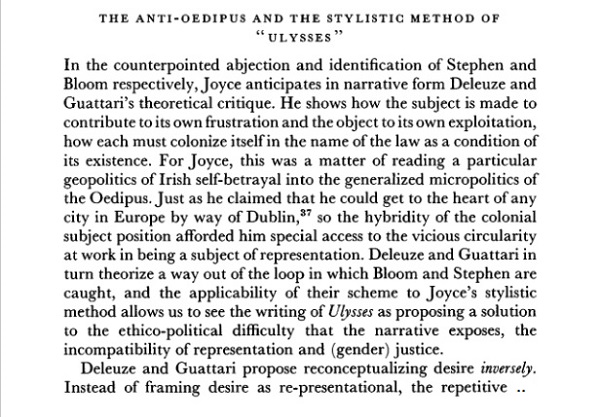
Joseph Valente, James Joyce and the Problem of Justice: Negotiating Sexual and Colonial Difference (Cambridge UP 1995):
[...] The self-styled juridicial structures of the whiteboys, the Repeal Association, the Land League, the tellingly named Sinn Fein (Ourselves Alone) aimed at securing a home not only in the sense of a self-determining Irish nation but in the sense of a stable, cohesive, more or less monolithic community organized around a single value and belief sysem: the moral economy in the eighteenth century, a Catholic Irish-Ireland in the nineteenth. Not just an Ireland free of the invader, then, but an Ireland purged of internal dissonance, not to say difference, as well. While this exclusionary tendency is the legacy of the internal ethnic and sectarian strife produced by colonial plantation, its reach extended from questions of racial and religious overtones, and from there to any stirring that did not conform with the stipulated community norm. The whiteboys’ opposition, the underground activities of other groups, the Repeal [34] Association’s vexation with the Young Ireland movement, Sinn Fein’s provocation against the national theatre and the Anglo-Irish Literary Revival, in each case the speaking of a certain metropolitan differend turned into the silencing of another under the aegis of the one “true” community. Even as these extrajuridicial institutions re-marked the fundamental hybridity of the colonial condition, they tried to refute or eradicate that hybridity, to secure an ‘internal’ peace, only to reproduce that hybridity, once more “at the outskirts”. |
|
|
|
| —Partially available at Google Books - online; accessed 30.11.2017]. |
[ top ]
Richard Bradford, Stylistics (London: Routledge 1997): ‘Joyce’s Finnegans Wake (1939) is the archetype and extremity of modernist writing. It invokes and unsettles practically every stylistic convention of literature. Finnegans Wake is generally perceived to be a novel, but it is extremely difficult to make any of it conform to the structural frameworks that define the genre. There is a narrator, but this presence is defined not in terms of his/her control of focalizing angles, descriptive methods, use of time and space or deployment of reported speech: rather, the narrator is the style of the entire text. Moreover the style is without precedent in literary or non-literary discourses. It is poetic in that it constantly unsettles familiar lexical and referential patterns with portmanteau words which connote geographical, mythical, literary and historical registers, and it supplements this with extra-syntactic sequences of assonance and alliteration. It is difficult in “Prufrock” [of T. S. Eliot] to disentangle the literary from the non-literary registers; in Finnegans Wake it is impossible. No referential framework or deictic structure remains secure for long enough to establish itself as the background to a stylistic pattern. / There is some evidence to associate the narrator with a Mr Porter who might be giving an account of his dream, in which he [163] takes on the role of a textual dreamself called Humphrey Chimpden Earwicker [...] A key element in any stylistic analysis is the identification of a centralizing focus on perspective but in Joyce’s text this putative presence is effectively absorbed into the continuously shifiting stylistic fabric. [Here quotes ‘Sir Tristram violer d’amore ... penisolate war’] It is impossible to find a framework of broad narrative structuring that will allow us to specify in Perry’s terms the “various data of the text” [...; paragraph follows exploring above quotation.] The extract seems to satisfy Jakobson’s definition of the poetic function, which “projects the principle of equivalance from the axis of selection into the axis of combination”. The selective axis is never at rest. Joyce is always inventing unusual lexical and semantic constructions (connoting a vast framework of references) [164] which will react with other equally unexpected projections along the syntagmatic, combinative chain. In fact, the syntagmatic deep structure is the only stable element in the book.’ (pp.163-65.)
[Bradford, Stylistics, 1997] - cont.: ‘In the passage quoted the ambiguities occur predominantly within the noun phrases and qualifying clauses. The main verbs establish clearly enough that Sir Tristram is moving from North America to Europe [recte Amorica = Brittany]. There is a close similarity between Joyce’s use of a syntagmatic deep structure as the basis for multiple, alternative meanings and poetic double pattern. However as we have already seen, Riffaterre has pointed out that such a multi-layered fabric in a sonnet would overload the cognitive faculties of the reader. If it requires a “super-reader” to simultaneously apprehend, let along naturalize, the formal and referential complexities of fourteen iambic lines, what kind of being would be able to follow the same textual densities for 500 pages? Finnegans Wake is, as Barthes claims, a “space of writing to be ranged over, not pierced; [it] ceaselessly posits meaning, ceaselessly to evaporate it” carrying out a systematic exemption of meaning (Lodge, ed., Modern Criticism and Theory: A Reader, Longman 1988, p.171.) It is impossible, in Perry’s terms, to find “a system of hypotheses or frames which can create maximal relevancy among the various data of the text” (Menakhem Perry, ‘Literary Dynamics: How the Order of a Text Creates Meanings’, in Poetics Today, 1, 1979, p.31.) All that of the known systems and frames of stylistic analysis - focalization, grammars of narrative, Jakobsonian poetics - are effectively dismantled by the text’s endless interweavings of device and meaning. / Barthes’s model of naturalization - or rather the impossibility of objective naturalization - is valid for Finnegans Wake, but Perry’s model is applicable to the vast majority if conventional texts and indeed for many works - such as our other examples from Joyce, Williams and Eliot - in the modernist mainstream. The opposition of the two models provides us with an intriguing perspective on the progress and quite possibly the terminus of literary history.’ [Cont.]
[Bradford, Stylistics, 1997] - cont.: - cont.: ‘In Finnegans Wake the only recognizable feature that the text shares with non-literary discourse is the syntagmatic deep structure. [165] The rest is a dense saturation of semantic parallelism, referential echoes and unresolved ambiguities;: the literary dimension almost displaces its non-literary counterpart. Verse such as Williams’s shifts the balance in the opposite direction: its recognizably poetic features subtly shadow and deflect the predominantly non-literary improvisational structure of the text. / To shift the balance any further in either direction would be to destroy the double pattern. [...] Modernism is effectively the terminus of literary history, by which I mean that the limits of the double pattern have now been established in literary texts. before modern the vast majority of literary writings worked within these limits. The eighteenth-century novel explored ways in which established non-literary styles and functions could be organized within th eevolving structures of fictional narrative. The objective was to bring these features together, and the eventual reslt was the nineteenth-cneuty classic realist novel. Two centuries of establishing balances and symmetries with the double pattern (with slight abberations by the likes of Sterne) gave way in modernism to a culture which tested the relationship between literary and non-literary registers, from the informal transparencies of stream of consciousness to the dense, literary excesses of Finnegans Wake. (...; p.166.) The terminus of liteary history does not preclude further stylistic experimentation [..]’ (pp.165-66.] (See also Bradford’s redaction of Colin MacCabe’s theory of Victorian fiction - as infra.)
[ top ]
Christine Van Boheemen, ‘Joyce’s Sublime Body’, in Vincent J. Cheng, et. al., ed., Joycean Cultures/Culturing Joyces (Delaware UP; AUP 1998), writes of Joyce and ‘the pain of linguistic dispossession, of the radical severance at the point of origin that belongs to growing up Irish’ (p.23): ‘‘The avoidance of pain, or death, or disfigurement, the awareness of mutability and embodied existence in general, would seem itself a characteristic feature of late-twentieth-century culture. This narcissism is, in turn, a form of belated complicity with Eugene Jolas’s proclamation of a new linguistic reality. His “new artist of the word,” recognizing the “autonomy of language,” had “hammer[ed out] a verbal vision that destroys time and space [Eugene Jolas, “James Joyce and the Revolution of the Word”, in Our Exagmination [ ... &c.], 1929, NY 1972, p.79.]. Even Joyce himself (and not just Stephen Dedalus) might be understood as a votary to a poetics of linguistic transcendence in desiring a “language which is above all languages, a language to which all do service,” [Richard Ellmann, James Joyce, 1982 Rev. Edn., p.397] betraying the dream of an ahistorical language, unmarked by difference or local embodiment. Finnegans Wake may well be considered the product of such an idea of language - an essential image beyond national language, time, and space; but its complex textuality also forces the reader to the realization that language cannot do mute service to the projection of a transcendent, disembodied subjectivity. It constantly rubs the reader’s nose in his or her limitations as a reader, and in our imprisonment in the linguistic web. Read with awareness, Finnegans Wake is a cure for narcissism. It forces even non-native speakers of English into reading it out loud with an Irish accent. / What strikes me as ironic is that the more pressing and clear this pedagogy becomes, the more that same text seems to serve as fetish to alleviate the very castration anxiety that it evokes and illustrates. It provides an ideal playground in which to forget that, for all its linguistic display, even Finnegans Wake is the product of flesh, blood, sweat, and pain - no creativity, especially not such obsessive creativity, without pain. In what follows, I have chosen to try to articulate the, obsessiveness of Joyce’s engagement with language - in connection with his obsessive fascination with speech about the body - as a symptom of loss, a record of trauma.’ (pp.23-24; for longer extracts, see Ricorso Library, “Criticism”, infra.)
Jean Kimball, Odyssey of the Psyche: Jungian Patterns in Joyce’s Ulysses (Southern Illinois UP 1997): ‘Ulysses is a book without a hero but with two protagonists who are together its subject. It is a critical truism that Stephen and Bloom are opposites, but together [...] they represent Joyce’s vision of the artist as a divided self working towards integration.’ (p. ix.) Further: ‘In Ulysses Joyce split his autobiographical subject into two opposite persons, each of whom could reveal a part of the contradictory truth about himself. A Portrait had traced the development of Stephen, the self-conscious artist of Joyce’s original conception of his autobiographical fiction. The 1909 experience, however, including both the unfounded jealousy and its aftermath in the pornographic letters, which wallow in the excremental language and mawkish sentimentality at the same time, had revealed to Joyce, as an essential part of his true personality, “those poisonous subtleties which envelop the soul, the ascending fumes of sex”, which he associated with the modern theme. Stephen simply could not encompass the whole, for this realm of Joyce’s psyche does not belong to the artist-self that has been developed through Stephen in A Portrait, a basic incompatibility that Joyce must have realised when he attempted to attach this particular “poisonous subtlety” to Richard Rowan.’ (p.39.)
Gerry Smyth, Decolonisation and Criticism: The Construction of Irish Literature (London: Pluto Press 1998): ‘Joyce’s work is parodic, as many have remarked. But it is a subverse parody in which he has seized the rules of dominant decolonising discourse and disrupted what he sees as its flawed identitarian message. The creative artist cannot escape the languages of liberal and radical decolonisation; [83] indeed, Joyce does not actually want to “escape” them as he remains affiliated to a certain notion of Irishness which can only be imagined in terms of those discourses. However, by exposing them as discourses, as formal and historical organisations of signs, he can displace them so as to ward off, at least temporarily, the disabling structures into which they are locked. And the most disabling structure which Ulysses exposes is Irish literary criticism and the twin assumptions upon which it rests: a natural link between culture and nation, and a natural aporia between the primary (imaginative) and secondary (critical) discourses.’ (pp.83-84.) [Cont.]
Gerry Smyth (Decolonisation and Criticism, 1998) - cont.: ‘Joyce’s resistance to Irish decolonisation takes the form of a challenge to a tradition of literary criticism organised around the notion of an indissoluble link between national culture and nationalist politics.’ (p.87.) Further, ‘In so far as he was an Irish writer, Joyce was a radical critic of English domination of Ireland; but in so far as he refused the limitations of both Irishness and Englishness, he managed to incorporate both these categories into a writing practice which itself refused incorporation into any dialectical discourse predicated on a subject who, like the critic, purports to stand outside his own constitution in discourse. After Joyce’s revolution of the word and [87] Ireland’s revolution of the sword, both the role of the national subject and the function of a critical discourse in which such a subject was constituted had to be renegotiated.’ (pp.87-88.)
[ top ]
Denis Donoghue, ‘Ireland, Race, Nation, State’ [Part 1], in Partisan Review, Vol. LXVI, No. 2 (1999), pp.223-34: There is no reason to think that he is being ironic at Stephen Dedalus’s expense when he has him exclaim: “I go to encounter ... race.” It is possible to read that declaration ironically, but the irony soon becomes ashamed of itself.’ (p.229.)
See also Donoghue, The Ordinary Universe (London: Faber 1967): In this study Donoghue tests authors according as their work is answerable to the integrity of the actual world rather than their author’s personalities. By this standard, he finds that Dubliners is respectful of Joyce’s world and his material; in A Portrait, Stephen’s subjectivity is allowed too free a rein; in early chapters of Ulysses, a magnificent recovery is made, but the novel gradually and irreversibly loses focus while Joyce’s interests are not primarily represented by such words as character, life, relation and so forth’; by Finnegans Wake, finally, ‘the mind is detached from its responsibility to things.’ (pp.63, 64.) Donoghue concludes that Joyce ‘is not in trouble, he is in sin, the sin of pride’ (Ibid., p.308). See summary given by Terence Killeen, in ‘Ireland must be Important ...’, in Joyce Studies Annual, 2003, pp.18-36.)
| Denis Donoghue, review of Hans Walter Gabler’s digital edition of Ulysses (1984), in London Review of Books |
|
Joyce’s Ulysses was published on his 40th birthday, 2 February 1922, in a limited edition of 1000 numbered copies. The text was full of misprints, as Joyce irritatedly knew. As late as November, he had been tinkering with the last chapters, getting further detail from Dublin - ‘Is it possible for an ordinary person to climb over the area railings of No 7 Eccles Street, either from the path or the steps, lower himself down from the lowest part of the railings till his feet are within 2 feet or 3 of the ground and drop unhurt?’ he wrote to his Aunt Josephine - and the galleys were demanding attention he couldn’t give them. On 6 November he complained to Harriet Shaw Weaver that ‘working as I do amid piles of notes at a table in a hotel I cannot possibly do this mechanical part with my wretched eye and a half.’ He evidently decided that he couldn’t do much about the printer’s errors in time for the birthday, but he hoped they would be corrected ‘in future editions’. [/...] Gabler’s aim has been ‘to uncover and to undo the first edition’s textual corruption’. His main principle has been to distinguish ‘the documents of composition’ - which he regards as authoritative, unless they can be shown to be faulty - from ‘the documents of transmission’ - which he regards as potentially faulty, unless they can be proved to be authoritative. So Joyce’s autographs are separated from the typescripts, the serial versions in the Little Review and the Egoist, the proofs of the first edition, and the first edition itself. But the distinction is hard to maintain, since transmission becomes composition as soon as Joyce tinkers with it. In any case, Gabler has tried to assemble, as his copytext, ‘a continuous manuscript text for Ulysses, extending over a sequence of actual documents’. His principle is a narrative one, as if he were reconstructing a story. Or an archaeological one, deducing a complete structure from related fragments. In the new edition, the left-hand pages record the entire history of each word and accidental, so far as it can be established and indicated by a complicated system of notation: the right-hand pages give the clean text of the book without interruption or comment. Textual explanations and justifications are set out at the end. I’ll give a few examples, in a minute, of the differences the new edition makes. But it’s worth saying at once that they’re not merely a matter of correcting ‘Steeeeeeeeeephen’ to ‘Steeeeeeeeeeeephen’ in the Telemachus chapter and ‘Pprrpffrrppfff’ to ‘Pprrpffrrppffff’ in the Sirens chapter, as Craig Raine pretended to think a few weeks ago in the Sunday Times. If you are totally indifferent to misprints, you won’t even consider buying or otherwise consulting the new Ulysses. ‘On the whole,’ Raine claimed, about misprints, ‘I couldn’t give a fuppenny tuck.’ Not even if the botched printing were of his own verses? More to the point: suppose it were discovered that the printing of Paradise Lost is botched, with lines and half-lines dropped, wouldn’t English poets, critics, and common readers agree that a new edition should be produced, especially if the hard labour involved were to be done, as it probably would be, by German or American scholars? [/...] |
| —For long extract, see under Donoghue > infra. |
[ top ]
Michael Malouf, ‘Forging the Nation: James Joyce and the Celtic Tiger’, in Jouvert: Journal of Postcolonial Studies [Special Irish Issue], 1, 4 (Fall 1999): ‘[... The] production of a symbolic autonomy is even more pronounced with Joyce’s image which appeared in 1993, around the same time that Ireland was preparing itself for inclusion in the European Union and the common currency. Like the mostly middle-class emigrants returning to work for the Celtic Tiger, Joyce, too, has returned from his exile. On the front side there is a contented image of Joyce with Howth hill next to his head. On the other, non-Gaelic side there is an image of Anna Livia and a quote from that most cosmopolitan of texts, Finnegans Wake, superimposed over a map of Dublin. The two sides of the ten-pound note illustrate Tom Nairn’s celebrated description of the ambivalence of nationalism as “Janus-faced”: one side healthy, rational, modern; the other side morbid, irrational, ancestral. On one side there is Joyce as the face of modernity, liberal democracy, postnationalism; on the other, Anna Livia, Celtic ethnicity, and the “mythic-realism” of Dublin. It is ironic that Joyce, who created in the Circe chapter of Ulysses a critical demystification of commodity fetishism, has become such a magical object himself. But the relevant text here is A Portrait of the Artist as a Young Man as the state-sponsored image is that of the reified Artist “above and beyond his creation, paring his fingernails.” Not that this is without any ambivalence. The green-shaded portrait with its calm demeanor and half-smile replaces the notoriety of the blasphemous artist for a kinder, gentler figure. In fact, juxtaposed with the “mother language” and a traditionally feminized landscape, Joyce as a patriarchal, castrating figure is removed once he is reconstituted as a national symbol. Phrases such as “simpering, genial figure,” and “avuncular and mawkish,” describe the “wry grin” which appears in Robert Ballagh’s portrait. It is as if Ballagh, a well-known Irish artist and Republican activist (he has been accused of being the “arty wing” of the IRA), had reinvented Joyce for the pounds note. While this neutered image is a response to the contradictions of using the heretical Joyce as a national icon, the portrait also makes an historical argument by erasing the critical status that comes with exile. While the dates under his portrait, 1882-1941, suggest that his lifetime encompassed the major events of Irish history in the twentieth-century, they repress the fact that he was absent for all of them. Yet it is precisely this absence that marks Joyce’s social value; he is valued for transcending traditional sectarian divisions rather than for expressing a critical perspective by virtue of his exile. And while he is made uncontroversial within Irish history, his value as a Modernist hero is sanctioned from Europe. Even the new pounds note was accused by one dissatisfied customer as merely “in the mainstream of the contemporary currency design” and, in replacing the earlier, more unconventional designs were meant to “bring us into line with Europ” (Paul Hogan, ‘New Banknotes and Old’, letter to Irish Times, 9 May 1994, p.17). Thus, just as paper money receives its value against an external measure, so Joyce’s social and economic value comes against a European standard.’ (Available online; accessed 11.10.2010.)
Terence Killeen, review of James Joyce, Occasional Critical and Political Writings, ed. Kevin Barry [Oxford World Classic] (OUP 2001), in The Irish Times (3 March, 2001), calls Joyce’s essays on “Art and Life” and “Mangan” ‘a fine illustration of Oscar Wilde’s dictum on the importance of seeing the object as in itself it really is not. Joyce needed a safe precursor figure, a prophet, and Mangan conveniently filled the bill. These pieces should be read in conjunction with Stephen Hero and A Portrait of the Artist as a Young Man; when they are they fill perfectly. They are continuation of fiction by other means.’ [Note that they both of course ante-dated those writings.] Killeen remarks that Joyce was a ‘hopeless reviewer’ who gives the ‘impression of a determined withholding of personal involvement, a refusal to engage with the works under review’. He quotes Joyce on the Ireland of the literary revival as ‘a land almost fabulous in its sorrow and senility’. Of the Triestine pieces: ‘those who have wished to promote a nationalist view of Joyce have been happy to use them as evidence, but there is a great deal of ambiguity in what the pieces actually say [... a]long with a more passionate ambivalence towards the Irish themselves and the mess they have got themselves into.’ He concludes, ‘no coherent political or ideological stance can really be taken from this very mixed bag.’ Killeen notes that the editor refers to distortion of readings seeking for a political message; commends Barry’s introduction as valuable in tracing the ‘complex process whereby Joyce, in his Triestine writings, began to liberate himself from the fixed antinomies and stereotypes that were the norm of Irish history and to embark on a process of crossing-over and inversion of such antinomies that he took much further, in his creative work’.
Conor McCarthy, Modernisation, Crisis and Culture in Ireland, 1969-1992 (Dublin: Four Courts 2000), summarising the remarks of Seamus Deane: ‘Deane demonstrates Joyce’s difference from Arnoldian cultural liberalism, which embraced the Hellenisation of England and the Celticisation of Ireland. To reject the latter is also to reject the former, and this is what Joyce achieved. He famously had no time for the Celticism of Yeats and the Revivalists, but he also saw that it was derived from Arnold’s opposition of Hellen[ic]istic and [British?] culture. In Joyce’s repudiation of Celtic heroicism, essentialism, even racism, he was at the same time effecting a critique of the Arnoldian idea of culture as discourse that could help bind the English middle classes to their poorer countrymen. To this extent, Joyce becomes an anti-hegemonic writer, since Arnold was never less than sure that culture was a force for the state, the state being the material manifestation of man’s best self.’ (217.)
Patsy McGarry, ‘Once a Catholic, Always’ (The Irish Times, 16 June 2001), raises the question whether James Joyce died a Catholic on the basis of the belief held by his siser Gertrude Mary Joyce, who lived as a Mercy nun in New Zealand and received letters from Joyce, destroyed at her death. Joyce saw her off at Kingstown in 1909, when she took the surplice he had worn as a boy. She held him to be the most religious of the family, claiming that he never read [books] during Lent, and called him the inspiration of her own vocation. She received a call from a Jesuit on the death of Joyce in 1941, telling her that he died with a priest in attendance. The informant is a Fr. Feehan and the priest purportedly bearing the news a Fr. Leonard.
[Query: doesn’t this raise the question of the Jesuits’ long-term interest in Joyce and their willingness to deceive a Catholic nun for her own good and that of the congregation?]
[ top ]
David Fuller, James Joyce’s Ulysses (Harvester Wheatsheaf 1992), on Joyce and Yeats: ‘Yeats was antithetical to Joyce in his politics. Joyce’s seedy urban realism is a kind of answer to Yeats’s idealising picture of an authentic rural Ireland of aristocrats and pesanta, heroic myth and widely disseminated imaginative legend. Joyce and Yeats offer competing versions of Ireland and, beyond that, competing versions of what it is to be human, as Yeats acknowledged by attacking Joyce in the first edition of A Vision (1926): Joyce is an example of the fractured modern consciousness against which his own work strove.’ (p.14.)
Further [David Fuller on Ulysses and Dubliners]: ‘Joyce also portrays the city by drawing in a number of characters from Dubliners. It is fiction referring to fiction, but, amongst so much realistic Dublin detail, the knowledge that these characters exist outside Ulysses heightens the feeling of reference to an actual world. The Dubliners characters bring with them Dubliners’ themes: emotional paralysis and religious factionalism.’ (Ibid., p.42; the foregoing quoted in Laurie Magowan, UG Diss., UUC, 2006.)
Charles Mudede, ‘Assassinating William Shakespeare: Joyce’s Ulysses Is an Act of Terrorism Against the English’, on The Stranger [Seattle], (11 June 2009): ‘Searching for the father, searching for home, finding mythic meaning in your ordinary life - not only are these the sorts of things you’d find in self-help books, they avoid the destructive and dark side of Ulysses, which happens not at the level of the story but at the level of words, sentences, syntax. It is here that Ulysses reveals what it is really about - a massive attack on an institution that oppressed the Irish for centuries: the English language. / And it is a strange attack indeed. Joyce does not battle English with the weapons of the Irish language, which was in a very weak state at the time the novel was set (the early 20th century), but with English itself. Joyce’s extraordinary mastery (if not sorcery) over the colonizer’s words mobilized a linguistic assault of unprecedented magnitude over a wide surface of the language’s history and styles. There is nothing like this battle in any other book: Each sentence in Ulysses is packed with small or large explosives. Sometimes a sentence explodes into a brilliance of fireworks, other times into a spray of semen and salty water, other times into slime and shit, other times into blood and guts. This destruction radiates from a center, and that center is William Shakespeare, Joyce’s ultimate target. / Operation Takedown begins in the first sentence of the book: “Stately, plump Buck Mulligan came from the stairhead, bearing a bowl of lather on which a mirror and a razor lay crossed.” That “stairhead” is in the Martello tower, a decommissioned fort the British built in the early part of the 19th century to repress the Irish. Mulligan, a cynical medical student, lives in this fort with Dedalus and Haines, an Englishman who has appropriated the very language his country has decimated, Irish. Joyce has begun his assault in the fortress, behind enemy lines. / The novel makes us aware that when a foreign language dominates a people, when it enters and shapes their thoughts, when being becomes being in English, there is no going back. This is why Dedalus (Joyce’s alter ego) is opposed to the Irish literary revival (or Celtic twilight). Not only is it sentimental, but it also devalues the present as inauthentic. For Joyce, all that was left for the Irish was English, the stranger’s words, and it is this that must be destroyed, not for the purpose of returning to the past, but to create a space for the emergence of something new. [...] Ulysses’s primary project is to break the ruling power of English and transform its energies into its opposite, a liberating power. This project, of course, has little to do with runs, pub-crawling, and all the other joyful festivities that dominate Bloomsday. The “re-Joyce-ers” do not realize they are toasting an attack on English - the very language they are using to celebrate.’
Jean-Michel Rabaté, James Joyce and the Politics of Egoism (Cambridge UP 2001) Eco, Joyce and the New Reader]: ‘Finnegans Wake: ‘The question of Joyce’s potentially psychotic structure remained a haunting one for Lacan, and for the generations of Lacanian psychoanalysts who started reading Joyce in the hope of understanding psychosis. The possible diagnosis of Joyce’s psychotic structure can be seen as the result of several related factors: a systematic linguistic deregulation, a re-knotting of the four circles providing a new place for an ego that occupies a crucial but fragile position since it depends entirely upon language to “hold”, and more importantly perhaps, the determination of the whole structure by a <jouissance> of language experienced as raw material yielding enjoyment but produced outside the social norms of accepted meanings. It is indeed the “crazy” Joyce of the Wake who is given as a model for the new millenium. (p.10) [Available at Google Books - online; accessed 28.05.2014.] Quotes Stuart Gilbert on the failings of the Wake: ‘’
Quotes Shaun: ‘—Amtsadam, sir, to you! Eternest cittas, heil! Here we are again ! I am bubub brought up under a camel act of dynasties long out of print, the first of Shitric Shilkanbeard (or is it Owllaugh MacAuscullpth the Thord?) but, in pontofacts massimust, I am known throughout the world wherever my good Allenglishces Angleslachen is spoke.’ (532.6-11; Chapter 10, p.179.)
Further [Sect.: Eco, Joyce and the New Reader]: ‘Finnegans Wake is a text which aims at giving birth ot a new reader, a reader who has to approach the difficult and opaque language less with glosses and annotations than through the material evidence of the notebooks, drafts, corrected proofs reproduced by the James Joyce Archive. We have lost the illusion that we might discover a “first-draft version” of Finnegans Wake written in almost “normal” English and providing a plot or skeleton-key. This reductive notion is steadily opposed and deconstructed by Joyce’s writing method, a method that nevertheless presupposes an “ideal reader.” My further contention is that this ideal reader will become a “genetic” reader, or in another sense a generic reader, both engendered by the text and engendering the text. / The function of what might be called a “genreader” is to be a textual agent that actively confronts a new type of materiality and temporality: texts have to be read in the context of an expanding archive that also creates its own sense of pedagogy. Such a reader, like Moretti, will read differently since he or she has had to use the notebooks and the drafts [...&’; 196]
[ top ]
Carol Loeb Shloss, Lucia Joyce: To Dance in the Wake (NY: Farrar & Strauss 2004) - see Terry Eagleton’s review which summarises the argument in these terms: if Carol Loeb Shloss’s account is to be credited, Finnegans Wake [...] both plunders her for perceptions and offers sorrowful reparation for the wreckage to which this reduced her.’ (LRB, 22 July 2004), pp.17-18; available online. In 1934, Joyce wrote: ‘Whatever spark or gift I possess has been transmitted to Lucia and it has kindled a fire in her brain’ (Cited at Bloomsbury Pub. - online; accessed 1.11.2017.) Sean O’Hagan quotes Shloss: ‘This is a story that was not supposed to be told’ and cites the facts that Maria Jolas destroyed the entire correspondence of 100s of letters from Joyce to Lucia after her death while Samuel Beckett burnt his letters from Lucia at the request of Joyce’s nephew [sic], Stephen, ‘a man unstinting in his opposition to the Joycean industry in academia and publishing. (O’Hagan, review in The Guardian, 1 May 2004 - online.] See also exchange between Shloss and Brenda Maddox following the latter’s review of To Dance in the Wake in the Times Literary Supplement (2 July 2004) - at Arlindo Correia online [accessed 01.11.2017.)
| See reviews: |
|
Law suit: In 2006 Shloss filed a a federal lawsuit against Joyce’s grandson, Stephen James Joyce, and Sean Sweeney, the Trustee of the Estate, for destroying papers, improperly withholding access to copyrighted materials and actively intimidating academics in order to protect the Joyce family name. (See Stanford First Amendment Center - 27.03.20087 - online. Note that Shloss won the suit against the Joyce Estate for preventing her from publishing the available letters, with David Olson acting for her in court. (See BBC News, 25 March 2007 - online.)
Carol Loeb Shloss |
| —Letter to the TLS (20 Aug. 2004) - available at Arlindo Correia online [accessed 01.11.2017.) |
| [ previous ] | [ top ] | [ next ] |