|
|







| File 1 | File 2 | File 3 | File 4 | File 5 |
| File 6 | File 7 | File 8 | File 9 | File 10 |
| File 11 | File 12 | File 13 |
| General Index |
| Frank Budgen (1934) to Anthony Cronin (1989) | |||
| Frank Budgen Theodore Spencer Louis Gillet |
Flann O’Brien Patrick Kavanagh Denis Johnston |
W. B. Stanford Andrew Cass John V. Kelleher |
Patricia Hutchins George Lukacs Jean-Paul Sartre |
| Anthony Burgess | Anthony Cronin | Brendan Behan |
Frank Budgen, James Joyce and the Making of Ulysses [1934] (Indiana UP 1967), on “Proteus” [episode]: ‘Change is the theme. Everything changes- sea, sky, man, animals. The words change too. There is nothing from beginning to end of Proteus that is not thought or sensation. Other characters who come into the picture do so not only as part of the content of Stephen’s mind. Through his sense the seashore comes to life.’ (p.49; quoted in Laurie Magowan, UG Diss., UUC 2006.) [Cont.]
[ See full text of James Joyce and the Making of Ulysses at “The James Joyce Scholars’ Collection” at Wisconsin University - online; accessed 10.10.2011.]
Budgen, (op. cit. 1967) - cont. [quoting Joyce]: ‘I am now writing a book [...] based on the wanderings of Ulysses. The Odyssey, that is to say, serves me as a ground plan. Only my time is recent time and all my hero’s wanderigns take no more than eighteen hours.’ (p.15.) [Cont.]
Budgen, (op. cit. 1967) - cont.: ‘You seem to read a lot, Mr. Budgen. Do you know of any complete all-round character presented by any writer?’ (p.15.) Budgen goes on to quote Joyce’s view of the Odyssey: ‘Ulysses is son to Laertes, but he is father to Telemachus, husband of Penelope, lover of Calypso, companion in arms of the Greek warriors around Troy and King of Ithaca. He was subjected to many trials, but with his wisdom and courage he came through them all. Don’t forget that he was a war-dodger who tried to evade military service by simulating madness. [...] But once at the war the conscientious objector became a [16] jusqu’au-bout-ist [viz., to the bitter end]. When the others wanted to abandon the siege he insisted on staying till Troy should fall.’ (Indiana UP [1960; 4th printing 1967, p.16; OUP edn. 1972, p.16-17.) [Cont.]
Stephen/Joyce? - Joyce to Budgen: ‘I just got a letter asking me why I don’t give Bloom a rest. The writer of it wants more Stephen. But Stephen no longer interests me to the same extent. He has a shape that can’t be changed.’ (Quoted in Budgen, James Joyce and the Making of ‘Ulysses’ [1934] Indiana UP 1960 [rep edn.], p.105). Further, Joyce tells Budgen that the reader ‘will know early in the book that SD’s mind is full like everyone else’s of borrowed words.’ (Letters, Vol. I, p.263.)
Budgen, James Joyce and the Making of Ulysses, OUP, 1972): ‘On festive occasions and with a suitable stimulus, beribboned and wearing a straw picture hat (Autolycus turned pedant and keeping school, Malvolio snapping up unconsidered trifles) Joyce would execute a fantastic dance. It was not a terpsichorean effort of the statuesque Isadora Duncan variety, but a thing of whirling arms, high-kicking legs, grotesque capers and coy grimaces that suggested somehow the ritual antics of a comic religion. / "You look like David,”; I said, “leaping and dancing before the ark.” ...’ (pp.194-95.)
Joyce offers his own view of Bloom: ‘I see him from all sides, and therefore he is all-round in the sense of your sculptor’s figure. But he is a complete man as well - a good man. At any rate, that is what I intend that he shall be.’ (Indiana UP, 1967 Edn., p.17; OUP edn., 1972, pp. 18-19.) Note: In “Eumaeus”, Bloom is ‘a bit of an artist in his spare time.’ [794].
Budgen, (op. cit. 1967) - cont.: ‘[T]he unity of place is as thoroughgoing as that of time and there are many topical allusions to characteristic sights of Dublin streets, to facts and personalities of the Dublin milieu of nearly half a century ago.’ (Idem.) [Cont.; see also Notes, “Lestrygonians”, infra.]
Budgen, (op. cit. 1967) - cont. [on “Wandering Rocks”]: ‘Not Bloom, not Stephen is here the principle personage, but Dublin itself. Its houses, streets, spaces, tramways and waterways are shown us.’ (p.123.)
Budgen, (op. cit. 1967) - cont. [on “Penelope”]: ‘There is none of the coldness of an abstraction in Molly Bloom, but she is more symbolical than any other person in Ulysses. What she symbolises is evident: it is the teeming earth with her countless brood of created things.’ (p.175.)
Frank Budgen, James Joyce and the Making of 'Ulysses', and Other Writings (1972)
“James Joyce” [1941] 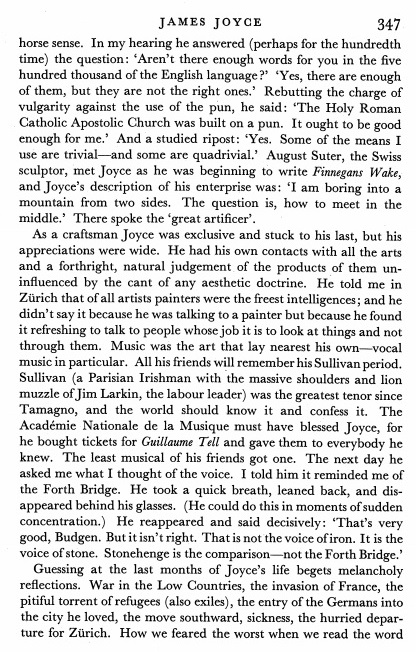
Transcription: Sayings of Joyce that stick do so like sayings of Lincoln - for their [346] horse sense. In my hearing he answered (perhaps for the hundredth time) the question: “Aren’t there enough words for you in the five hundred thousand of the English language?” “ Yes, there are enough of them, but they are not the right ones.” Rebutting the charge of vulgarity against the use of the pun, he said: “The Holy Roman Catholic Apostolic Church was built on a pun. It ought to be good enough for me.” And a studied riposte: “Yes. Some of the means I use are trivial - and some are quadrivial.” August Suter, the Swiss sculptor, met Joyce as he was beginning to write Finnegans Wake, and Joyce’s description of his enterprise was: “I am boring into a mountain from two sides. The question is, how to meet in the middle.” There spoke the “great artificer”.
As a craftsman Joyce was exclusive and stuck to his last, but his appreciations were wide. He had his own contacts with all the arts and a forthright, natural judgement of the products of them uninfluenced by the cant of any aesthetic doctrine. He told me in Zurich that of all artists painters were the freest intelligences; and he didn’t say it because he was talking to a painter but because he found it refreshing to talk to people whose job it is to look at things and not through them. Music was the art that lay nearest his own - vocal music in particular. All his friends will remember his Sullivan period. Sullivan (a Parisian Irishman with the massive shoulders and lion muzzle of Jim Larkin, the labour leader) was the greatest tenor since Tamagno, and the world should know it and confess it. The Académie Nationale de la Musique must have blessed Joyce, for he bought tickets for Guillaume Tell and gave them to everybody he knew. The least musical of his friends got one. The next day he asked me what I thought of the voice. I told him it reminded me of the Forth Bridge. He took a quick breath, leaned back, and disappeared behind his glasses. (He could do this in moments of sudden concentration.) He reappeared and said decisively: “That’s very good, Budgen. But it isn’t right. That is not the voice of iron. It is the voice of stone. Stonehenge is the comparison - not the Forth Bridge.”
Guessing at the last months of Joyce’s life begets melancholy reflections. War in the Low Countries, the invasion of France, the pitiful torrent of refugees (also exiles), the entry of the Germans into the city he loved, the move southward, sickness, the hurried departure for Zurich. How we feared the worst when we read the word [387] “Urgent!” But I was thankful it was Zurich. I know how many devoted friends were there to comfort and sustain Mrs. Joyce. No wonder that Joyce could so well dispense with contact with his native land. Ireland herself was ever present at his side.Available at Wisconsin University Library > Digital Collections - text & pdf; accessed 25.10.2017; see also Joyce’s response to Budgen’s book on Ulysses in draft under Quotations > To Frank Budgen (20 August 1939) - as attached.
Budgen writes: ‘Joyce flew the nets of religion and Irish oppressed nation politics, and parties and classes meant nothing to him, but there was one social social institution that for him was quasi-sacred: the family’ (“James Joyce”, [1941], in James Joyce and the Making of Ulysses and Other Writings, OUP 1972, p.346.)
Frank Budgen, James Joyce and the Making of Ulysses [1934] (Oxford UP 1972 Edn.), on “Wandering Rocks”: ‘Joyce wrote the Wandering Rocks with a map of Dublin before him on which were traced in red ink [124] the paths of the Earl of Dudley and Father Conmee. He calculated to a minute the time necessary for his characters to cover a given distance of the city. For this is peculiarly the episode of Dublin. Not Bloom, not Stephen is here the principal personage, but Dublin itself. Its houses, streets, spaces, tramways and waterways are shown us, and the people appear as sons and daughters and guests of the city. All towns are labyrinths in which for the townsfolk there are charted fairways; but we are strangers in the town and can find our way only by the exercise of attention and caution. While working on The Wandering Rocks Joyce bought at Franz Karl Weber’s on the Bahnhofstrasse a game called “Labyrinth”, which he played every evening for a time with his daughter Lucia. As a result of winning or losing at the game he was enabled to catalogue six main errors of judgment into which one might fall in choosing a right, left or centre way out of the maze.’ (pp.124-25; Indiana UP Edn., p.122-23.) [Cont.]
Frank Budgen, James Joyce and the Making of Ulysses [1934] (Oxford UP 1972 Edn.), on “Wandering Rocks” [episode]: ‘Joyce took carefully into account all the mechanical conditions of his day, but those mechanical conditions never influenced him in the sense that they influenced many of his contemporaries. The cubist, for example, is stricken with dull wonder by the massive organisation of the machine at rest. The futurist is excited to frenzy by the speed and fury of the machine in motion. Both are slavishly subservient to the wheels and pistons of the engines that were created to be our slaves. Them the machine has mastered, but it has never influenced the material or outlook of Joyce in this sense. Except by way of observing its effects on the minds and movements of his characters Joyce pays mechanical development no heed. Still less does he pay heed to it in his tempo of composition. [132] / In Wandering Rocks the action goes forward at clockspeed.’ (pp.132-33.)
Frank Budgen, James Joyce and the Making of Ulysses [.... &c.] (1972 Edn.) - Bloom in the “Cyclops” episode: ‘This is the only episode, Penelope excepted, in which Bloom is entirely seen through other eyes. There is no comment of his own on himself or others. First he appears performing furtively a good deed, looking for the Dignam insurance [...] The he is guest in the stranger’s house. A child of light, he is entertained by the children of this world. He begins by bringing the light of intelligence to bear on such simple questions as physical exercise, diseases in cattle and so on, but soon enteres the dangerous ground of the conduct of life and the relation of living man to his past. [...] Bloom, who has no son in whom to place his messianic hopes, must be son and messiah to himself. He asks for martyrdom and gets it. He appreciates it. [...] He becomes a man with a mission, reforming the world by the force of the spoken word. It is beautifully normal and logical that he [167] shall seize the opportunity of making good on the large field of society what he has lost in the family bedroom, thus turning private woe into a source of public weal. The ideas he defends are his own. He always held humanity to be above races and creeds, but on many occasions he would have let the Irish nationalists talk their fill unopposed. His Irish fellow citizens will have none of him as Irishman or world-reformer, and so he goes one better. He affirms his Judaism and becomes prophet and messiah. / There is a strain of naîveté in Bloom. He seems not to know that oppressed nationalities have a peculiar and ferocious snobbery that for exclusiveness far outdoes the snobbery of schools and clubs. When he makes his perfectly reasonable claim as a Jew to be regarded as belonging to an oppressed people they look on him as a vile outsider, an impudent gate-crasher. He is in the position of the council schoolboy caught wearing a Harrow tie. And when he adds to that a recital of the cultural achievements of the Jews, one of which is the Christian religion, there is nothing for it but the ascent into heaven. On Irish soil there is no longer room for him. Yet Bloom furthered the cause of Irish nationalism. He informed Arthur Griffith of the Hungarian scheme of action on which Sinn Fein was founded although he must have done so in a scientific, not a combative spirit. All the others in Barney Kiernan’s are proud, violent men, willing to kill and be killed for their cause. Not so Bloom. For him the human body, its well-being and continued existence, is the greatest good, the worthiest cause of all.’ (p.168.)
Further [quoting Joyce:] ‘You see [-...] “I” is really a great admirer of Bloom who, besides being a better man, is also more cunning, a better talker, and more fertile in expedients. If you re-read Troilus and Cressida you will see that of all the heroes Thersites respects only Ulysses. Theresites admires Ulysses.”’ (p.169.)
True Bloom: Budgen also remarks that there is only one reason for Bloom’s argumentativeness - that he knows that events at Eccles St. have passed beyond rehearsing “Love’s Old Sweet Song” (p.167), and that the charges laid against Bloom by the nameless narrator [Thersites] and by Pisser Burke as regards his attempt to gain a place in an elderly female’s will, and his once having been at risk of prosecution for selling illegal lottery tickets are true.’ (James Joyce and the Making of Ulysses [.... &c.] (1834; 1972 Edn., p.168.)
[ top ]
Frank Budgen, James Joyce and the Making of Ulysses [1934] (Indiana UP 1967 Edn.) - cont.: ‘The observed fact is that hallucination is common human experience. Joyce shows it as being a common experience of sane men. It may be objected that Stephen is drunk. Bloom, however, is sober than many judges, and it is mainly Bloom’s inner world that is projected into three dimensional space.’ (Ibid., p.245; quoted in Laurie Magowan, UG Diss., UUC 2006.) [Cont.]
Frank Budgen, James Joyce and the Making of Ulysses and Other Writings, introduced by Clive Hart (OUP 1972): ‘[T]o Joyce words are more than pleasurable material out of which agreeable patterns can be made, or though and emotion communicated. They are quick with human history as pitchblende with radium, or coal with heat and flame. They have a will and a life of their own and are not to be put [?] like lead soldiers, but to be energised and persuaded like soldiers of flesh and blood. the commerce of life new mints them every day and gives them new values in the exchanges, and Joyce is ever listening for living speech from any human lips. / “What a lot of nonsense is talked about style,” he said. / This was apropos of The Oxen of the Sun.’ (p.179.)
Frank Budgen, James Joyce and the Making of Ulysses [1934] (Oxford: OUP 1972): ‘On festive occasions and with a suitable stimulus, breribboned and wearing a straw picture hat [....] Joyce would execute a fantastic dance. It was not a terpischoriean effort of the statuesque Isadora Duncan variety, but a thing of whirling argms, high-kicking legs, grotesque capers and coy grimaces that suggested something the ritual antics of a comic religion.’ (pp.194-95.)
Frank Budgen, James Joyce and the Making of Ulysses [1934] (Oxford: OUP 1989): ‘He was always looking and listening for the necessary fact or word; and he was a great believer in his luck. What he needed would come to him. That which he collected would prove useful in its time and place. [...] I have seen him collect in the space of a few hours the oddest assortment of material: a parody on the House that Jack Built, the name and action of a poison, the method of caning boys on training ships, the wobbly cessation of a tired unfinished sentence, the nervous tick of a convive turning his glass in inward-turning circles, a Swiss music-hall joke turning on a pun in Swiss dialect, a description of the Fitzsimmons shift. [...] At intervals, alone or in conversation, seated or walking, one of these tablets was produced, and a word or two scribbled on it at lightening speed as ear or memory served his turn. No one knew how all this material was given place in the completed pattern of his work. [...] The method of making a multitude of criss-cross notes in pencil was a strange one for a man whose sight was never good.’ (pp.175-77; quoted in Sam Slote, Catalogue Notes, “Bloomsday” - Joyce Centennial Exhibit, Lockwood Mem. Library, Univ. of Buffalo [online 29.12.08.)
Frank Budgen (James Joyce and the Making of Ulysses [1934] OUP 1972) - cont.: ‘The multiplicity of technical devices in Ulysses is proof that Joyce subscribed to non-limiting aesthetic creed, and proof also that he was willing to use any available instrument that might serve his purpose. It was hardly likely that, having denied all religious dogma, he would submit to artistic limitations. There are hints of all practices in Ulysses - cubism, futurism, simultanism, dadaism and the rest - and this is the clearest proof that he was attached to none of the schools that followed them. At one time in Zürich, I wanted to learn Italian and, as a reading exercise, Joyce lent me Bocioni’s book on futurism. I quoted to him one full-sounding phrase I had learned: “Noi futuristi italiani siamo senza passato.” “E senza avvenire,” said Joyce [trans. “Our Italian future will be without a past” ... “And without a future”]. Any other doctrine would have called forth the same [198] comment. The sworn foe of sensibility in art is doctrine. When an artist believes in no creed he is the more likely to believe in himself, in what he sees, hears, experiences. Hence, I think, the stream of actual life that flows so strongly through the pages of Ulysses. Any partisan pledges would have cramped it in one way or another. Hence the insistence on the mystery of the body, which is the medium of experience. On brief life here with its creative possibilities, and death, is before us to make us humble and tolerant. Apropos of one contentious critic Joyce observed: “What a pity it is we don’t take our coffins round with us like the Chinese. It would give us a better sense of perspective.”’ (pp.198-99.) [Cont.]
Frank Budgen (James Joyce and the Making of Ulysses [1934] : OUP 1972) - cont. [on “Ithaca” and “Penelope”]: ‘[Bloom’s] ultimate reflections are those of the purely rational man whose emotional reactions are quickly stilled in thought. Tiredly he envisages some forms of husbandly self-assertion but abandons them as either immoral or useless or inexpedient. In the vast scheme of things with which he identifies himself the adultery of his wife becomes an unimportant event. He considers the nature and desires of the human body and its functional necessities and mechanisms “... the futility of triumph or protest or vindication: the inanity of extolled virtue: the lethargy of nescient matter: the apathy of the stars.” / It is in the unsmiled smile of his equanimity that the bowstring of the lord of 7 Eccles Street most loudly twangs. It slaughters the suitors of Marion as effectively as did the divinely aided Ulysses those of Penelope. With bloodless thought Bloom banishes his rivals to nonentity, and it must be admitted that he does his work just as sweepingly well as the more bloody-minded archer king of Ithaca. His triumph is, in a sense, all too complete; for he condemns to vast spaces of time - hurls into eternity in short - not only the adulterous violators but the adulterously violated, and himself too, the matrimonial violator. The temporal institution of monogamic marriage also goes by the board; for in that region whereto were expedited suitors, wife and husband [267] there is neither marrying nor giving in marriage.’ (pp.267-68.) [Cont.]
[ top ]
Frank Budgen (James Joyce and the Making of Ulysses [1934] OUP 1972) - cont. ‘[...] Bloom’s victory is to all appearances complete. The derangement of the bed wakes Marion, who begins a truly wifely catechism, to which Bloom with perfect presence of mind replies, giving an account of his day’s activities, largely true, but with such adaptations and omissions as shall make it domestically acceptable. The conversation becomes increasingly more laconic till it fades altogether, and then, but not before ordering two eggs for his to-morrow’s breakfast, to variations on the name and adventures of Sinbad the sailor, the tired hero drops off to sleep. / But Marion remains awake and it is she who has the last word. Some strangenesses of manner on the part of Leopold [has] to be explained; some lapses in his narrative have to be filled in with guess work; and then, guessing and explaining, her mind runs through all the world that is hers. In eight unpunctuated sentences of about five thousand words each she paints a portrait of herself not known to Leopold, and a portrait of a Poldy not [268] known to him or his friends, and a picture of the world, the values of which would be is by every other person in the book. There is none of the coldness of an abstraction in Molly Bloom, but she is more symbolical than any other person in Ulysses.’ [Cont.]
Frank Budgen (James Joyce and the Making of Ulysses [1934] OUP 1972) - cont.: [...] ‘Joyce wrote to me at the time he was composing Penelope: “Her monologue turns slowly, evenly, though with variations, capriciously, but surely like the huge earthball itself round and round spinning. Its four cardinal points are the female breasts, arse, womb and sex expressed by the words because, bottom (in all senses bottom button, bottom of the class, bottom of the sea, bottom of his heart) woman, yes.” It is clearly in her symbolical character as fruitful mother earth that Molly speaks, through the medium of her body, for what individual, socially limited woman, if she were capable of entertaining such thoughts, would not be secretive enough to suppress them? [...] Both Bloom and Molly have this in common that they bring out of inconstancy tribute to fidelity. [...] In Joyce’s own words in a letter to me she is, ‘sane full amoral fertilisable untrustworthy engaging limited prudent indifferent Weib. “Ich bin das Fleisch das stets bejaht” [after Goethe’s Dr. Faust: “I am the Flesh that always says Yes” [recte: “Ich bin der Fleisch der stets bejaht”]’ (pp.267-68; being a letter of Joyce’s to Budgen, 16 Aug. 1921, given in Letters, Vol. 1 p.170; Sel. Letters, ed. Ellmann, p.285.)
Frank Budgen, Further Recollections of James Joyce (London: Shenval 1955 Edn): ‘It is often said of Joyce that he was greatly influence by psychoanalysis in the composition of Ulysses and Finnegans Wake [...] nothing could be farther from the truth. The Joycean method of composition and the passively automatic method are two [2] opposite and opposed principles [...] Joyce was always impatient or contemptuously silent when it was talked about as both an all-sufficient Weltanschauung and a source of law for artistic production “Why all this fuss about the mystery of the unconscious?” he said to me one evening at the Pfauen Restaurant. “What about the mystery of the conscious? [D]o they know about that?” One might say that both as a man and an artist Joyce was exceedingly conscious. Great artificers have to be.’ (p.8; quoted in Michael Begnal, Dreamscheme: Narrative and Voice in Finnegans Wake, Syracuse UP 1988, pp.2-3.)
Frank Budgen, ‘Resurrection’, in Twelve and A Tilly: Essays on the Occasion of the 25th Anniversary of Finnegans Wake , ed. Jack P. Dalton & Clive Hart (London: Faber & Faber 1966), pp.11-15: ‘Joyce once told me (it was during the composition of Finnegans Wake) that he thought he had found the meaning of the Tower of Babel story. If I had done my bounden duty I should have been ready with “what” and “how” and “tell”, but, slow of wit and more apt to ruminate than ask, I let the occasion slide, so that what Joyce though was the true inwardness of the Biblical story is anybody’s guess. / I wonder if Joyce saw the Plain of Shinar and its presumptuous builders as existing in a world of the collective unconscious. Their tower would be a sort of Hegelian tower of knowledge starting from nothing and stretching to the comprehension of everything - built, however, not with man-made categories but with pure a priori intuitions. In that case, waking them out of their Paradise to the “real world” of time and space, subject and object, perception and its limitations would suffice to confuse and scatter them.’ (p.12; cont.)
Cont: ‘A rather slender thread, it may be thought[,] and more more likely to bog me down in some private little gnosis of my own than lead me through the maze of Finnegans Wake [having in mind the more promising idea that Stephen Dedalus’ “twin eternities” (SH188) are closer to the founding principles of that strange book]. (Idem.) [BS Diss. 1979.]
[ top ]
Theodore Spencer, Preface to Stephen Hero [1944] (rev. edn. London: Jonathan Cape 1969): ‘It [Stephen Hero] portrays many characters and incidents which the published version [A Portrait ..., &c., 1916] leaves out, and it describes the growth of Stephen’s mind in a far more direct and less elliptical form than that with which we are familiar. [...] It not only gives us a wonderfully convincing transcript of life, it throws light on Joyce’s whole development as an artist by showing us more clealry than we have been able to see before what the beginning of that development was like.’ (p.16.) [Cont.]
Theodore Spencer (Preface to Stephen Hero [1944] 1969) - cont.: ‘We can easily undersand, of course, what Joyce was aiming at when he discared his first draft and rewrote the material in this fashion [A Portrait]. He was aiming at economy, and he was trying to place his centre of action as much as possible inside the consciousness of his hero. To do this he evidently decided to sacrifice the method - which is, after all, the method of Dubliners rather than that of the Portrait - of objectively presenting one episode or character after another. As a result the Portrait has more intensity and concentration, a more controlled focus, than the earlier version. In the Portrait, Mr. Levin observes, “drama has retired before soliloquy”. The diffuseness of real life is controlled and ordered by being rpesented from a single point of view.’ (p.17.)
Theodore Spencer (Preface to Stephen Hero [1944] 1969) - cont.: ‘The most striking differences which the reader will notice between the two versions is in the way Stephen himself is described. In the present text [SH] he is emotionally and intellectually a cruder and more youthful figure than in his creator’s eyes he was later to become; he is more like the average undergraduate and, in spite or because of the fact that he is portrayed more diffusely, he is on the whole a more sympathetic person, proud and arrogant as he may be. He has more weakness and does more foolish things [...] than are entirely consistent with th self-posssesion of his later portrait. He has a hero-worship for Ibsen, which is scarcely mentioned later, and his reaction from his Jesuit training makes him rage in a more sophomoric fury against what he calls the “plague of Catholicism” He is more dependent on his family for approval and support.’ (p.19.) [Cont.]
Theodore Spencer (Preface to Stephen Hero [1944] 1969) - cont. [on Finnegans Wake]: ‘Here it is not any individual that is epiphanised; it is all of human history, symbolised in certain types the representatives of which combine with one another as the words describing them combine with various meanings, so that H. C. Earwicker and his family, his acquaintances, the city of Dublin where he lives, his morality and religion, become symbols of an epiphanic view of human life as a whole, and the final end of the artist is achieved.’ (Grafton/Triad edn., 1977, p.20; Cape Edition, 1968, p.23.)
[ top ]
Louis Gillet, ‘The Living Joyce’, trans. in Maria Jolas, ed., The James Joyce Year Book (Paris 1949); quoted in Patricia Hutchins, James Joyce’s World, London: Methuen 1957): ‘With absolute simplicity, quite devoid of pretentiousness, he furnished me with the key to his work. he explained to me the mystery of the titanic figure of H.C.E., the unique, many-faceted hero of innumerable incarnations [...] He told me about the language he had adopted in order to give his vocabulary the elasticity of sleep, to multiply the meaning of words, to permit the play of light and colour, and make of the sentence a rainbow to which each tiny drop is itself a many-hued prism.’ (p.178; rep. in Willard Potts, Portraits of the Artist in Exile: Recollection of James Joyce by Europeans (Washington UP 1979.) [Cont.]
Louis Gillet, (‘The Living Joyce’, ... &c.): ‘[...] Dedalus entering the [172] musico of Bella Cohen while singing the Introit of Easter [....] As for the atheism of the young man, it is a misfortune; where the clergy is king, as in Ireland, where it makes the sun rise and set, the jacobinism of Joyce seems natural. Oppression engenders revolt. One shoud admit, moreover, that in this presumptuous duel the rash young man showed himself more discerning than his friends of the Irish Revival. The question of Home Rule might be a tiny detail in the total of world affairs [...] But to declare war on Heaven meant stepping out of local intrigues; it meant giving this enterprise a titanic character and placing oneself on a level with the universe. [173] / These words seem quite big for a merry ne’er-do-well emancipating himself; but I doubt that they were actually bigger than the boy’s thoughts. He placed himself at once among the descendants of the greatest master of his race, the immortal Dean Swift. Swift’s superiority when dealing with dogmas is due to the fact that he belonged to the clergy; it is as a theologian that he maltreats theology [...] to apply to all things the system of Gulliver and The Tale of a Tub, to dislocate the forms of logic and reasoning, to demolish the edifice of our representations upon which our conventions rest - our ideas of order, consequence, continuation, conformity, even of space and time - to dissolve at last the language itself and the words by which we designate all things, this was to shake the columns of the universe and make the Temple quiver to its base, its was to substitute a new creation, the world of consciousness and dream for the reality of things and gods. [...] as an act of liberation and nefranchisement it is far more than a vague charter of independence for the Republic of Éire: a prodigious Walpurgis Nacht, an immense Gotterdammerung.’ (p.172-74.) [Cont.]
Louis Gillet, (‘The Living Joyce’, ... &c.): ‘Joyce was willing to explain to me the scheme of his book. He spoke in a most simple tone, without any sort of pretention. He gave me the clue to his work. He explained to me the mystery of the immense H.C.E., this unrivalled hero, thick-textured, of boundless embodiments, whose master-key character lends itself to all kinds of metamorphoses and is up to every role, like a kind of universal Fregoli. He spoke of the language he had used in order to give to vocabulary the elasticity of sleep, multiplying the meaning of words, playing with glisterings and iridescences, making the sentence a rainbow where each drop is a prism assuming a thousand colours. [...; 178] What facilitated the system was the fact that Joyce possessed an unerring memory. He knew his book by heart. In his mind the text was written in an indelible way. I believe that he even used to do most of his corrections by memory. Nevertheless, I would have been pleased to see his manuscripts. We shall really understand Joyce’s thoughts only on the day when we can have it in its first state, before all the retouches with which he complicated it - after the fashion of Mallarmé [....]. He was aiming deliberately for extreme consequences, like the heroic discoverers of new elements who first leaped into the void. “Am I mad?” he said at the end. It was not an affected remark.’ (pp.178-79.) [Gillet first met Joyce in 1931.]
[ top ]
Louis Gillet, Claybook for James Joyce, translated by Georges Markow-Totevy (London & NY: Abelard-Schuman 1958): ‘[Joyce’s] text has to be read like Dante’s, according to several superimposed meanings. There is a literal meaning, an allegorical meaning, and perhaps several others - almost as many as the skins of an onion.’ (p.58; quoted in Jonathan McCreedy, ‘“Ocone! Ocone!”: ALP’s 3D Siglum and Dolph’s “Dainty’[s] Diagram”’, in Genetic Joyce Studies, No. 11, Spring 2011, n.11 - available online.)
[ top ]
Flann O’Brien, ‘A Bash in the Tunnel’, in Envoy (April 1951): ‘Funny? But surely there you have the Irish artist? Sitting fully dressed, innerly locked in the toilet of a locked coach where he has no right to be, resentfully drinking somebody else’s whiskey, being whisked hither and thither by anonymous shunters, keeping fastidiously the while on the outer face of his door the simple word ENGAGED? I think the image fits Joyce: but particularly in his manifestation of a most Irish characteristic-the transgressor’s resentment with the nongressor.’ Further: ‘Perhaps the true fascination Joyce lies in his secretiveness, his ambiguity (his polyguity, perhaps)), his leg-pulling, his dishonesties, his technical skill, his attraction for Americans. His works are a garden in which some of us may play. This issue of ENVOY claims to be merely a small bit of that garden. / But at the end, Joyce will still be in his tunnel, unabashed.’ (‘Introduction’, Envoy: A Review of Literature and Art, “James Joyce” [Special Issue], Dublin 1951, p.9; rep. as ‘A Bash in the Tunnel’ in John Ryan, ed., A Bash in the Tunnel: James Joyce by the Irish, Brighton: Clifton Books 1970, pp.15-20; p.18.)
Flann O’Brien, ‘A Bash in the Tunnel’, in Envoy (April 1951) - cont.: ‘Humour, the handmaid of sorrow and fear, creeps out endlessly in all Joyce’s works. He uses the thing, in the same way as Shakespeare does but less formally, to attenuate the fear of those who have belief and who genuinely think that they will be in hell or in heaven shortly, and possibly very shortly. With laughs he palliates the sense of doom that is the heritage of the Irish Catholic. True humour needs this background urgency, Rabelais is funny, but his stuff cloys. His stuff lacks tragedy.’ (Flann O’Brien, ‘A Bash in the Tunnel’, in Envoy (April 1951), p.11; rep. in A Bash in the Tunnel, ed. John Ryan, London: Clifton Books 1970, p.20.) Note: S. L. Goldberg enumberates critical attitudes to Joyce including the view of ‘Ulysses as an elaborate joke’ adding that this is ‘hardly favoured outside Dublin itself’. (p.21.) He adds in a footnote that the attitude is ‘well-represented in some of the articles in the Joyce number of Envoy, V, April 1951’ but that ‘Arland Ussher’s lively essay on Joyce in Three Great Irishmen, London, 1952, is of a somewhat differernt calibre, however.’ (Ibid., p.316.) Note: S. L. Goldberg enumberates among critical attitude to Joyce the view of ‘Ulysses as an elaborate joke’ (The Classical Temper: A Study of James Joyce’s “Ulysses”, London: Chatto & Windus 1961, p.21) , adding that this is ‘hardly favoured outside Dublin itself’, adding in a footnote that the atttitude is ‘well-represented in some of the articles in the Joyce number of Envoy, V, April 1951’ (p.21), but that ‘Arland Ussher’s lively essay on Joyce in Three Great Irishmen, London, 1952, is of a somewhat different calibre, however.’ (Ibid., p.316.)
Flann O’Brien [as Myles na gCopaleen], in “An Cruiskeen Lawn” (The Irish Times [column] q.d.): ‘James Joyce was illiterate ... his every foreign language quotation was incorrect’; his ‘few sallies at Greek at wrong, and his few attempts at a Gaelic phrase absolutely monstrous.’ (Q. Source.)
Flann O’Brien [as Myles na gCopaleen], in “An Cruiskeen Lawn” (The Irish Times [column] 16 June 1954): ‘Ní IRISH LITERATURE a bhfuil scríobhtha ag James Joyce adeir-sé, acht tá an teideal sin ion luaidhte aige i dtaobh SÉADHNA leis an Athair Ó Laoghaire.’ (Quoted in Anthony Cronin, Flann O’Brien: No Laughing Matter, 1989, p.111.)
Flann O’Brien on translating Joyce’s Ulysses I suppose uncertainty is the handmaid of all grandiose literary projects. Many motives lay behind that 1951 decision of mine to translate Joyce’s Ulysses into Irish. If they won.t read it in English, I said to myself, bedamn but we’ll put them in the situation that they can boast they won’t read it in Irish aither.
It’s work, though. And black thoughts encloister me, like brooding buzzards. Is it worth being accurate if nobody will ever read the translation? What’s the Irish for Robert Emmet? And who will put Irish on this fearsome thing written by Joyce himself: Suil, suil, suil arun, suil go siocair agus, suil go cuin.
See the snares in this business, doom impending, heart-break?Flann goes on in the same episode of his Irish Times column, “Cruiskeen Lawn”: Recently a chap said to me: How’s it going? I told him it was going so-so. Slow of course. These things take time. . . . Uphill work when all decent Christians are in bed. The midnight oil. Drudgery of a special kind.
Told you. Bit off more than you could chaw. You and all that B. Comm. crowd is too smart.
No, no, no, I told him. The job COULD be done. There were, of course, difficulties - minute things of rhythm, luminance, impact. The acute difficulty in translation lay in the lucid conveyance of obscurity. Even the hidden thing was susceptible of diacrisis. Not in the same darkness were all dark things enwrapped.—From “Cruiskeen Lawn”, in The Hair of the Dogma (Paladin 1989). Stan Carey notes that Stephen’s Irish sentence in the “Ithaca” chapter in Ulysses [as infra] is taken from the Irish song ‘Siúil A Rún’ (‘Walk, my dear’, or ‘Go, my love’) and that Joyce also refers to it in Finnegans Wake in this form: ‘‘who goes cute goes siocur and shoos aroun’. The Ulysses occurence falls in the catethical question-answer exchange where Stephen and Bloom render lines in their respective ‘native’ languages: What fragments of verse from the ancient Hebrew and ancient Irish languages were cited with modulations of voice and translation of texts by guest to host and by host to guest?
By Stephen: suil, suil, suil arun, suil go siocair agus, suil go cuin (walk, walk, walk your way, walk in safety, walk with care).
By Bloom: Kifeloch, harimon rakatejch m’baad l’zamatejch (thy temple amid thy hair is as a slice of pomegranate). [Q.p.]Writing on the same occasion, Flann then adds a specimen ‘from [his] large manuscript’: Mionshamhlíocht dosheachanta an tsofheicse; fiú an mhéid sin féin, intiniocht tré fháisnéis súl. Lorg an uile a bhfuil agam annso le sonnrú, scéag mara, leathach, an tuile i gcuaird, an bhróg úd mheirgeach ...
This being a rendering of: Ineluctable modality of the visible: at least that if no more, thought through my eye. Signatures of all things I am here to read, seaspawn and seawrack, the nearing tide, that rusty boot ... (“Proteus”)
For all of these quotations and remarks, see Stan Carey, Sentence First: An Irishman’s Blog about the English Language - online [accessed 30.06.2020]
[ top ]
Patrick Kavanagh, ‘Diary’, in Envoy [Special James Joyce Issue] (April 1951): ‘I find it difficult to form any particular opinion about Joyce. I have one advantage over certain others: I was never an original admirer of Joyce and so I have not had the normal reaction, that readjusting of one’s values which is common in regard to one’s enthusiasms. [...] I read Ulysses for the first time about seven years ago. Since then, it has been my second favourite bedside book. / What I think is a mistake is reading deep symbolism into Ulysses, drawing comparisons. Ulysses is a very funny book, and it is also a very wearying book. It is almost entirely a transcription of life. Joyce added nothing - excecpt possibly Stephen, and he gave us Stephen completely in the Portrait. / There is something wrong with Joyce who, as Chesterton said about someone else, is sane enough; it is his commentators who are mad. / Almost the most outstanding quality in Joyce is his Catholicism or rather his anti-Protestantism. Joyce, through Stephen, in the Portrait, must have done more damage to Protestantism than any modern apologist. / His reason made him a bad Catholic, but whatever the defects of Catholicism, he saw that Protestantism was a compendium of all those defects. / There was nothing in Joyce’s life of self-sacrifice - except the fact that he went off with a penniless girl. Perhaps it was the artist in him which gave him this kink in his character. / Yet I am constantly reminded of the number of writers who achieved the depths of hell’s despair simpy because they happened to get a woman without spondulecs. [... 70] If Joyce had had a thousand a year would he have written Ulysses as he did? [...]’ [Cont.]
Patrick Kavanagh (‘Diary’, in Envoy, April 1951): ‘Art is life squeezed through repression. [...] Byron and Shelley, two wealthy men, did manage to achieve misery and sudden death. / Joyce and Eliot have a good deal in common: they are both materialists which may be one reason why they have become a fashion. [...; 71]; What I am trying to say is that Joyce has little, or none, of that etheral commodity known as inspiration. He is the very clever cynical man who has found a formula. / In the end this introvert formula which feeds on itself exhausts its material. A true creator is always trying to be a little more than matter. / Finnegans Wake is the delirium of a man with no more to say. He has melted down the matrix. [...] The Portrait of the Artist is Joyce’s testament. / And yet, as I read through some of the more violent parts of Ulysses, I feel that Joyce is an unmannerly child enjoying destruction. Hate and pride. / It is a form of idealism. We feel that when the cities are flattened and civilisation is destroyed, something better will arise. It is a delusion. [...]’ (pp.70-72; rep. in John Ryan, ed., A Bash in the Tunnel, Brighton: Clifton Books 1970, pp.49-52.) Note: Kavanagh elsewhere called Joyce one of the ‘great parishioners.’ (Collected Pruse, 1973, p.283), and see his poems to Joyce (“Who Killed James Joyce?” and “James Joyce’s Ulysses”, under Kavanagh, Quotations, supra.)
[ top ]
Denis Johnston: ‘Progress of Joyceanity’, in Envoy (April 1951): ‘[...] A mass of misinformation provided by people like his brother Stanislaus, and by a biographer who do not wish to tell us the whole story for reasons of good taste, is sign-posting the way down further blind alleys. For the present, however, most of the departments, are having as much as they can do in disentangling the author’s actual message. This is a task which he deliberately left to others, and it was a very clever move to have done so - unless we are wrong in our suspicions that Joyce’s message is the least important part of Joyce. / There is actually no reason why the legacy of Dedalism to the world should be of very great weight once it has been discovered. It is only a coincidence when those who have the supreme gift of self-expression in any of the arts have got anything startling to express. The one does not in any sense depend on the other. The impression of profundity that we get from Shaw, for example, comes from his lucidity rather from any special merit in his plethora of half-truths. Compared with Goethe or Ibsen - who happened to have had both gifts - he is a very readable Smart Alec, with a good line of bull that smothens opposition. Swift was another case in point. What gallons of ink have been expended in endowing him with a meaning, when all that he needs is a biography. [...; American Sophomores] are being set to mull over the nine months of pregnancy, and to consider the significance of each [“Oxen of the Sun”]. They are being told that Mr. Bloom is a Scapegoat, bearing on his shoulders the sins of the human race, and they are well out now on a limb of the Golden Bough, looking for anything else that can be found with whiskers and horns. They are busy writing papers on Bruno’s idea that all created things are the offspring of a Demiurge of Intellect and a Matrix of Necessity. And they shaking their heads over Vico’s picture of History as a sort of organ-grinder with only a limited number of tunes.’ (pp.14-15; cont.)
Denis Johnston (‘Progress of Joyceanity’, 1951) - cont.: ‘What nuggets have the diligent workers in the quarry of Great Thoughts managed to produce so far? Well, respectfully admitting that ontogeny is probably a recapitulation of phylogony, we have the fact that all religion begins in a thunderclap; that the Liffey is female, while Howth Head is definitely male; that in the world of dreams, all time happens at once. This, I admit, is impressive enough, and may perhaps provide some clues to a new way of life. But it also must be admitted that the vast bulk of the clues from Finnegans Wake that we. have been offered to date, are concerned only with puns, chance resemblances of words, forced parallels from history or mythology, and (Joyce’s greatest sin) an unabashed confusion of the subjective with the objective that makes it impossible to distinguish between the author’s observation of his hero, the hero’s observation of his past, or the reader’s observation of any of them. In fact, there is an air of unreality about all the explanations that reminds me irresistably of a commentary on the liturgy, and not of literary criticisms at all. [/.../] The fact that there is any difficulty in answering these questions is entirely Joyce’s own doing. [...] ]Joyce [...] says little or nothing about himself, and seems to have directed all his contemporary biographers away from the real facts of his life to a lot of dreary rows with Maunsell & Co. He even goes so far as to delete the chapter headings from his work, so as to make us find them out for ourselves.’ (p.17; see further under Johnston, infra.)
Denis Johnston, ‘Clarify Begin At: Non-information of Finnegans Wake’, in Irish Renaissance: A Gathering of Essays, Memoirs, and Letters from the Massachusetts Review, ed. Robin Skelton & David R. Clark (Dublin: Dolmen Press 1965), pp.120-27 - traces the place and date of central event of Finnegans Wake. The articles ends: ‘[...] Joyce’s return to religion in this, his final work. While the first half of his life is devoted to denial and doubt, there is every indication in the Wake that the Joyce of later middle age was not only a Gracehoper but was profoundly concerned, maybe not with a heavenly life-hereafter, but with the eternity of this life. Hence the significance to him of the river as an image or model of a working Viconian cycle - a phenomenon that is born in the hills, that flows and grows, and is finally lost in the sea, from whence it returns once more to the hills. And here’s the point - there is no mutual exclusiveness in all of these phases. They are all happening “Now”. Finn again and again and again. What a hell for the damned, as Sartre has since pointed out. But Joyce is not damned, for all his Non Serviams. He has got the mysterious gift of Grace, as even Clongowes will agree nowadays.’ (...; p.126; see further under Johnston, Quotations, supra.)
[ top ]
W. B. Stanford, ‘Ulyssean Qualities in Joyce’s Leopold Bloom’, in Comparative Literature, 5 (1953): The encounter between Stephen and Bloom is a confrontation between what Stanford calls ‘primeval [...] racial, ideological and tempermental’ differences, involving on either side ‘the Irishman and Jew, the Aristotelian and the Platonist, the artistic and the scientific mind, the Trojan and the Greek, the young and the middle-aged.’ (p.[135]; see also Ireland and the Classical Tradition, IAP 1976, p.106; quoted in in Loredana Salis, ‘“So Greek with Consequence”: Classical Tragedy in Contemporary Irish Drama’, PhD Diss., UUC, 2005.)
[ top ]
Andrew Cass [pseud. of John Garvin], ‘Childe Horrid’s Pilgrimace’ (Envoy, April 1951): ‘The literature on Joyce’s life and work is growing apace but a large amount if it is inaccurate in biographical detail and uncritical in literary appraisal. Such writing is worse than useless for it tends to turn the man into a myth and to embalm his works in shrouds of speculative and unfounded commentary. (p.19.) ‘The circumstances of the flight into Europe have given rise to a series of further myths.’ (Idem.) ‘In the “definitive” biography, Mr. [Herbert] Gorman takes the Dubliners of the time to task for ignoring the youthful Joyce and letting Paris and the four corners of the earth (sic) shelter the man who was not stamped in their pattern but he apparently contradicts himself by admitting that “there was a third element that was violently pushing him toward flight. It was Nora Barnacle, his present wife.” No further explication of this “third element” is offered. There seems to be more Bowdler than Boswell in biography of this kind.’ (p.20; cont.)
Andrew Cass (in Envoy, April 1951) - cont.: ‘Enough has been said to make it clear that Stephen Dedalus is not an accurate authentic portrait of James Joyce as a young man. Accordingly, unless it can be treated as a study from which the writer had achieved an inhuman and almost schizoid detachment, it must be ascribed to the pathetic desire of a middle-aged man to dramatise his own lost youth and to exaggerate its intellectual capacity and promise. Such a petty pursuit is reminiscent of the father who writes his boy’s prize essays or of the mentally-retarded person whose conversation impulsively recurs to “when I was in College 20 years ago”. [...] / As Joyce himself said, all this stuff was boiling inside him and he had to get it out of his system, but it is a pity that he did not rid himself of it quickly. If, for example, the Portrait, with the Stephen Dedalus portion of Ulysses included, had been written by 1907, it should have provided an adequate medium for the expression of his youthful resentments and he could then have redeemed his 1904 promise that “in ten years’ time he would give them a novel to talk about.” This threatened novel was not published until 1922 and then proved to be a mere continuation and elaboration of Dubliners and the Portrait, with the author of 40 still pre-occupied with the burnt-out passions and dissipations of 22.’ (p.21.)
Andrew Cass (‘Childe Horrid’s Pilgrimace’, 1951) - cont.: ‘Ulysses with its interminable trimmings and its stuffed Odysseus promoted from a short story to balance the pretentious epic of Telemachus, enabled Joyce to get off his chest a great deal of juvenile resentments and self-pity. [.. / .. W]hat captivated while it shocked the 1922 critics was the novel treatment of the long, unpunctuated soliloquy in the last chapter, a magical record (they acclaimed) of the quintessential inwardness of feminity. The form of expression is certainly designed excellently to suit the representation of a stream of consciousness but the actual content is very far from such a representation. Much of it is dependent upon and, indeed, intended to supplement, the preceding treatment of personalities and events. [/...] The omission of punctuation marks is a mere trick designed to hide the fact that a great deal of the alleged run-on thinking is in fact nothing more than a characteristic piece of pungent Joyce prose.’ (p.23; cont.)
Andrew Cass (in Envoy, April 1951) - cont.: ‘Ulysses demonstrated the author’s inability to give forthright expression to his own mature personality [...] this mental paralysis inhibiting direct self-expressioin continued but side by side with it there was an uncontrollable urge to some form of autobiography [...] He, therefore, wanted a medium of expression in which he could give vent to his Irish memories, [by] obliquely autobiographical [methods] and at the same time epitomise himself as the all-wisest Stagyrite who could express all knowledge in the most intricate symbolic terms. / The dream-state regarded as a reservoir of personal and racial memories and a furnace for remoulding language provided the required medium.’ (p.24.) ‘Ireland is the real “Joyce country”, the primary scene and source of inspiration for Finnegans Wake, and no other work in the English language has the Irish accent ever been so authentically reproduced.’ (p.26.) ‘In dealing with his spiritual mother, Anna Liffey, he shows his affection for the accents and the story of Ireland, her woods and mountinas and plains and her rivers as symbols of eternal nature in their unceasing flow by bogs and bends and green hills and dark pools [....&c.]’ (p.27.)
Andrew Cass (‘Childe Horrid’s Pilgrimace’, 1951) - cont.: ‘Indeed, if we pursued his own symbols of universality to their logical conclusion and take the personified Dublin to represent all men and all cities, we get the impression of a dull misanthropy pervading Joyce’s mind even in his later years, milder perhaps than that which soured his youth, but still potent enough to bedevil hos outlook on his fellow me. His closest friends tell of a wall of reserve beyond which none of them ever penetrated. Many friendships formed during the years crumbled suddenly, surely because his intimates were inevitably bound to sense the ultimate exclusiveness of that cold, introverted, antisocial intellect. / He could play with the idea of an alternative life’s history for himself had he stayed at home in 1904 and participated in the developments which by the time Ulysses was published had crystallised in a new Ireland and a new concept of national identity.’ (p.29; the whole rep. in John Ryan, ed., A Bash in the Tunnel: James Joyce by the Irish, London: Clifton Books 1970, pp.169-80. [See also James Joyce’s Disunited Kingdom, under John Garvin, infra.]
[ top ]
John V. Kelleher, ‘The Perceptions of James Joyce’, review of A Portrait of the Artist as a Young Man (Penguin Classics), in Atlantic Monthly (March 1958): ‘[...] This way of writing - I suppose we shall have to call it symbolism, though the word has been beaten shapeless - is, I believe, Joyce’s natural and most central method. It antedates the Portrait. There are hints of it in the first story in Dubliners; and in the last, “The Dead,” where the ubiquitous Mr. Brown is Death himself, it has already become systematic. At the same time, symbolism is never Joyce’s sole method; it is always employed in conjunction with means which, though they receive reinforcement from it, are themselves self-sustaining. / Thus the Portrait functions well enough simply as a naturalistic novel. It was meant to. The book has several levels, each with a workable meaning of its own; and yet, since the containing form is the same for all levels, each meaning necessarily relates to the one overall statement. The irony that we remarked before depends on this. In the final chapter we have Stephen theorizing a little too positively about what he has not yet actually tried. This is his priggishness which, if honesty is to be complete, is inescapably part of the statement too. Proudly Stephen declares what qualities - fortitude, discipline, detachment - characterize the true, and the very rare, artist. The novel, telling his story so intricately and simply, is the proof of those qualities. And the proof itself is a measure of how far Stephen has yet to travel, through how much discouragement and pain, before he can practice what he so confidently preaches. Again let us remember that this is not Stephen’s self portrait. When the book is written Stephen no longer exists.’ (Cont.)
John V. Kelleher (review of A Portrait in Atlantic Monthly, March 1958) - cont.: ‘Still, does even this achievement justify so much complexity? Or as the question is more usually put, has Joyce the right to demand so much of the reader? The answer, I think, is that he demands no more than the serious artist normally expects is due his work. All that he wrote can be validly appreciated as what it outwardly appears to be because it is what it outwardly appears, as well as much else. His short stories, his play, his novels are all true specimens. As a matter of fact, he was aggrieved that readers, probing worriedly for deeper significances, should so consistently miss what lay on the surface. He pointed out in exasperation that Ulysses was, after all, a funny book. It is indeed. And if the reader gets the symbolic meanings but misses the fun, he has missed a good third of what the author was at pains to provide. Again, if the reader exploits the symbolism only for its meaning and fails to grasp its structural function, he has missed the deepest pleasure of all, the apprehension of pure form purely realized.’ (Source: “3 Quarks Daily Blog” [online; copied thence from Powell’s “A Review a Day”, 17 July 2007 online] - accessed 22 July 2007.] (For full text see RICORSO Library, “Criticism / Major Authors” - James Joyce [infra].)
Note also that Harry Levin gives thanks to Kelleher ‘for his Irish lore’ in the Acknowledgements to James Joyce: A Critical Introduction [1944] London: Faber 1960; and, further, that the Co. Dublin village of Dalkey is given as ‘Dalkley’ in that study (p.106), suggesting a mistranscription of Kelleher’s remarks on Stephen’s fondness for John Dowland, who reputedly lived there.
John V. Kelleher, formerly printed as ‘Identifying the Irish Printed Sources for Finnegans Wake’, in Irish University Review, 1, 2 (Spring 1971), pp.161-77, rep. in Selected Writings of John V. Kelleher on Ireland and Irish America, ed. Charles Fanning (Illinois UP 2002), pp.57-72: ‘[...] A very short myth which Joyce cites quite explicitly is dereived from Eoin MacNeill’s Celtic Ireland (1921), the only material he did take from that book. It is plainly discoverable in the following passages: ‘he hat locktoes, this shortshins, and, Obeold that’s pectoral his mammamuscles most mousterious (15.31); ... and his blood and milk brother Frisky Shorty .. (39.18); He had buckgoat paps on him, soft ones for orphans. Ho Lord! Twins of his bosom. (215.17.) &c. [3 examples - 241.21; 480.14, and 496.24; 167] Explanation: ‘Lugaid Cicech (i.e., having milk-breasts) - reared the two sons of Crimthann, Aed and Laegaire, on his breasts. It was new milk he gave from his breast to Laegaire, and blood he gave to Aed. Each of the took after his nurture, the race of Aed being marked by fierceness in arms, the race of Laegaire by thrift.’ (p.168.)
Cont. (Kelleher, ‘Identifying Irish Printed Sources [... &c.]’: ‘I have long been convinced that the ground level of the Wake in its mythological aspect is inhabited by the shadowy figure of a primitive hermaphroditic ancestor from whom all the later, more distinctly human, characters emerge.’ (p.168.)
The deficiencies of Joyce’s mind insure that generally nothing much happens. All too usually what might be noble is not only wedded to its opposite, but is interpenetrated by its opposite, so that we have neither light nor dark but a complexity of greyness. Tragedy is interfused with and weighted down by farce, sacrifice by self-nihilism. What should be firm statement is all too often obscured and fragmented by duiously relevant word-play. Now that we have Richard Ellmann’s definitive biography of Joyce [1959] and his edition of Joyce’s letters [1966] we can no longer escape seeing that in many long passages where it could formerly be assumed that the extended confessional aspect merely overlay deeper meanings which remained to be discovered, the confession is in fact the only consecutive meaning - a compulsive dance of the seven veils by a grave literary giant who also wanted to be revealed as a rather wicked fellow. Yet the naughtinesses admitted to are so sly and petty that I doubt that any experienced confessor would give him more than five Our Fathers and five Hail Marys for penance, with a tired admonition to amend his life and be a good boy hereafter.
For me, reading the Wake nowadays is like watching a huge, marvellously constructed aircraft, the unique final creation of a great designer, taxi along an endless airstrip [...176] I will admit that I may well be wrong thus to critize the spectacle. After all, there is no other such plane - no other such book - none even remotely like this. In truthh, however, after watching for many years I find I get bored stiff, and my feet hurt.’ (p.177; end; available at JSTOR - online; accessed 23.03.2015.)
[Note footnote reference to his own article, ‘Irish History and Mythology in James Joyce’s “The Dead’’, Review of Politics, XXVII, July 1965, pp.414-33.)
[ top ]
Patricia Hutchins, James Joyce’s World (London: Methuen 1957), writes: ‘The fact that I never met Mr. or Mrs. Joyce has given this work more variety in that they are presented through the reactions of other people. (If one can gather a good deal from the books a man owns, how much more revealing is his choice of friends!) On the other hand, there has been no chance to see in progress that combination of circumstances which we call an individual, to have formed an impression of what underlay the “considerate Lord Chesterfield manners” as Mary Colum described them, nor to have guessed at the enigmatic quality which Stuart Gilbert and others had encountered there. It is clear that Joyce, like most Irishmen, had his share of pride, something which must hold the balance between personal dignity, honour, and a stubborn resistance to humility. Like St Columkille, Ireland’s first spiritual exile, he gradually resolved the problems of his own nature, thus fulfilling that promise, whose measurements were hardly realised at the time, “to forge in the smithy of my soul the uncreated conscience of my race”. Stephen in A Portrait of the Artist as a Young Man speaks of his ancestors throwing off their language and allowing a handful of foreigners to subject them and asks, “Do you fancy I am going to pay in my own life and person debts they made?” There is a certain danger in stressing the autobiographical elements in the novel, yet Joyce never tried to write outside the framework of his early environment and was obliged, however critical his attitude, to convey its implications. Not until the emergence of people, cultures, ideas and psychological tendencies have been studied with the care and comparative research now given to factual history; will the issues inherent in Joyce’s work be clearly defined. For one thing, the early books delineate that subjectivism (so often exploited by colonial and military interests in Ireland) of those for whom friendship often has something of die old fosterhood nearness, and which, by some slight or disillusionment, can quickly turn to hatred. Joyce’s chosen prototype was Ulysses, “the victim of enmity”. “I do not think that Jim ever forgot a thing-all his life” said someone who had known him well.’ (p.4.) Note, Hutchins takes as epigraph the sentence ‘Loud, heap miseries upon us yet entwine out arts with laughters low!’ (Mime of Mick, Nick and the Maggies, The Hague: 1934). [See also under Notes, “Sundry”, infra.]
|
|
[ top ]
George Lukacs, ‘The Ideology of Modernism’ [Chap. 1], in The Meaning of Contemporary Realism, trans. by John & Necke Mander (London: Merlin Press 1963), pp.17-46: ‘It is in no way surprising that the most influential contemporary school of writing should be committed to the dogma of “modernist” anti-realism. [...] To take an example: the monologue intérieur. Compare, for instance, Bloom’s monologue in the lavatory or Molly’s monologue in bed, at the beginning and the end of Ulysses, with Goethe’s early-morning monologue as conceived by Thomas Mann in his Lotte in Weimar. Plainly the same stylistic technique is being employed. [...] yet is is not easy to think of any two novels more basically dissimilar than Ulysses and Lotte in Weimar. [.; 17] I am not referring to the - to my mind - striking difference in intellectual quality. I refer to the fact that with Joyce the stream-of-conscious technique is no mere stylistic device; it is itself the formative principle governing the narrative patter and the presentation of character. Technique here is something absolute; it is part and parcel of the aesthetic ambition informing Ulysses. (pp.17-18.)
Further (Lukacs): ‘It would be absurd, in view of Joyce’s artistic ambitions and his manifest abilities, to qualify the exaggerated attention he gives to the detailed recording of sense-data, and his comparative neglect of ideas and emotions, as artistic failure. All this was in conformity with Joyce’s artistic intention; and, by use of such techniques, he may be said to have achieved them satisfactorily. But between Joyce’s intentions and those of Thomas Mann there is a total opposition. The perpetually oscillating patterns of sense- and memory- data, their powerfully charged but aimless and directionless - fields of force, give rise to an epic structure which is static, reflecting a belief in the basically static character of events.’ (p.18.) ‘[T]he ontology on which the image of man in modernist literature is based invalidates this principle. If the “human condition” - man as solitary being, incapable of meaningful relationships - is identified with reality itself, the distinction between abstract and concrete potentiality becomes null and void. [...] Thus Cesare Pavese notes with John Dos Passos, and his German contemporary Alfred Döblin, a sharp oscillation between “superficial verisme” and “abstract Expressionist schematism”. [...]’ (p.23.)
George Lukacs (The Meaning of Contemporary Realism, trans. 1963), cont.: ‘The problem, once again, is ideological. [...] As individual character manifests itself in life’s moments of decision, so too in literature. If the distinction between abstract and concrete potentiality [24] vanishes, if man’s inwardness is identified with an abstract subjectivity, human personality must necessarily disintegrate. [Quotes T. S. Eliot: “Shape without form, shade without colour, / Paralysed force, gesture without motion.”] The disintegration of personality is matched by a disintegration of the outer world. Certain leading modernist writers, attempting an apology, have admitted this quite frankly. Often this theoretical impossibility of understanding reality is the point of departure, rather than the exaltation of subjectivity. But in any case the connection between the two is plain. (pp.23-25.) [Goes on to quote and discuss Gottfried Benn (‘there is no outer reality, there is only human consciousness, constantly building, modifying, rebuilding new worlds out of its own creativity’), and Robert Musil (viz., subjective existence ‘without qualities’ is the complement of the negation of outward reality), Kafka, and Wolfgang Koeppen]. (pp.25-26.) A similar attenuation of reality underlies Joyce’s stream of consciousness. It is, of course, intensified where the stream of consciousness is itself the medium through which reality is presented. And it is carried ad absurdum where the stream of consciousness is that of an abnormal subject or that of an idiot - consider the first part of Faulkner’s Sound and Fury or, a still more extreme case, Beckett’s Molloy.’ (p.26; cont.)
George Lukacs (The Meaning of Contemporary Realism, trans. 1963) - cont.: ‘Lack of objectivity in the description of the outer world finds its complement in the reduction of reality to a nightmare. Beckett’s Molloy is perhaps the ne plus ultra of this development, although Joyce’s vision of reality as an incoherent stream of consciousness had already assumed in Faulkner a nightmare quality. In Beckett’s novel we have the same vision twice over. He presents us with an image of the utmost human degradation - an idiot’s vegetative existence. Then, as help is imminent from a mysterious unspecified source, [31] the rescuer sinks into idiocy. The story is told through the parallel streams of consciousness of the idiot and of his rescuer. (pp.31-32.) [Here examines Benjamin’s account of allegory as a modernist genre and considers closely Kakfa’s writings and his ultimately failure; 44.] If we combine what we have up to now discussed separately we arrive at a consistent pattern. We seen that modernism leads not only to the destruction of traditional literary forms; it leads to the destruction of literature as such. And this is true not only of Joyce, or of the literature of Expressionism and Surrealism. [46; here discusses Gide’s Faux-Monnayeurs, in which ‘suffered from a characteristic modernist schizophrenia [in that] it was supposed to be written by the man who was also the hero of the novel.] We have here a practical demonstration that - as Benjamin showed in another context - modernism means not the enrichment, but the negation of art.’ [End; p.46.] (For longer extract, see RICORSO, Library, “Criticism”, infra.)
Jean-Paul Sartre: ‘[Ulysses] lacks the intermonadic dimension’ [What is Literature, p. 132.) Also remarks that ‘the intimate odour rising from beneath [Bloom]’ signifies ‘the initial project of the recovery of the body’ and shows Joyce’s attempt at ‘a solution of the problem of the absolute’ (Being and Nothingness, trans. Hazel Barnes, NY, 1966), p. 588. Vide Joyce: ‘the world a living body’ (Workshop of Daedalus, 1965, p.104.)
[ top ]
Anthony Burgess, A literature inglesa [English Literature, 1958, 1974; trans. by Duda Machado] (São Paolo: Editora Atica 2003): ‘En 1922, surgiu uma importante obra em prosa que (inevitavamente) soa, às vezes, como poesia. Trata-se de do irlandês James Joyce (1882-1941), um romance enorme tratando dos fatos ocorridos em um só dia na vida [255] de uma cidade - a cidade natal do autor, Dublin. Joyce já havia publicado antiormente veros encantadores mas nada extraordinários, um volume de contos chamado Dubliners e um impressionante romance autobiográfico - Retrado de artista quando jovem. O herói deste romance - Stephen Dedalus - aparece de novo em Ulysses, desta vez subordinato a um papel secondário: a herói é um judeu húngaro, establecido em Dublin chamado Leopold Bloom. O romance não tem do fato um enredo. Como o heroi grego do título, Bloom vagueia de um lugar para outra, tem aventuras nada heróicas, e finalmente se encontra com Stephen, que assume uma espécie de papel de filho espiritual. Depois disso, o livre termina. Mas as oitocentas páginas não são preenchidas a esmo; jamais houve um romance escrito en prosa tão concisa. Somos levados a entrar nas mentes dos personagens principais que nos são mostrados com seus pensamentos e sentimentos em ume corrente continuá (a téchnica é chamada de “monólogue interior”). O livro é sobretudo uma corrente sem fim das impressoes semi-articuladas de Bloom sobre a dia, mas Joyce faz com que o livro não se resuma apenas a isso, ao impor uma forma bastante rígida. Cada capítulo corresponde a uma episódio da Odysseia de Homero e tem seu proprio estilo; por exemplo, na cena da Maternidade a prosa imita todos os estilos literários ingleses desde o Beowulf até Carlyle e um pouca além, simbolizando o crescimentio do feto no útero em seus movimentos firmes através do tempo. A habilidade do livro é espantosa, e, quando pegamos um romance de Arnold Bennett ou de Hugh Walpole depois de ler Ulysses, não conseguimos mais apreciar a maneira como foram escritos pois parecem monótonos, descuidados, meio sonolentes. Ulysses é o romance mais cuidadosamente do século XX. (pp.255-56.)
Further (Burgess): ‘Em Finnegans Wake, Joyce tentou mostrar toda a história humana como um sonho na mente de um zelador de Dublin chamado H. C. Earwicker, e aqui o estilo - com o qual Joyce, que ficara cego, despendeu um enorme trabalho - é adaquado ao sonho, a linguagem se desloca e muda, as palavras se aglutinam, sugerindo a mistura de imagens no sonho e fazendo com que Joyce seja capaz de apresentar a história e o mito em uma só imagem, com todos as personagens da história se transformando em alguns poucos tipos eternos, que afinal são identificandos por Earwicker como ele próprio, sua mulher e três filhos. Esta grande e dificil obra marca provavelmente o limite da experimentacão com a linguagem - seria difícil para qualquer escritor ir mais longe do que Joyce. (p.256.) [Further speaks of Joyce’s great works as revealing a ‘new faith [um novo credo]’ involving the idea of circularity and change expressed in the histories of the City (symbolised by Dublin), time itself, and the cycle of the river always running into the ocean but always renewing itself through rainfall - a pattern reflected in the continuous sentence which unites and the beginning of the Wake with a phrase whose continuation begins the novel [o fim de Finnegans Wake é o começo de uma frase se cuja continuacão começa o livro].]’ (end; p.257).]
Anthony Cronin, No Laughing Matter: No Laughing Matter: The Life and Times of Flann O’Brien (1989): ‘The hold of Catholicism in Ireland in those years was partly parental. To disavow the faith, whether in public or in private, was a gesture so extreme that most people who had doubts or reservations suppressed them on the grounds that it would cause their parents too much suffering, might indeed even “break their hearts”. True, Joyce had managed the business a quarter of a century or so before, but the extreme song and dance he had made of it showed how difficult he found it; and he had, after all, to refuse to kneel at his mother’s bedside, to go into exile and to render himself both déraciné and déclassé to do it.’ (q.p.)
[ top ]
 |
| [ previous ] | [ top ] | [ next ] |