       |
| full-text copys | |
| A Drama in Muslin [1887] (as Muslin, 1915) | Confessions of A Young Man (1888) |
| Esther Waters (1899) | |
 |
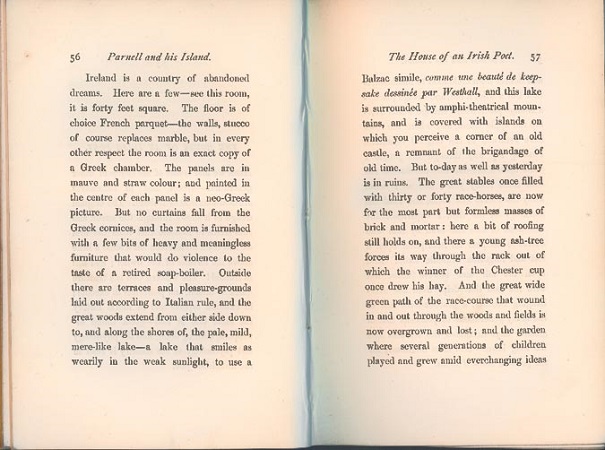 |
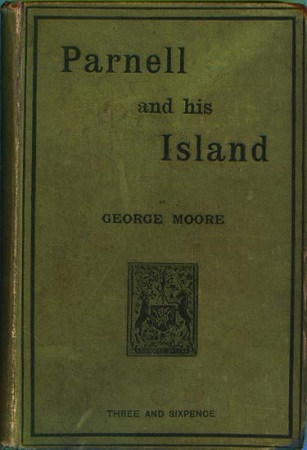
| Cover and pages from Parnell and His Island (1887) | |
| George Moore and his island ... |
|
| —Confessions of a Young Man (1888) - Chap. [see full-text copy - attached] |
[ top ]
Novels and Prose
Drama in Muslin (1886). ‘The history of a nation as often lies hidden in social wrongs and domestic griefs as in the story of revolution, and if it be for the historian to narrate the one, it is for the novelist to dissect and explain the other; and who would say which is of the most vital importance - the thunder of the people against the oppression of the Castle, or the unnatural sterility, the cruel idleness of mind and body of the muslin martyrs who cover with their white skirts the shames of Cork Hill?’ (rep. edn., Belfast: Appletree Press 1992), p.159; quoted in Margaret Kelleher, ‘Prose Writing and Drama in English; 1830-1890 [...]’, in Cambridge History of Irish Literature, ed. Kelleher & Philip O’Leary, Cambridge UP 2006, Vol. 1, p.483.) [For longer extracts - see attached.]
Note: In Court and Society Magazine, Moore himself describes Drama in Muslin as ‘a picture of Ireland all complete, Castle, landlords and Land Leaguers, and painted by an Irishman ... as vivid an account as existed of social life in Irenad during the Land League.’ (Quoted in John Gray, A Peculiar Man: A Life of George Moore, Sinclair-Stevenson 1996, p.136.)
[See full-text copy of Muslin (1915 Edn.) - in RICORSO Library > Irish Classics > George Moore > - attached.
[ top ]
Drama in Muslin (1886; revised as Muslin, 1915) - Preface: ‘A soul searcher, if ever there was one [...] whose desire to write well is apparent on every page, a headlong, eager, uncertain style [...] a young hound yelping at every trace of scent but if we look beneath the style we catch sight of the man’s true self, a real interest in religious questions and a hatred as lively as Ibsen’s of the social conventions that drive woman into the marriage market. [...] Since Nora slammed the door [in A Doll’s House] the practice of acquiring a share in a woman’s life, rather than insisting on the whole of it, has caught such a firm root in our civilisation that it is no exaggeration to say that every married woman today will admit she could manage two men better than her husband could manage two wives. [...] if polygamy thrives in Mohommedanism in the East, polyandry has settled down in the West with Christianity [xiii] Dram. Pers: Alice, May, Violet, Olive (Alice’s sister); Capt Hibert; Mr Lynch; Lord Dungory; Mrs Lawler; Miss Brennan, Cullens, Gores. (For longer extracts from text, see RICORSO Library, “Irish Classics”, via index, or direct.)
| Longer extract [Muslin]: |
| He was writing at that time A Mummer’s Wife in his bedroom at the Shelbourne Hotel, and I thought how different were the two visions, A Mummer’s Wife and A Drama in Muslin and how the choice of these two subjects revealed him to me. “It was life that interested him rather than the envelope” I said. “He sought Alice Barton’s heart as eagerly as Kate Ede’s;” and my heart went out to the three policemen to whose assiduities I owed this pleasant evening, all alone with my cat and my immediate ancestor; and as I sat looking into the fire I fell to wondering how it was that the critics of the “eighties” could have been blind enough to dub him an imitator of Zola. “A soul searcher, if ever there was one,” I continued, “whose desire to write well is apparent on every page, a headlong, eager, uncertain style (a young hound yelping at every trace of scent), but if we look beneath the style we catch sight of the young man’s true self, a real interest in religious questions and a hatred as lively as Ibsen’s of the social conventions that drive women into the marriage market. It seems strange,” I said, abandoning myself to recollection, “that the critics of the “eighties” failed [viii] to notice that the theme of A Drama in Muslin is the same as that of the Doll’s House; the very title should have pointed this put to them.” But they were not interested in themes; but in morality, and how they might crush a play which, if it were uncrushed by them, would succeed in undermining the foundations of society - their favourite phrase at the time, it entered into every article written about the Doll’s House - and, looking upon themselves as the saviours of society, these master-builders kept on staying and propping the damaged construction till at length they were joined by some dramatists and story-tellers who feared with them for the “foundations of society,” and these latter set themselves the task of devising new endings that would be likely to catch the popular taste and so mitigate the evil, the substitution of an educational motive for a carnal one. For Nora does not leave her husband for a lover, but to educate herself. The critics were used to lovers, and what we are used to is bearable, but a woman who leaves her husband and her children for school-books is unbearable, and much more immoral than the usual little wanton. So the critics thought in the “eighties”, and they thought truly, if it be true that morality and custom are interchangeable terms. The critics were right in a way; everybody is right in a way, for nothing is wholly right and nothing wholly wrong, a truth often served up by philosophers; but the public has ever eschewed it, and perhaps our argument will be better appreciated if we dilute this truth a little, saying instead that it is the telling that makes a story true or false, and that the dramatic critics of the “eighties” were not altogether as wrong [ix] as Mr. Archer imagined them to be, but failed to express themselves. The public is without power of expression, and it felt that it was being fooled for some purpose not very apparent and perhaps anarchical. Nor is a sudden revelation very convincing in modern times. In the space of three minutes, Nora, who has been her husband’s sensual toy, and has taken pleasure in being that, and only that, leaves her husband and her children, as has been said, for school-books. A more arbitrary piece of stage craft was never devised; but it was not the stage craft the critics were accustomed to, and the admirers of Ibsen did not dare to admit that he had devised Nora to cry aloud that a woman is more than a domestic animal. It would have been fatal for an apostle or even a disciple to admit the obvious fact that Ibsen was a dramatist of moral ideas rather than of sensuous emotions; and there was nobody in the “eighties” to explain the redemption of Ibsen by his dialogue, the strongest and most condensed ever written, yet coming off the reel like silk. A wonderful thread, that never tangles in his hands. Ibsen is a magical weaver, and so closely does he weave that we are drawn along in the net like fishes. But it is with the subject of the Doll’s House rather than with the art with which it is woven that we are concerned here. [...] (NY: Brentano’s 1915, pp.viii-x.) |
| See full-text copy of the Preface and the novel in RICORSO LIbrary, “Irish Classics” - via index or as attached. |
Note: In the preface to the 1932 edition, Moore wrote that the book showed ‘a real interest in the religious questions and a hatred lively as Ibsen’s of the social conventions that drive women into the marriage market. [...] the theme of A Drama in Muslin is the same as that of The Doll’s House .. Nora does not leave her husband for a lover, but to educate herself.’ (Both the foregoing cited in Linda Faith-Kelly, PG Dip. essay, UUC 2012.)
[ See Preface to the 1915 New Edition of Drama in Muslin - attached.]
Parnell and His Island (London: Swan Sonnenschein, Lowrey & Co. 1887), A sketch of Ireland and Irish conditions. CONTENTS: Dublin: The Castle; The Shelbourne Hotel; The Kildare Street Club; Mrs Rusville (dressmaker). An Irish Country House. The House of an Irish Poet. The Landlord. The Tenant Farmer. The Patriot. The Priest. A Castle of Yesterday. A Castle of Today. An Eviction. A Hunting Breakfast. Conclusion. SUMMARY (Life languishing in Dalkey and Dublin:) ‘For in Ireland there is nothing but the land; with the exception of a few brewers and distillers in Dublin, who live upon the drunkenness of the people, there is no way, in Ireland of getting money except through the peasant [...] in Ireland the passage, direct and brutal of money from the horny hands of the peasant to the delicate hands of the proprietor is terribly suggestive of serfdom. In England the landlord lays out the farm and builds the farm-buildings. In Ireland he does absolutely nothing. He gives the bare land to the peasant, and sends his agent to collect the half-yearly rent; in a word he allows the peasant to keep him in ease and luxury. [...] (Note: For longer extracts, go to RICORSO Library > Irish Classics > via index, or direct.)
[ top ]
The Untilled Field (1903), Preface—| ‘It must have been somewhere at the end of the nineties, not unlikely in ninety-nine, that dear Edward said to me in the Temple: “I should like to write my plays in Irish.” And it was not long afterwards, in the beginning of 1900, that Yeats persuaded him to come to Ireland to found a literary theatre. In search of a third person, they called on me in Victoria Street, and it is related in Ave we packed our bags and went away to do something. We all did something, but none did what he set out to do. Yeats founded a realistic theatre, Edward emptied two churches - he and Palestrina between them - and I wrote The Untilled Field, a book written in the beginning out of no desire of self-expression, but in the hope of furnishing the young Irish of the future with models. Yeats said that I had learned the art of presentation in Paris, and in 1900 we believed that the Irish language could be revived. “You see, it is necessary,” I observed to Edward, “that Ireland’s future writers should have models, and the stories will be published in a Jesuit magazine”. “If the Jesuits assume all responsibility,” he muttered, and fell to pondering over his pipe, but he raised no further objection and invested with full authority I wrote “The Wedding Gown”, “Almsgiving”, “The Clerk’s Quest”, and “So On He Goes”, in English rather than in Anglo-Irish, for what help would that pretty idiom, in which we catch the last accents of the original language, be to Taigh Donoghue, my translator? As soon as his translations were finished, my manuscripts were to be burnt; but these first stories begot a desire to paint the portrait of my country, and this could only be done in a Catholic atmosphere, and as I had just come out of Evelyn Innes and Sister Teresa, “The Exile” rose up in my mind quickly, and before putting the finishing hand to it I began “Home Sickness”. The village of Duncannon in the story set me thinking of the villages round Dublin, and I wrote “Some Parishioners”, “Patchwork”, “The Wedding Feast”, and “The Window”. The somewhat harsh rule of Father Maguire set me thinking of a gentler type of priest, and the pathetic figure of Father MacTurnan tempted me. I wrote “A Letter to Rome ” and “A Playhouse in the Waste”; and as fast as these stories were written they were translated into Irish and published in a very pretty book of which nobody took any notice, and that the Gaelic League could not be persuaded to put in its window; and one evening a disheartened man was driven to the bitter extremity of collecting his manuscripts for a London publisher. The cheque they brought back on account of royalties did not soothe me; in 1903 England was hateful on account of the Boer War, and the sale of one hundred copies of the book that I could not read would have pleased me more than ten thousand of the book that I could. In a word, I was hipped with my book, and willingly forgot it in the excitement of The Lake, a thing an author should never do, for to forget a book or to speak contemptuously of it brings bad luck. And so Synge was raised up against me in Ireland, and for the last ten years we have been thinking and talking of him as the one man who saw Irish life truly and wrote it candidly.’ |
| [ Note: Text reparagraphed for screen reading; see full-text copy in RICORSO Library > Irish Classics > via index, or direct.] |
[ top ]
“Home Sickness” (The Untilled Field): ‘There is an unchanging, silent life within every man that none knows but, himself, and his unchanging silent life was his memory of Margaret Dirkin. The bar-room was forgotten and all that concerned it, and the things he saw most clearly were the green hillside, and the bog lake and the rushes about it, and the greater lake in the distance, and behind it the blue line of the wandering hills.’ (The Untilled Field, 1903 Edn., p.49; quoted in Peter Costello, The Heart Grown Brutal: The Irish Revolution in Literature from Parnell to the Death of W. B. Yeats, 1891-1939, 1977, p.53.)
The Lake (1905)| Preface |
|
The Lake (1905), Extracts: ‘England was after all only an island like Ireland - a little larger, but an island - and he though he would like a continent to roam in. The French cathedrals were more beautiful than the English, and it would be pleasant to wander in the French country in happy-go-lucky fashion resting when one was tired, walking when it pleased one, taking an interest in whatever might strike one’s fancy [5].
This lake was beautiful, but he was tired of its low gray shores; he was tired of those mountains, melancholy as Irish melodies, and as beautiful [6]; No doubt there is a moment in everyone’s life when something happens to turn him into the road which he is destined to follow; for all that it would be superficial to think that the fate of one’s life is dependent upon accident. The accident that turns one into the road is only the means that Providence takes to procure the working out of certain ends [8]; Very wonderful is life’s coming and going, but however rapidly life passes, there is always time for wrong-doing; and only time for repentance is short [32].
Gogarty to Rose: Without a leader the people are helpless; they wander like sheep on a mountain-side, falling over rocks or dying amid snowdrifts. Sometimes the shepherd grows weary of watching, and the question arises if one has no duty towards one’s self. Then one begins to wonder what is one’s duty and what is duty-if duty is more than the opinions of others-a convention which no one would like to hear called into question, because he feels instinctively that it is well for everyone to continue in the rut [...] But following of the rut is beset with difficulties; there are big holes on either side. Sometimes the road ends nowhere, and one gets lost in spite of one’s self. (The Lake, London: William Heinemann 1905, p.43; Internet Archive.)
Kilronan Abbey - ‘Father Gogarty wondered if God were reserving the bright destiny for Ireland which He had withheld a thousand years ago, and he looked out for the abbey that Roderick O’Connor, King of Connaught, had built in the twelfth century’ [70]; ‘Father Moran held his peace for a little while, and then he began talking about the penal times, telling how religion in Ireland was another form of love of country, and that, if Catholics were intolerant of every form of heresy, it was because they instinctively felt that the questioning of dogma would mean some slight subsidence from the idea of nationality that held the people together. Like the ancient Jews, the Irish believed that the faith of their forefathers could bring them into their ultimate inheritance; this was why a proselytiser was hated so intensely. (For longer extracts, see attached.)
[ top ]
Hail and Farewell, 3 vols. (Ave, 1911, rep. 1947; Salve, 1912, rep. 1926; Vale, 1914, 2nd edn. 1915; 1947 edn., with sep. pagination [as supra]: ‘PREFACE’, 1919 revised Edn., a paper entitled ‘Art without the Artist’, deals with the Irish revival as a natural subject for art, complete with its own cast of exceptional characters, chiefly AE (George Russell), Yeats, Edward Martyn, Lady Gregory, Gill and Plunkett. The authorship, he argues, belongs to Banva. COMMISSION: ‘Moore Hall will be no more than a villa in the midst of a wild country ... the present cottagers would probably prevent the pigs from rooting in the graveyard, but the cottagers fifty years hence will have no scruples.’ [V344] ‘In those days the peasants were afraid to thatch their houses lest their rent should be raised […] nor was there one peasant in our villages or in Tower Hill villages with a ten pound note … The landlords have had their day, their day is over. We are a disappearing class, our lands are being confiscated, and our houses are decaying or being pulled down to build cottages for the folk. Dialect, idiom, local customs, and character are disappearing, and in a great hurry […]. In another fifty years we will have lost all the civilisation of the eighteenth century; a swamp of peasants with a priest here and there, the exaltation of the rosary and whiskey her lot. A hundred legislators interested only in protecting monkeries and nunneries from secular inquisition.’ (Hail and Farewell, Appleton 1911-14, Vol. III, pp.361, 364; quoted in Tom Garvin, Irish Revolutionaries, Clarendon Press, 1987, p.3.) [On the road to Chelsea - cf. St. Paul’s Damascus an St. Patrick’s Woods of Foghlut]: ’Providence has to make a choice of instrument; you are chosen today, another tomorrow; that day I was the chosen instrument, and on the road to Chelsea, thinking of this great and merciful Providence, I head a voice bidding me back to Ireland. It is difficult to know for certain what one hears and what one imagines one has heard; one’s thoughts are sometimes very loud, but the voice was from without. I am sure it was, AE. Three or four days afterwards I head the same words spoken within my ear while I was lying in bed asleep. And the voice spoke so distinctly that I threw out my arms to retain the speaker.’ (Gerrards Cross Edn. 1985,p.277.) [For more extensive quotations - arranged by subject - see separate file [infra; see also remarks on Yeats, Edward Martyn, et al., intersperses in this web site.]
The Passing Of The Essenes (1930, lim. edn.; London: Heinemann 1931) - Bibliographical note:
The second edition contains a prefatory letter reprinted from the Times Literary Supplement 30th Oct. 1930: ‘Once on a time I remarked to a learned friend who had written a book on the origins of Christianity that the nails and the spear were not mentioned in the three synoptic Gospels ...; I did not accept Jesus as divine because he himself declares in all three synoptic Gospels that he lays no claim to divinity. ...; Jesus spoke for all kinds and conditions of men, and his words were meant to be everlasting, and for them to be everlasting they must be reborn in every individual consciousness.’
The scene in each of three acts is [the] ‘interior of the cenoby of the Essenes on a shelf of rock in the gorge of the brook Kerith.’ The crisis occurs when Jesus innocently tells how he was ‘raised from the tomb’. ‘He is possessed of an evil spirit’, says Paul. Mathias comments: ’On hearing Jesus say he was raised from the tomb Paul’s disturbed brain might have begun to doubt the death and resurrection that he hath preached for the last twenty years, and in his desperation at seeing his whole life crushed like an empty eggshell underfoot strange words would come to him, and why not the words he spoke?’ [60-61].
Jesus later gives an fuller account in Paul’s hearing: ‘On it [the cross] I hung till I passed into a swoon, and being deemed dead at the end of the third hour, my body was given up to Joseph of Armimathea for burial. He laid in the tomb he had had carved for himself I stirred in my grave-clothes ...; seeing I was not dead he carried me into the house ...; See Paul listens. His wits are returning to him.’ Paul denies that it is the same Jesus who, in his religion was ‘raised from the dead and will remain until the last man perished’, and Jesus says: ‘It may be that my name has become mingled with these happenings ...; Paul, I would not rob thee of they namesake!’ [83]
The Bending of the Bough (1900) - Preface: ‘Art may rest for a space in this forlorn Atlantic island [...] re-knitting herself to the tradition which existed before England was in many tales of chivalry.’ (Quoted in T. R. Henn, The Lonely Tower: Studies in the Poetry of W. B. Yeats (London: Methuen 1950, 1965, p.106 - adding, ‘I suspect that George Moore’s wish was an empty one’; idem. )
[ top ]
| See Helmut E Gerber, ed., Moore in Transition: Letters to T. Fisher Unwin and Lena Milman, 1894-1910, Detroit: Wayne State UP 1968): |
To Lena Milman: ‘Nothing seems to you more despicable than the following of one’s inclinations! If one does not follow one’s inclinations the result seems to me to be complete sterilisation. It is only those who are wanting in strength who do not follow them - will you allow me to substitute the word instincts? We must discriminate between what is mere inclination and what is instinct. All my sympathies are with instincts and their development. Instinct alone may lead us aright.’ (p.71.) |
Reply to query about an art-teacher: ‘[Y]our friend in common with nine tenths of the world believes that she can be taught. We can learn much but we are taught nothing. Your friend must work; it does not much matter how - if she has anything in her instinct will guide her right. If she has nothing in her - which is probable - teaching will only teach her a number of tricks, in other words a number of bad habits. This is chilling I know but the truth is often chilling. I have seen women (men too) progress from trick to trick and in the end lay down their palettes in despair. The first thing in art is to be sure you have something to say. If your friend has anything to say the manner of saying it will come of itself.’ (p.74.) |
‘I have just written the last page of Esther Waters - the two mothers living alone, tilling their garden and thinking of their sons. For the first time in my life I cried over my work. It is only too possible that my emotion did not pass from my heart to the paper [...].’ (p.80). |
(Moore in Transition, 1968 - cont.). On The Untilled Field: ‘A very flamboyant title for my book has occurred to me “The Sin Against the Holy Ghost”. I believe religious minded young men and women have been puzzling their heads over this sin. I believe the sin to be the sin against life. All that tends to diminish, to impoverish and to humiliate life is the sin against the Holy Ghost and the theme of my book is that the excessive Catholicism that prevails in Ireland tends to diminish the vitality of the human plant ... (pp.259-60.) |
‘I have finished twelve stories. In everyone there is a priest and Ireland is represented as a sort of modern Tibet [vide “The Wild Goose”]. The book is a perfect unity and I hope it will not be reviewed as a collection of short stories.’ (p.247). |
|
Gerber remarks: ‘While Moore began with the artistically unpromising intention of proving that the Church, symbolised by the priests, was the force making for the decay of Ireland, and, literally, its depopulation, he intuitively appeared to have recognised that such a thesis was a gross oversimplification. More important, he also recognised that he was slighting the artistry of his book, In any event, the stories as published even in the first English edition do not wholly bear out the anti-clerical thesis ...’ (p.272-73).
|
[ top ]
Shelbourne address (Speech at the Shelbourne Banquet in honour of Sir Horace Plunkett): ‘If the revival of interest in the ancient language and the myths and traditions of the ancient people mean more than a flitting apparition of art, then peaceful economics and policy of social reconstruction of Mr Horace Plunkett, rather than the revival of old animosities, may be expected to fill the near future. Mr. O’Brien and Mr. Dillon, if rightly interpret their utterances, do not pretend to any new ideas - they seem to believe in repetition of old ideas; possibly they are right. M. Horace Plunkett, however, comes with a new set of ideas, with a new system of economics, especially adapted to the needs of modern Ireland [...]. Further: "The analogy between a system of rural banking and co-operation dairies and the poetry of Mr Yeats is not obvious at first sight; but ... [I]t would seem that the time has come for putting all the old ideas, whether of land agitation or of literature behind us. When I say old, I really mean those of the last two generations. (Reported in Daily Express, 12 May 1899; quoted in P. J. Mathews, ‘The Irish Revival: A Reappraisal’, in New Voices in Irish Criticism, ed. Mathews, Dublin: Four Courts Press 2000, pp.12-19; p.18; also given in ESSE papers/Helsinki 2000).
Letter on Joyce (being a recommendation for support from the Civil List): ‘The only book of Joyce’s that I have read is a collection of stories called Dubliners, some of them are trivial and disagreeable, but alt are written by a clever man, and the book contains one story, the longest story in the book and the last story which seemed to me perfection whilst I read it, I regretted that I was not the author of it. But this story, which I am sure you would appreciate as much as I did, does not prove that Joyce will go on writing and will end by writing something like a masterpiece. A talent, musical, literary or pictorial, is a pale fluttering thing that a breath will extinguish. I will get Dubliners from Heinemann to whom I lent the book and you will see for yourself. Of the novel I know nothing. Joyce left a disagreeable reputation behind him in Dublin, but he came back after some years a different man and everything I heard of him is to his credit. Of his political views I know nothing. He was not in Ireland during the sowing of the Sinn Féin seed and I hope he is not even a home ruler. Democratic principles are unsuited to Ireland. Already the people are beginning to regret their landlords ’and to hate the congested District Board. The Irish like priests and believe in the power of priests to forgive them their sins, and to change God into a biscuit. They are only happy in convents and monasteries. The only reason that the Irish would tolerate home rule would be.if.they were given permission to persecute someone, that is [418] the Roman Catholic idea of liberty. It always has been and always will be.
I am am admirer of Asquith and regret that he cannot bring himself to believe that there can be no settlement, and that all attempts at settlement will fail. The Irish like discipline, and if Mr Asquith would treat the Irish as the Pope does he would be the most popular man in Ireland. / Yours .&c. GM]. PS: I am sure that from the literary point of view Joyce is deserving of help.’ (Letter to Edward Marsh [Asquith’s secretary], 3 Aug. [1916]; quoted in Richard Ellmann, James Joyce, 1965 Edn., pp.418-19; note that Ellmann erroneously dates the letter 1917 in his references, ibid., p.789; see also remarks to Barrett Clark, in Paris, calling Joyce ‘a sort of Zola gone to seed ... Probably Joyce thinks that because he prints all the dirty little words he is a great novelist. You know of course he got his ideas from Dujardin [... &c.]’; given in Ellmann, op. cit., p.543-44.)
Letter to Louis Gillet ( 20 Aug. 1931): ‘[...] I am lost in admiration of the thought that you have put into this article and it required thought and consideration and reading and re-reading to disentangle Joyce’s metaphysics. I say metaphysics for Joyce’s book has nothing to do with art, nor yet science, so I suppose it must be metaphysics. Art is concerned with what the eye sees and not with the thinking mind. To the mind life is but the dreaming of a shade, but our actions arise from the belief that it is a great deal more than a shade and history will continue to be written notwithstanding Mr. Joyce’s protest. I am by temperament an artist, that is to say by temperament one who is interested on appearance; a metaphysician only in the belief that the appearance may be illuminated faintly by a moral conception, but oh so faintly! With Joyce it is just the opposite. There are no appearances in Joyce; it is all syllogism. I am not quite sure of the meaning of the word syllogism, but I hope it will serve my present purpose. Joyce was in England some time ago. He had recovered his sight to some extent and lost his speech. I always heard of him in Dublin as one of the most garrulous of men. Now, he sits as silent as a mummy He dined with me two nights and I had to make conversation all the time, which was tedious, and when I asked him to tell me how the action or the thought of Ulysses was advanced by associating the minor acts Bloom with the acts of Ulysses, he answered “I see I am on my defence.” I apologised. And by the next post I received a primer explaining all t mysteries of Ulysses and learnt from it that when Bloom smokes a corpulent cigar the reader is obliged to think of the Greek wanderer who blinded Polyphemus with a fire-hardened stake. I wrote to Joyce telling him that up to the present I had looked upon myself as a competent judge a work of art and failing completely to discover the literary effect aimed at in the analogy of Bloom and his cigar and the wanderer’s fire-hardened stake, I concluded that one of us had a blind patch in his mind somewhere. Which of us it is it would be an affectation for me to decide. [...]’ (Rep. in Robert Deming, ed., James Joyce: The Critical Heritage, London: Routledge & Kegan Paul 1970, Vol. 2, p.565-66; p.566.)
[ top ]
‘Literature & Irish’: ‘a return to the language [...;]a mysterious inheritance in which resides the soul of the Irish people’ (Ideals in Ireland, p.47; cited in Declan Kiberd, Inventing Ireland, London: Cape 1995, p.156, with additional comment: ‘and threatened to disinherit his nephews if they failed to learn the native tongue; but when his own Irish teacher called at the appointed hour to his house in Ely Place, he had the butler tell him he was out.’)
The Irish Peasantry: ‘In those days the peasants were afraid to thatch their houses lest their rent should be raised [...;] nor was there one peasant in our villages or in Tower Hill villages with a ten pound note ...; The landlords have had their day, their day is over. We are a disappearing class, our lands are being confiscated, and our houses are decaying or being pulled down to build cottages for the folk. Dialect, idiom, local customs, and character are disappearing, and in a great hurry [...;]. In another fifty years we will have lost all the civilisation of the eighteenth century; a swamp of peasants with a priest here and there, the exaltation of the rosary and whiskey her lot. A hundred legislators interested only in protecting monkeries and nunneries from secular inquisition.’ (Hail and Farewell, Appleton 1911-14, vol. iii, pp.361, 364; quoted in Tom Garvin, Irish Revolutionaries, Clarendon Press, 1987, p.3.)
National history: ‘The history of a nation often lies in social wrongs and domestic griefs as in the story of revolution, and if it is for the historian to narrate the one, it is for the novelist to dissect and explain the other; and who could say which is of the most vital importance, the thunder of the public against the oppression of the Castle, or the unnatural sterility, the cruel idleness of mind and body of the muslin martyrs who cover with their white skirts the lawns of Cork Hill’ (from Drama in Muslin, [1886, pp.203-04; quoted as from 1884 edn. [sic] in Peter Costello, The Heart Grown Brutal, 1977, p.50.)
Death & Life: ‘Death is in such strange contradiction to life that it is no matter for wonder that we recoil from it, and turn to remembrances, and find recompense in perceiving that those we have loved live in our memories as intensely as if they were still before our eyes; and it would seem, therefore, that we should garner and treasure our past and forebear to regret partings with [to] grief, however dear our friends may be; for by parting from them all their imperfections will pass out of sight, and they will become dearer and nearer to us. The present is no more than a little arid sand dribbling through the neck of an hour-glass; but the past may be compared to a shrine in the coigne of some sea-cliff, whither the white birds of recollections come to roost and rest awhile, and fly away again into the darkness.’ (Ave, 1991, American Edn., p.335; cited in Ronald Schleifer, ‘George Moore’s Turning Mind: Digression and Autobiographical Art in Hail and Farewell’, in Schleifer, ed., The Genres of Irish Literary Revival, Dublin: Wolfhound 1980, pp.84-85.)
Comic vision: ‘In my walks comedy after comedy rises up in my mind, or I should say scene after scene, for there are empty interspaces between the scenes, in which I play parts that would have suited Charles Mathews excellently well. The dialogue flows along, sparkling like a May morning, quite different from any dialogue that I should be likely to find pen in hand, for in my novels I can write only tragedy, and in life play nothing but light comedy, and the one explanation that occurs to me of this dual personality is that I write according to my soul, and act according to my appearance. (Ave, 1911, p.113; Schleifer, op. cit., 1980, p.87.)
Ireland in 1918: ‘I found Ireland today a land of milk, honey, and discontent. They are all obsessed by the Sinn Féin delusion. [...] If there was a General Election now, you would have nothing but Ulster and Sinn Féin ... People who begin by believing in absurdities are soon ready to commit atrocities.’ Further, on hearing a republican say that it might be best for Ireland if Germany won the war, Moore wrote: ‘You see the picture he has in mind - the Irishman sitting on a wall and smoking his pipe and the German digging for him! The Sinn Feiners are children!’ (Quoted by Adrian Frazier, in The Irish Times, Weekend [‘Literary Landmarks’], 24 Aug. 2002.)
[ top