|







[ top ]
| Works |
|
|
[ top ]
Representative Irish Tales, ed. W. B. Yeats (1891): In his collection of Representative Irish Tales, Yeats ascribed to Maginn the comic story “Father Tom and the Popel or, A Night in the Vatican” which was actually by Samuel Ferguson - as made known in Mary Ferguson’s Sir Samuel Ferguson and the Ireland of his Day (1895). The story had appeared anonymously in Blackwood’s Magazine (May 1838, pp.614-17). Presumably Yeats thought it more in keeping with Maginn’s humour ...
The story was reprinted as Father Tom and the Pope / or / A Night in the Vatican (Philadephia MSCCCLXI [1861]) - commenc[ing] with Praefatiuncula: ‘“Who was Mr. Michael Heffernan who thus pleasantly chronicled the incident “A Night at the Vatican”? “Ferguson of Dublin”, was the reply of Thackeray, when asked this question in Philadelphia in 1853. A similar return was given two years before to a query in Willis’s current notes, with the variation that Ferguson “was a Wexford man”. Popular opinion has identified Michael Heffernan with William Maginn, by Dr. Shelton Mackenzie, our grand referee in the re literaria vexata, ignores Maginn and substitutes another Irishman John Fisher Murray, who was also a contributor to Blackwood’s Magazine. We may here be permitted to remark that the acknowledged writings fo these men are not marked by the wit, humour, and learning, or the terse, racy expression [vii] of the historiographer of this famous Vatican symposium. It has been said that the Rev. Francis Mahoney was not only the Oliver Yorke of Fraser, but also Michael Heffernan of Blackwood. The internal evidence of style and the non-appearance of “Father Tom and the The Pope” in the recent edition of Mahoney’s collected writings militates against this disposition. If to others than these five the production has been attributed their names have not reached us.
We venture the opinion of an ecclesiastic, perhaps a Catholic, perhaps a Protestant, who, for obvious reasons to his readers, chose to maintain a strict incognito, and that this very remarkable book was his only literary effort. A man who has written well once will probably, but not always, write again. The best three monographs upon Shakespeare - that of Morgan, that of Farmer, and that of Edward, were, respectively, written by men who wrote nothing else.
In conclusion, we indulge the expectation that future editors of this rich morceau will regard ours as the textus receptus, it having been carefully collated with the later and with the editio princeps.’ (Available at Google Books - online; accessed 06.11.2011.)[Yeats’s version has single inverted commas in dialogue for the double-inverted commas of the original and omits the introductory explanation, which occupies a half-title page in the Philadelphia edition (p.[10]) -
FATHER TOM AND THE POPE;
or,
A NIGHT AT THE VATICAN.as related by
Mr. Michael Heffernan,Master of the National School of Tallymactaggart, in the County of Leitrim, to a friend, during his official visit to Dublin, for the purpose of studying Political Economy, in the Spring of 1838.’
[ top ]
Bibliographical detailsSee The Works of Professor Wilson/ edited by his son-in-law / Professor [James Frederick] Ferrier / Vol. I / Noctes Ambrosianae / William Blackwood and Sons / Edinburgh and London / MDCCCLV. [1855]).
PREFACE: ‘[...] The original series, as it stands in Blackwood’s Magazine, consisted of seventy-one numbers; but by this process of retrenchment thirty of these have been excluded from the list, thus leaving forty-one numbers to be republished as the authentic compositions of Professor Wilson; and these forty-one Dialogues are now given forth, not in the character of a selection, - which is always an objectionable and unsatisfactory species of publication, - but as constituting the work to which the title “NOCTES AMBROSIANAE” properly pertains. In America the popularity of the Noctes Ambrosianae has been proved by the extent to which they have been republished and circulated in that country - and this notwithstanding the drawbacks and disadvantages under which they have laboured. In that country an edition was published a good many years ago by Dr Shelton Mackenzie, which, in spite of some slips, and a good many oversights - (mostly to be explained on the ground that it was impossible for him to be in possession of the requisite information) - it is, on the whol, creditable to the industry and good sense of that gentleman. But both these editions are encumbered with that plethora of alien matter which is cleared off in the present impression; and no attempt has been made in either of them to distinguish [ix] the compositions of Professor Wilson from the occasional workmanship of his associates.’ (pp.ix-x. )
[Ending:] ‘I must be permitted once again to express my deep regret that it should have been the fate of the Noctes Ambrosianae to go forth into the world in a collected form under other auspices than those of their illustrious author, and without having had the benefit of his notes and emendations.’ [End; the Preface being signed ‘J. F. F. / West Park, St. Andrews, July 18, 1855’ [p.xx].) [Available at Google Books online; accessed 07.03.2011.] (See also Oliver Goldsmith, >“The March of Intellect” - supra.
Noctes Ambrosianae (1855): In the preface to the revised edition of Noctes Ambrosianae published in Edinburgh in 1855, the author J. F. F. [James Frederick Ferrier] retells a story from John Lockhart in which a certain Gabriel, called a licentiate preacher of the Kirk, was working as a domestic tutor in the household of an Edinburgh family whose sons he murdered in an open field in sight of numerous witnesses because they had seen him kissing their mother’s chambermaid and told her so, probably in a spirit of curiosity and fun. Gabriel was then tried and hanged as having been caught ‘red-handed’, the bloodied knife being tied around his neck. Lockhart’s book in which the story is told appeared in 1819 as Peter’s Letters to his Kinsfolk. According to Ferrier’s redaction of his tale, ‘the idea of having been detected in such a trivial trespass’ as to kiss the lady’s abigail - as her personal servant is called - was enough to poison for ever the spirit of this juvenile Presbyterian.’ The tutor first stabbed one boy in the heart, then chased the second and killed him too, and then ‘sat down upon the spot immediately after having concluded his butchery, as if in a stupor of despair and madness, and was only roused to his recollection by the touch of the hands that seized him.’ The tutor’s name was Gabriel and the street built on the scene of the crime was named after him and later become the location of the hostelry called Ambrose’s where the hilarious Noctes Ambrosianae published in Blackwood’s Magazine from 1825 to 1835 were set. Most of these were written by an ingenious ‘professor’ at Edinburgh University called John Henry Wilson, others by William Maginn[,] the chief exponent of a style of Irish anti-plagiarism called Cork Carnivalesque after the place of origin of himself and his literary confrère Sylvester Mahony (“Fr Prout”).’
Noctes Ambrosianae, [revised edn]. 5 vols. (NY: W. J. Widdleton 1880), 12° - John Wilson, editor’s preface: Author wrote under the pseudonym Christopher North in Blackwood’s Magazine. Includes a brief history of that magazine by Shelton Mackenzie. General index, index to poetry. Covers rubbed and scuffed. Joints cracked. Available at Oak Knoll Bookseller, Delaware St. Newcastle, DE19720; 09.09.2024.
[ top ]
[ top ]
Commentary| Epitaph by John Lockhart (inscribed on his grave at Walton-on-Thames) |
|
—Quoted in John Gross, The Rise and Fall of the Man of Letters: English Literary Life since 1800 (1973), Chapter 1: ‘The Rise of the Reviewer’ [as infra]; also cited more briefly in W. B. Stanford, Ireland and the Classical Tradition (IAP 1984) [as infra]. |
[ top ]
James Clarence Mangan wrote of himself: ‘And he fell far through that pit abysmal, / The gulf and grave of Maginn and Burns, / And pawned his soul for the Devil’s dismal / Stock of returns. // But yet redeemed it in days of darkness [ ...].’ (“The Nameless One”, quoted Stephen Gwynn, Irish Literature and Drama, 1936.)
| The Duel with the Hon. Grantley Berkeley, M.P., in Aug. 1836. |
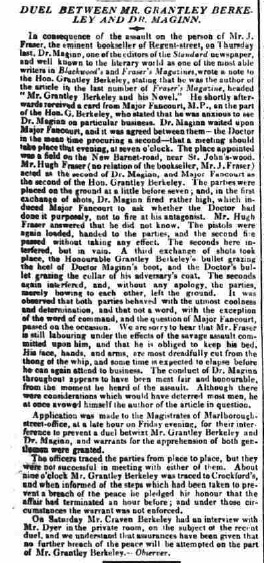 |
| Evening Chronicle (London), Monday, August 8 [1836], p.4. |
|
| —Full-page PDF supplied by Colin Smythe (email - 20.08.2015). |
[ top ]
W. M. Thackeray: ‘Everybody [in Cork] seemed to know what Maginn was doing [...]’ (Irish Sketchbook, 1842; rep. Blackstaff, 1985), p.84. Captain Shandon in Thackeray’s ballad is generally taken to represent William Maginn. And see the Dictionary of National Biography article by ‘R.G.’, which discusses probability of Thackeray’s claim to have lent £500 to Maginn at a time when his own financial records show that he could ill afford it. Charged with ‘fostering baneful prejudice against literary men’, he replied in Morning Chronicle (12 Jan. 1850), making reference to ‘someone not unlike Captain Shandon in prison’ to whom his bookseller brings financial assistance. (See John A. Gamble under W. M. Thackeray > infra.)
R. W. Montague, ed., Miscellanies, 2 vols. (1885). Preface notes that Fraser’s nickname for Maginn was “Regina”; called ‘bright broken Maginn’ by Lockhart; Thackeray’s Captain Shandon; beginner of Blackwood’s Noctes Ambrosianiae; Shakespeare Papers, pref. George Saintsbury (ed.?) in an essay on Shakespeare’s characters, Falstaff [whom he defends with Hazlitt against Dr. Johnson], Jacques, Romeo, Polonius, Iago, & ‘his ladies’; J. C. Mangan, “Nameless One” suggests that Maginn and Burns ‘fell into the pit abyssmal and sold his soul for the Devil’s dismal returns’; also derides James Hays and Lady Morgan; Memoir of Morgan O’Doherty, his leading comic character. Parody of Coleridge’s “Christobel”, ‘Listen! Ye know that I am mad / And ye will listen …’.
Louise Imogen Guiney, James Clarence Mangan, His Selected Poems (London: John Lane 1897): ‘It seems ironic to recall to the present generation of readers the Sir Morgan Odoherty of Blackwood’s, the star of Fraser’s and the Noctes, now cinis et manes et fabula, the joyous, the learned, the amazing William Maginn, LL.D., who, because he reaped a temporal reward as the most magazinable of men, has all but perished from the heaven of remembered literature.’ (‘A Study’ [i.e., introduction], p.35.)
[ top ]
John Gross, The Rise and Fall of the Man of Letters: English Literary Life since 1800 (1973), Chapter 1: ‘The Rise of the Reviewer’: ‘[...] Like several of his satellites - the folklorist Crofton Croker, for instance, and F. S. Mahoney, the learned ex-Jesuit who wrote comic verse under the name of Father Prout, Maginn originally came from Cork. A child prodigy, he was already fluent in Latin, Greek and Hebrew when he entered Trinity College, Dublin, at the age of eleven. He went on to master an extraordinary number of languages, ancient and modern, and to graduate as a precocious LL.D. - to the Fraserians he was inevitably ‘the Doctor’. After ten in his home town, he decided to settle (if that [27] is the right, word) in London; by this time he was an accredited member of the Blackwood’s team, having initially clambered aboard the magazine behind a smokescreen of facetious mystification which must have bewildered even Christopher North. His stamina was prodigious: he scribbled incessantly, everything from scurrilous paragraphs of political gossip to notes for his projected editions of Homer and Shakespeare. And as Dr. Johnson said of Richard Savage, ‘at no time of his life was it any part of his character to be the first of the company that desired to separate’. [Cont.]
John Gross (The Rise and Fall of the Man of Letters, 1973) - cont. ‘In the end drink got the better him, and his last few years were a reckless plunge downhill into gin-sodden obscurity. He intimidated contemporaries: one can get some idea both of his learning and of his misplaced polemical vigour from his slashing attack – a small book in itself - on the eighteenth-century Shakespearean scholar Dr. Farmer. But nothing he wrote has lasted, not even the once- popular Homeric ballads which Matthew Arnold rated much higher than Macaulay’s Lays of Ancient Rome. If he and his henchmen can be said to survive anywhere, it is in the elegant, slightly mocking outline portraits by Daniel Maclise, another exile from Cork, which were the most popular single feature in Fraser’s and which remained collectors’ items for years afterwards - greatly admired, among others, by Goethe.’ [Cont.]
John Gross (The Rise and Fall of the Man of Letters, 1973) - cont. ‘Maginn’s career is a reminder that economic conditions are never quite enough in themselves to account for the calamities of Grub Street. A man of his stamp would have come to grief in any period, and all the patronage in the world would hardly have sufficed to damp down his talent for self-destruction. In a sense, though, he was the last of his breed. By the 1840s the kind of raffishness which he represented was being driven steadily underground. Fraser’s quietened down and eventually re-emerged as an eminently respectable publication edited by J. A. Froude; within a year or two of Christopher North’s Blackwood’s was serializing Scenes of Clerical Life. [...]’ Quotes Lockhart’s epitaph [as infra].
Patrick Rafroidi, Irish Literature in English, The Romantic Period, 1789-1850 (1980), , Vol 1: William Maginn’s record of anti-Romanticism; not author of the odious pastiches of Coleridge published in Blackwood’s as ‘The Rime of the Ancient Waggonere’ and ‘Christabel, Part III’. (Blackwood’s Magazine, IV, 571, and V, 286. These were by David Muir, as M. Thrall has shown (see Rebellious Fraser’s, pp.305-06). Maginn did however parody Wordsworth, lady Morgan, O’Connell, and Moore. [18]. Maginn attacked Moore in a comic piece [as in Quotations, infra]. William Maginn, ‘Maxims of Sir Morgan O’Doherty, Bart.’, published in book-form in 1849. [4 specimens in Rafroidi, e.g., ‘LXIIth, Ass-milk, they say, tastes exceedingly like a woman’s. No wonder.’ [24]. Note also that Mahony sided with Henry O’Brien in his accusation that Thomas Moore plagiarised the latter in his History of Ireland [O’Brien, q.v.]. [See also Rafroidi, under References, infra.]
[ top ]
Claire Connolly, ‘Irish Romanticism, 1800-1839’, in Cambridge History of Irish Literature (Cambridge UP 2006), Vol. I [Chap. 10], p.407-48: ‘Moore had a bitter political and literary enemy in the Cork-born writer William Maginn (794-1842): hostile to Moore’s luxuriant verse and to Lady Morgan’s Romantic nationalism (always connected with the Whiggism of both), Maginn was a vocal spokesperson for the crusty circle that gathered around Blackwood’s Edinburgh Magazine. The talented son of a Cork schoolmaster, Maginn began writing for Blackwood’s from Cork (a place, remarks Mrs Oliphant, William Blackwood’s daughter-in-law and memoirist, “more associated with pigs and salted provisions than with literature”), and finally moved to Edinburgh in 1823. Oliphant wonders at how he ‘took up the tone, and even the local colour’ of Edinburgh before even visiting there; one answer may be found in the connection (suggested by Terry Eagleton) between Maginn’s beleaguered Cork Protestantism and the reactionary Toryism of the 1820s. A further reason may lie in the magazine’s embrace of “the nationalist discourses of the post-Enlightenment”, including antiquarianism and vernacular poetry. Maginn remained deeply sceptical of the forms of literary Irishness practised by Moore and Morgan, but it is important to note that the Blackwood’s context offered an alternative form of cultural nationalism - one better fitted for his own politics - rather than a rejection of its tenets.’ (p.437.) [Cont.]
Claire Connolly, ‘Irish Romanticism, 1800-1839’ (2006) - cont.: ‘In a letter Maginn tries to explain to William Blackwood the particular antipathy to Catholic emancipation experienced in his native Cork: ‘If you were in Ireland you would not wonder at our hostility. I never knew a traveller from the sister island, even were he bitten by the Edinburgh Review ... who did not leave Ireland with the same feeling.’ Maginn’s criticisms of Moore similarly upbraid him for a lack of local knowledge, accusing him of only paying lip-service to ‘our localities’ and refuting his ‘absurd’ and ‘unlrish’ Melodies in ringing Munster metaphors. This ‘crystallised Paddy’ (in Mrs Oliphant’s terms) quickly became the star of the Blackwood’s scene, favourite spokesperson for its Tory politics and dislike of literary innovation. / Maginn’s own writings, however, roamed across a precocious range of genres and voices. ‘Some Account of the Life and Writings of Ensign and Adjutant Odoherty, late of the 99th regiment’ was first published in the Blackwood’s Edinburgh Magazine of February 1818 and became a regular feature of the journal. In these admiring memoirs of a sometime poet, militiaman and soldier, Odoherty [437] presents himself in a drunken overblown style that consistently undercuts his many claims to virtue and excellence. Maginn offers such specimens of Odoherty’s verse as “Odoherty”s Garland in honour of Mrs Cook, The Great’ and “The Eve of St. Jerry” in which he stretches the resources of vocabulary and grammar to ludicrous effect.’ (pp.437-38.)
Claire Connolly, ‘Irish Romanticism, 1800-1839’ (2006) - cont.: ‘Maginn’s poetry brilliantly mocks Romantic literary values (the fragment, the cult of the imagination, the elevation of subjective genius). The high disdain for literary originality, the combination of prose and poetry, the use of Arabic languages and typography, and the inebriated and eccentric range of voices deployed all prefigure the work of James Clarence Mangan. Maginn, however, left nothing as serious or politically committed as Mangan’s lyrics or ringing refrains, and his cranky Cork genius soon faded from the vision of a literary establishment that became more sternly nationalist in outlook as the century progressed.’ (pp.437-38; for longer extracts from this chapter - including notes omitted here - see RICORSO Library, “Irish Critical Classics”, via index, or direct; and note prominence of references to Terry Eagleton, ‘Cork and the Carnavalesque’, in Crazy John and the Bishop: Essays in Irish Culture, Cork UP 1998, pp.199-206. )
[ top ]
W. B. Stanford, Ireland and the Classical Tradition (1984), Eccentric efforts of an Irishman of brilliant but undisciplined talents, the Homeric Ballads (1838) by William Maginn, influential in their day. b. Cork, 1794, he entered TCD in 1811 and took a doctorate in 1819; an undergraduate poem called Aeneas the Eunuch has not survived; went to London as a result of the good reception of his contributions to Blackwood’s; portrayed as Captain Shandon in Pendennis, calling him ‘one of the wittiest, most amiable, and the most incorrigible of Irishmen’. Quarrelled with Blackwood’s and began to publish his ‘Homeric Ballads’ in Fraser’s Magazine in 1838; rendered the Homeric poems in popular metres instead of iambic pentameters, in keeping with the current theory of their popular origin, criticised as a perversion by some, but regarded by Gladstone as ‘admirably turned Homeric tone’, and Arnold rated them above Macauley’s Lays of Ancient Rome, calling them ‘genuine poems in their own way’. [Standford also notes a twentieth-century scholar’s comment that it is hard to ‘see how they escaped instant condemnation’; cited in Michael Cronin, Translating Ireland: Translations, Languages, Cultures, Cork UP 1996, p.121]; Stanford cites two ‘egregious examples’ [170-71], and asserts that the best are hardly better than mediocre. Maginn added notes and an introduction which show considerable acumen; other experiments include translations of dialogues by Lucian into blank-verse comedies; he projected edns. of Homer and the Greek dramatists; after imprisonment for debt, he died in 1842 and lay in an unmarked grave until 1926, when subscribers had a Celtic cross erected. Lockhart’s epitaph ends: ‘Many worse, few better, than bright broken Maginn.’ [171]
[ top ]
| For a selection of his writings in verse and prose, go to RICORSO Library, “Various Authors”, via index, or direct. |
[ top ]
Tom Moore: ‘It has often struck me with astonishment that the people of Ireland should have so tamely submitted to Mr Thomas Moore’s audacity, in prefixing the title of Irish to his Melodies. That the tune are Irish, I admit; but as for the songs, they in general have as much to do with Ireland as with Nova Scotia ... [T]here would be no end were I to point out all the un-Irish points of Moore’s poetry. Allusions to our localities, it is true, we sometimes meet with [...] there’s the ‘Vale of Avoca’, for instance, a song upon a Valley in Wicklow, but which would suit any other valley in the world, provided always that it had three syllables, and the middle one of due length. / Were I in savage mood, I would cut him up with as much ease as a butcher in Ormond market dissects an ox from the county of Tipperary; but I shall spare him for this time […]’ (Rep. in Magazine Miscellanies, 1841, p.126; quoted in Patrick Rafroidi, Irish Literature in English, The Romantic Period, 1789-1850, 1980, Vol 1, p.22.)
Roscrea whiskey [respecting the character of wine as an Irish drinker’s choice]: ‘a bottle of grape-juice, which would not be within five quarts of relieving me from the horrors of sobriety, when for the selfsame sum I could stow under my belt a full gallon of Roscrea.’ (Quoted in Patrick Rafroidi, Irish Literature in English, The Romantic Period, 1789-1850, 1980, Vol 1, p.22.)
[ top ]
References
Dictionary of National Biography, William Maginn, LLD, b. Marlboro Fort, Cork, 10 July; TCD BA, 1811; LLD, 1819; took off Moore’s style perfectly and perpetrated a parody of Adonais more inept, if possible, than his previous parody of Christabel.... Some suspension for some unexplained reason of his contributions to Blackwood in 1828 left him free for the most memorable of his undertakings, the est. of Fraser’s Magazine, in 1830.
| D. J. O’Donoghue, The Poets of Ireland (Dublin: Hodges Figgis 1912) - “William Maginn, LL.D.”;. O’Donoghue quotes two poetical titles — Eneas Eunuchus (published while at Trinity College, Dublin), Homeric Ballads (London 1850), and Miscellanies ion Prose and Verse, 2 vols. (London, 1835) - which serve him as a pretext for an untypically long biographical notice which supplies much detail on his journal contributions, pseudonyms and frequently disputed authorship of certain novels - though typically free from paragraph-breaks - as follows: |
|
| (End; pp.295-79; available online - accessed 28.06.2024.) |
| Idem - in Summary (BS 15.04.1998) |
| D. J. O’Donoghue, Poets of Ireland (Dublin: Hodges Figgis 1912), lists Eneas Eunuchus [published while at TCD]; Homeric Ballads (Lon 1850); Miscellanies in Prose and Verse (2 vols., London 1835); pseuds are Morgan O’Doherty; M. O’D.; R.T.S.; Olinthus Petre, D.D.; Rev. E. Hincks, F.T.C.D.; Morty MacNamara Mulligan; Philip Forager; Richard Dowden; Wm. Holt; An Irish Gentleman lately Deceased; Bob Buller; Giles Middlestitch; Thomas Jennings, Soda Water Manufacturer; Blaize FitzTravesty, Esq.; Rev. J. Barrett, DD FTCD; R.F.P; Augustinus; P.T.T.; W. Seward; Ralph Tuckett Scott; John T-n; etc., etc.; m. Ellan, dg. Robert Bullen, of Mallow; assumed names in Literary Gazette were Dionysius Duggan; P. P. Crossman; P.P.P; P. J. Crossman; and C. O. Crossman; published satirical novel Whitehall, or the Days of George IV (1827); other works include Tales of Military Life (c.1841), being the only one to bear his name on the title page; Dr. Kenealy was the only one present at his funeral; Miscellanies, 5 vols. (1857) ed. Dr. Mackenzie in America and reissued in selection 2 vols. (London 1885). |
Justin McCarthy, gen. ed., Irish Literature (Washington: CUA 1904), gives ‘Bob Burke’s Duel with Ensign Brady’ and ‘Daniel O’Rourke’.
[ top ]
Justin McCarthy, ed., Irish Literature (Washington: Catholic Univ. of America 1904), contains a long biographical notice, beginning with the story of his jocose manner of introducing himself to Moir [Muir], the Blackwood’s editor; selects “Bob Burke’s Duel with Ensign Brady” and “Daniel O’Rourke” [written for Crofton Croker’s Fairy Legends, and attributed long after], both prose pieces; no verse.
Stephen Brown, Ireland in Fiction [Pt. I] (Dublin: Maunsel 1919), lists Miscellanies, Prose and Verse [1840]; IF2 adds Ten Tales (1933); A Story Without a Tail (1928); and The Maxims of Sir Morgan O’Doherty (1849). [Check for reprints.]
[ top ]
Brian McKenna, Irish Literature, 1800-1875: A Guide to Information Sources (Detroit: Gale Research Co. 1978), citing Micheal Sadlier, ‘William Maginn ... Bibl. and Epitaph’, in Bulwer, A Panorama, Edward and Rosina 1803-1836 (London 1931), pp.419-21; also a bibliography by Miriam M. H. Thrall in Rebellious Fraser’s [ ... &c.]. (NY 1934), and Wellesley’s Index to Victorian Periodicals. Biogs. incl. Edward Vaughan Kenealy, ‘Our Portrait Gallery’, no. 34, William Maginn LLD, Dublin University Magazine 23 (1844), pp.72-101; John Lyle Donaghy (Dublin Mag., 1938); see also J. S. Crone in Irish Book Lover, 26 (1939). WORKS, Miscellaneous Writings of the Late Dr. Maginn, ed. R Skelton MacKenzie, 5 vols. (NY 1855-57), I & II, the O’Doherty Papers; III The Shakespeare Papers; IV, The Homeric Ballads; V, The Fraserian Papers; R. S. MacKenzie ed., Noctes Ambrosianae, 5 vols. (NY 1863-65); R. W. Montagu, ed., Miscellanies, Prose and Verse, 2 vols. (Lon. 1885); also Ten Tales (1933), reviewed by Patrick S. O’Hegarty in Dublin Magazine (1934).
John Sutherland, The Longman Companion to Victorian Fiction (Longmans 1988; rep. 1989), remarks on astonishing amount of literary activity [during] short, debaunched life; b. Cork, schoolmaster’s son; precocious; ed. TCD; classics BA Mod., 1811; law doctorate, 1819, after school-teaching with his father; contrib. Blackwood’s Magazine, and Literary Gazette; leading Blackwood’s author in Edinburgh after 1821; generally used pseud. Morgan O’Doherty; London, 1823; connection with Laetitia Landon (L.E.L), till her mysterious death in 1838; by-word for dissipation; Whitehall, or the Days of George IV (1827), satirical novel; broke with Blackwood’s in 1828 and fnd. Fraser’s Magazine in 1830; duelled with author of Berkeley Castle following his review, in 1836; debtor’s prison in 1837; protrayed unflattering affection as Captain Shandon in Thackeray’s Pendennis; began John Manesty, issued posthumously. Sutherland lists John Manesty, The Liverpool Merchant, ill. George Cruickshank (1844; ser. Ainsworth’s Magazine, intermittently July 1843-Feb. 1844); inedited work completed by Charles Ollier for Ainsworth to relieve family distress after Maginn’s early death from debauchery; starts brilliantly with description of Liverpool in 1760s, a city built on slavery; continues with grotesque theatricality rather than Maginn’s characteristic wit. See also note under W. H. Maxwell: Maginn prefaces Erin Go Bragh with a biographical sketch (1859), presumably taken from his Literary Portraits [1840].
Patrick Rafroidi, Irish Literature in English, The Romantic Period, 1789-1850 (1980), Vol 2: biog. note: Maginn, b. Cork, son of headmaster in Marlboro St. school, a remarkable teacher, whom he succeeded; qualified as lawyer at 25; contr. Advertiser, Freeholder, Literary Gazette and Blackwood’s; m. Ellen Bullen, 1823, and went to London; Paris, 1824; ed. The Standard, and later Fraser’s. His health damaged by a ‘platonic’ affair with Letitia Landon; baled out of debt by Thackeray and friends; d. of tuberculosis. Bibl. of Works and Criticism, as supra.] Note: Rafroidi asserts that Maginn edited Gallery of Illustrious Characters - including, for instance, a sketch of Béranger by Sylvester Mahony [“Father Prout”].
Seamus Deane, gen. ed., Field Day Anthology of Irish Writing (Derry: Field Day 1991), Vol. 2, selects from The O’Doherty Papers (1855), “The Wine-Bibber’s Glory, A New Song”, “Toporis Gloria, a Latin Melody”, “Tis the Last Glass of Claret [18-20]; remarks at 4, 9, 1011, and 112, BIOG: took over as principal of father’s Marlborough St. school at his death, and after TCD degree; m. 1823, and devoted to writing; fnd. Fraser’s Magazine with Hugh Fraser; best work in it incl. Homeric Ballads, and A Gallery of Literary Portraits; joint ed. Evening Standard, contrib. Punch and Lit. Gazette; one of the most important contribs. to Noctes Ambrosianae, 1822-35; d. of tuberculosis at Walton-on-Thames shortly after release from debtors’ prison. Noctes Ambrosianae, 5 vols. (NY 1863-65) contains his various contribs. to famous series of dialogues between J. G. Lockhart, J. Wilson, J. Hogg, et el.; R. W. Montague, ed., Miscellanies, Prose and Verse, 2 vols. (London 1885); Whitehall [...&c.] (1827; never reprinted).
Belfast Central Public Library holds Miscellanies, Prose and Verse (1885); Shakespeare Papers (1860); A Story without a Tail (1928); Ten Tales (1933).
[ top ]
Notes
M. J. Barry: Barry alludes a paper by Maginn on subject of Irish Songs, ‘in which he exposes with his usual wit and ability, the spuriousness of a number of these stupid caricatures’ (Blackwood’s Magazine, Vol. 17 [q.d.] p.318). See Preface of Songs of Ireland (Dublin: James Duffy 1845), ftn.
Variants: Maginn’s posthumous editor is cited as R. Sheldon Makenzie in Brian McKenna, Irish Literature, 1800-1875: A Guide to Information Sources (Detroit: Gale Research Co. 1978), and do. in Robert Hogan, ed., Dictionary of Irish Literature (Dublin: Gill & Macmillan 1979), but called J. S. Knowles in Patrick Rafroidi, Irish Literature in English: The Romantic Period, 1789-1850 (Gerrards Cross: Colin Smythe 1980).
[ top ]