       |
Life
| 1955- ; b. 5 July, Dublin, son of Francis J. Barry, architect, and the Abbey actress Joan O’Hara, and hence a nephew of the singer Mary O’Hara [m. Pat O’Toole form the Aran Islands]; siblings Jane, Siuban, and Guy; first lived with parents in flat on St. Stephen’s Green, later at Dartmouth Square; spent four early years in London; later again in the Turret Apartment at Dalkey Castle, and finally 27 Longford Tce., Monkstown, [Dun Laoghaire]; ed. Catholic University School, for matriculation purposes, and afterwards TCD (grad. Latin & English); stayed at 21 Mountjoy Sq., in 1974 - a delapidated Georgian House under student occupation; travelled in the USA and lived in Paris, England, Greece and Switzerland, 1977-85; returned to Dublin; received Arts Council Bursary, 1982; issued first novel, Macker’s Garden (1982) and then Strappado Square (1983), both for children; issued Elsewhere: The Adventures of Belemus (1985) for younger readers; he wrote The Engine of Owl-Light (1987) - an autobiographical novel in an experimental, multi-style manner; issued poetry collections, The Water Colourist (1983), The Rhetorical Town (1985), and Fanny Hawkes Goes to the Mainland Forever (1989); |
| worked as Honorary Fellow in Writing at the University of Iowa (1984); issued an experimental novel, The Engine of Owl-Light (1987); a first play, The Pentagonal Dream, a one-woman play performed at An Damer [Damer Hall], Feb. 1986; wrote Boss Grady’s Boys (Peacock 1989), about Mick and Josey, two old fellas working on a hill-farm on the Cork-Kerry border, still dreaming of the Wild West; winner of inaugural BBC/Stewart Parker Award, concerning the last days of two old brothers, Mick and Josie Kelly (resp. Eamon Kelly and Jim Norton); elected to Aosdána, 1989; wrote Prayers of Sherkin (Peacock 1990; Old Vic, London, May 1997), set in 1890s and based on youth and marriage Fanny Hawkes, - supposedly the playwright’s grandmother - who leaves the island where her Quaker people are settled following the flight of Matt Purdy from industrial Manchester a century earlier; |
| appt. Ansbacher writer-in-residence at the Abbey Theatre, 1990; appt. member of the Abbey Board, 1990-91; wrote White Woman Street (Peacock and Bush, London 1992), set in Southern States of America, and dealing with Irish emigration and in particular a great-uncle who went off to join the army; produced in Manhattan by Daedalus Theatre Co.; wrote The Only True History of Lizzie Finn (Abbey, Oct. 1995), based on his grandmother and dealing with economic decay and social snobbery among the landowning class of the 1890s; wrote Steward of Christendom (Royal Court Upstairs 1995; Gate 1995), the narrative of a former Dublin Metropolitan Police commissioner, born in Baltinglass and ending in an asylum; dir. Max Stafford-Clark, in Out-of-Joint Company début with Donal McCann as Thomas Dunne in the title role, attracting ovations in London, Dublin and Broadway (NY); |
| winner of Lloyds Private Banking Playwright of the Year Award, 1995; Writing Fellow, TCD, 1995-96; awarded Ewart Biggs Peace Prize for Steward of Christendom, March 1997, judged by Roy Foster and others; received Ireland Fund Writer’s Award (£10,000), June 1997; death of Donal McCann, July 1999 - leaving Barry to continue (in his own encomiastic words) ‘like a bird on one wing’; his Prayers of Sherkin revived at Old Vic, London (May-June, 1997); winner of Ireland Fund Literary Award, 1997; issued The Whereabouts of Eneas McNulty (Feb. 1998), novel of an RIC-man who turns world-traveller and finally returns to a hostile Ireland; wrote Our Lady of Sligo (1997), concerning a grandmother, portrayed as Mai O’Hara, who died in 1953 in a middle-class tragedy of ‘fuelled by alcohol and despair’; premiered at Cottesloe Theatre, London (July, 1997), directed for Out of Joint by Max Stafford-Clark for Out of Joint Co., with Sinéad Cusack in the title role, Nigel Terry as Jack, and Catherine Cusack as Joanie; |
| issued Annie Dunne (2002), a novel set in Co. Wicklow about the hunch-back daughter of Thomas Dunne and her Dublin nephews, now departing into the modern Irish world; an extract of Annie Dunne was published in Dublin Review, 5 (Winter, 2001-02); trans. The House of Bernarda Alba, by Frederico García Lorca (Abbey, April 2003), adapted by Barry with his mother Joan O’Hara in the lead role; Whistling Psyche premiered at the Almeida Th., Islington, London (May-June 2004; dir. Robert Delamere), based on a supposed meeting of the transgendered Dr. James Barry and Florence Nightingale of Crimea fame in a station waitingroom in 1910, with Kathryn Hunter and Clare Bloom in the respective roles - the Psyche of the title being a poodle belonging to Barry; issued new poems, The Pinkening Boy (2004); gave “Rattlebag” broadcast interview for RTÉ at Dun Laoghaire Pavilion Theatre, 29 March 2005; issued A Long Long Way (2005), a novel about Willie Dunne, the soldier son of Tom Dunne of Steward in the First World War; shortlisted for the Man Booker Prize in the year when it was won by John Banville; |
| issued The Secret Scripture (2008), the story of Roseanne Clear [née McNulty - sis. of Aeneas], who reconstructs her life in notebooks hidden under the floorboards of her room in an asylum in Roscommon at the age of 100; his play The Pride of Parnell Street, a play of intertwining dialogues, deals with the marriage and rupture of two petty-criminals and their shared love of Dublin [‘But also even the worst sin can’t wipe out a love, you know?’; premiered by Fishamble in 2007, played at Tricycle (London), and later in New York in 2009, and revived by Fishamble to tour Ireland in 2011; winner of the 2008 Costa Book of Year, the [Ryan] Tubridy Show Listeners’ Choice (RTÉ), and the Hughes Irish Novel of the Year Award, 2009; premier of his Tales of Ballycumber (Abbey Oct. 2009) - set in Tinahely, Co. Wicklow; suffered the death of his mother, Joan O’Hara, d. 23 July 2007 - from cancer; |
| premier of Andersen’s English (Hamstead, London; April-May 2010), a play dealing with the visit of Hans Christian Andersen to Charles Dickens’s home in 1857, dir. Max Stafford-Clark, with David Rintoul as Dickens, Danny Sapani as Andersen and Niamh Cusack as Catherine, Dickens’ soon-to-be-discarded wife; issued On Canaan’s Side (2011), the narrative of Willie Dunne’s sister Lily Bere, set in Dublin and Chicago, and concluding with the suicide of her beloved grandson in the Gulf War - the “long story of suffering and glory” of individuals and nations; the novel, with was shortlisted for the Man Booker Prize and heavily favoured, takes its title from a contemporary reflection on the death of Martin Luther King, echoing the African American spiritual which serves the novel as an epigraph [‘Livin’ on Canaan’s side, Egypt behind / Crossed over Jordan wide, gladness to find’]; winner of the Walter Scott Award for Historical Fiction June 2012; |
| issued The Temporary Gentleman (2014), concerning Jack McNulty, br. of Eneas McNulty and modelled on the author’s maternal grandfather - a British officer who served as an engineer in World War II and afterwards in Africa in the late 1950s, addicted to drink and gambling and now reflecting on his ruined marriage and family life in Ireland; The Secret Scripture was filmed by Jim Sheridan, with Rooney Mara and Vanessa Redgrave as Roseanne McNulty, young and old, in 2016 - to be met with the author’s objections to changes in the narrative, though faithful to the ending; participated with Roy Foster in Easter Rising Centenary Symposium at Baylor University, MC, with lecture (Foster) conversation, and reading, 22 March 2016; issued Days Without End (2017), the story of Thomas [later “Thomasina”] McNulty and John Cole, set in Civil War America - with a transgender protagonist and an adopted Indian child, Winona; winner of Costa Book of the Year [‘a miracle of a book’] - for the author’s second time; the homosexual relationship between Thomas McNulty and John Cole inspired by his son Toby but also owes to Annie Proulx’s “Brokeback Mountain”; |
| second-time winner of the Walter Scott Historical Novel Award with Days Without End, June 2017 - for a work of ‘Unfaltering power and authenticity’; a new play, On Blueberry Hill, premiered by Fishamble at Pavilion Th., Dun Laoghaire, dir. Jim Culleton satge design by Sabine Dargent, during the Dublin Theatre Festival (Sept.-Oct. 2017), with David Ganly and Niall Buggy in the two-hander Mountjoy prisoner roles; and travelled to the Centre Culturel Irlandais in Paris in October 2017; later played in New York, and finally in London at Trafalgar Studios, West End, 5-16, May 2020; Barry addressed at the Hay Film Festival (May-June 2017), with Colm Tóibín and others; appointed Irish Fiction Laureate, succeeding Anne Enright, by a panel chaired by Paul Muldoon, and annouced by President Higgins, Feb. 2018; delivered a Laureate lecture on ‘Lives of the Saints’ at QUB, May 2019; |
| issued A Thousand Moons (2020); issued Old God’s Time (2023), in which Tom Kettle, retired policeman, revisits the abuse suffered by his dead wife at the hands of the Catholic clergy when a cold case is reopened; his literary papers are held in the Ransom Humanities Centre of Texas University, which he visited in April 2006 following their acquisition in 2001 with additional material in 2005; Barry lives in a former rectory at Tinahely, Co. Wicklow, with his wife Ali (Alison, née Deegan), dg. of a Prodestant Irish policeman who appeared in Prayers of Sherkin and in the BBC television series Casualty; with whom three children - twins Coral, Merlin (b. 1993) and Toby (b.1998). DIW FDA OCIL DIL |
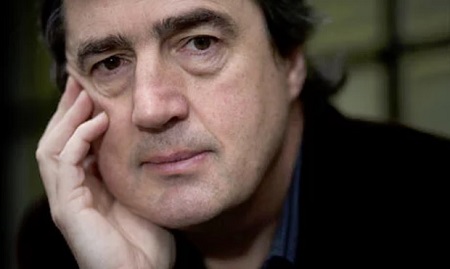 |
| Sebastian Barry (photo by Teri Pengilley) |
|
[ top ]
Works| Poetry | |||
|
|||
| Plays | |||
|
|||
| Collected Plays | |||
|
|||
| Anthologised | |||
|
|||
| Fiction | |||
|
|||
| Memoir | |||
|
|||
|
|||
|
|||
| Miscellaneous’ | |||
|
|||
| [ top ] |
Bibliographical details
| See a copy of the title-page, contents, and Introduction to The Inherited Boundaries: Younger Poets of the Irish Republic (Dolmen 1986), in RICORSO, Bibliography, “Anthologies”, attached. |
[ top ]
| Poems in The Inherited Boundaries: Younger Poets of the Republic of Ireland, ed. Sebastian Barry (Dolmen 1986) | ||||||||||||||
|
|
||||
Stewardship of Christendom (1995), a play in which Thomas Dunne, formerly the last Dublin Metropolitan Police commissioner (based on a forebear of the author, James Patrick Dunne), and the one who handed the keys of Dublin Castle over to Michael Collins, recalls his service with emphasis on his reaction to the Dublin Lock-Out strike for which he was anathemised by the nationalist press; now incarcetated in a ‘home’ in Co Dublin and faced with the resentment of his three daughters and the torment of a warder who treats him as an enemy of the Irish people; ends with a moving reminiscence of his own childhood with his father and the sparing of a sheep-killer dog, and finally with a vision of his own son who died in Flanders. The play restores regard for those who served Ireland in ways at variance with the nationalist narrative of struggle and independence from British Rule and includes a paean to Queen Victoria, but also a profound expression of admiration for Michael Collins. (See extracts.)
Amazon notice (pb. 1 Jan 2001): The Steward of Christendom established Barry as one of Ireland’s most powerful contemporary playwrights Thomas Dunne, ex-chief superintendent of the Dublin Metropolitan police looks back on his career built during the latter years of Queen Victoria’s empire, from his home in Baltinglass in Dublin in 1932. Like King Lear, Dunne tries valiantly to break free of history and himself. The Steward of Christendom took London by storm when it premiered at the Royal Court Theatre Upstairs in March 1995 with Donal McCann in the title role. It transferred to Broadway and has toured around the world. ’Sebastian Barry’s beautiful and devastating memory play ... will stay with us for many years.’ (New York Times)
Far from the Land: Contemporary Irish Plays (London: Methuen 1998), xiv, 340pp. CONTENTS [Plays]: Vincent Woods, At the Black Pig’s Dyke; Daragh Carville, Language Roulette; Enda Walsh, Disco Pigs; Donal O’Kelly, Bat the Father, Rabbit the Son; Patrick McCabe, Frank Pig Says Hello; Conall Morrison, Hard to Believe.
Hinterland (2002) [a play]: ‘Johnny Silvester, from Derry - a character loosely based on Charles Haughey - has been Taoiseach of the Republic of Ireland and now lives in opulence in a country house outside Dublin, facing political disgrace due to his self-serving political management of the country. His wife Daisy is on her way to the country for a weekend visit to her cousin while Johnny stays at home to give an interview to the young woman who is writing a PhD on his period of government; a mistress arrives and a son, living in the house, attempts suicide; Daisy returns to a moment of confrontation involving a tragi-comical cupboard-hiding scene while the habitually self-exonerating central figure struggles with the charge of failure on all fronts, familial and public, and is comprehensively exposed as a straw man.
Venues: The play was premiered at the Octagon Theatre (Bolton, Jan 2002), transferring to the Abbey (30 Jan.-23 Feb.) before opening at the Royal National Th. (London) in March 2002; it was an Out Of Joint/Abbey Theatre/Royal National Theatre co-production with a cast incl. Patrick Malahide, Dearbhla Molloy, Phelim Drew, Kieran Ahern, James Hayes, Anna Healy and Lucianne McEvoy.
Charlie Haughey: Jody Corcoran, ‘Haughey Fury at Abbey Plan’ [news story], reports that Sean Haughey - son of the ex-premier - has told the Sunday Independent that there was ‘a basis for consideration of legal action’ (Sunday Independent, 10 Feb. 2001) - later disregarded.
[ top ]
Whistling Psyche (2004), a play: Miranda James Stuart, who passed herself off as a military surgeon James Barry, has a chance encounter with Florence Nightingale of Crimea fame in a railway station waiting room; in the cold hours between nightfall and daybreak, silent questions prompt unexpected revelations ending in the baring of Dr. Barry’s femininity and the stripping of Miss Nightingale’s.
Fred and Jane (pub. 2004) - the accompanying play (Faber 2009) - explores the deep and sustaining friendship between two nuns, Anna and Beatrice, as they recall the trials and joys of religious life. (See COPAC online.)
Whistling Psyche (2004) deals with the imaginary meeting and chance encounter betweem of Dr. James Barry and Florence Nightingale, and ends with a degree of rapprochement. In the printed text, the play concludes with a tableau, in which the characters have ‘a quality of a Victorian daguerreotype about them - a strange mariage, an unacceptable couple. [...] Their nearest hands just touching, perhaps by accident.’ (Whistling Psyche, Faber, 2004, p.61; quoted in Munira H. Mutran, ‘The Mysterious Dimension of the Human Spirit’: Sebastian Barry’s Whistling Psyche’, in From English Literature to Literatures in English [Vol. V], Heidelberg 2005, pp.184.) However, in the first production at the Almeida Theatre, London, Nightingale unwraps the swathes about the other’s chest and, finally, the pair embrace. [See Mutran’s remarks on this adjustment under Commentary, supra - and biographical notice on James Barry > Notes - infra.)
See also Barry’s acknowledgements in Whistling Psyche (Faber 2004), citing the biographies that went to the making of the play - viz., The Perfect Gentleman: The Remarkable Life of Dr. James Miranda Barry, the woman who served as an officer in the British Army from 1813 to 1859 (Hutchinson 1977), by June Rose; Florence Nightingale: 1820-1910 (London: Constable 1950), by Cecil Woodham-Smith and the chapter on Miss Nightingale in Eminent Victorians (London: Chatto & Windus 1966) by Lytton Strachey. (All cited thus in Mutran, op. cit., 2005, pp.184.)
The Pride of Parnell Street (2007): The score that marked Ireland’s demoralizing exit from Italia ’90 took its toll. No more so than for Janet and Joe Brady of Parnell Street who lost far more than the match that night. Some years on, Joe and Janet reveal the intimacies of their love and the rupture of their marriage, through interconnecting monologues that also evoke their life-long love affair with Dublin city itself. Barry explores with vivid tenderness the devastating effects of public and private acts of violence. This is an intimate, heroic tale of ordinary and extraordinary life on the streets of Dublin. Fishamble’s world premiere of The Pride of Parnell Street opened at the Tricycle Theatre, London, and as part of the Dublin Theatre Festival at the Tivoli Theatre, Dublin, in September 2007. (See Faber Notice - online.)
Tales of Ballycumber (2009) - a play with cast: Nicolas (a farmer), Evans (a young friend), Andrew (Evan’s father), Tania Nicholas’s sister), A Girl. Opening stage-directions, of Nicholas: -[...] a dark-haired dark-faced farmer [punct. sic] of possibly Cromwelian stock; he could be be in his mid-forties or fifty, hard to say. He wears clothes with no regard at all for anything except their nearness to hand and their usefulness [...] He speaks with a Wickow accent of the district around Tinahely [...] His [...] family is called Farquhar and has been in Ireland since the sixteenth century, although perhaps Nicolas himself is no longer aware of that.’ (Sample available at Google Books - online; accessed 30.05.2017.)
On Blueberry Hill - produced by Fishamble:The New Play Company, at Pavilion Theatre, Dun Laoghaire (Co. Dublin), during the Dublin Theatre Festival (28 Sept.-15 Oct. 2017) - featuring best of friends and worst of enemies Christy and PJ, played by Niall Buggy and David Ganly. Excerpt: ‘Now we’ve lived together in contentment, more or less, for nigh on twenty year. Like turtle doves. - In prison, I mean, for fuck’s sake, the chances of that.’
|
|
[ top ]
The Engine of Owl-Light (1986) is an experimental novel, written in several narrative strands each narrated in parallel sections of twenty chapters (or ‘sixfoils’) and dealing with the childhood of the central character Oliver in a home environment very like that of the author, then with a love-affair in Paris and Lucerne with a certain Xenia, a sexually-voracious but spiritually chilly Swiss girl, and afterwards with the adventures of Oliver in America in the form of a road-journey with Sue and a car-thief called ‘Chicken’, and ending with her death. Meanwhile, a further series of strands incorporates a medieval Irish tale of a petty petty chieftain ousted by his scheming queen and a Roman Catholic bishop, and the story of a certain Batty Moran (the proto-type of Aeneas MacNulty), who is raised in a workhouse and sent to fight in a British imperial war in Africa, but later (anachronistically) fetches up in Key West at the same time as the events assigned to Oliver and takes part in a house burglary whose object is a manuscript bearing the title of the novel we are reading. (See extracts.)
The Whereabouts of Aeneas MacNulty (1998) a novel and the story of a Sligo-man who gets recruited naively to the Royal Irish Constabulary at the time of the Irish War of Independence and crosses the local IRA chief, Jonno, his childhood friend, by his refusal to participate in the assassination of his RIC chief. After a period as a merchant sailor, Aeneas finds himself in Nigeria with Harcourt, a black-man with a similar history, and later in London with him, before returning to Ireland to face his accusers. There he finds Jonno still unforgiving but ultimately disarms him through his own essential innocence of spirit and finds a way to live anonymously in Sligo. (See extracts.)
Annie Dunne (2002), a novel concerning the daughter of Tom Dunne in Steward of Christendom and her cousin Sarah who live and work on a small farm in a remote part of Wicklow in late 1950s at a time when the traditional rural life is about to disappear. When her nephew and his wife prepare to go to London for work their children, a little boy and his older sister, come to spend the summer with their grand-aunt. Meanwhile Sarah becomes the target of a marriage-plan on the part of a malevolent neighbour who begins to scheme the eviction of Annie. The old nostalgias and present fears involved in Annie’s shared past with Sarah, and her tender relationship with the children, which brings on a crisis of false accusation, forgiveness, and final revelation. The novel includes a carefully-handled scene of prococious sexuality on the part of the children. (See extracts.)
A Long Long Way (2005), a novel which tells the tale of Willie Dunne - the lost son of Tom Dunne - and his regiment, the Royal Dublin Fusiliers, in World War I, conveying the the cruelty and sorrow of war together with its comraderie but also the divided loyalties of the Irish soldiers, with their the doubts and dissensions caused by the Easter Rising. As in The Steward of Christendom, the underlying subject of the novel, the effect of that sudden shift in the axis of Irish politics on the young men who went off to fight for England on foreign fields on the promise of Irish independence afterwards.
[ top ]
The Secret Scripture (2008), a novel in which Roseanne McNulty, nearing her 100th birthday - no one is quite sure - faces an uncertain future as the Roscommon Regional Mental Hospital where she’s spent the best part of her adult life prepares for closure. Over the weeks leading up to this upheaval, she talks often with her psychiatrist Dr Grene. This relationship, guarded but trusting after so many years, intensifies and complicates as Dr Grene mourns the death of his wife. / Told through their respective journals, the story that emerges - of Roseanne’s family in 1930s Sligo - is at once shocking and deeply beautiful. Refracted through the haze of memory and retelling, Roseanne’s story becomes an alternative, secret, history of Ireland. Exquisitely written, it is the story of a life blighted by terrible mistreatment and ignorance, and yet marked still by love and passion and hope. (Greg Carr / Read Ireland - Phibsboro, Dublin [email].)
The Secret Scripture (2008): Nearing her one-hundredth birthday, Roseanne McNulty is threated with eviction from the Roscommon Regional Mental hospital, now facing closure, where she’s been an inmate for most of her life. In the period of the novel, she keeps a journal while her psychiatrist Dr Grene, with whom her relationship grows more intense as they explore the past together, does likewise. The story that emerges in their respective journals is shocking and deeply moving, revealing an alternative version of Ireland’s social history in the form of a life blighted by terrible mistreatment and ignorance yet marked by passion, love and hope.
Inspiration: ‘We were driving through Sligo, and my mother [Joan Barry, née O’Hara; see infra] pointed out a hut and told me that was where my great uncle’s first wife had lived before being put into a lunatic asylum by the family. She knew nothing more, except that she was beautiful.’ (See Stuart Jeffries, ‘Unexpected triumph ... Sebastian Barry, winner of the Costa book of the year award’, in The Guardian (29 Jan. 2009) - as attached.
Note: Dr. Grene, the psychiatrist, shares a name (and spelling) with Nicholas Grene, Professor of English Drama at Trinity College, Dublin, who lives near Barry in Co. Wicklow - a coincidence that can be construed as a compliment and a private joke. [BS].
See also Census of Recurrent Words in The Secret Scripture - as attached.
See Guardian Searchable Book Data - <Barry +The Secret Scripture> - online [accessed 25.05.2017].
Days Without End (2016): ‘Thomas McNulty, aged barely seventeen and having fled the Great Famine in Ireland, signs up for the U.S. Army in the 1850s. With his brother in arms, John Cole, Thomas goes on to fight in the Indian Wars - against the Sioux and the Yurok - and, ultimately, the Civil War. Orphans of terrible hardships themselves, the men find these days to be vivid and alive, despite the horrors they see and are complicit in. Moving from the plains of Wyoming to Tennessee, Sebastian Barry’s latest work is a masterpiece of atmosphere and language. An intensely poignant story of two men and the makeshift family they create with a young Sioux girl, Winona, Days Without End is a fresh and haunting portrait of the most fateful years in American history and is a novel never to be forgotten.’ (Goodreads, 24 Jan. 2017 - online; accessed 07.06.2017.)
[ See transcript of NPR interview with Samuel Briger - 27 Feb. 2017 - as attached. ]
Days Without End (2017) - the epigraph: ‘I saw a wayworn traveler / in tattered garments clad’ - known as “The Palm of Victory”, or “Deliverance Will Come”; presumed to be by John [B.] Matthias; composed in 1836 and appeared in various hymnals from 1902 (see Wikipedia - online; accessed 07.06.2017). See full text version and hymnal page-image in a separate window - as attached].
[ top ]
Criticism| Full-length studies |
|
| Interviews |
|
| [ top ] |
| Articles |
|
|
| Reviews |
|
See sundry other reviews in Commentary, infra. |
Bibliographical details
Christina Hunt Mahony, ed., Out of History: Essays on the Writings of Sebastian Barry (Dublin: Carysfort Press 2006), 262pp. CONTENTS: Acknowledgements [ix]; List of Illustrations [xi]. Christina Hunt Mahony, ‘Introduction’ [1]; Peter Denman, ‘From Rhetoric to Narrative: The Poems of Sebastian Barry’ [9]; Eilís Ní Dhuibhne, ‘Transcending Genre: Sebastian Barry’s Juvenile Fiction’ [25]; Bruce Stewart, ‘”To have a father is always big news”: Theme and Structure in The Engine of Owl-Light’ [37]; David Cregan, ‘“Everyman’s story is the whisper of God”: Sacred and Secular in Barry’s Dramaturgy’ [61]; Christina Hunt Mahony, ‘Children of the Light amid the “risky dancers”: Barry’s Naifs and the Poetry of Humanism’ [83]; John Wilson Foster, ‘“All the long traditions”: Loyalty and Service in Barry and Ishiguro’ [99]; Elizabeth Butler Cullingford, ‘Colonial Policing: The Steward of Christendom and The Whereabouts of Eneas McNulty’ [121]; Anthony Roche, ‘Redressing the lrish Theatrical Landscape: Sebastian Barry’s The Only True History of Lizzie Finn [147]; Nicholas Grene, ‘Out of History: from The Steward of Christendom to Annie Dunne’ [167]; Roy Foster, ‘“Something of us will remain”: Sebastian Barry and Irish History’ [183]; Colm Tóibín, ‘Hinterland: The Public Becomes Private’ [199]; Claire Gleitman, ‘“In the dank margins of things”: Whistling Psyche and the Illness of Empire’ [209]. Bibliography of Works of Sebastian Barry’ [229]; Contributors [245]; Endnotes [249]; Index [259].
[ top ]
Commentary
See separate file, infra.
Quotations
See separate file, infra.
[ top ]
References
Seamus Deane, gen. ed., The Field Day Anthology of Irish Writing (Derry: Field Day 1991), Vol. 3, selects ‘The Tree Alphabet”, “The Real Snow”, and “The February Town” from The Rhetorical Town (1985); biographical note p.1436 characterises him in terms of ‘coolness of tone and elaborately figured vocabulary.’
Gerald Dawe, ed., The New Younger Irish Poets (Blackstaff 1982; revised 1991), selects “Hermaphroditus”; “Summer desk”; “At a gate of St Stephen’s Green”; “Fanny Hawke goes to the mainland forever”; “Lines discovered under the foundations of Dublin in a language neither Irish nor English”; “Trooper O’Hara at the Indian Wars” (pp.44-48).
Barry’s papers are held at Harry Ransom Research Center of Texas University - online.
William Trevor, ed., The Oxford Book of Irish Short Stories (Oxford: OUP 1989), cites Barry in the introduction.
The Abbey Theatre (Promotion notice): The House of Bernarda Alba, by Federico García Lorca in a new translation by Sebastian Barry; directed by Martin Drury with Cast incl. Rosaleen Linehan, Olwen Fouéré, Bernadette McKenna, Ruth McCabe, Joan O’Hara, Justine Mitchell, Isabel Claffey Gertrude Montgomery, Emma Colohan, Andrea Irvine, Sile Nugent. Previews: Wednesday 9th-Saturday 12th April; Monday 14th April 8.00pm (Sat matinees 2.30pm).
[ top ]
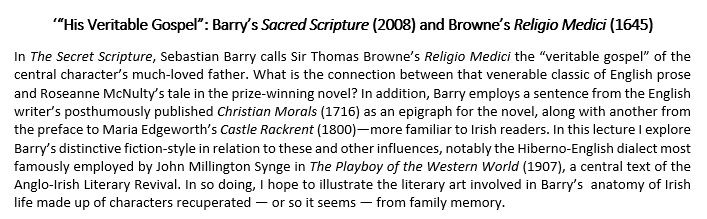
| For notes on Sir Thomas Browne and Maria Edgeworth as sources of epigraphs to The Secret Scripture (2008), see Appendix - as attached. |
Richard Murphy, The Kick (Granta 2002): Murphy and Patricia Avis arrange to meet Richard Selig and Mary O’Hara after the latter couple have had dinner at the Bailey and before collectively ‘going to Tom Kinsella’s flat in Baggot Street for a late-night party at which Richard hoped Mary O’Hara would sing. We had already received an invitation from Tom and his wife, Eleanor, so Richard invited us to join him and Mary for coffee after dinner./ By the time we got there the restaurant upstairs looked empty, and it smelled of cigar smoke. But then, in a niche by an open window, we saw a couple absorbed in each other’s radiance. We joined them, talking of this and that, sniffing each other’s territory, feeling unwanted except as witnesses to the drama of their blossoming love. When Richard mentioned Hollywood, Mary responded in the voice of an impoverished Abbey actress hoping to enchant a film producer with her Irish feyness. “Hollywood”, she signed, “the land of heartbreak!” This was enough to make Patricia, reaching for her coffee, knock over a wine-glass. / In the Kinsella’s top-floor flat, Selig sat with legs crossed on the floor, and Francis Barry, whose son Sebastian, of future fame, had just been born, lay supine on a bed like a king on a tomb. As chatter faded into silence, the strings of a harp I couldn’t see were plucked lightly by fingernails, and a faraway voice sang us back through lamentation for the dead of Aughrim to the land of the ever-living young - if only I had known what the Irish words meant.’ (p.162.)
Libel?: Jody Corcoran reports that Sean Haughey has told the Sunday Independent that there was ‘a basis for consideration of legal action’ (‘Haughey Fury at Abbey Play’ [news story], in Sunday Independent (10 Feb. 2001).
Kith, Kin & Namesake: Barry’s mother, Joan O’Hara, whose sister Mary O’Hara is a traditional Irish singer, is unrelated to Maureen O’Hara the legendary Irish actress who appeared as Mary Kate Danaher opposite John Wayne in The Quiet Man (1952), and with Tyrone Power in The Long Gray Line (1955), &c. Born Maureen Fitzsimmons, the more successful actress left for an audition in London at 17 and later got a contract with Mayflower Pictures through the influence of Charles Laughton. Mayflower Inc. insisted that she change her name to O’Hara, at the time the best-known Irish name in the wake of Gone with the Wind (1939), the film based on Margaret Mitchell’s novel, in which Vivien Leigh played the part of Scarlet O’Hara opposite Clark Gable.
More McNultys: See notice in The Enniskillen Chronicle & Erne Packet (1. Jan. 1824): ‘A correspondent informs us that a shocking outrage was committed early on the morning of Wednesday the 24th instant, by a number of armed persons, who had assembled near Rossinver, county of Leitrim, between Garrison and Manorhamilton, for the purpose of taking the Salmon going up the river to spawn. The party, it appears, besides being armed with firelocks, had a drum and fife with them. The dreadful result was the killing of - M’Nulty, a water-keeper to Mr. Cassidy, to whom the fishery belongs. As an inquest has been held, and as some of the magistrates of the neighbourhood have been on the spot, we hope soon to hear of active measures being adopted to discover the villains concerned, and to put down this lawless banditti. This not being a solitary instance of murder on a like occasion, every exertion should be made to prevent persons having arms in their possession who are not legally authorised, a circumstance, we understandt [sic], too common thereabouts. Our correspondent adds, that some of the arms were said to be lent on the above occasion, by persons intrusted with them for far different purposes. It is hoped, should such be the case, that due punishment may await them; as an armed force of the description above stated, may not always confine their excesses to the shooting of a water-keeper, or the depredation on a salmon fishery.’ (Available at Ireland Old News website - online; submitted by Alison Kilpatrick - vide www.arborealis.ns.ca; accessed 12.01.2012.)
James Barry, MD (1792-1865): b. Margaret Ann Bulkley, dg. of a Cork grocer and Mary-Ann, née Barry, who was sister of the painter James Barry; dressed as a boy from 10; father gaoled for debt, 1803; removed to Edinburgh with her mother, posing as aunt and nephew; enrolled as James Barry; lied about her age, and hence purportedly grad. MD aetat 13 - becoming the first woman to graduate in medicine in Britain; appt. asst.-surgeon in Army at 15; posted to Cape Town; personal physician to Sir Charles Somerset, Gov., with whom she is thought to have had a child, actually born in Mauritius; performed first successful British Caesarian, 1826; served in Mauritius and Jamaica; posted to St. Helena as resident surgeon; court-martialled for conduct unbecoming arising from argumentative temperament; exon.; returned to Britain; appt. inspector-gen. of hospitals in Corfu, 1851; introduced new standards of hygience; purportedly visited Florence Nightingale [in the Crimea] and rebuked her for medical hygiene; “I should say [he] was the most hardened creature I ever met thoughout the army” (Nightingale); retired and settled in Marylebone, London; d. of diarrhoea in epidemic of 1865; instructed that his body be sewn in a sheet and buried at sea; identified as a female who had borne a child by laying-out attendant; bur. Kensal Green Cemetery. (See notice in See John Lloyd & John Mitchinson, The QI Book of the Dead, London Faber & Faber 2009, pp.298-301. Bibl. cites Rachel Holmes, Scanty Particulars: The Life of James Barry, Viking 2002.)
[ top ]
Dishonour: Sebastian Barry is a signatory, with many others in the theatrical world and more farther afield, who ‘deplore the violent events that have very regrettably led to the cancelling of the remaining performances of Behzti (Dishonour) by Gurpreet Kaur Bhatti at Birmingham Repertory theatre on grounds of the safety of the audience, performers and staff of the theatre.’ (Guardian, 23 Dec. 2004.)
Radio Time: World Service (BBC4) on the night of 14/15th August 2001 broadcast an interview with Sebastian Barry, speaking of his novel On Canaan’s Side and his experience as a young man in America at the age of 17 when every street corner there young men who had been destroyed - not necessarily physically - or ‘hollowed out’, in the (presumably borrowed) phrase of the interviewer. He also spoke of the patriotism of the parents who had sent their sons to war, mentioning Joseph Conrad and his wife who felt honoured to make the sacrifice - their son died - and of others in that period who, being childless, were stricken with sorrow that they had no sons to give. ‘I am Irish’, he said, speaking of the love of one’s own country, and added that we don’t feel like that any more - and that he would give his own 56 year old body in place of either of his sons, aged 18 and 14.
Brasilian connection: CIA Ludens, a Brasilian theatre company (founded in 2003), gave a reading of Sebastian Barry’s Whistling Psyche (2004) trans. by Munira H. Mutran in 2006.
[ top ]
Movie-time: commenting on Jim Sheridan’s film-version of The Secret Scripture (2016), Barry said: ‘There is no dialogue from the book in the film, there are no scenes from the book in the film, and the backstory is entirely new ... no Sligo, no father, no ballroom, the things that are important to me are not there.’ Sheridan defended his changes on the grounds that all the previous novels he brought to the screen which went on to be box-office successes involved such changes: ‘It is always going to be different when you adapt a book. My Left Foot stops when [author] Christy Brown is 17 and we went on until he was 45 and we changed everything. The Field [by J. B. Keane] changed an awful lot too. Things change when you make films. You can’t help, it you know?’ (See Irish Independent, 19 Feb. 2017 - available online; accessed 19 Feb. 2017.)
Joan O’Hara: born and raised in Rosses Point, Co. Sligo, dg. of Major John Charles O’Hara, an officer in the British Corps of Royal Engineers and his wife, Mai (née Kirwan); ed. Ursuline convent school; lived in Monkstown, Co. Dublin, excepting a period in London, with her husband, Francis J. Barry (poet and architect); four children: Siubhan, Jane, Guy, and Sebastian; Mary O’Hara’s (b.1935), the soprano/harpist, is a sister; a br. Dermot (b.1934) lives with his family in Canada; she was a year-round sea-swimmer. (See Wikipedia article, online.)
Irish Times: Joan O’Hara was obituarised by The Irish Times as ‘Admired and gifted Abbey actor who put family first’: ‘[..] Joan and Mary took part in local feiseanna and Joan wrote poetry, some of which was published by the Sligo Champion. At 14 she wrote a play that attracted the interest of dramatist and Abbey Theatre board member Lennox Robinson. He adjudicated on the play, believed to be The Demon Pier, at a feis and asked to see its author. When Joan arrived at his home in Dublin he is said to have been astonished that someone so young could have written such a work. She played the lead in its production at the Sligo feis.’- see Irish Times - online.
Childhood home: The Irish Times reports that Barry’s ‘childhood home’ was on sale for €1.75 million in March 2017. The house has been used as offices since its sale by the writer‘s father Francis Barry. The report quotes the story, “A Christmas Tale”, commissioned by An Post [Irish Postal Service] in which the home is mentioned: ‘It was only when I got back to Ireland, when I was about nine ... she in Longford Place and myself in Longford Terrace - we were neighbours, and I could go and see her as often as I liked ...’ (The Irish Times, 23 March 2017 - online.)
No. 21, Mountjoy Square - Sebastian stayed for some months at this address on the north-east side of the square, two houses removed from Fitzgibbon St., in 1974. This was a large delapidated Georgian terrace house with railings and sunken area, originally a wealthy domicile and latterly a Dublin tenement which was owned the property developer Ivan Underwood at the time and occupied by Bruce Stewart by virtue of Georgian Society connections through Thomas [“Tommy”] O’Connell and Charlotte Schulenberg. Barry was then sharing accommodation with Cathy Denne-Bolton who remained in occupation after his departure and Stewart’s departure for a teaching post in Northern Ireland [NUU] sometime later. Several of the houses on Mountjoy Square in comparable states of partial removation - or, at least, shoring up against final collapse - were likewise occupied by students in a bohemian community.
Barry wrote a poem entitled “Mountjoy Square 1974” which is anthologised in Dermot Bolger’s Invisible Dublin: A Journey Through the Dublin Suburbs (Raven Arts 1991). No. 21 was also the setting of the original short-story in which the narrator finds a diary written by a victim of a typhus epidemic and hidden under the floorboards. This in time developed into the plot of The Secret Scripture. Barry has name Stewart with thanks on several occasions for his introduction to James Joyce which was then Stewart’s doctoral topic at TCD - have returned form the University of California and a brief sojourn at Cambridge to complete a PhD in Dublin. Stewart subsequently wrote a chapter in a collection of essay on Barry, edited by Christine Mahony giving an account of Bary"s Engine by Owl-Light, a novel which engages in Joycean experiments with style and narration. The house was afterward let or sold as the premisses of El Grito Taqueria though retaining its grey concrete rendered facade unlike the redbrick frontage share by most of the houses on the Square. [BS 26.06.2023.]
|
[ top ]
|
A Secret Scripture?: Sebastian Barry’s 2008 novel of that title involves an affair between the protagonist Rose and a wartime airman whom she finds hanging from a tree in his parachute after his plane has crashed. He turns out to be Michael McNulty, a pro-British Irishman and Protestant with whom he has had a brief affair. Now she conceives a child with him which is removed by the clergy while she herself is cast forth as a “nymphomaniac” Wikipedia relays up the story: ‘One day a plane crashes nearby and Rose discovers the pilot hanging from a tree, trapped in his parachute. She cuts him down, discovers it is Michael and shelters him while he recovers, hiding him from the anti-British locals. They grow close and just as he is about to leave they confess their love, have sex, and are quickly married by the local Protestant minister. Before Michael can leave, the anti-British locals seize him from Rose’s cottage and later kill him.’ Aside from the improbability of the fact that it is Rose who finds her erstwhile lover in RAF uniform dangling from an tree in Ireland, but alive and well and dangling from a tree in Ireland, the story of the airman much resembles the main events of Temple Lane’s popular novel Friday’s Well - an indication, perhaps, that Barry is familiar with that novel and with Irish short fiction of the wartime period generally. (See Wikipedia on The Secret Scripture (film) - online; accessed 08.09.2023.) [See further details of crashed planes in Ireland under Temple Lane - infra.)
[ top ]