       |
Life
| b. 30 Nov. 1670, Inishowen, Co. Donegal, [var. 1699]; prob. b. as Seán Ó Tuathhalláin; also pseud. John Roberts in the period 1710-22]; baptised by his own account as Janus Junius Eoganesius, a Catholic, and reputedly the illegitimate son of Derry priest; established early notoreity by disputing with a local priest; became Presbyterian at 15 [var. 16]; ed. Glasgow, Edinburgh, and Leiden [Leyden]; at Glasgow he manned barricades against the Jacobites and received a certificate as ‘ane true Protestant and loyal subject’; MA, Edinburgh Univ., 1691 [var. 1690]; attended Leiden, and became acquainted with Huguenots; studied at the Franciscan College in Prague; Toland met Edward Lhuyd [q.v.] at Oxford; thought to have collaborated with Dermod O’Connor [q.v.] in his translation of Keating’s Foras Feasa ar Eirinn; started the ‘Deist Controversy’ with the publication of his Christianity not Mysterious (1696), the second edition appearing under his own name; elicited many answers in Ireland incl. those from Edward Synge and Swift, who called him the ‘great Oracle of anti-Christians’ and denominated him both a Catholic priest and the son of a priest in An Argument against Abolishing the Christian Religion (1708), satirising his writings extensively in A Tale of a Tub (1704); |
| Dr. Peter Browne (Fellow TCD and Bishop of Cork) [q.v.], being invited to reply by Narcissus Marsh [see note] - who sent him a copy of the book - condemned Toland as ‘an inveterate enemy of revealed religion’ - and reputedly told Toland that his response to the latter was the foundation of his own preferment in the church [Ryan, Biog. Hib., under Browne]; Toland returned to Ireland in 1697, supposedly in hope of preferment; associated with the patronage of Robert Molesworth, a lifelong friend, and the Presbyterian Commonwealth circle associated with Wood St. Church (estab. in Dublin by Cromwell); caused resentment through his quarrelsome behaviour as well as his doctrines, and his constant boasting of the friendship of Locke; became acquainted with Molyneux in Dublin, who reported his imprudence in letters to Locke; fled before arrest, his Christianity being burned in Dublin by order of the House of Commons [var. Grand Jury], 1698 - never to return to Ireland; Life of Milton (1698); edited The Oceana of James Harrington (1700); coins term ‘West Britain’ in his Limitations for the next Foreign Successor, or A New Saxon Race (1701); travelled to Berlin and ed. Milton’s prose works (Berlin 1702), included in party that carried the Act of Succession to Hanover, effecting succession of English crown to Sophia, wife of Elector of Hanover and mother of George I, to the exclusion of Catholic candidates, later writing in its defence (1710); introduced to Gottfried Wilhelm Leibniz, the court philosopher at Hanover, who wrote ‘[he is] a man of esprit and is not lacking in erudition, but he pushes things too far.’ |
| issued Letter to Serena (1704), to Sophie Charlotte [Sophia] Queen of Prussia; coined term ‘pantheist’ in that writing, reiterating in it the title of Socinianism Truly Stated, by a pantheist (1705); issued Reasons for Naturalising the Jews in Great Britain and Ireland (1714); issued The Probability of the Speedy and Final Destruction of the Pope (1718), infl. by Giordano Bruno’s Spaccio de la Beastia Trionfante (Eng. trans. 1713), which was favoured by Thomas Leslie Birch and other Presbyterians in Ulster; wrote a preface to Del’ Infinito, Universo e Mondi; issued Pantheisticon sive Foruma Celebrandae Sodalitatis Socraticae (1720; trans. 1751), the manual for a civic religion, with liturgy along Freemason lines; accused by Thomas Sullevane of orchestrating Dermod O’Connor’s specious translation of Keating’s Foras Feasa ar Eirinn (History of Ireland), in prefatory notice to Memoirs of the Marquis of Clanricarde (1722);his posthumous History of the Celtic Religion and Learning Containing an Account of the Druids (1726) argued that the Celtic Church was Protestants in its opposition to Rome, and condemned the Bull Laudabiliter; spent last four years of his life in Putney, nr. London, lodging with Edward Hinton, a carpenter, and there wrote Pantheisticon; |
| impoverished by South Sea Bubble, d. 11 March 1722; buried in pauper’s grave in Putney; castigated by French bishop as illegitimate; he was the object of Locke’s coinage, ‘free-thinker’; he was the first to employ the terms West Britain, South Britain, and North Britain for Ireland, England, and Scotland; he kept a copy of Lucretius’s De rerum natura about him in the room where he died; his will and literary estate executed Pierre Desmaizeaux, who called the rumour that Toland was a belated supporter of Cromwell’s policy in Ireland ‘a ridiculous story’ in his ‘Memoir of Toland’ attached to Collection of Several Pieces (1726); biographised in Richard Ryan, Biographia Hibernica, Irish Worthies, Vol. II (1821, pp.594-690); a copy of Christianity Not Mysterious annotated by Archbishop Marsh is held in Marsh’s Library, St Patrick’s Close, Dublin;there is an inscribed copy of Pantheisticon in the Queen’s University Library, having been donated by the Belfast First Presbyterian Church. RR CAB ODNB PI DIB DIW OCEL FDA OCIL |
| Toland’s Credo: |
|
—Pantheisticon (1720) |
| Quoted in Richard Ryan, Biographia Hibernica [...], Vol.II [of 2] (London & Dublin 1821) - “John Toland” [as attached]. |
[ top ]
A John Toland website was unveiled on 22 March 2108 John Toland, Irish-born rationalist philosopher and freethinker, died on this day (11 March) in 1722. ‘If you would know more of him, search his writings,’ he wrote in a self-penned epitaph that appeared a few days later. Toland is best remembered today as a philosopher, freethinker, author, pamphleteer who made important contributions to the various fields of philosophy - in what today would be regarded as both the natural and social sciences. We choose this day to formally unveil a new website dedicated to Toland, his life and work. This website will serve as a free, online resource and repository of knowledge pertaining to his writings, the times in which he lived and to the social movement that he, along with others, spearheaded and represented, with particular reference to the enduring legacy and effect.
There is a lot that has been said about John Toland and probably a lot more that could be said. This website will serve the purpose of ensuring that nothing that should be said will go unsaid. That is why this is a free website, open to anyone who may wish to contribute. Furthermore, we invite those who may wish to contribute to get in touch with us. [contact] The fact that this website is being formally unveiled on the anniversary of Toland’s death is not coincidental. In fact, the date has been deliberately chosen. The 350th anniversary of Toland’s birth will be observed on 30 November 2020 and the 300th anniversary of his death falls less than two years later, in 2022. We particularly encourage anyone who has an interest in these anniversaries get in touch with us to ensure that they are properly observed and accorded the respect that they are due. We will do our best (without fear or favour) to publicise events that are taking place, using networks and channels of communication within our reach.
[Available online; accessed 06.04.2018.There are also e-list, Facebook and Twitter accounts.]
[ top ]
Works| [Selected] | |||
|
|||
| Note: Toland issued an edition of James Harrington’s Oceana, rep. in Dublin in 1737. | |||
| [ top ] | |||
| Modern reprints | |||
|
|||
|
|||
See also Patrick Kelly, ‘A Pamphlet Attributed to John Toland and an Unpublished Reply by Archbishop William King, in Topoi, 4 (1985), pp.81-90. |
[ top ]
Bibliographical details
[ top ]
Criticism
|
See also Caroline Robbins, The Eighteenth-Century Commonwealth Man (Harvard UP 1959); Margaret Jacob, The Radical Enlightenment (London: Allen & Unwin 1981); Jürgen Schneider and Ralf Sotscheck, Ireland: Eine Bibliographie selbständiger deutschsprachiger (Verlag Georg Büchner Buchhandlung 1989), pp.276-78. |
|
[ top ]
| Correspondence of William Molyneux and John Locke on John Toland | |||
| Some Familiar Letters between Mr Locke and Several of His Friends (London 1708) [of which the letters of Lock and Molyneux form the main part - including those treating of John Toland.] | |||
|
|||
| The correspondence is quoted at some length in Richard Ryan, Biographia Hibernica,, Vol. II (1821) : | |||
|
|||
| Richard Ryan, Biographia Hibernica: Irish Worthies, Vol.II [of 2] (London & Dublin 1821), “John Toland” (pp.594-600)- as attached. |
William [Nicholson], Bishop of Derry, The Irish Historical Library (1724): ‘The late Mr Toland valu[e]d himself much on the Historical Discoveries which he met with in an old Latin Manuscript of the four Gospels in Irish characters; and fell foul upon Fr Simon for affirming that the Book was written in Saxon letters, that the writer was an English Benedictine monk, and his name Dom. Aelbrigte, whereas, says Nazarenus, the truth of the matter is, Do is an Irish prepositive Particle; and Maelbrigte, the Transcriber’s name, signifies servant of Brigit [...] Mr Toland’s book is (since he first perused it) fallen into other good Company in the Harleyan Library [xxvi] [...] I shall not dispute Mr Toland’s skill in the Irish tongue [xxvii] lest I give my self an air of knowing what I do not [...]’ The author disputes Toland’s interpretation of -anus suffix in inscription of said book; he also disputes Toland’s account of the Culdees as a ‘sort of Lay-religious who had the power of electing their own bishops’ [xxix].
Samuel Johnson mentions in his life of Milton that Toland published letters written by Milton to friends of the new commonwealth after the death of Cromwell and the failure of his son Richard, and even in the year of the Restoration, in which ‘he was fantastical enough to think that the nation, agitated as it was, could be settled by a pamphlet’. (See Lives of the Poets [ed. by Walesby, 1825], available at Google Books - online.)
W. B. Stanford, Ireland and the Classical Tradition (IAP 1984), John Toland joined the battle of the books on the side of the classicists, with Letters on Roman Education, in which he wrote, ‘Nor can I imagine that any men will so far oppose matter of fact, or expose their own judgement, as to deny that all perfections of the Moderns beyond the Schoolmen have been revealed to them by the Ghosts of the Ancients, that is, by following their rules, reading their works, imitating their method and copying their stile, which last holds true in prose and verse.’ [164-65.] Note that in Alciphron, Berkeley’s sceptical speaker in the dialogue is called a ‘witty gentleman of our sect who was a great admirer of the ancient Druids’ [234] Berkeley also found ‘something useful in the old religions of Rome and Greece.’ [234]. Stanford gives a full account of John Toland, 1670-1722, whom he calls a ‘flagitious propagator of religious scepticism, based partly on classical learning’. Ed. Glasgow, Leyden, Oxford. He had the intention in 1693 while still at Oxford, of compiling an Irish dictionary and composing a dissertation to prove that the Irish were colonists from Gaul. He never produced these, but his Specimens of the Critical History of the Celtic Religion and Learning, Containing an Account of the Druids drew widely on Greek and Latin writers such as Lucian, Athenaeus, Caesar, Cicero, Pliny, and Virgil to make ingenious comparisons between the Irish and Greeks (connecting for example Ogam with Lucian’s Hercules Ogmios). In 1694 he published an essay arguing that the heroic death of Roman Consul Regulus at the hands of Carthaginins torturers was a fable, so removing ‘all the cruelty from Africa, where it lay so long, into Italy whose title to it I find much better.’
Further: Next, in London, he came under the influence of Locke; in 1699 he published his Christianity Not Mysterious (later burned by the hangman in Dublin), a work with no special classical learning; his Letters to Serena (1704) uses a wide selection of classical quotations ostensibly to criticise the pagan conception of worship but actually presenting a rationalistic approach to all religions; his Adeisidaemon (The Unsuperstitious Man), purporting to exculpate Livy from superstitious beliefs, asserted that the modern state could be harmed equally by superstition or atheism, and was banned by Rome. Hypatia or the History of a Most Beautiful, Most Vertuous, Most Learned, and Every Way Accomplish’d Lady, Who Was Torn to Pieces by the Clergy of Alexandria, to Gratify the Pride, Emulation and Cruelty of their Archbishop, commonly but Undeservdly Stil’d Saint Cyril (1720), self-evidently a riposte. His Latin tract, Pantheisticon sive Foruma Celebrandae Sodalitatis Socraticae (1720), primarily an exposition of his pantheistical beliefs, but with the ultimate intention of establishing a sodality or cult, begins with a discussion of the philosophical communities of antiquity such as Epicureans and Socratics, and curiously appends a pantheistical liturgy, possibly a parody of Christian liturgy, possible an index of his need for an equivalent of the ceremonials he had left behind, ‘Mod, Floreat PHILOSOPHIA/Resp, Cum ARTIBUS politioribus/Mod, Favete linguis VERITATI, LIBERTATI, SANITATI, triplici Sapientium voto, Coetus his (omneque inibi cogitandum, loquendum, agendum)sacer esto/Resp, Et nunc et semper.’ Praises are offered to Socrates, Plato, Marcus Cato, Cicero and others, including Solomon and Confucius, with hymns from writers as varied as Pacuvius, Manilius, Virgil and Lactantius interspersed, and a list of appropriate odes from Horace relevant to the themes of wisdom, equanimity, cheerfulness and innocence of life, all of this laided out in the form of a prayerbook, with red and black type. [233-34]
Bibl., A Collection of Pieces by Mr John Toland (London 1726), and Miscellaneous Works, etc. (London 1747); ODNB; J. G. Simms, ‘John Toland 1670-1722: A Donegal Heretic’, in Irish Historical Studies, XVI (1969), 340-50 [sic; notes, p.244.]
Stephen H. Daniel, John Toland: His Methods, Manners and Mind (Kingston & Montreal: McGill-Queen’s UP 1984): Drawing on a variety of published and unpublished material representing Toland’s broad interests, Professor Daniel reveals a common theme emphasizing man’s capacity for independent thought on basic philosophical, religious, and political issues. Roughly chronological, Daniel’s treatment describes Toland’s progressive refinement of this fundamental aspect of his thought. After examining, in his early works, the process whereby religion becomes mystified, Toland turned to biography, demonstrating that through it one can regain rational control over religion. Prejudices and superstitions, topics of the Letters to Serena, are shown to be overcome through corrections implicit in the principles of biographical and historical exegesis. Polemic as philosophic methode required Toland to provide a doctrine of esoteric communication. In the course of his later writings this doctrine became grounded in a metaphysics suitable for the Cieronian religion of the pantheists. (See COPAC summary - online; accessed 30.04.2014.)
[ top ]
Stephen H. Daniel, ‘The Subversive Philosophy of John Toland’, in Paul Hyland & Neil Sammells, ed., Irish Writing, [Bath College of Higher Ed.] (London: Macmillan 1991), pp.1-12, supplies biographical details & remarks: Bastard son of an Irish cleric in Londonderry, christened distinctively Janus Junius; renounced Catholicism at 16; studed in Scotland and Holland, arriving at Oxford in 1693; researched on Irish dictionary and tract showing that Ireland had been colonised by Gauls, leading to life-long study of druids; notoreity of Christianity Not Mysterious, showing that the religion contained no true miracles; biographies of Milton and Harrington; supported Protestant succession in 1688; offended clerics with new applications of biblical criticism; in his last years resorted to secretive esoteric/exoteric doctrine; his interest in Druids and the ancient practice of distinguishing recondite doctrine from public announcement evident from Letters to Serena (1704) on, marks him as leading 18th century theorist of discretion; concerned with way in which orthodox interpretations of scripture are supported by centres of political power [~3]; distinguishes two kinds of doctrines, 1] ‘the one internal and the other external, or the one private and the other publick; the latter to be indifferently communicated to all the World, and the former only very cautiously to their best Friends, or to some few capable of receiving it, and that wou’d not make ill use of the same’ (Letter to Serena); reactions to his Christianity, with its subversion of communal doctrine, led to the concuion that ‘one Thing should be in the Heart, and in a private Meeting; and another Thing Abroad, and in Public Assemblies’ (Pantheisticon); suspicion that, under these conditions, communicant in dispute cannot be accorded full credibility sets him apart from other [franker] deists, ‘When a man maintains what is commonly believ’d, or professes what is publicly enjoin’d, it is not always a sure rule that he speaks what he thinks, but when he seriously maintains the contrary of what’s by law establish’d, then there’s a strong presumption that he utters his mind.’ (‘“Clidophorus”, or of the Exoteric and the Esoteric Philosophy’, in Tetradymus); for Toland when a belief is communal it makes the individual holding that belief superfluous.
Note: Daniel quotes long section from Propositions, in which Toland discusses differences of opinion with a friend, remarking that whereas he himself is ‘extremely easy and unconcern’d’ amid the expression of differences, the friend ‘cou’d never enjoy Tranquillity’ because - Toland conjectures - the former is happy so reach ‘a further knowledge of human Nature’ while the latter prefers to hold in view the correct opinion, ‘you represent Mankind to your self, such as they ought to be, and [that] I consider ‘em but just such as they are; you are uneasy to see ‘em continue their own Enemies, and [that] I am easy since they cannot become their own Friends’ [5] (Socianism Truly Stated, 1705); Toland promoted interests of foreigners and Jews in England, ‘There is no Co[u]ntry in Europe more divided than England; and [...] we cherish all the kinds of Difference which in any place or Time disturb’d the Peace of the World.’ (Propositions for Uniting the Two East India Companies).
Stephen H. Daniel, ‘The Subversive Philosophy of John Toland’, in Irish Writing (1991) - cont.: ‘What is significant is not that Toland had any particular esoteric doctrine but that there is always the prospect that an esoteric doctrine underlies and comprises the exoteric and publicly regulated pronouncement. [6] [...] exegesis is possible only if texts are treated as ‘other’ and remote; Fascinated by the mysterious, the individual often fails to recognise the alterity of meaning that is of his or her own making and is part of the attempt to understand; indeed the mystery or otherness of the text provides precisely the metaphysical basis for the appeal to the esoteric-exoteric distinction in philosophic practice[~7]; compares Toland’s view with Foucault and Jean-Francois Lyotard’s theory of epistemological disruption by which a strategy of self-imposed exile from political sanctioned interpretation establishes the gap between intelligible (public) and sensible (individual) interpretation [8]
Toland on Druids [Daniel’s paraphrases], His History of the Druids (1814) refuses to draw druidical themes into the universal vortex of the Judaeo-Christian, Graeco-Roman canon; [...] their existence challenges the bias of cultural integrity implicit with syntheses of nominally different cultures [9]; any attempt to explain the meaning or rationality behind the practices or language of the Druids misses the essential point that for them the performance and sensual immediacy of their speech constitute, in each figural expression, meaning; The secret of the Druids reveals itself in their Celtic language because, in this ancient language, the secret writing is the secret of writing; to write is not to provide an external expression of some internal knowledge, just as to speak is not to clothe some idea verbally; writing is nothing other than itself, its incantations describe the sounds that make reality [...] [12].
[ top ]
Joseph Th. Leerssen, Mere Irish & Fior-Ghael: Studies in the Idea of Irish Nationality, Its Development and Literary Expression Prior To The Nineteenth Century (John Benjamins Pub. Co., Amsterdam & Philadelphia, 1986), John Toland, a native speaker of Irish, from N. Donegal, studied Glasgow, Edinburgh, and Leyden; visited Oxford 1694-5 while preparing Christianity Not Mysterious (1696), a precursor of English Deism; given to loudly proclaiming controversial views in coffee houses; claimed in a letter to Molesworth of 1718 that he had suggested first to Edward Lhuyd - who was keeper of the Ashmolean in 1694 - that Irish and Welsh were akin, in contrast with the accepted Scythian theory of Irish origin [see Lloyd, Edward]. Lhuyd’s correspondence mentions that ‘one Mr. Tholonne is lately come hither [...] with a design to write and Irish dictionary & a dissertation to prove Irish a colony of Gauls’ (letter of 9 Jan 1694) [335]. An opponent of revealed religion, he toyed with the idea of a hermetic ‘Socratic Society’, see Paul Hazard, La crise de la conscience européene 1680-1715, 3 vols. (Paris 1935) [364]. Toland attacked the declaratory act of 1720, not with any national, Irish arguments (for Toland repeatedly expressed a unionist attitude like that of Sir Richard Cox) but with the libertarian argument that this act would give the House of Lords a dangerous supremacy over the Commons. See Toland, Reasons offer’d to the honourable house of commons why the bill sent to them shou’d not pass into law (Lon 1720).
Further: Toland, strenuous[ly] anti-Catholic, but no less interested in Gaelic history. He outlined a plan for a history of Gaelic antiquity in a series of letters to Molesworth, published posthumously in 1726. Toland speaks with all the combined authority of a Protestant and a native son, and vindicates the Gaelic past, even from a Protestant point of view, against writers misguided by the Gaels’ more recent shabbiness. [Joseph Leerssen, Mere Irish & Fíor Ghael (1986). p.365; ftn.387/p.483.]
Bibl., John Toland, Vindicius liberius, or, Mr. Toland’s defence of himself against the late lower house of convocation and others (London 1702); Reasons offer’d to the honourable house of commons why the bill sent to them shou’d not pass into a law (London 1720); A collection of several pieces now first published, 2 vols. (London 1726) [issued by Molesworth?].
[ top ]
Philip McGuinness, ‘Tolerant Sectarian: The Peculiar Contradictions of John Toland’, in Times Literary Supplement, ‘Irish Literature’ Issue (27 Sept. 1996), p.14-15; subversive of religious orthodoxy; clinically undercuts the presumption of any religious sect having sole possession of ultimate truth; suggested that all religious sects, from Catholicism to Anglicanaism, have the seeds of popery; wrote, “there may very well be such a thing as Protestant Popery”; This literate servant of the rich and powerful in England is in every splinter of Stephen’s Dedalus’s looking-glass’; ‘In English history, Toland is imporant as a transmitter of the political ideas of the Commonwealth-Protectorate into the eighteenth-century. Radicalism and Protestantism were compatible in eighteenth-century England, but much less so in Penal Law Ireland. When we view Toland’s life and writings from an Irish perspective, we see that he can be regarded as both radical and reactionary; an either-or view of his political outlook will not suffice’; notes that Caroline Robbins (Commonwealth Man, 1959) suggests that Toland “supported the claims of the Irish to have laws of theie own devising”, but does not heed the fact that his Irish body politic was exclusively Protestant; ‘Toland was only to happy to see the fomenting of sectarian hatred in Ireland as a strategy for maintaining Protestant hegemony’ (p.15); employed the terms West Britain, South Britain, and North Britain for Ireland, England, and Scotland’; ‘by his enthusiastic embrace of Protestantism, Francophobia, and proto-imperialism, Toland is one of the earliest persons to see himself as completely British’ (p.15); ‘Toland assumed that radicalism was possible only if Catholicism was kept underfoot’. ‘his description of th Papal Bull Laudability as “having betrayed the country to the English” in his nazarenus (1718) [...] suggest someone who has not quite severed the bonds of emotional attachment to his tribe.’ (p.15).
Richard Kearney, Postnationalist Ireland (1997), comments on Toland arising from strictures on his Irishness implied by Bishop Jeremiah Newman in relation to an earlier work (Kearney, ed., The Irish Mind): ‘I am not claiming that no other European cultures of the period experienced similar divisions, only that Ireland was arguably a more accentuated version of such conflict to the extent that it was at once a brutally colonised country (particularly since the introduction of the Penal Laws) and one of the most advanced centres of elite intellectal culture (especially in the Pale). Toland’s doubleness was undoubtedly a general feature of persecutaed Enlightenment rationalists but it also bore the birthmarks of his culural-histoircal origins. This is true of all thinkers, no matter how universal or cosmopolitan their thought, and certainly true of Toland who was consciously aware of his “Irish” identity, and devoted several works to the study of it, most notably the History of the Druids. In short, while Toland’s doubleness was not uniquely or exclusively Irish, it was Irish to some extent; and this extent is not insignificant.’ (Cited in review by Roy Foster, Times Literary Supplement, 11.4.1997.)
Michael Cronin, Translating Ireland: Tranlsations, Languages, Cultures (Cork UP 1996), p.96, quoting Thomas O’Sullevane’s anticipatory attack on Dermod O’Connor’s History of Ireland (1723), in preface to Memoirs of Marquis of Clanricarde (1722), where O’Sullevane charges O’Connor of taking tutelage from Toland: ‘But the truth is, his name is only made use of for a flourish, or outward shew, whilst others behind the Curtain are hard at Work, in licking this ill-born cub into some Shape, under the Direction of a certain Gentleman, who has already render’d himself famous by new Schemes of Doctrine and Religion.’ (An Account, p.11; here p.96.)
[ top ]
Philip McGuinness, ‘John Toland and Eighteenth-Century Irish Republicanism’, in Bullán: An Irish Studies Journal (Summer 1997), pp.15-22; remarks that Toland’s three allusions of any substance to his Irish origins ‘suggest something of his complexity [and’ suggest as well that he was one of those fluent, uprooted persons who, by refashioning themselves to addres different audiences in different cicumstances, evade self-disclosure and perhaps self-discovery’ (p.20); argues in conclusion argues that Toland pioneered the ‘antithesis between classical pagan reason and subsequent Christian superstition [that] ‘informed … all those thoseies about what by 1800 was identified as civilisation asserted that a modern European elite had recovered and improved the essential rationality which the wiseest ancient heathens possessed but later Christians repudiated’, and therefore established the ‘more learned and credible history of the intellectual descent and progress of Europe and its cultural provinces’ (p.33); cites Hewitt on Toland’s ‘no unfrequented legacy of excellently disputatious prose’ (Ancestral Voices, 1987, p.71); quotes Molyneux’s letter to Locke, ‘I do not think His management since he came into this Citty has been so prudent: He has raised against him the clamour of all Partys; and this not so much by his Difference in Opinion as by his Unseasonable Way of discoursing, propagating and Maintaining it, Coffee-houses and Public Tables are not proper Places for serious Discourses relating to the most Important Truths’ (quoted in Stephen H. Daniel, John Toland, His Methods, Manners and Mind, McGill-Queen’s UP 1984, p.246.)
Further: McGuinness gives an account of the Presbyterian New Light movement incl. Samuel Haliday, Thomas Drennan, and Francis Hutcheson; quotes as analogous to Toland’s stance the words of Linda Colley: ‘it was their common investment in Protestantism that first allowed the English, the Welsh and the Scots to become fused together, and to remain so, despite their many cultural divergences. And it was Protestantism that helped to make Britain’s successive wars against France after 1689 so significant in terms of national formation. A powerful and persistently threatening France became the haunting embodiment of that Catholic Other which Britons had been taught to fear since the Reformation in the sixteenth century. Confronting it encouraged them to bury their internal differences in the struggle for survival, victory, or booty.’ (Colley, Forging the Nation, 1707-1837, Vintage 1992, p.387.)
Cites Toland on the entitlement of Britain to Empire: ‘The whole Variety of things wherewith the Earth is stock’d had bin principally design’d for our profit and delight, and no more of ’em allowed to the rest of Men, than what they must necessarily use as our Purveyors or Labourers. [London is] a new Rome in the West [deserving] like the old one, to become the Sovereign Mistress of the Universe.’ (Toland, [Pref.], The Oceana of James Harrington, 1700, pp.ii-iv [sic]); Nazarenus includes reference to the Pope as having ‘betrayed the country to the English’ (Letter II).
Quotes Toland on the dangers of intolerance within Protestantism: ‘Since Religion is calculated for reasonable Creatures, ‘ ‘tis conviction and not authority that should bear Weight with them. A wise and good man … knows no Difference between Popish Infallibility, and being oblig’d blindly to acquiesce in the Decisions of fallible Protestants’; further, ‘there may very well be such a thing as Protestant Popery’ (Christianity Not Mysterious, pp.xv-xvi; ‘A Memorial for the Earl of Oxford’, 1711, in Collection, Vol. 2, p.230.
Bibl. cites additionally Margaret Jacob, The Radical Enlightenment: Pantheists, Freemasons, and Republicans (Allen & Unwin 1981), espec. pp.267-72, arguing that Toland was a key figure in the spread of radical Masonry, and suggesting that a document in his manuscripts outlining a meeting of Pantheists (Knights of Jubilation), at the Hague in 1710, actually describes a Masons’ meeting; cites Kenneth Craven, Jonathan Swift and the Millennium of Madness: The Information Age in Swift’s Tale of a Tub (E. J. Brill 1992), as arguing that Toland’s works were the chief targets of Swift’s satire, esp. his Christianity not Mysterious, his edition of Oceana, his Life of Milton, and his unauthorised publication of Shrewsbury’s An Inquiry Concerning Virtue. [Bibl. and biography as supra.]
Daniel C. Fouke, Philosophy and Theology in a Burlesque Mode: John Toland and “The Way of Paradox” (Amherst: Prometheus Press 2007), 395pp. Fouke argues that Toland’s use of language in theology and philosophy represents a neglected current of early modern thought, in significant contrast to Locke, to whom Toland is often compared. Toland’s practice of philosophy recognises a social dimension to knowledge, which cannot be found in many of his contemporaries. Fouke analyses Toland’s “exoteric strategy” of speaking as others speak, but with a different meaning. He argues that Toland’s philosophy and theology had little to do with positive expression of beliefs, and that his philosophical aim was not to develop an epistemology, a true metaphysical system, an ideal form of governance, or the basis of ethical obligation, but to find ways to participate in the discourses of others while undermining those discourses from within. Fouke traces Toland’s practices to Shaftesbury’s conception of a comic or ’derisory’ mode of philosophising aimed at exposing pedantry, imposture, dogmatism, and folly. This important study adds new depth to our understanding of a neglected though influential British writer. (Account as given in COPAC - online; accessed 30.04.2014.)
Ian Leask, ‘A Matter of Dangerous Consequence’: Molyneux and Locke on Toland, in Between Secularization and Reform, ed. : Anna Tomaszewska (Brill(2022), pp.219-36: ‘William Molyneux’s attitude to John Locke, as demonstrated by their cor- respondence, might appear to be that of a fawning acolyte: on the face of it, Molyneux’s reverence at times leaves him almost prostrate. Certainly, Locke makes important changes to the Essa9-y Concerning Human Understanding as a direct result of Molyneux’s queries. Nonetheless, reading Molyneux’s own account, there is no mistaking the seniority of Locke: in 1694, for example, Molyneux declares that “a man of greater candour and humanity [than Locke] there moves not on the face of the earth.”1 Three years later, Molyneux tells Locke (on 17th Sept. 1697) about the portrait of him (Locke) that hangs in his dining room in Dublin – and also that Robert Molesworth is wont to call by in order to “pay his Devotion”!2 (Even allowing for the exaggerated conventions of epistolary discourse, this depiction of philosophical worship remains strik- ingly strange.) Despite the genuine reverence evidenced here, closer analysis of the Locke-Molyneux correspondence regarding the very particular case of John Toland, and the events and misadventures that characterized Toland’s sojourn in Dublin in 1697, reveal a different aspect to Molyneux’s attitude. As I want to show in this chapter, it seems that Molyneux refused to accept the “abandon- ment” of Toland that Locke more or less commands; moreover, he sought to defend Toland, in part, upon the basis of Locke’s own philosophical-political principles – thereby showing himself to be (on this occasion, at least) more Lockean than Locke himself. To make this case, I begin by providing some wider biographical and contex- tual information about both Molyneux and Toland. I then outline, first, the way in which Toland’s most famous (or infamous) text, Christianity Not Mysterious, [219] draws on important Lockean conceptions to construct its case against conventional religious views and, secondly, the kind of backlash that this “borrowing” produced, against Locke himself, as well as Toland. With this established, I offer a narrative account of the relevant sections of the Molyneux-Locke corre- spondence, showing Locke’s increasing irritation with the trouble that Toland (and their perceived association) had generated. I conclude with more detailed focus upon the construction of a particular letter that “closes” the exchange between Locke and Molyneux regarding Toland; as already indicated, this may well show that Molyneux applies Lockean principles more consistently and evenly than their original author did.’ (pp.219-20; available online; see further under Molyneux - supra.)
[ top ]
| ‘If you would know more of him, search his writings’, —said Toland of himself. |
| Sundry observations |
|
—‘Nothing shou’d be attempted that might bring about the possibility of a Union of civil interests between the Protestants and Papists of Ireland, whose antipathies and animosities all sound Politicians will ever labour to keep alive.’ (Reasons, 1690.) |
|
(All the foregoing quoted in Philip McGuinness, ‘Tolerant Sectarian: The peculiar contradictions of John Toland’, Times Literary Supplement, 27 Sept. 1996, p.14-15.) |
Intellectual Freedom: ‘By the original right of Nature, and the main principle of the Reformation, ‘tis the privilege of every man, whether by word or by writing, to inform others, or to seek information from them [...] to confine writing on [religious] subjects to any set of men, wou’ be the certain way in a short time to have neither true doctrine nor true history; as is the case in fact, where and whenever this practice has been sottishly authoris’d or even indulged, ignorance becoming triumphant begets Credulity, as Credulity unavoidably occasions Lyes; and Lyes have recourse to Force for their support against Reason, which left free would soon expose them to contempt, and then quite explode them.’ (”Mangoneutes”, Being a Defence of Nazarenus’, in Tetradymus (1720), p.142.) Further, ‘Why are Gallic or Irish superstitions more unfit to be transmitted to posterity, than those of the Greeks and Romans? Why shou’d [St] Patric be more squeamish in this respect than Moses or the succeeding Jewish prophets, who have transmitted to all ages the idolatries of the Egyptians, Phenicians, Caldeans, and other eastern nations? What an irreparable destruction of history, what a deplorable extinction of arts and inventions, what an unspeakable detriment to learning, what a dishonor upon human understanding, has the cowardly proceeding of the ignorant, or rather of the interested, against unarm’d monuments at all times occasion’d! And yet this book and letter murdering humor, tho’ far from being commanded by Christ, has prevailed in Christianity from the beginning.’ (History of the Druids; quoted in Daniel, op. cit., 1991.)
Christianity Not Mysterious (1696), Preface: ‘I hope to make it appear, that the Use of Reason is not so dangerous in Religion as it is commonly represented, and that too by such as mightily extol it, when it seems to favour ’em, yet vouchsafe it not a hearing when it makes against them, but oppose its own Authority to itself [...]. I hold nothing as an Article of my Religion but what the highest Evidence forc’d me to embrace [...]. Since Religion is calculated for reasonable Creatures, ‘tis Conviction and not Authority that should bear Weight with them [...]. Truth is always and everywhere the same; and an unintelligible or absurd Proposition is to be never the more respected for being ancient or strange, for being originally written in Latin, Greek, or Hebrew [...]. The true Religion must necessarily be reasonable and intelligible.’ TEXT: ‘There is nothing that Men make a greater Noise about, in our Time especially, than what they generally profess least of all to understand [...] I mean the Mysteries of the Christian Religion [...]. Some say the Mysteries of the Gospel are to be understood only in the Sense of the Ancient Father [...]. Others tell us we must be of the Mind of some particular Doctors, pronounc’d Orthodox by the Authority of the Church [...]. Some give a decisive Voice in the Unravelling of Mysteries, and the Interpretation of Scripture, to a General Council; and others to one Man whom they hold to be the head of the Church Universal upon Earth, and the infallible Judge of all Controversies [...]. But they come nearest the thing who affirm, that we are to keep what the Scriptures determine about these Matters: and there is nothing more true, if rightly understood [...]. Some will have us always believe what the literal Sense imports, with little or no Consideration for Reason, which they reject as not fit to be employ’d about the reveal’d Part of Religion. Others assert, that we may use Reason as the Instrument, but not the Rule of our Belief. The first contend, some Mysteries may be, or at least seem to be contrary to Reason, and yet be receiv’d by Faith. The second, that no Mystery is contrary to Reason, but that all are above it. Both of ’em from different Principles agree, that several Doctrines of the New Testament belong no farther to the Enquiries of Reason than to prove ’em divinely reveal’d, and that they are properly Mysteries still. [... &c.]’. Further, Thus god is pleas’d to reveal to us in Scripture several wonderful Matters of Fact, as the Creation of the World, the last Judgement, and many other important Truths, which no Man left to himself could ever imagine, no more than any of my fellow creatures can be sure of my private Thoughts. [...] Secret things belong unto the Lord; [but] those things which are reveal’d belong unto us and to our Children. Yet, as we discours’d before, we do not receive them only because they are reveal’d: For besides the infallible Testimony of the Revelation from all requisite Circumstances, we must see in its Subject the indisputable Characters of Divine Wisdom and Sound Reason; which are the only Marks we have to distinguish the Oracles and Will of God, from the impostures and Traditions of Men. Whoever reveals any thing, that is, whoever tells us something we did not know before, his Words must be intelligible, and the Matter possible. This Rule holds good, let God or Man be the Revealer. If we count that Person a Fool who requires our Assent to what is manifestly incredible, how dare we blasphemously attribute to the most perfect Being, what is an acknowledg’d Defect in one of our selves? As for unintelligible Revelations, we can no more believe them from the Revelation of God, than from that of Man; for the conceiv’d Ideas of things are the only Subjects of Believing, Denying, Approving, and every other Act of the Understanding: Therefore all Matters reveal’d by God or Man, must be equally intelligible and possible; so far both Revelations agree. But in this they differ, that tho the Revelation of Man should be thus qualified, yet he may impose upon me as to the Truth of a think; whereas what God is pleas’d to discover to me is not only clear to my Reason (without which his Revelation could make me no wiser) but likewise is always true. A Man, for example, acquaints me that he has found a Treasure: This is plain and possible, but he may easily deceive me. God assures me, that he has form’d Man of Earth: This is not only possible to God, and to me very intelligible; but the thing is also most certain, God not being capable to deceive me, as Man is. In how many places are we exhorted to beware of false Prophets and Teachers, Seducers and Deceivers? We are not only to prove or try all things, and to hold fast that which is best, but also to try the Spirits whether they be of God. But how shall we try? How shall we discern? Not as the Horse and Mule which have no understanding, but as circumspect and wise Men, judging what is said. [...] The New Testament (if it be indeed Divine) must consequently agree with Natural Reason, and our own ordinary Ideas. The Apostles commend themselves to every Man’s conscience, that is, the appeal to every Man’s Reason, in the Sight of God. Peter exhorts Christians to be ready always to give an Answer to every one that asks them a Reason of their Hope. Now to what purpose serv’d all these Appeal, if no Regard was to be had to Men’s Understandings? If the Doctrines of Christ were incomprehensible, contradictory; or were we oblig’d to believe in reveal’d Nonsense?’; further, I acknowledge no Orthodoxy but the Truth; and, I’m sure, where-ever the Truth is, there must also be the Church, of God I mean, and no any Human Faction or Policy.’ [END; abbrev. from full version posted by Stephen J. Shoemaker, Dept. of Religious Studies, Oregon Univ., REL 323: History of Christianity - Modern Western Christianity [link - direct to Toland page].)
Pantheisticon: The universe is infinite, with infinite stars and inhabited worlds: In an infinite space there can be no up or down, no centre or extremities. / There is an infinite number of other worlds similar to the earth we inhabit, circling around their suns (which we call the fixed stars). / The Universe (of which the world we know is only a very small part), is infinite in extent as well as in potential. By the continuity of all and by the contiguity of its parts it is one. In its totality it is immobile, having no space outside of itself, but in its parts it is mobile by infinite intervals. The universe is a unity: Every material thing is in all things. / All things come from all, and all is in all things. The Universe is divine: The power and energy of All, which has created all and which governs all, having always the best goal as it aim, is God, which you may if you wish call Spirit and Soul of the Universe. This is why the Socratic Associates have been called pantheists, because according to them this soul cannot be separated from the Universe itself. Matter is made up of atoms: The basic bodies, or the elements of the elements, are very simple, indivisible, incorruptible, and infinite in species and number. Motion is inherent to matter: There is not in nature a sole point at rest, but only occasionally in relation to other bodies, since even rest is only a resistance to motion. Thought and soul is a property of matter: Thought is a special movement of the brain. The brain is the first cause of the soul, of thoughts and of sensations. Brain, being a highly composite material organ, can produce only material effects. Thus all ideas are corporal. There is an ethereal fire: The ethereal fire (is) supreme because it surrounds everything, intimate because it penetrates everything. This fire is the only thing that can traverse nerves. Death is merely a transformation of matter: Nothing dies totally, the death of one thing brings the birth of another, by a universally reciprocal exchange, and everything contributes necessarily to the preservation and welfare of the Whole by a continual change of forms and a marvelous variation which forms an eternal cycle. The years that Nature accords to each one on earth should seem sufficient to him. The person who is worried that he will not be alive in a thousand years is as foolish as he who would be worried that he was not born 1000 years ago. Ethical injunctions: Virtue alone is enough to live happily and brings its own reward. The wise prefer pleasure to profit. / It is better to never command anyone, than to obey someone. (Quoted on Paul Harrison’s Panteism Page - online [featured 16 Dec. 1996; now defunct; - available at www.pantheism.net - online [16.02.2013].)
Irish MSS: ‘[...] whether, besides the language and traditions of the Irish, or the monuments of stone and other materials which the country affords, there yet remain any Literary records truly antient and unadulterated, whereby the History of the Druids, with such other points of antiquity, may be retriev’d, or at least illustrated? This is a material question, to which I return a clear and direct answer; that not onely there remain very many antient Manuscripts undoubtedly genuine, besides such as are forg’d, and greater numbers interpolated, several whereof are in Ireland itself, some here in England, and others in the Irish Monasteries abroad; but that, notwithstanding the long state of barbarity in which that nation hath lain, and after all the rebellions and wars with which the kingdom has been harrass’d; they have incomparably more antient materials of that kind for their history, to which even their Mythology is not unserviceable, than either the English, or the French, or any other European nation, with whose whose Manuscripts I have any acquaintance. Of these I shall one day give a catalogue, marking the places where they now ly [sic], as many as I know of them; but not meaning every Transcript of the same Manuscript, which wou’d be endless, if not impossible. In all conditions the Irish have been strangely sollicitous, if not in some degree superstitious, about preserving their books and parchments; even those of them which are are so old, as to be now partly or wholly unintelligible. Abundance, thro’ over care have perished under ground, the concealer, [95] not having skill, or wanting searcloth and other proper materials for preserving them. The most valuable pieces, both in verse and prose, were written by their Heathen ancestors; whereof some indeed have been interpolated after the prevailing of Christianity, which additions or alterations are nevertheless easily distinguish’d: and in these books the rites and formularies of the Druids, together with their Divinity and Philosophy; especially their two grand doctrines of the eternity and incorruptibility of the universe, and the incessant Revolution of all beings and forms, are very specially, tho’ sometimes very figuratively, express’d. Hence their Allanimation and Transmigration.’ Why none of the natives have hitherto made any better use of these treasures; or why both they, and such others as have written concerning the History of Ireland, have onely entertairi’d the world with the fables of it, as no country wants a fabulous account of its original, or the succession of its Princes, why the modern Irish Historians, 1 say, give us such a medley of relations, unpick’d and unchosen, 1 had rather any man else shou’d tell. The matter is certainly ready, there wants but will or skill for working of it; separating the Dross from the pure Ore, and distinguishing counterfeit from sterling coin. This in the meantime is undeniable, that learned men in other places, perceiving the same dishes to be eternally serv’d up at every meal, are of opinion that there is no better fare in the country while those things have been conceal’d from them by the ignorant or the lazy, that would have added no small ornament even to their classical studies. [...]’ (Extract given in A. N. Jeffares & Peter Van de Kamp, eds., Irish Literature: The Eighteenth Century - An Annotated Anthology, Dublin: IAP 2006, pp.96-97.)
[ top ]
| Some Websites | |
Several websites devoted to Toland can be found on Internet and numerous others to a modern namesake. A selection of passages from the works available on these sites have been copied under Quotations, infra. |
|
| Pantheist Association for Nature | Toland Father of Pantheism (P. Harrison)* |
| The Raymond Bell Anthology | Stephen Shoemaker (Oregon Univ.) |
| *previously at aol.com. | |
Margaret Drabble, ed., Oxford Companion of English Literature, ed. (OUP: 1985), calls him a freethinker, b. Inisowen, Donegal; ‘educated from the cradle in grossest superstition’, he says in his Apology (1697); studied Scotland and Holland and settled at Oxford, where he completed Christianity Not Mysterious (1696); travelled to Berlin in 1702; Letters of Serena (1704) addressed to Queen of Prussia, coined the word ‘pantheist’ in 1705; Pantheisticon (1720); life of Milton and edition his prose, 1698; Tetradymos (1720) distinguishes esoteric from exoteric; Swift called him ‘the great Oracle of the Anti-Christians’ in Argument Against Abolishing Christianity (1708), rep. in Prose Works of Jonathan Swift, ed. Herbert Davis (Basil Blackwell 1939), Vol. II, p.37 [ref. given in Philip McGuinness, 1997].
Seamus Deane, gen. ed., The Field Day Anthology of Irish Writing (Derry: Field Day 1991), Vol. 1: selects Christianity Not Mysterious, “that nothing ought to be called a Mystery because we have not an adequate Idea of all its Properties, nor any at all of its Essence [...] knowing nothing of Bodies but their Properties, God has wisely provided we should understand no more of these than are useful and necessary for us, which is all our present Condition needs”; also, “neither to trouble our selves nor others with what is useless, were it known; or what is impossible to be known at all”; “we may as well deny the Existence of the Body, because we have not an idea of its real Essence, as call the Being of the Soul in question for the same Reason”; “what Infinite Goodness has not been pleas’d to reveal to us, we are either sufficiently capable to discover for our selves, or need not understand it at all.” called ‘the seminal work of Irish philosophy’ [FDA eds.; 765-68]; also selects A Critical History of the Celtic Religion, otherwise called A History of the Druids (1718, publ. 1726), in which he speaks of the Irish having been ‘strangely sollicitous’ to preserve manuscripts with their pre-Christian mythologies, and how ‘some indeed have been interpolated after the prevailing Christianity, which additions or alterations are nevertheless easily distinguish’d [...] two grand doctrines of the eternity and incorruptibility of the universe, and the incessant Revolution of all beings and forms [...] Hence their Allanimation and Transmigration [...; 970-72].
Biog. & Comm.: ‘educated from the cradle in grossest superstition’, says his Apology (1697); Christianity &c burnt by orders of Dublin House of Commons; abandoned Ireland, 1697; Life of Milton, 1698; coined term ‘pantheist’; a native speaker, A History of the Druids (posthum. 1726); d. Putney; Bibl. [as in Criticism, supra; 803-04].
Seamus Deane, gen. ed., The Field Day Anthology of Irish Writing (Derry: Field Day 1991), Vol. 1 - further remarks: Christianity Not Mysterious the loudest call for a radical rethinking of traditional Christianity issued in the late seventeenth century, carried the radical subtitle that ‘there is nothing in the gospel contrary to reason nor above it’, 761-62; struck at the heart of the hierarchical, exclusive, conservative traditions of the Church of Ireland [...] Peter Browne wrote a direct [...] Answer &c (1697) [...] [also] Edward Synge’s Appendix to his Gentleman’s Religion (1698) [763]; compared with Berkeley; cast gauntlet before Anglicans of Ireland [...] attack on Christian mysteries and defence of natural religion represented a challenge to the political status quo [for if] no mysteries [...] nothing to separate rival sects, and no basis for penal laws [764]; ‘as referred to as ‘a late Author’ in E. Synge’s, An Appendix, Browne’s Answer, 788-790; Robert Clayton shows affinity with Toland on mystery and meaning [eds.; 797]; Toland slyly boasted that he had made Browne a bishop [805], Edmund Burke, ‘who, born within the last forty years, has read one word of Collins, and Toland, and Tindal [...] and that whole race who called themselves Free-thinkers? Who now reads Bolingbroke?’ [Reflections; 828-29n.]; Toland [et al.] all queried the basis of English rule in Ireland [856], compared with Tone as a humanist [857]; Molesworth was a friend [870]; most important and symbolic figure of all those [transitional characters] [...] forsook his faith and entered upon an intellectual career that was to make him notorious as a freethinker and as a founding figure of the enlightenment[. B]orn into the Gaelic world, he chose the English world; repudiated by it, he turned to Europe and its newly born vision of rational, secular, human community[. Y]et towards the end of his life, [he] returned to the culture he had initially foresaken and attempted to reincorporate it, as an object of study and as an early exercise in cultural anthropology [...] attempted to see early Irish history in a detached light [...; 962]; (cf. Michael Moore, p.965.)
[ top ]
A. N. Jeffares & Peter Van de Kamp, eds., Irish Literature: The Eighteenth Century - An Annotated Anthology (Dublin/Oregon: Irish Academic Press 2006), gives extract from A Critical History of the Celtic Religion and Learning [95].
COPAC (2002) lists Oliver Hill, A rod for the back of fools: in answer to a book of Mr. John Toland, called Christianity not mysterious; [...]and to the lecture of one Dr. Joseph Brown, taken from the author’s book against the circulation; and to the answer of one Mr. John Gardiner, surgeon, to that pretended lecture (1702); [Bernardo Davanzati-Bostichi,] A discourse upon coins [...] translated out of Italian by John Toland (1696) ; [Pierre Des Maizeaux, ed.,] The miscellaneous works of Mr. John Toland, now first published from his original manuscripts. [...] To the whole is prefixed, a copious account of Mr. Toland’s life and writings., 2 vols. (1747); A collection of several pieces of Mr. John Toland: now first publish’d from his original manuscripts: with some memoirs of his life and writings (1726, another edn. 1747); The theological and philological works of the late Mr. John Toland: being a system of Jewish, Gentile and Mahometan Christianity [...] &c.] (1732); Letters from [...] the late earl of Shaftesbury [Anthony Ashley-Cooper], to Robert Molesworth, esq; now the Lord Viscount of that name. With two letters written by the late Sir John Cropley. To which is prefix’d a large introduction by the editor [John Toland] (1721); Edmund Curll, An historical account of the life and writings of the late eminently famous Mr. John Toland.: Containing, I. A faithful extract of his works, and an account of his travels in Germany, Holland, &c. II. An account of the controversies wherein he was engaged, and a particular enquiry into his principles [...] III. An exact catalogue of his writings, published both with, and without his name, and of the manuscripts he left behind (1722); A collection of several pieces of Mr. John Toland: now first publish’d from his original manuscripts ; with some memoirs of his life and writings (1726); The Oceana of James Harrington, and his other works; som wherof are now first publish’d from his own manuscripts. The whole collected, methodiz’d and review’d, with an exact account of his life prefix’d, by John Toland [...] &c.] (1700), and Do., as The Oceana of James Harrington, Esq: and his other works: with an account of his life prefix’d, by John Toland. To which is added, Plato redivivus: or, a dialogue concerning government (1737); The Oceana and other works of James Harrington, Esq. [...] with an extract account of his life prefix’d, by John Toland. To which is added, an appendix, containing all the political tracts wrote by this author, omitted in Mr. Toland’s edition (1747); The Oceana and other works of James Harrington, with an account of his life by John Toland (1771); Samuel Clarke, Some reflections on that part of a book [by John Toland] called Amyntor, or the defence of Milton’s life which relates to the writings of the primitive fathers and Canon of the New Testament (1689), and Do., [...] In a letter to a friend [Samuel Clarke] (1699); Christianity not mysterious: or, a treatise shewing, that there is nothing in the Gospel contrary to reason, nor above it [...] , [John Toland]. To which is added, an apology for Mr. Toland, in relation to the Parliament of Ireland’s ordering this book to be burnt [...] (1702); [Peter Browne,] A letter in answer to a book [by John Toland] entituled, Christianity not mysterious. As also to all those who set up for reason and evidence in opposition to revelation and mysteries [...] (1697); A Letter to the author of the Memorial of the State of England [John Toland] / Thomas Rawlins (1705); An historical account of the life and writings of [...] John Toland [...] (1722); John Toland’s Christianity not mysterious [German trans. as Christentum ohne Geheimnis] 1696 (1908); John Toland’s Christianity not mysterious: text, associated works and critical essays. Christianity not mysterious, or, a treatise shewing, that there is nothing in the Gospel contrary to reason, nor above it, and that no Christian doctrine can be properly call’d a mystery. An apology for Mr. Toland, in a letter from himself to a member of the House of Commons in Ireland, written the day before his book was resolv’d to be burnt by the Committee of Religion, to which is prefix’d a narrative containing the occasion of the said letter. A defence of Mr Toland, in a letter to himself. Vindicius liberius, or, M. Toland’s defence of himself, against the late Lower House of Convocation, and others [Facs. Edn.] (Dublin: Lilliput Press 1997), xii, 339pp. port.; A complete collection of the historical, political, and miscellaneous works of John Milton, both English and Latin. With som [sic] papers never before publish’d [...]To which is prefix’d the life of the author [by J. Toland] Containing, besides the history of his works, several extraordinary characters of men and books, sects, parties, and opinions (1698); Poems on affairs of state, from the reign of K. James the First, to the present year 1703. Written by the greatest wits of the age. Viz. Duke of Buckingham. the Earl of Rochester. The Earl of D----t. Lord J---s. Mr. Milton. Mr. Marvel. Mr. St. J---n. Mr. John Dryden. Dr. G---th. Mr. Toland. Mr Hughes. Mr. F---e. Mr Finch. Mr. Harcourt. Mr. T----n, &c. Many of which never before publish’d. Vol. II (1703), and Do., as Poems on affairs of state, from the reign of K. James the First, to the year 1703. Written by the greatest wits of the age. Viz. The late Duke of Buckingham. Late Earl of Rochester. Earl of Dorset. Lord Jefferys. Mr. Milton. Andrew Marvel Esq. Mr. St. John. Mr. Dryden. Dr. Garth. Mr. Toland. Mr Hughes. Mr. Foe. Mr Finch. Mr. Harcourt. Mr. Tutchin, &c. Many of which never before publish’d. Vol. II (1716).
Monographs: Gerhard Berthold, John Toland und der Monismus der Gegenwart (1876); Albert Lantoine, Un précurseur de la Franc-Maçonnerie: John Toland, 1670-1722: suivi de la traduction française du Pantheisticon de John Toland (1927); Anna Seeber, John Toland als politischer Schriftsteller: Inaugural-Dissertation (1933); Leibnizens Kritik der Religionsphilosophie von John Toland / Margrit Muff (1940); Carabelli Giancarlo, Tolandiana: materiali bibliografici per lo studio dell’opera e della fortuna di John Toland 1670-1722 (1975); Alfredo Sabetti, John Toland: un irregolare della società e della cultura inglese tra Seicento e Settecento (1976); Chiara Giuntini, Panteismo e ideologia repubblicana: John Toland (1979 ); Robert E. Sullivan, John Toland and the Deist controversy: a study in adaptations (1982); Manlio Iofrida, La filosofia di John Toland: spinozismo, scienza e religione nella cultura europea fra 1600 e 1700 (1983); Gavina Cherchi, Satira ed enigma: due saggi sul Pantheisticon di John Toland (1985); Stephen H. Daniel, John Toland: his methods, manners, and mind (1984); Giannes Plangeses, “John Toland”: hoi peges, he dome kai hoi epidraseis tou hylismou tou (1985); Ella Twynam, John Toland, Freethinker (1968 ); Margaret Candee Jacob, John Toland and the Newtonian ideology [q.d.]; Béal eiriciúil as Inis Eoghain: John Toland (1670-1722) / Harrison, Alan (1994); Gavina Luigia Cherchi, Atheism, dissimulation and atomism in the philosophy of John Toland (1994); Robert Rees Evans, Pantheisticon: the career of John Toland (1991).
Articles: Giovanni Aquilecchia, ‘Nota su John Toland traduttore di Giordano Bruno’, in English miscellany, 9 (1958); Zbigniew Ogonowski, ‘Le “Christiamisme sans mystères” selon John Toland et les sociniens’, in Archiwum historii filozofii i mysli spolecznej, 12 (1966); Maria Rita Pagnoni Sturlese, ‘Postille autografe di John Toland allo Spaccio del Bruno’, in Giornale critico della filosofia italiana, 65 (1986).
Belfast Public Library holds A Critical History of the Celtic Religion and Learning (1726); Ulster Univ. Library (Morris Collection), holds A Critical History of the Celtic Religion, with a history of Abaris the Hyperborian, priest of the sun, to which is added an abstract of the life of the author. Printed by J. T. Tindlay (1815) 256p.
[ top ]
Notes
Portrait: The only known portrait of Toland appears in U. G. Thorschmid, Versuch einer Vollstandige Englandiche Freydenker-Bibliothek (1766), Vol. 3; rep. in Stephen H. Daniel, John Toland: His Methods, Manners, and Mind. It came from Volume 3 of [?] and it shows him holding a copy of Pantheisticon.
Giordano Bruno [1]: according to the Encyclopaedia Britannica (1949 Edn.), Toland wrote a preface to Bruno’s Del’ Infinito, Universo e Mondi which appeared in posthum. works (viz., Toland’s).
Lost citation: ‘Toland is cited in Domenico Berti’s Vita di Giordano Bruno da Nola (Firenze 1868), among other foreign writers who have treated Bruno as an atheist (‘intorno all’ateismo del Bruno’).’ (Q. source; p.319.)
Giordano Bruno [2]: J. Lewis McIntyre notes in Giordano Bruno (Macmillan 1903) that Schopp’s letter giving an account of the death of Bruno was translated by La Roche (Memoirs of Literature, Vol. II) and by Toland (Misc. Works, Vol. 1). See McIntyre, op. cit., p.96.
Giordano Bruno [3] - See James Atherton, The Books at the Wake: A Study of Literary Allusion in James Joyce’s Finnegans Wake [1959] (Arcturus 1974): ‘Bruno also stated in his Of the Infinite Universe and Innumerable Worlds that “The actual and the possible are not different in eternity.”’ (p.36 - citing John Toland, A Collection of Several Pieces with an Account of Jordano Bruno’s Of the Infinite Universe and Innumerable Worlds, London 1726, p.322.)
[See further under James Joyce > Notes > Literary Figures > Giordano Bruno - infra.]
Narcissus Marsh, founder of Marsh’s Library in St. Patrick’s Close, has left sardonic marginalia in a copy of Christianity Not Mysterious by Toland held in that Library - writing in the margin against Toland’s phrase, ‘I have clearly prov’d it’ - ‘Y[o]u have said it indeed but you prov'd nothing unless saying a thing is so, be proving it to be so.’
‘thing was inexplicable. But of what? Of Miracles? No; but of those Doctrines in Confirmation whereof the Miracles are wrought. Still I stand by still, and may add, I hope, that I have clearly prov'd it too: But to say as much of Miracles would be to make 'em no Miracles, which shews the Impertinence of this Objection; though People in Distress are generally allow'd to do anything.’ (Posted by Marsh’s Library on Facebook - with photo of that part of the page.)
More Tolands: A John Toland is listed as a “married taxable” in the Pennsylvania Archive (Robinson Twa III, 22, 767) and also appears on the 1784 tax list. He was a private in Capt. Thomas Rankin’s company of militia July 8-1782 (Pa Archives, VI, 2, 145). In the 1790 census John Toland is in Strabane (Penn.) with one son and one daughter listed as children and also appears on the 1793 tax list for Strabane. In 1785 he was granted 400 acres on King’s Creek in what is now Hancock Co. [...]. (Summary of information on the Toland Family of Washington, given in the “Raymond M. Bell Anthology” [link].)
Gottfried Willhelm Leibniz [1]: In 1710 Toland offered a definition of his term pantheism in a letter to Leibniz where he referred to ‘the pantheistic opinion of those who believe in no other eternal being but the universe’ [14th Feb 1710].
Gottfried Willhelm Leibniz [2] See also Leibniz’s remarks on Toland in relation to Giordano Bruno - whose work Leibniz knows that Toland knows, but has not spoken of with him - in a letter to Lacroze of 11 April 1708 given in Dutena, v. 492 - and cited by J. Lewis McIntyre in his life of Bruno (Giordano Bruno, Macmilan 1903) - as quoted under James Joyce, Appendices, supra.
Pierre des Maizeaux: Des Maizeaux - author of the first study of Toland (1726) - was a French Huguenot, living in exile in London at the time of writing. While his original purpose was simply to provide an overview of Toland’s immense literary output and the various controversies that he became embroiled in, it was ‘reatest accident in the world, that I fell into the company of a Gentleman, who had been intimately acquainted with Mr. Toland, and who very generously communicated to me several particulars concerning him.’ (TMP Publications- e-mail notice; 30.11.2020; available online; 24.01.2021.)
Leslie Stephen - a copy of Toland’s Critical History of the Celtic Religion was in the possession of Leslie Stephen (1832-1904), the creator of the Dictionary of National Biography (UK) who was President of the London Library, appt. in 1892, and father of Virginia Woolf and Vanessa Bell.
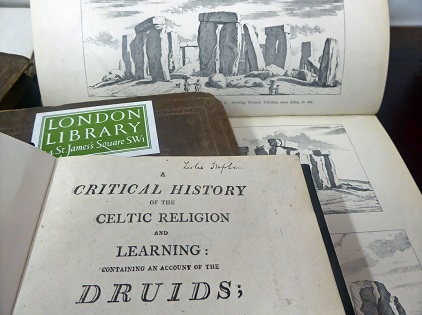 |
| Image supplied by Claire Connolly in Facebook - 20.12.2016. |
[ top ]