       |
Life
| 1858-1949 [Edith Anna Oenone; part of Somerville & Ross]; b. 2 May, Corfu; dg. of Lieut.-Col. in British Army, who shortly retired to Drishane Hse., West Carbery, Co. Cork [Castletownsend, nr. Skibbereen], the family home or eight generations; her elder Robert abandoned family home as economically unviable, 1872, to be inherited by his yngr br. Cameron; ed. privately and Alexandra Coll.; studied art at S. Kensington School of Art [var. Royal Westminster School of Art, London], then Dusseldorf and in Paris under Colarossi in 1884 and 1886; met Violet Martin on 17 Jan. 1886, a cousin and, like her a g-dg., of Charles Kendal Bushe - later calling the meeting ‘a hinge, the place where my life and hers, turned over’; produced together the “Budh Dictionary”, a lexicon of oddities in use among in the Martin’s, Somervilles, Martins and Coghills, 1886; travelled together to Aran Islands; commenced writing together when “well stricken in years” (resp. 24 & 28); as ‘Martin Ross’ they jointly published their first story “Great Uncle McCarthy”, in Badminton Magazine (London [1888]); |
| issues An Irish Cousin (1889), published pseudonymously by ‘Geilles Herring’ and ‘Martin Ross’; rewritten in 1903), predominantly written by Ross with Somerville’s illustrations; issued Naboth’s Vineyard (1891), taking a harsh view of Catholic Ireland; issued The Real Charlotte (1894), in which an unscrupulous woman ruins Francie Fitzpatrick, an innocent girl - called by Molly Keane ‘a lower-class Dublin nymphette’; issued The Silver Fox (1897), set in west of Ireland; wrote the “RM” [Resident Magistrate] stories written between Oct. 1898 and Sept. 1899 and issued Some Experiences of an Irish RM (1899), orig. in Badminton Magazine, to be followed by Further Experiences of an Irish RM (1908) and Mr Knox’s Country (1915), all relating Major Yeates’s dealings with Flurry Knox and his extended family; she refused to be recruited to the Abbey at its foundation, 1904; served as Master of Foxhounds, 1903, and re-established the pack in 1911, becoming Master of West Carbery Foxhounds, 1912 and hunting actively in that capacity up to 1919. |
| issued Dan Russel the Fox (1911), the story of an English heiress, Katherine Rowan, who turns hunting enthusiast in Ireland; together Edith and Violet began learning Irish and were active in suffrage movement, exchanging letters with feminist and composer Dame Ethel Smyth; accepted membership of the Irish Academy of Medals and Literature (MIAL) at its foundation in 1926, and received its Gregory Medal in 1941; Violet Martin suffered a brain tumour in a fall from her horse Dervish, in 1898 from which she never fully recovered; d. 21 Dec. 1915; thereafter Edith maintained contact with her through spiritualism; absent from Ireland during the 1916 Rising but wrote to the Times blaming England for the state of affairs in Ireland and appealing for leniency towards the leaders; Edith issued Irish Memories (1917), being a biography of self and Violet; |
| later supported Irish independence with a kind of resigned nationalism (‘We owe Ireland nearly 300 good years and must try and “stick it” and hope for luck’); she exhibited her pictures in Dublin and London,1920-38; issued The Big House at Inver (1925), a story of Anglo-Irish degeneracy based on memories of Tyrone House, Co. Galway; awarded TCD DLitt, 1932; her favourite brother Admiral Boyle Somerville was murdered by Republicans, for recruiting 52 Irishmen to the British Navy in previous months, 1936; Edith left Drishane House, 1946, and settled with her sister Hildegarde (Lady Coghill) at Tally-Ho, Castletownshend; d. in Castletownshend, 8 Oct. 1949; extensive papers formerly belonging to Sir Patrick Coghill were acquired by sale from Sotheby’s by QUB (Belfast), c.1968; Professor John Cronin directed a symposium on Somerville and Ross at The Queen’s University, Belfast [QUB], in 1969; a digitally-imaged collection of the Edith Somerville-Violet Martin Correspondence is being placed online at QUB by Anne Jamison and Deirdre Wildy [see infra]. JMC NCBE IF OCEL DIL DIW DIB DIH KUN SUTH OCIL |
| [ top ] |
| Fiction & Prose | |||||||
| |||||||
| Reprint Edns. | |||||||
| |||||||
| Bibliography | |||||||
| |||||||
|
[ top ]
[ top ]
[ top ] | |||||||
|
|
[ top ]
Bibliographical details
Gifford Lewis, Edith Somerville: A Biography (Dublin: Four Courts 2005), 518pp. [Notes & Index, 451ff.] CONTENTS: List of illustrations [vii];’ Acknowledgements [ix]; Abbreviations [x]; Introduction [1]; Family backgrounds [13]; Family predicaments [32]; Escaping the cage [58]; Violet Martin comes to Castletownshend [93]; Commencing athors [147]; A popular success with the Irish RM [200]; The late novels: Ross’s death and Somerville’s reaction [245]; Ethel Smyth, sexuality and high life [303]; Last books: America, Ireland and a bad time for farming [363]; ‘Eigty years of unbroken love and good fellowship. I thank God for them’ [413]; Conclusion [426]; Notes [451]; Sources and select bibliography [463]; Index [467]. Gifford Lewis, Edith Somerville: A Biography (Dublin: Four Courts 2005), 518pp. [Notes & Index, 451ff.] CONTENTS: List of illustrations [vii];’ Acknowledgements [ix]; Abbreviations [x]; Introduction [1]; Family backgrounds [13]; Family predicaments [32]; Escaping the cage [58]; Violet Martin comes to Castletownshend [93]; Commencing athors [147]; A popular success with the Irish RM [200]; The late novels: Ross’s death and Somerville’s reaction [245]; Ethel Smyth, sexuality and high life [303]; Last books: America, Ireland and a bad time for farming [363]; ‘Eighty years of unbroken love and good fellowship. I thank God for them’ [413]; Conclusion [426]; Notes [451]; Sources and select bibliography [463]; Index [467]. (See sample text under Commentary, infra.) See review of this book by Aisling Foster in Times Literary Supplement (22 Feb. 2006) [online].
[ top ]
Commentary
Stephen Brown, Ireland in Fiction: A Guide to Irish Novels, Tales, Romances and Folklore [Pt. I] (Dublin: Maunsel 1919), offers summary and comments on An Irish Cousin, viz., ‘Modern country-house life in Co. Cork. A serious study of the slow awakening of a young man to the realisation that there are things in life more real to him than horses and dogs. His love for a clever cousin returned from Canada has a tragic ending. The characters of the tale are drawn from Protestant country society. Clever description of Durrus, the ramshackle home of the Sarsfields. Miss Jackson-Croly’s “At Home” and the run with the Moycullen hounds are said to be worthy of [Charles] Lever. (Brown, op. cit., p.281.)
Rosa Mulholland, review of Further Experiences of an Irish RM, in Irish Monthly, 18, (1890) p.614: ‘[T]he rollicking tone of Charles Lever’s early novels is very distasteful to many, it seems forced, heartless and a little vulgar; and this is somewhat our feeling towards the present volume. These Beaumont and Fletcher partners view our good people too much from afar, as a lower race closely connected with horses and dogs.’ (quoted in James H. Murphy, Catholic Fiction and Social Reality in Ireland, 1873-1922, Conn: Greenwood Press 1997, p.18.)
Maurice Headlam, Irish Reminiscences (London: Robert Hale 1947): ‘The Real Charlotte (1894), set around Castle Dysart, somewhat based on the Cuffe family, Earls of Desart, and their place Castle Desart in Kilkenny, formerly given to an ancestor as Cuffe’s Desart [...] the same destroyed by Sinn Fein members.’ (p.50).
Maurice Collis, Somerville & Ross (Faber 1968), cites the phrase “Discussed the Shockerawn” (in a letter of Edith’s, dated 19 Oct.): ‘The future Irish Cousin was so called because Mrs Somerville used to say with a laugh, “How’s the shocker going?” On 2 Jan. 1888 Martin has, “Terrible stress of the Shocker. At it all day [...] Shockered far into the night.” (p.45.) The plot is a simple one. A younger son of the Sarsfield family at Durrus, an estate on the west coast of Cork, had emigrated to Canada and in due course his daughter came over to stay at Durrus with her uncle and his son, her first cousin. Durrus, deep in the Irish countryside, is more like Ross than Drishane, though it partakes of both. A love story evolves along Victorian lines, professionally handled to a happy ending for the heroine. But below is a brooding air of calamity. [...] Take the following passage. The niece from Canada finds herself one day at a cove called Tra-na-morruf, the Strand of the Dead [...] She hears the sound of oars [...] the crowd waits silently as ‘the boats slowly advanced to the shore; but directly the keep of the first touched the shingle, the women in the others raised a sustained, penetrating wail, which rose and fell in the sunny air and made me shiver. I thought I had never heard such a terrible cry. I had often been told of the Irish custom of “keening” at funerals, but I was not prepared for anything so barbaric and despairing. It broke out with increasing volume and intensity as the coffin was being lifted from the boat [...] &c.’ [Elsewhere Martin called it ‘a dolorous wailing sound, a howling and lamentation of women’s voices [...] the Irish cry, a burial custom belonging to another age and full of barbaric woes.’ [From ‘Olympia to Connemara’, in World magazine] (Collis, p.65). Martin wrote description of omnivorous boghole in An Irish Cousin, for ‘it appealed to her sense of mystery’. (p.68). Notes good reviews of An Irish Cousin in Athenaeum and Observer, et al. (Collis, pp.71-72).
Hilary Robinson, Somerville and Ross: A Critical Appreciation (Dublin: Gill & Macmillan 1980), discusses the ‘killing’ of Francie Fitzpatrick in The Real Charlotte, quoting the authors on ‘the vile chapter 50’, so reluctantly written, and quoting also a letter from Edith Somerville’s mother, as follows: ‘Franice deserved to break her neck for her vulgarity; she certainy wasn’t nice enough in any way to evoke sympathy, and the girls had to kill her to get the whole set of them out of the awful muddle they had got into’. (Quoted in Robinson, op. cit., p.87; cited in Susan Parlour, MA Diss., UUC 2008.)
Seán McMahon, ‘John Bull’s Other Ireland: A Consideration of The Real Charlotte by Somerville & Ross’, in Éire-Ireland, 3, 4 (Winter 1968): McMahon writes that Edith Somerville ‘had not as much experience of the raw facts of Irish life as Martin, nor had she the same interest in them. Life in Castletownshend was as insulated as in a cathedral close and her knowledge of Irish affairs came mainly from servants. Of the partnership, Edith was the less sympathetic to the Irish thing; her gestures are somewhat patent. Her distant cousin Lionel Fleming explains the roles: “Anyone not of the Irish gentry was usually a servant of some kind - an amusing, often an endearing one. Ireland continued to be divided neatly between US and THEM, and the ones who mattered in it, who made the place tick over at all, were undeniably US.”’ (p.124.)
Patrick Rafroidi, ‘The Irish Short Story in English: The Birth of a New Tradition’, in The Irish Short Story, ed. Terence Brown & Rafroidi (Gerrards Cross: Colin Smythe 1979), writes of ‘the Irish cousins, Edith Somerville and Martin Ross whose work should not be too systematically contrasted with their great predecessor’s [i.e., William Carleton]. Like him they use rural material, they are as sensitive to laughter as to tears, and they show the same gift for rendering linguistic particularities. Such points of resemblance are more important than the obvious differences, of social class, which from another point of view would place the two aristocratic writers in the lineage of Maria Edgeworth or in that of William Hamilton Maxwell in his Wild Sports of the West [1832] rather than in step with the peasant writers. But their class position does add a patronizing touch to their humour and introduces echoes of the insecurity of a doomed society. / The greatest gap between the short stories of the cousins and those of Carleton lies in the artistic education and consciousness of their authors. Somerville and Ross are anything but selfeducated. They were acquainted with the English tradition in which they admired, among other storytellers, Kipling. While a student at the École des Beaux-Arts in Paris Edith had, before George Moore, come into contact with the French tradition. Their compositions do not show the improvisation and inconsistency of those of the author of Traits and Stories. Each story has a coherent internal structure and each collection also shows a careful overall structure involving a common framework, a common protagonist [Major Yeates] and variations on a theme that ultimately reveals its unity, that of the disharmony between man and the world which surrounds him. Details and isolated effects are all subordinated to a general design based on economy, progression, crisis and dénouement. / One wonders therefore at the way the work of these two writers is neglected while George Moore and James Joyce are proclaimed as the fathers of the modern Irish short story. Ignorance is not the only explanation of this state of affairs; the windows of the Great Houses of Somerville and Ross were too tightly closed and their lands too strictly reserved for the horses and hounds. The formal perfection of their work could not make up for such deficiency.’ (.q.p.)
[ top ]
David Norris, ‘Imaginative Response versus Authority: A Theme of the Anglo-Irish Short Story’, in Terence Brown & Patrick Rafroidi, eds., The Irish Short Story (Gerrards Cross: Colin Smythe 1979): ‘The world of Somerville and Ross’s R.M. stories could hardly provide a more startling contrast to the work of Joyce. Nevertheless he himself would probably not grudge these two [48] daughters of the Big House their niche in literary history, if only for the deliberateness of their art and the precise way in which they calculate the effect of each word on the general texture of their prose. There is, moreover, a striking similarity between humourless English condescension as portrayed in Somerville and Ross characters such as Leigh Kelway (“Lisheen Races Second Hand”) and Maxwell Bruce (“The Last Day of Shraft”, and Joyce’s later presentation of Haines in Ulysses. The “Protestant Ladies” are unfortunate however in that their reputation has been stranded by historical accident; for while the ethos of their world was firmly established, they were the immediate predecessors of, and are often judged in the company of writers who saw the exploration of the question of Irish National identity as among the main functions of the new literature, O’Connor, O’Faolain and O’Flaherty. As a consequence, a combination of literary pomposity and national sentiment has obscured the proper evaluation of their work, and made even so sensitive a critic as Frank O’Connor apologize for having been guilty of a rereading the Irish R.M. off and on for forty years for the mere pleasure of it.’ (A Lonely Voice, pp.34-35.) [...; cont.]
David Norris, ‘Imaginative Response versus Authority [..., &c.]’ (1979) - cont.: ‘One of the first of these eunuchoid commentators to carp at the writing of Somerville and Ross was Ernest Boyd [Irish Literary Renaissance, Dublin: Alan Figgis 1968, pp.385-86]. Boyd initiated the still continuing attempts to divert critical attention away from the genuine achievement of the R. M. stories into the consideration of something regarded as more “serious” - i.e., The Real Charlotte, a book of such unreadable though doubtless “worthy” dullness that only a highly specialised variety of bookworm could bore its way through the soggy interior [...] The R. M. Stories are the literary equivalent of sporting prints. [...; 49] Accusations of a patronising tone or of stage Irishry are ludicrously far of the mark [...] The R. M. himself represents the rational world defeated by the humorous imaginative anarchy of the Gaelic mind. [...] It is clear from such stories as “The Last Day of Shraft” that Somerville and Ross recognised and sympathised with the technique of subterranean survival adopted by Irish folk culture. [...]’ (pp.49-51.)
Anthony Cronin, ‘Somerville & Ross: Women Fighting Back’, in Heritage Now: Irish Literature in the English Language (Dingle: Brandon 1982), remarks that Somerville and Ross ‘had a better ear for Irish dialogue than James Joyce.’ (p.82.) The character of Francie called one ‘of the most convincing and penetrating portraits of women in all literature’ (p.85.) [The foregoing both quoted in Susan Parlour, MA Diss., UUC 2008.]
Maureen Watters, The Comic Irishman (NY: Albany SUNY 1984): ‘[There is] a racist consciousness at work in Somerville and Ross and they undoubtedly contributed to the stereotype of the Irish countryman as a tricky clown’. (p.20.)
Seamus Deane, Heroic Styles: The Tradition of an Idea [Field Day Pamphlet, No. 4] (Derry: Field Day 1984): ‘Somerville and Ross showed how to take the middle-class seriousness out of Edgeworth’s world and make it endearingly quaint.’ (p.9.)
James Cahalan, The Irish Novel (Dublin: Gill & Macmillan 1988): ‘Somerville wore collars and ties, and as an author Martin adopted a man’s name [...] all of these rather divergent characteristics are evident in their fiction.’ (p.90.) Also speaks of their ‘masterfully accurate and effective rural Irish dialogue’ (p.91.) ‘Particular views of gender and of the life of the body and the life of the mind are central to all the novels of Somerville and Ross, yet have never received sufficient critical attention, the focus having always been a socio-political one on their status as Ascendancy, Big House novelists - a status whcih is, in fact, inseparable form these other themes.’ (p.92.) Speaks of the ‘most frank colloquial critique of sexual relationships [which] represents new language in an Irish novel’ (p.93). [The foregoing both quoted in Susan Parlour, MA Diss., UUC 2008.]
Ann Owens Weekes, Irish Women Writers: An Uncharted Tradition (Kentucky UP 1990), p.212; ‘These narrators are not the intrusive guiding narrators of many nineteenth-century novels whose presence is often felt. We cannot predict the sympathies of the narrators of The Real Charlotte.’ (p.72.) Weekes sees Pamela Dysart as ‘the positive, passive woman’ in her character as ‘the model Anglo-Irish Victorian woman [who] cannot reveal her affection to Captain Cursiter, who lacks the courage to speak his own.’ (Idem; the foregoing both quoted in Susan Parlour, MA Diss., UUC 2008.) Further: ‘OE Somerville and Martin Ross present an unappealing and immoral character in The Real Charlotte [viz., Charlotte], but depict her neverthless as a victim of an unjust society [... &c.]’ (q.p. & source.)
Declan Kiberd, ‘Tragedies of Manners - Somerville and Ross’, in ‘Inventing Ireland: the Literature of the Modern Nation (London: Jonathan Cape 1995): Kiberd pinpoints Edith Somerville’s attitudes to womens role in their own class, and more generally, their support of sufferage. Further, ‘There is a real sense in which the literature of the Irish revival arose out of the ironies of such a master-servant relationship. Francie Fitzpatrick is simply the final consummation of this tradition, where an exhausted upper-class seems not just humour, but also sexual release, in a vibrant underclass.’ (p.73.) ‘What fascinates in The Real Charlotte is the author’s [sic] refusal to privilege any one consciousness at all. [...] Intending to criticize a society which they yet wished to remain within, Somerville and Ross choose to express their ultimate values by technique, with irony as a prevailing narrative point of view. Like other novels of manners, this is designed not just to be read but re-read, and its art is a strategy of preparations.’ (p.77.) This is an ominous image [the collapse of the newsbearing servant Norry] of a landless class left rudderless in a new Ireland, whose putative inheritors are quite unequal to the challenges with which they have confronted themselves. .. It is such persons who act as a choric voice within the plot for the author’s overall design.’ (p.79.) ‘Somerville and Ross [...] implicitly conceded that theirs has been an unconscionably jaunting book about a hopeless situation.’ (p.79).
[ top ]
Gifford Lewis, Edith Somerville: A Biography (Dublin: Four Courts Press 2005): ‘Although it seems that both Edith and Martin had considered marriage as a possibility, they concealed this as they were trained to conceal all sexual matters, and their natural talents provided them with an alternative route. And although they both made a cult of female friendship that networked this alternative route. this did not preclude close and admiring relationships with men. As they became older their moral sense grew stricter, and the tenets of their religion held them tighter. Unchanged from their parents’ day, the chief sources of moral outrage and disgust remained bastardy and apostasy, or as Martin termed it, perversion. She had recoiled with suspicion and horror from The Picture of Dorian Gray and from the overt sexuality of “The Ballad of the Nun” in the first number of the Yellow Book in 1894. Both writers in their essays on marriage are hard-bitten, seemingly disappointed in romantic love. In her essay In Sickness and in Health (1890), written when she was twenty-seven, Martin wrote of peasant marriages in which: “Love [was] the negligible quantity and attachment the rule. It is for us, more singly bent on happiness, to aim at rapture and foreknow disappointment.’ Some bitter experience seems to inform her: “It is romance that holds the two-edged sword, the sharp ecstasy and the severing scythe stroke, the expectancy and the disillusioning, the trance and the clearer vision.” The essay was written in the second fortnight of April at Glen Barrahane, during a year when she was very much taken with Warham St Leger, whom she failed to persuade to visit her at Ross in the late summer. She had formed an attachment to him by 1888.’ [447]
Cont. (Gifford Lewis, Edith Somerville: A Biography, 2005): ‘The pragmatic marriages of the Cork country people that she knew also fascinated Edith. When she was eighty-five, in her essay For Richer for Poorer (1933), she wrote: “these state alliances, founded though they may be on the commonplace of financial security, have a way of making for happiness that love matches do not invariably achieve, and one begins dispassionately to wonder if the Romantics and the Poets haven’t been wrong all the time, and the stern, business-like parents right.”’ The essay closes with a re-set version of a quotation from a Drishane housemaid, taken down in December 1881, when Edith’s relationship with Barry Avonmore had been put on hold. “I think I will never be married. I’d love to be an ould maid. A single life is airy.” It shows an unusually extensive re-write. In the final version, made fifty years after it was first recorded, Edith fictionally describes herself in conversation with a widow who farms alone. “I asked her whether she thought a married life or a single one was the happier. The reply was ... “once ye’d got over the disgrace of it, a single life’d be the more airy. But faith!” she added with a laugh, “if ye get marri’d, or if ye stay single, its aiqual which way it is, ye’ll be sorry!’” / The effects of the “cage” imposed on Edith by her class and family proved to be lifelong. [...].’ (p.447-48.)
Cont. (Gifford Lewis, Edith Somerville: A Biography, 2005): Of Edith’s possible lesbianism in relation to Violet Martin as reflected in her dealings with Ethel Smyth, the lesbian who seems to have “got a claw in” (as Ethel put it in a letter), Lewis writes: ‘It does not seem to have occurred to Ethel that Edith might have preferred sexual “entrainment” from a man rather than a woman. From the evidence of her free-going relationships with young men in the 1870s and 1880s this is entirely within the realms of possibility. Geraldine Cummins, Muriel Currey and Rose Marie Salter Townshend have given abundant confirmation that Edith even as an old woman showed marked attention to handsome men of any age, and Muriel Currey makes a habit of remarking humorously on her interest in particular young workmen, and her desire for their company, in her diary transcripts.’ (p.309.) Edith used the otherworld Martin to fend her off. Lewis writes: ‘Ethel was not pleased with this intervention from “the impertinent ghost” but furious. Her letters to Edith became intemperate attacks on what she saw as prudishness and gentility. The physical intrusiveness of Ethel’s attempt to possess Edith is evident in the phrase “I have indeed ‘got a claw in’ and hold a bit of you fast” this prepares us for Virginia Woolf’s reaction to Ethel’s later fixation on her as “like being caught by a giant crab.”’ (Quoted in Louise Collis, Impetuous Heart, p.180; here p.308.) See also longer extract [from Gifford Lewis], attached.)
Lucille Redmond, review of Gifford Lewis, Edith Somerville, in Books Ireland I(Summer 2006): remarks on ‘the roguish stories of the Anglo-Irish resident magistrate and his dealings with the thinly-disguised Martin family in its outlying branches’ and quotes [presum. Martin] on the family response to the Boycott episode (in which her uncle Kendal is hurt in a fall from a horse during the Relief Expedition, protecting Captain Boycott’s scabs): ‘Uncle Josc’s tenants have paid up £300 and refuse to give more. The amount due is £1,600. Pleasing prospect for Uncle Joscelyn until eviction forces the brutes to pay.’ Also quotes Lewis on Edith’s snobbery: ‘privately quite perverted by snobbery; this in part was the attraction of the Martin family, for whatever had befallen them in the way of bankruptcy, their bloodlines were a thing to revere. Edith had flirted with fair-haired moustachio’d horsemen in teenage but, on meeting Martin (i.e., Violet Martin, so-named because of the plethora of Violet’s in the Somerville family) [realised] that there was “another way” - an alternative to marriage. Further notes that Edith suffered from persistent infection of her teeth resulting in a degree of deformation of the jaw and perpetual bad (“sour”) breath. Also documents her shifting attitude to W. B. Yeats (see under Yeats, infra.)
[ top ]
Quotations| On the Anglo-Irish: ‘An old stock, isolated from the world at large, wearing itself out in those excesses that are a protest of human nature against unnatural conditions, dies at last with its victims round its death-bed. Half-acknowledged, half-witted, wholly horrifying; living ghosts, haunting the house that gave them but half their share of life, yet withheld from them, with half-hearted guardianship, the boon of death.’ (Quoted in Violet Powell, The Irish Cousins: The Books and Background of Somerville and Ross, London: [Heinemann 1970, p.20; cited in Patrick Sheeran, “The Novels of Liam O’Flaherty: A Study in Romantic Realism”, Ph.D., UCG 1972, p.144.) |
| ‘[...T]ake Carbery and grind its bones to make our bread [...]’ (Quoted in Judith Hill, review of Gifford Lewis, Edith Somerville: A Biography, in Times Literary Supplement, 25 Feb. 2006, p.12.) |
The Real Charlotte (1894) - Charlotte Mullen: ‘[…] Charlotte had many tones of voice, according with the many facets of her characters, and when she wished to be playful she affected a vigorous brogue, not perhaps being aware that her own accent scarcely admitted of being strengthened. / This refinement of humour was probably wasted on Lady Dysart.’ (1977 edn., p.11; quoted in Declan Kiberd, Inventing Ireland, 1995, p.69-70.)
Charlotte Mullen (in The Real Charlotte): ‘It is hard to ask pity for Charlotte, whose many evil qualities have without pity been set down, but the seal of ignoble tragedy had been set on her life; she had not asked for love, but it had come to her, twisted by the malign hand of fate. There is pathos as well as humiliation in the thought that such a thing as a soul can be stunted by the trivialities of personal appearance, and it is a fact not beyond the reach of sympathy that each time Charlotte stood before her glass her ugliness spoke to her of failure, and goaded her to revenge.’ (The Real Charlotte; q.p.; quoted in Ann Owens Weekes, Irish Women Writers: An Uncharted Tradition, Kentucky UP 1990, p.61.)
Francie Fitzpatrick (in The Real Charlotte): ‘Francie’s accent and mode of expressing herself were alike deplorable: Dublin had done its worst for her in that respect.’ (p.17.) - of this character Edith Somerville wrote: ‘I think of all the company of more or less tangible shadows who have been fated by our pens, it is Francie Fitzpatrick who was the most constant companion, and she was the one of them all who “had the sway”. We knew her best, we were fondest of her. Martin began by knowing her better than I did, but even during the period when she sat on the shelf with her fellows, Martin and I boiled the pot with short stories and the like [...] or wrote up tours, or drea[mily] idled, Francie was taking a hand in what we did, and her point of view was in our minds.’ (Quoted in John Cronin, ‘Somerville & Ross, The Real Charlotte’, in The Anglo-Irish Novel: The Nineteenth Century [Vol. I], Belfast: Appletree Press 1980, both p.141.)
Further (on Francie): ‘[H]er delicate defeated face was drawn to his [Capt. Gerald Hawkins]; her young soul rushed with it, and with passionate, innocent sincerity, thought it had found Heaven itself [...] After this there was nothing to be done except sit down again, and with her head on his shoulder, allow that fatal anaesthetic to rob him of all considerations beyond Francie’s kisses.’ (p.231; (quoted in Susan Parlour, MA Diss., UUC 2008.)
S & R’s remarks: ‘We felt her death very much [...] when we began to know there could be but one fate for Francie. It felt like killing a wild bird that had entrusted itself to you.’ (Quoted in Cronin, op. cit., idem; both cited in Susan Parlour, MA Diss, UUC 2008.)
Roddy Lambert (in The Real Charlotte): ‘His handsome brown eyes rested approvingly on Francie’s flushed face, and the thought that mainly occupied his mind was surprise that Nosey Fitzpatrick should have such a pretty daughter.’ (p.20.) ‘He looked at Francie under his lowered lids, and tried to find it in his heart to wish that she was a little more grown up and serius. She was leaning against the trunk of a tree, so that its brim made a halo round her face, and the golden green light that filtered through the leaves of the lime moved like water over the white dress.’ (p.162; quoted in Susan Parlour, MA Diss., UUC 2008.)
The Real Charlotte (1894): “I’m not asking you to keep me,” said Francie, starting up in her turn and standing in the window facing her cousin; “I’m able to keep myself, and to wait as long as I choose till I get married; I’m not afraid of being an old maid!” They glared at each other, the fire of anger smiting on both their faces, lighting Francie’s cheek with a malign brilliance, and burning in ugly purple-red on Charlotte’s leathery skin. The girl’s aggressive beauty was to Charlotte a keener taunt than the rudimentary insult of her words; it brought with it a swarm of thoughts that buzzed and stung in her soul like poisonous flies.’ (q.p.; quoted in Bridget O’Toole, review of Irish Literature: The Nineteenth Century, ed. Peter Van de Kamp & A. Norman Jeffares, in Books Ireland, Feb. 2008, p.16.)
[ top ]
Landlord & tenant - “The Finger of Mrs, Knox” (in Mr. Knox’s Country, 1915):|
‘[...] |
Bon mots (in “The Comte de Pralines”): ‘I crept home, third class, with full trunks and empty pockets, sustained only by the aphoris evolved by my wide, that economies, not extravagances, are what one really regrets’ (p.254); ‘a predeliction for the society of the young was one of the surest signs of old age.’ (p.255.) |
| See also ‘Snobbery’ in Notes - infra. |
[ top ]
The Silver Fox (1898; 1902; corr. edn. 1904, 1912, 1914)
 |
 |
| TAKEN FROM an architectural point of view there was nothing to be said for French’s Court. It belonged to the race of stone boxes, with tightly-fitting lids, that were built in Ireland a hundred years ago, the greater box or the less, according to the circumstances of the builder, and it was of as Presbyterian a gauntness as its tribe. Contrary, however, to the rule which ordained that the stone box should, as far as possible, face north and east, French’s Court, with its ranks of high windows, looked out into the sunset across a great plain of western ocean. From the edge of the long bare terrace in front of the house, the grass-lands sloped suavely between plantations to the sea, where Atlantic rollers charged and volleyed in stubborn fastnesses of cliff. The low hills behind the house were clothed with woods, brown and grey now in the mute suspense of January, touched here and there with orange where last year’s beech leaves clung like a stain of rust. It was a big outlook, and the owner of French Court was a very small incident of the foreground [.. |
| —from The Silver Fox (1898) [Chap. VI], p.82. |
Building a railway station
|
The ring of the trowel travelled far on the wind across the heather, a voice of civilization, saying pertinent, unhesitating things to a country where all was loose, and limitless, and inexact. Up here, by the shores of Lough Ture, people had, from all ages, told the time by the sun, and half-an-hour either way made no difference to any one; now - most wondrous of all impossibilities - the winter sunrise was daily heralded by the steely shriek of an engine whirling truckloads of men to their work across the dark and dumb bog-lands. The trout in the lakes no longer glided to safety at the recurrence of the strange tremor and clatter that accompanied the twilights, the wild duck no longer splashed into wing along the water’s surface, and the people scattered among the hillsides already counted as their chiefest landmark the red gable of the new railway-station. Every morning saw a villageful of men shot into it; bricklayers working high up in the gable, stone-cutters dressing limestone blocks with infinite chip and clink, workmen shovelling gravel, and over all the voice of the ganger arising at intervals in earnest, profuse profanity. The Dublin artisans worked in silence, except when one or other trolled forth one of the ditties of his class - genteel romance, with a waltz refrain, or obscure vulgarity of the threepenny music-hall, yet representing to the singer the songs of Zion in a strange land; while the local gang used every chance of proximity to carry on a low growl of conversation. Whether it was the party of twenty whose picks and spades were gradually levelling and filling the unfinished platform, or the two whose voices ascended [101] in Irish from the depths of the well that they were sinking, the general topic was the same, and was one that intimately concerned Mr. Glasgow. —from The Silver Fox (1898) [Chap. VI], p.101-02. |
The death of Solomon
|
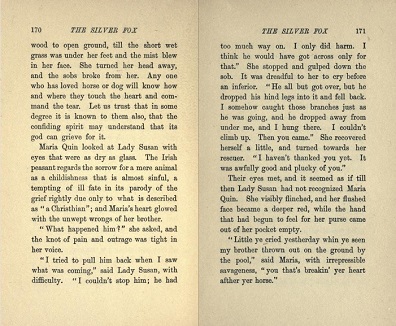
[...] Maria caught her by the wrist and drew her slowly upward. [...] Lady Susan got her knee over the edge and fell forward on to Maria’s shoulder. Her hat dangled by its guard, her habit sleeve had burst away from the shoulder, her patent-leather boots were cut and scraped by the crevices in which they had searched to find a footing; she drew hard breaths in the effort to recover herself. —from The Silver Fox (1898) [Chap. XII], p.171-74. |
| See full-text copy in Ricorso Library, “Classic Texts”, via index or direct. |
[ top ]
Collaboration: ‘[A]s a matter of fact, during our many years of collaboration, it was a point that never entered our minds to consider. To those who may be interested in an unimportant detail, I may say that our work was done conversationally. One or the other - not infrequently both, simultaneously - would state a proposition. This would be argued, combated perhaps, approved, or modified, it would then be written down by the (wholly fortuitous) holder of the pen [...] (Irish Memories, 1917; quoted in P. J. Kavanagh, Voices in Ireland, 1994, p.183.)
J. M. Synge: ‘This is cast in a form so simple as to be at times too simple, as far as mere reading goes. I suppose that the dialect is of the nature of a literal translation of Irish, but it seems to me to lack fire and spontaneity - you [Lady Gregory] know, and no one better, what the power of repartee and argument is among such as these. It is inimitable, in my opinion, I mean that no one who is not of themselves can invent it - and it is so much a part of themselves that to present them without it makes an artificial and an unreal picture. [...]’ (Quoted Gifford Lewis, Somerville and Ross: The World of the Irish R.M., Harmondsworth: Penguin, p.252; cited in Declan Kiberd, Inventing Ireland, 1995, p.70).
‘Anglo-Irish dialect […] is something more than a dialect, more than an affair of pidgin English, bad spellings, provincialisms, and preposterous grammar; it is a tongue, pliant and subtle, expressing with every breadth the mind of its makers. When at its richest, in the mouths of the older peasants, it owes most to Shakespearean English - not in amount but in quantity.’ (“The Anglo-Irish Language”, in Stray-Aways, London: Longmans, Green 1920, 184; quoted in Nicole Pepinster Greene, ‘Dialect and Social Identity in The Real Charlotte’, in New Hibernian Review, 4, 1, Spring 2000, p.123.)
[ top ]
References| Queens University, Belfast: QUB Library contains a collection of Somerville & Ross materials consisting of approx. 2100 items, c.1873-1948, including 113 volumes (diaries), 4 files of notes, approx. 1800 autograph letters, approx. 60 literary manuscripts, 12 notebooks and 119 drawings and illustrations. |
|
Stephen Brown, Ireland in Fiction (Dublin: Maunsel 1919), lists, An Irish Cousin ([1889]; new ed., rev., Longmans 1903) , county society Cork, a young man’s spiritual awakening and a tragic story of cousin-love; Naboth’s Vineyard (Blackett 1891), ‘unworthy of their reputation’, a Land League love-intrigue; The Real Charlotte [1894], ‘dark tale, unscrupulous woman, sweet-natured, ill-trained girl’[Brown]; The Silver Fox [1896] fox-hunting and superstitious peasantry viewed from an ‘uncomprehending standpoint’; Some Experiences of an Irish R.M. (Longmans [1899], with 31 ill. by E. OE. Somerville; Nelson 1916), ‘racy, humorous sketches’, orig. in the Badminton Magazine [monthly]; Further Experiences of an Irish R.M. (Longmans [1908]; Nelson 1917); All on an Irish Shore (Longmans [1903], 10 ills. by E.OE.S.; Nelson 1917), foxhunting, racing, boycotting, gentry, peasants; Some Irish Yesterdays (Longmans 1908, 51 ills. E.OE.S.; Nelson 1917) light magazine sketches in racy style, Connemara; Dan Russell, the Fox (Methuen, 1911), Miss Rowan comes to Ireland, hounds and horses, ‘a story of which we cannot speak favourably’; In Mr. Knox’s Country (1915, 8 ills. E.OE.S), RM stories. And note Longman’s cheap eds. of various titles in 1916 . [See also Brown’s remarks under Commentary, supra.]
Desmond Clarke, Ireland in Fiction [Pt. II] (Cork: Royal Carbery 1985) adds Mount Music (Longmans 1919), mixed marriage between Christian Talbot Press Lowery and Larry Coppinger of Coppinger Court; Strayaways (Longman 1920), travel sketches; An Enthusiast (1921), tragedy of squire Dan Palliser of Monalour, returning from WWI with good intentions; French Leave (Heinemann 1928), Patsey Kirwen runs away from home in 1884 and studies art in Paris; Big House at Inver (Heinemann 1925), Shibby struggles to restore the degenerate family-fortunes but the House burns; The Smile and the Tear (Methuen 1933, ill. E.OE.S.), reminiscences of West Carbery; The Sweet Cry of the Hounds (Methuen 1936), trans. Irish ballad and 10 hunting sketches; Notions in Garrison (Methuen 1941, ill. E.OE.S.), ‘paths leading into a past that was light-hearted and inconsequent’ [author]; The Irish RM, in one vol. (Faber 1956); An Irish Cousin, orig. by Herring Geilles and Martin Ross.
John Sutherland, The Longman Companion to Victorian Fiction (Longmans 1988; rep. 1989), contains separate entries for The Real Charlotte and Experiences of an Irish RM.
Seamus Deane, gen. ed., The Field Day Anthology of Irish Writing (Derry: Field Day 1991), Vol. 2: Edith Somerville’s father was a British Army officer; returned to Drishane, Castletowns[h]end Co. Cork; ‘[...] there was a mystical relationship between the two authors which enabled them to communicate after Violet’s death at Cork in 1915’ (p.1217). [Primary bibliography as in Works, supra.]
Seamus Deane, gen. ed., The Field Day Anthology of Irish Writing (Derry: Field Day 1991), Vol. 2, Daniel Corkery: ‘In Ascendancy literature the leading theme from the start has been, the decline and fall of an Ascendancy “Big House”. Maria Edgeworth started this hare also, and the hunt still goes on. Within the last few years we have had The Big House of Inver by Somerville and Ross and The Big House by Lennox Robinson [...] Again, the work of Somerville and Ross lives mostly by English suffrage; while Carleton’s work - though written quite obviously under Ascendancy influence - lives by Irish suffrage [...]’ [FDA2 1009-10]. Somerville [viz., S&R] identified by Augustine Martin as a late exemplar of regional fiction [1021-22]. Further comments: ‘[...] that tradition, looking out in arrogant decline through the windows of Somerville and Ross’ [1026]; excerpt from The Real Charlotte [1046-59]. FDA3 represents Somerville & Ross as illustrating Sean O’Faolain’s view of Irish social history [104]. Note also W. J. McCormack: ‘One of the central experiences of Anglo-Irish literature is embarrassment. In narrative terms this may be traced in fictions or shame such as Castle Rackrent, Uncle Silas, and later Somerville and Ross’s Big House of Inver.’ (Ibid., p.665).
Robert Hogan, ed., Dictionary of Irish Literature (Dublin: Gill & Macmillan 1979), quotes: ‘in all the happy years of our working and living together, there was never a break in the harmony of our work, nor a flaw in our mutual understanding.’ (Edith Somerville, essay in Irish Writing, 1946; Hogan, op. cit., p.620). Calls The Irish Cousin (1889) an attempt at a Gothic novel.
Hickey & O’Doherty, Dictionary of Irish History (1979), lists other various Somervilles, viz., Vice-Admiral Henry Boyle Somerville (1864-1936), a br. of the writer; and Sir William Meredyth Somerville (1802-73), Chf. Sec. in Ireland, 1847-52; 1st Baron Athlumney of Somerville and Dollard, 1863.
Lady Cynthia Asquith, ed., The Funny Bone, New Humorous Stories (London: Jarrold 1928), 287pp., incls. a contribution by Edith Somerville.
Belfast Central Library holds All on the Irish Shore (1903); Big House at Inver (1927); Dan Russel the Fox (1911); An Enthusiast (1921); IN Mr. Knox’s Country (1925); Maria (1949); Naboth’s Vineyard (1891); Mount Music (1919); Patrick’s Day Hunt (n.d.); The Real Charlotte (1903); Sarah’s Youth (1938); the Silver Box (n.d.); The Smile and the Tear (1933); The States through Irish Eyes (1931); ‘Happy Days’ (n.d.); An Incorruptible Irishman (1932) [on Kendall Bushe]; The Irish R.M. and His Experiences (1928, 1937); Further Experiences of and Irish R.M. (1897, 1910); Irish Memories (1917, 1918); Maria and some other Dogs (1949); Notions in Garrison (1941); Some Irish Yesterdays (1916); Though Connemara in a Governess Cart (1893); Wheel-tracks (1923); The Chase (1896).
Film: Experiences of an Irish R.M., & Further Experiences of an Irish RM - TV production by Channel 4/RTÉ One (18 episodes, 1983-85); later series by collaboration between RTE and BBC Ulster. Dram. personae: the RM - Peter Bowles; Philippa - Doran Godwin; Flurry Knox - Bryan Murray; Mrs Cadagan - Anna Manahan; Slipper - Niall Toibin; Mrs. Knox - Beryl Reid. (Also Susan Fitzgerald.) Filmed in Ireland at locations in Kildare and Wicklow with additional locations in the West of Ireland. The house used as Aussolas Castle, the residence of Beryl Reid’s incarnation of the erstwhile Mrs. Knox (located at Newhall, Naas in Kildare), was badly damaged by fire following completion of filming for the series, it has since been returned to its former glory. Johnstown Kennedy - the house used as Major Yeates’ residence, Shreelane House - was situated near Rathcoole, Co. Dublin. It was demolished soon after the 3rd series was completed and a golf course now stands on the site.
[ top ]
Notes
The Real Charlotte (1894) tells of the rivalry between sunny Francie Fitzpatrick and her ambitious cousin Charlotte. When Francie arrives in Lismoyle, her flirtatious ways attract the attention of three very different men: the scholarly heir of the aristocratic Dysart family, the bold English officer Gerald Hawkins and the raffish land-agent Roddy Lambert. Charlotte too is interested in Roddy Lambert, but her secret schemes are doomed to go astray. Meanwhile Pamela Dysart is restrained by convention from expressing her feelings towards Capt. Cursiter, who is similarly afraid to express his, and so she remains a spinster, while Miss Hope-Drummond, drafted in from England as a potential wife for Christopher Dysart - who becomes infatuated with Francie - lacks all sexual feelings. (Summary in Cambridge Library Online Catalogue [via COPAC, March 2008]; together with plot notes in Susan Parlour, ‘Vixens and Virgins in the 19th-century Anglo-Irish Novel [Le Fanu, Somerville & Ross, Stoker]’, MA Diss., UUC 2008.)
Experiences of an Irish RM (TV style): ‘The various stories concern the life of an Irish ex-British Army officer Resident Magistrate (R.M.) recently appointed to his position in Ireland, which at that stage was still wholly a part of the United Kingdom, and before the creation of the present day Republic of Ireland. The humour in the series is greatly enhanced if the viewer has a broad understanding of the history of Ireland’s relationship with England, and how Ireland was governed, as well as the Irish country way of life. The show is, however, not political, although caricatures of Irish and British people are used for humorous purposes. Political references are, however, not completely absent; where they occur, they are invariably introduced in a subtle manner by guest characters. Notable among these are several visiting officials from Dublin Castle who regard the Major’s dispensation of justice as unduly lenient, and a Catholic canon with strong Irish nationalist sympathies who exploits the naiveté of the Major for his own purposes. In every case, the comfortable, if somewhat adversarial, co-existence of the Major and the local population is at risk. One element of the series’ humour involves the efforts of Flurry and the Major to hasten the departure of these troublesome visitors. One of the show’s key strengths lies in its ability to convey the extent to which the lives of the Anglo-Irish gentry and the simple, if rather stilted local characters, often became inadvertently intertwined to produce the memorable comic effects that are so unique to the Irish psyche. [...] The light-hearted humorous style of the Irish RM has often been compared with To the Manor Born, [in which Peter Bowles, who plays Major Yeates, also starred] although in a period Irish context instead of a present-day (as then was) English context. In one scene, the major’s English wife, Philippa (Doran Godwin) is dancing with Flurry’s groom, Slipper (Niall Toibin), at a servants’ ball. Slipper ventures to say that “The English and the Irish understand each other like the fox and the hound,” to which the lady replies in good humour, “But which is which?” The answer is, “Ah well, if we knew that, we’d know everything!”’ (See Wikipedia [q.auth.], online:
Influence on Joyce?: in The Real Charlotte, Somerville and Ross write of ‘tall brick houses browbeating each other in gloomy respectability across the white streets.’ (Quoted Maurice Craig, in Dublin 1660-1860, p.296-97. Cf. Joyce: ‘The other houses [on Richmond St.] gaze at each other with brown imperturbable faces … conscious of decent lives within them’ (“Araby” [D26].)
Hugh Lane Gallery: Edith Somerville [of Somerville Ross] signed a letter to The Irish Times (Dec. 1904; printed 5 Jan. 1905), appealing for donations to the value of £30,000 or £40,000 to purchase the collection of impressionist paintings ‘chosen by experts from the Staats-Froves and Durand-ruel Collections, and admitted to be the finest representation of modern French art outside Paris’, currently showing at the Royal Hibernian Academy. with Jane Barlow, Augusta Gregory, S. H. Butcher, Douglas Hyde, Edith Oe. Somerville, Martin Ross, Emily Lawless, W. B. Yeats, Geo. W. Russell (“AE”). (Denson, op. cit, p.54.)
1916 Rising: Maurice Collis writes in Somerville and Ross (1968): ‘Edith was therefore not in Ireland at the time of the Easter Rebellion, 24 April 1916, and records no opinion of it, though later she wrote to The Times pleading that mercy be extended to the rebel rank and file.’ (p.176n.)
Snobbery: “The Aussolas Martin Cat”, a story in Mr Knox’s Country (1915) includes the following transaction between Lady Knox and Major Yeates in their dealings with the potential leaser of her property, a Cockney with the usual speech defect. As Yeates narrates: “ ‘twas whispered in heaven, ‘twas muttered in hell.’” / By an amazing stroke of luck I was enabled to continue: “And echo caught softly the sound as it fell!” with a glance at Mr. Tebbutts that showed I was aware the quotation was directed at his missing aspirates.’
Note [supplied here]: The reference is to a riddle of Catherine Maria Fanshawe (1765–1834) to which the answer is the letter “H” – viz., “Riddle on the Letter H”: ‘ ‘twas whispered in Heaven, ‘twas muttered in Hell, / And echo caught faintly the sound as it fell; / On the confines of Earth, ‘twas permitted to rest, / And in the depths of the ocean its presence confessed; / ‘twill be found in the sphere when ‘tis riven asunder, / Be seen in the lightning and heard in the thunder; / ‘twas allotted to man with his earliest breath, / Attends him at birth and awaits him at death, / Presides o’er his happiness, honor and health, / Is the prop of his house and the end of his wealth. / In the heaps of the miser, ‘tis hoarded with care, / But is sure to be lost on his prodigal heir; / It begins every hope, every wish it must bound; / With the husbandman toils, and with monarchs is crowned; / Without it the soldier and seaman may roam, / But woe to the wretch who expels it from home! / In the whispers of conscience its voice will be found, / Nor e’er in the whirlwind of passion be drowned; / ‘twill soften the heart; but though deaf be the ear, / It will make him acutely and instantly hear. / Set in shade, let it rest like a delicate flower; / Ah! Breath on it softly, it dies in an hour.’ (Available at Google - online; accessed 28.10.2009.)
Portraits: There is an oil portrait of Edith Somerville by J. Crealock (1928); see Anne Crookshank, Irish Portraits Exhibition, Ulster Mus. (1965). Also various photo-portraits in Maurice Collis, Somerville and Ross (1968). Note biographies by Maurice Collis (1968) and Hilary Robinson (Dublin 1980).
[ top ]