George Bernard Shaw (1856-1950)
       |
Life
| [vars. Bernard Shaw; G. B. Shaw; fam. known as “Sonny”] b. Coombe Hospital. 26 July, son of George Carr Shaw and Lucinda Elizabeth Gurly (“Bessie”, m. 1852 - aetat. 22) of 3 Upr. Synge St., Dublin [now 33 Synge St.], the former owning an ailing flour-mill at Dolphin’s Barn and the latter wrongly assumed by him to possess the money to save it; GBS was first schooled by Rev. Carroll, rector of St. Bride’s, an uncle by marriage and later at the Wesley Connexional [now Wesley College], Dublin; after Mrs. Shaw, a mezzo-soprano, began to take voice-training with one George John Vandaleur Lee, the Shaws moved to 1, Hatch St., a house belonging to of Lee’s recently dead br., with whom he had shared it; |
| GBS attends Lee’s concerts and grow familiar with works of Handel, Haydn, Mozart, Beethoven, Rossini, Bellini, Donizetti, and Verdi; Shaw's father buys a house for his mother on Dalkey Hill; GBS spent long hours in the National Gallery of Ireland, recently opened, with his schoolfriend [Matthew] Edward McNulty during the late 1860s and early 1870s; the Shaws next moved to 61 Harcourt St., 1871; a sis. Agnes moves to the Isle of Wight for TB cure, and dies there; another, Lucy, moves to Fulham Rd., London, to live with her mother - still with Vandeleur; GBS leaves school and commences working for Charles Uniake Townsend, estate-agents, of Molesworth St.; publishes a letter in Public Opinion, signed “S”, commenting on the influence of the evangelists Moody and Sankey during their Dublin tour, 1875 [‘Respecting the effect of the revival on individuals I may mention that it has a tendency to make them highly objectionable [...] it remains doubtful if the change is not merely in the nature of the excitement rather than in the moral nature of the individual ...’]; |
| Mrs. (Lucinda) Shaw sends GBS to London, where he allegedly earned only £6 by writing in his first 9 years, April 1876; joined Zetetical Society, a group searching for ‘truth in all matters affecting the interests of the human race’, 1880; there he met Sidney Webb, founder of the Fabians and formed a fast friendship, supplying each other’s deficit of knowledge [“You knew everything that I didn't know and I knew everything you didn’t know [...] We had everything to learn from one another and brains enough to do it’; Wikipedia citing Holroyd, 1990]; became a vegetarian for economic reasons and remained so on principle, 1881; suffered an attack of smallpox in 1881 and started wearing a beard to hide facial marks; and publishes Immaturity (1879), a novel; also Love Among the Artists (1881), Cashel Byron’s Profession (1882-83) and An Unsocial Socialist (1883); joined Fabian Society at its foundation by Sidney and Beatrice Webb, and others, 1884 - later reporting that reading Marx ‘made a man of me’; contribs. book-reviews to Pall Mall Gazette (ed. William Archer) , 1885-88; |
| his play Widowers’ Houses was suggested by Archer as a means of promoting Ibsenism, 1885; reworked it for J. T. Grein’s Independent Theatre Co. which produced it at the Royal Theatre, 9 Dec. 1892; GBS acts as Art Critic for The World, 1886-89; acts as Music Critic for the Star, under pseud. “Corno di Bassetto”, 1888-90; ditto to World, 1890-95; issued The Quintessence of Ibsenism (1891); his first play Arms and the Man was performed Avenue Theatre, London, 21 April 1894, with subvention from Annie Horniman, and with Yeats’s The Land of Heart’s Desire as a curtain-raiser; later transferred to the Court Theatre and produced there by JHarley Granville-Barker and [ohn]. E[ugene]. Vedrenne, the brillian actor-director partnership, April 1894 - after which it transferred successfully to New York, Sept. 1894; appt. Drama Critic for the Saturday Review, edited by Frank Harris, 1895-98; |
| visited at Beachy Head with the Webbs and other Fabians, passing the time ‘diligently trying to ride bicycle for the first time in my life’, Easter 1895; took employment as ‘vestryman’, for St Pancras Local Govt. Councillor, 1897-1903; corresponded with Ellen Terry for whom he afterwards wrote Captain Brassbound’s Conversion; m. Charlotte Payne-Townsend (d.1943), 1898, and moved with her to Ayot St [Saint] Lawrence, Hertfordshire, where he remained thereafter; issued Plays Pleasant and Unpleasant, 2 Vols. (1898), containing Arms and the Man, The Man of Destiny, Candida, Mrs. Warren’s Profession, The Philanderer, &c.; refused invitation to participate in Centenary Commemoration of the 1798 Rebellion [‘Until Irishmen apply themselves to what the condition of Ireland will be in 1998, they will get very little patriotism out of Yours sincerely’]; staed extensively at Eccles Hotel, Glengarriff, Co. Cork, 1910-11; |
| hears Edward Elgar’s Enigma Variations [‘... took your breath. Whew! I knew we had got it at last’], and established friendship with Elgar, championing him as the greatest English composer since Purcell; appt. Mary Chavelita Bright (1859-1945) as his drama agent, 1901; issued Three Plays for Puritans (1901), being Caesar and Cleopatra; Captain Brassbound’s Conversion and The Devil’s Disciple; wrote Man and Superman, 1901-03, which was then premiered at the Royal Court Theatre (23 May, 1905) - and was from New York Public Libraries on moral grounds; further plays produced by Vedrenne and Granville-Barker at the Royal Court, 1904-07, including John Bull’s Other Island, commissioned by W. B. Yeats for the Abbey [‘Mr. Yeats got more than he bargained for’] and rejected supposedly for want of an actor to play Broadbent; premiered instead at the Royal Court (1 Nov. 1904) where it was viewed four times by Arthur Balfour with cabinet colleagues; revived in Dublin (Sept. 1916) and regarded by GBS as an ‘uncompromising presentment of the real old Ireland’; |
| wrote Major Barbara (28 Nov. 1905) and The Doctor’s Dilemma (20 Nov. 1906); served as a witness before the Parliamentary Committee on Censorship, 1909, declaring the untrammelled power of Lord Chamberlain in such matters to be ‘grossly unfair’ to authors; visited Coole Park, summer 1910; the leasing of Savoy Theatre, 1907-08 and the production of Shavian revivals resulted in financial loss and the termination of his partnership with Granville-Barker; his ’s play The Shewing-Up of Blanco Posnet was then produced in Dublin at the end of Horse Show Week, 25 Aug. 1909, and reviewed by Joyce; premiers of Androcles and the Lion (Berlin 25 Nov. 1912; St James, 1 Sept. 1913); premier of Pygmalion at Lessing Theatre, Berlin, Nov. 1913, first played in London, April 1914; assisted in founding The New Statesman with other Fabians - notably Sidney and Beatrice Webb and H. G. Wells, 1913; falls in love with Mrs. Campbell, who played Eliza Doolittle in Pygmalion; the death of GBS’s mother occurred in 1913; |
| wrote Common Sense About the War (Nov. 1914) and was declared a public enemy and considered to be ‘pro-Kaiser’ - later publishing What I Really Said About the War (1931); six of his plays were staged at the Abbey, 25 Sept. 1916–26 May 1917, dir. J. Augustus Keogh; GBS protested against execution of 1916 leaders [‘an Irishman resorting to arms to achieve the independence of his country is doing only what Englishmen will do if it is their misfortune to be invaded and conquered by the Germans in the course of the present war’] - warning that the executions would make martyrs of them; considered the trial of Roger Casement a lost cause and discarded a written defence - though 25 copies were afterwards published in 1922; however, his letter “Shall Roger Casement Hang?” was rejected by The Times, but printed in Manchester Guardian (22 July 1916), an eleventh-hour appeal from his hand also appearing in The Daily News (2 Aug. 1916); |
| contribs. ‘The Betrayal of Ulster’, a letter, to The Irish Statesman (10 Jan. 1920); his Heartbreak House was first performed at Theatre Guild, New York (10 Nov. 1920) and later in London (Court Theatre, 18 Oct. 1921); his Back to Methuselah was premiered at Theatre Guild, New York (27 Feb. 1922), and after played at the Birmingham Repertory Theatre (9 Oct. 1923); his St. Joan partly written at Eccles Hotel(Glengarriff) Summer 1923, Shaw reading it aloud to Fr. Leonard and Fr. Sheehy [Canon Sheehan? q.v.]; premiered at the Garrick, New York (1923), and played in London (New Theatre, March 1924); GBS was awarded the Nobel Prize for Literature in 1925; |
| issues The Intelligent Woman’s Guide to Socialism and Capitalism (1928); visits Russia and reported that he had ‘seen the future’, 1928; contrib. ‘The Irish Censorship’ to Irish Statesman, 11 (19 Nov. 1928); his play The Applecart (1929) was first played at the Polish Theatre, Warsaw (29 June 1929) and later at the Malvern Festival (Aug. 1929), estab. in that year by Sir Barry Jackson; publication of Collected Plays (1931); wrote The Adventures of a Black Girl in Her Search for God (1932) with engravings by [Sir] John Farleigh; issued The Political Madhouse in America and Nearer Home (1933), published in the US as American Boobs (1934); further Malvern Fest. plays incl. The Simpleton of the Unexpected Isles (1934); The Millionairess (1934); called for a representative commission of enquiry into the Casement diaries (Irish Press, 15 March 1937); |
| issued In Good King Charles’s Golden Days (1939), Buoyant Billions (1947); Sixteen Self-Sketches (1949,) and Shakes versus Shav (1949) - a puppet play of onl 10 mins. extent - his last written work; sent a letter to The Times about a peformance of Handel’s Messiah; engaged in correspondence with Terence Rattigan about drama and ideas (New Statesman & Nation, 4 March & 6 May 1950); fnd., with others, the Anglo-Swedish Literary Foundation for trans. of Swedish literature; obtained new universal fame and fortune through filming of plays, notably Pygmalion and Major Barbara; d. 2 Nov, of renal failure caused by fall when pruning an apple tree [aetat. 94]; ‘Shaw’s Corner’, his house at Ayot St Lawrence became property of National Trust; testament left residue of estate to institute a new British alphabet of at least 40 letters; the standard biography is by Michael Holroyd; an Annual of Bernard Shaw Studies is edited by Stanley Weintraub; papers are held in the National Library of Ireland; The Shaw Room of the National Gallery lately used for concerts, incl. regular Thursday evening performances of the National Chamber Choir; there is an annual Shaw Festival at Niagara-on-the-Lake, Ontaria Canada; there is a bust by Rodin (which Shaw kept in his London home at Whitehall Court); also portrayed by Augustus John; he was a life-long vegetarian and an advocate for vegetarianism. NCBE JMC ODNB DIB DIW DIH DIL OCEL KUN ODQ SUTH FDA OCIL |
| Shaviana: Shaw’s first biographer was Archibald Henderson, a mathematician at N. Carolina U. (Chapel Hill) who was entralled by a viewing of You Never Can Tell in Chicago, sought permission from Shaw to write his life (Bernard Shaw: His Life and Works (1911), to which he added two further biographical works and hundreds of articles and a collaboration; the Henderson collection is held at Chapel Hill . See Sarah A. Wadsworth, “IX: The Archibald Henderson Collection, in The Annual of Bernard Shaw Studies (Pennsylvania State UP, Vol. 20 (2000). available at MUSE - online. |
[ top ]
| |
Plays (premières)
|
|
|
| [ top ] | |
Complete Works (Plays & Prefaces)
|
|
|
|
| [ top ] |
|
|
| [ top ] |
There is an internet edition of Shaw’s pamphlet “O’Flaherty, V.C.”, at the Gutenberg Project [online]; see copy in RICORSO, Library, Irish Classic [attached]. Note also children’s life as Hugh O’Flaherty: His Wartime Adventures (Cork: Collins 2010), 128pp |
Bibliographical details
Complete Plays of Bernard Shaw (Odhams Press Ltd. 1934) [with a “Warning from the Author”; “and 42 titles; 1219pp.; contains the plays, “Widowers’ Houses”; “The Philanderer”; “Mrs. Warren’s Profession”; “Arms and the Man”; “Candida”; “The Man of Destiny”; “You Never Can Tell”; “The Devil’s Disciple”; “Caesar and Cleopatra”; “Captain Brassbound’s Conversion”; “Man and Superman”; “John Bull’s Other Island”; “How he Lied to Her Husband”; “Major Barbara”; “The Doctor’s Dilemma”; “Getting Married”; “The Shewing-up of Blanco Posnet”; “Misalliance”; “The Dark Lady of the Sonnets”; “Fanny’s First Play”; “Androcles and the Lion”; “Over-Ruled”; “Pygmalion”; “ Heartbreak House”; “Great Catherine”; “O’Flaherty V.C.”; “The Inca of Perusalem”; “Augustus Does His Bit”; “Annajaska, The Bolsehevik Empress”; “Back to Methuselah”; “Saint Joan”; “The Applecart”; “Jitta’s Atonement”; “The Admirable Bashville, or The Fatal Gazogene”; “The Fascinating Foundling”; “The Music-Cure”; “Too True to Be Good”; “Village Wooing”; “On the Rocks’]; Dan H. Laurence, ed., Selected Short Plays (Harmondsworth: Penguin 1988).Complete Prefaces by Bernard Shaw (London: Constable; OUP: Bombay; Toronto: Macmillan 1934), 802pp., with the author’s “Introduction’, signed 4 Dec. 1933. SOCIOLOGICAL: “Getting Married”; “Parents and Children (Misalliance)”; “Overruled”; “Majora Barbara”; “Killing for Sport”; “Man and Superman”; “Three Plays by Brieux”; “The Doctor’s Dillemma”; “Imprisonment (English Local Govt., by S & B Webb)”. POLITICAL: “The Apple Cart”; “Too Good to be True”; “On the Rocks”; “Heartbreak House”; “The Shewing-Up of Blanco Posnet”; “John Bull’s Other Island”; “Family Life in Germany under the Blockade”. RELIGIOUS: “Back to Methusalah”; “Androcles and the Lion”; “Saint Joan”; “The Adventure of the Black Girl in her Search for God’. AUTOBIOGRAPHICAL & PROFESSIONAL: “Immaturity”; “The Irrational Knot”; “Cashel Byron’s Profession”; “Widowers’ Houses (1893 edn.)”; “Plays Unpleasant”; “Plays Pleasant”; “Three Plays for Puritans”; “The Dark Lady of the Sonnets”; “The Admirable Bashville”; “Our Theatre in the Nineties”; “Ellen Terry and George Bernard Shaw: A Correspondence”; “The Autobiography of a Supertramp”; “The Sanity of Art’. MISCELLANEOUS: “Pygmalion”; “Great Catherine’. Index]. Other Edns. incl. H. G. Earnshaw, ed. [intro. and notes], A Selection from Shaw’s Prefaces (London: Longman Educ. 1977).
Three Plays (London: Constable 1936) [containing The Simpleton of the Unexpected Isles; The Six of Calais].
|
||||
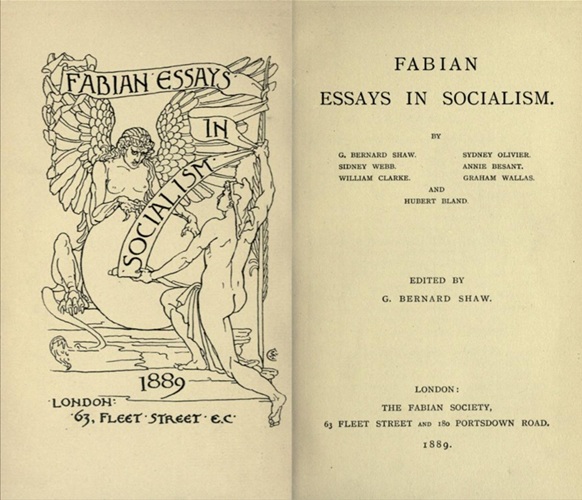
Fabian Essays in Socialism, by G. Bernard Shaw. / Sidney Webb. / William Clarke. [col. 1]; Sydney Olivier. / Annie Besant. / Graham Wallace. [col.2] / and Hubert Bland. / Edited by G. Bernard Shaw. (London: Fabian Society, / 63 Fleet Street and 180 Portsdown Rd. / 1889), 223pp. [Index, 221ff.]. Frontispiece plate facing t.p. shows a nude male figure kneeling with a banner bearing title in front of a nude female gryphon-figure in the superior position, with claws wrapped over an unmarked shield or globe - a probable allegory of Capitalism. This imae also appears on the cover against dark green cloth of a durable, utilitarian appearance, like a handbook. T.p. verso: Printed by A. Bonner, 34 Bouverie St., Fleet Street, E.C. Available in Internet archive [online]; also at Google Books [online] - both accessed 22.11.2019.
|
|
[ top ]
The Adventures of the Black Girl in Her Search for God (London: Constable & Co. 1932), 74pp., ill. b&w wood-cuts [‘written by Bernard Shaw. Designed and executed by John Farleigh. Printed by Clarks in Edinburgh, and published for the first time by Constable and Company Limited of Orange Street in London 1933’; p.77.] Published in USA as The Adventures of the Black Girl in Her Search for God / by George Bernard Shaw (NY: Dodd, Mead & Company [1933]), 74pp.
NEW ENLARGED EDITION: The Black Girl in Search of God, and Some Lesser Tales [1932] (London: Constable & Co. 1934), vii, 305pp. CONTENTS: The black girl in search of God; Aerial football: the new game; The emperor and the little girl; The miraculous revenge; The theatre of the future; A dressing room secret; Don Giovanni explains; Beauty's duty; Still after the doll's house; The domesticity of Franklyn Barnabas; Death of an old revolutionary hero; The serenade; A Sunday on the Surrey hills; Cannonfodder.
The Black Girl in Search of God, and some lesser tales, wood engravings by John Farleigh; definitive text under the editorial supervision of Dan H. Laurence (Harmondsworth: Penguin 1977), 285pp. [i.e., rep. of 1934 edn.] CONTENTS: The black girl in search of God; Aerial football: the new game; The emperor and the little girl; The miraculous revenge; The theatre of the future; A dressing room secret; Don Giovanni explains; Beauty's duty; Still after the doll's house; The domesticity of Franklyn Barnabas; Death of an old revolutionary hero; The serenade; A Sunday on the Surrey hills; Cannonfodder.
The Black Girl in Search of God, by Bernard Shaw, arranged for reading and performance by Dan L. Laurence (NY & London: French 1977), 57pp.
[ There is a List of the Works by George Bernard Shaw on Wikipedia - online. ]
[ top ]
Criticism
|
|
Biographies
|
| [ top ] |
| -1950 (i.e., contemporary) |
|
| 1950-69 |
|
| 1970-79 |
|
| 1980-2000 |
|
| 2000- |
| .
| [ top ] |
|
| [ top ] |
|
Note: [Dan H. Laurence,] ‘A Continuing Checklist of Shaviana’, Shaw: The Annual of Bernard Shaw Studies (Penn State UP [q.d.]); John R. Pfeiffer, Richard Elliott Winslow, “A Continuing Checklist of Shaviana”, in The Annual of Bernard Shaw Studies, Vol. 22 (Penn State UP 2002), pp.239-59. |
Bibliographical details
Hesketh Pearson, Bernard Shaw: His Life and Personality [St James’s Library] (London: Collins 1942, 1950), xi, 390pp.; Do. [another. edn.] (London: Reprint Soc. 1946 [1948]), 448pp., and Do. [US edn.], as G. B. S.: A Full Length Portrait (NY: NY: Harper), 424pp.; Do. (London: Methuen 1961), 480pp., ill. [ports.]; Do., (London: Four Square Books 1964), 508pp.; and Do. [rep. of Methuen 1961 edn.] (London: Macdonald & Jane’s 1975), [4],520p., ill. [8pp. pls., facs., ports]; Do [another edn.] (London: House of Stratus, 2001), vii, 551pp.Also found as G.B.S., A Full-Length Portrait (Garden City Publishing Co. 1942) and G.B.S., a full length portrait, and A postscript (NY: Harper 1950), xi, 381, vii, 120pp. [‘G.B.S.; A full length portrait is published in England under the title of Bernard Shaw: his life and personality’]. Held at Oxford University Libraries [COPAC/Discover - search.]
New Camb. Bibl. of English lists this work under “Edward Hesketh Gibbons Pearson” - as follows: Bernard Shaw: his life and personality. 1942, New York 1942 (as G.B.S.: a full length portrait), 1952 (with a postscript (pt. of G.B.S.: a postscript, 1950, below), London 1961 (original title, New York 1963 (as George Bernard Shaw: his life and personality. Further, below: G.B.S.: a postscript New York 1950, London 1951.
[ top ]
Michael Holroyd, Life of G. B. Shaw, Vol. 1: 1856-1898 - “The Search for Love” (London: Chatto & Windus; NY: Random House 1988), x, 486pp. [see contents]; Vol. 2: 1898-1918 - “The Pursuit of Power” (London: Chatto & Windus; NY: Random House 1989) [see contents]; Vol. 3: 1918-1950: “The Lure of Fantasy” (London: Chatto & Windus ; NY: Random House 1991), ix, 544, ill. [32pp. of pls., facs., ports.; see contents]; Vol. 4: 1950-1991 - “The Last Laugh” (London: Chatto & Windus; NY: Random House 1992) [ltd. edn. dealing with posthum. affairs and called author’s epilogue]. Also a fourth vol. comprising the third vol. with a bibliography and index (1993). [uniform 24cm.].
Note: all the foregoing reissued as Bernard Shaw: The One-volume Definitive Edition (London: Chatto & Windus 1997), xiv, 834pp., ill. [20pp. of pls., ports.; 25cm].
Michael Holroyd, The Shaw Companion (London: Chatto & Windus 1992), viii, 490pp. [containing over 10,000 researched source notes and cumulative index to the first three volumes; also text of Vol. 4: The Last Laugh 1950-1991 [being Holroyd’s epilogue].
Michael Holroyd, Bernard Shaw (London: Chatto & Windus 1992), being Vols. 3, 4 & 5 [Vol. 3: The Lure of Fantasy; Vol. 4: incls. The Last Laugh; Vol. 5: The Shaw Companion [coll. styled the final volume in a set of three comprising The Life and Work of George Bernard Shaw].
[ top ]
PENGUIN EDNS [being reprints of the Chatto & Windus 1st edns., as supra].
Michael Holroyd, Bernard Shaw - Vol. 1, 1856-1898: “The Search for Love” (Harmondsworth: Penguin 1990), x, 486pp. [20cm.], ill. [ports.; 20cm. CONTENTS. Part 1: An end and a beginning; a fermenting genealogy; How his parents met and were married; A devil of a childhood; Vandeleur Lee appears, leaving a trail of uncertainties; “Menage à trois”, Catholic and Protestant; The shame of education; Music in Dublin and how Mrs Shaw celebrated her 21st wedding anniversary; In which Shaw advances as an estate agent, marks time as a lover, and moves to London. Part 2: The ghosting and death of Vandeleur Lee; How Shaw experimented with the telephone and began writing novels in London; In which his history continues unsuccessfully; Whe trained and what he ate and drank; He grows a beard; Containing a sparring friendship with Pakenham Beatty and a sparring flirtation with Alice Lockett; Death of a novelist; Death of a father. Part 3: in which Shaw finds a new family among the Fabians; the moral and aesthetic influences of William Archer and William Morris; Showing how he went walkabout with Edith, spent his evenings with Eleanor and passed the night of his 29th birthday with Jenny; Introducing Sidney Webb, describing how the Fabian musketeers conducted themselves in Trafalgar square and showing in what way they turned defeat into victory with Fabian Essays. Part 4: A live red socialist from the streets comes in with The Quintessence of Ibsenism; A crust for the critics: Shaw as a literary reviewer; The mystical betrothal with May Morris - a story from another world; Corno di Bassetto in unison with G.B.S.; A section which begins with the entrance of Florence Farr and ends with the exit of Jenny Patterson. Part 5: The courtship of Sidney and Beatrice Webb; In which Shaw starts his career as an unpleasant playwright; In which he writes his first pleasant play, Arms and the Man; Pursuing the story of the playwright and his actresses; He writes Candida; how Candida fared with Janet Achurch and Richard Mansfield in North America. Part 6: Concerning the editorial versatility of Frank Harris; Containing some dramatic opinions; In which Shaw jousts with Henry Irving over Ellen Terry; Continuing the story of “Candida” and Janet Achurch; In which Shaw writes his last pleasant play and his first play for Puritans and relinquishes his dramatic criticism. Part 7: How Shaw performed at the Vestry; He is courted by Bertha Newcombe and courts Charlotte Payne-Townshend; The courtship persists and reaches its climax.
[ top ]
Michael Holroyd, Bernard Shaw - Vol. 2, 1898-1918: “The Pursuit of Power” (Harmondsworth: Penguin 1991), ix, 420pp. [20cm.], CONTENTS. Part 1: The happy accidents of marriage, two views of sea air, and Shaw repairs to Adelphi Terrace; On heroes and hero-worship - an essay on “The Perfect Wagnerite” and “Caesar and Cleopatra”. Shaw writes “Captain Brassbound’s Conversion” and Ellen Terry, who stars in it, marries one of the actors; “Three Plays for Puritans” versus the pornography in Victorian values; Fabian manoeuvres in the Boer war; Shaw drafts “Fabianism and the Empire” and fails to influence the general election. Part 2: Shaw takes up with some unexpected characters and is translated; In which Max Beerbohm begins his caricatures and Charlotte Shaw persists with her holidays; A short section upstaging Shakespeare with The Admirable Bashville; The comedy and philosophy of Man and Superman; The dreams and realities of John Bull’s Other Island; Granville Barker comes to court; The curtain goes up on Major Barbara; “The alleluias will get me yet”. Part 3: Fabian bedfellows at the turn of the century and the difficult birth of “Fabianism and the Fiscal Question”; H. G. Wells joins the Fabian cast and becomes Shaw’s protagonist; A revolution at the court unites Granville Barker and Lillah McCarthy; Concerning the medical ethics of The Doctor’s Dilemma; An invasion of the West End and some dreams of a national theatre. Part 4: An exhibition of portraits; Shaw sits to Rodin in Paris and floats up in a balloon above Wandsworth gas works; A hectic section that begins with a look into the rectory at Ayot St [Saint] Lawrence and a glance through numerous postcards, continues with a visit to the Fabian Summer School and a career round the continent, and ends with a strange encounter with a Swedish playwright; An interesting discourse on a disquisitory play, Getting Married, and staying married; Which takes us outdoors for some alarming road-adventures; a treatise on how to handle biographers and another on how to quarrel properly demonstrated by G.K. Chesterton; The attractions of censorship and how to resist them as revealed by the stage histories of The Shewing-up of Blanco Posnet and Press Cuttings, with ith assistance from Lady Gregory and W.B. Yeats. Part 5: Shaw’s invocations to the God of Tolstoy and the Muse of Henry James followed by an analysis of Misalliance and the case re-emphasised for a national theatre; Further particulars in the shocking history of Mr Wells; Beatrice Webb produces her minority report and Shaw resigns from the Fabian Executive; A diversion of skits and farces; A jaunt to Jamaica and some misadventures in company with a chauffeur and a secretary; The success of Fanny’s First Play and the autobiographical impulses in Androcles and the Lion; What the playwright said to the actress - Mrs Patrick Campbell, Pygmalion, and the nature of love and comedy. Part 6: concerning fame and anonymity - the origins and early days of the New Statesman; the history and rehearsals of Pygmalion.
Michael Holroyd, Bernard Shaw - Vol. 3, 1918-1950: “The Lure of Fantasy”. (London: Penguin 1993), ix, 544p., ill. [32pp. of pls., facsims., ports.; 20cm.] (London: Chatto & Windus 1991). CONTENTS. Part 1: Some hints and consequences of peace; Shaw’s heartbreak; Working with Miss Cross Patch and travelling with Fred Day; The tragedy of an elderly gentleman; Home rule for England; Free will in translation. Part 2: Collaborating with a saint; I which Archer takes his leave, Lawrence of Arabia advances into the Shaws’ lives and the story is taken up by explorers and adventurers; An island of romance; Intelligent women and the body politic. Part 3: The Shaws move to Whitehall Court and meet Nancy Astor; G.B.S. performs at Cliveden and pronounces on Mussolini; In which G.B.S. upsets The Apple Cart over Stella Campbell and the socialist movement, starts up the Malvern festival, and establishes his friendship with Elgar; How Shaw became the author of himself, wrote his way into the lives of Ellen Terry’s children, and finally signed off from Stella Campbell; Positive capability and the great Celtic-Hibernian school - Wilde and Yeats, O’Casey, Joyce; Old friends make way for new romances - G.B.S. meets the boxer and the nun. Part 4: The elopement to Russia; Shaw’s pilgrim’s progress; Visions and judgments from his missionary travels; Prefaces to death. Part 5: Some domestic privacies and the demands of the political theatre; Which contains a sea change and a treasure hunt; spontaneous resurrection and a new life; New worlds of paperback and celluloid; Three plays for historians; Trebitsch uber alles. Part 6: Cease fire! turn up the lights! uncommon sense and careless talk; How G.B.S. managed a happy end for Charlotte; Containing several new characters and plots that are introduced rather late into the story; Two fatal attachments; Continuation of the story; In which the conclusion of the story is spelt out.
Michael Holroyd, Bernard Shaw: Vol. 4 - The Last Laugh: 1950-1991 [new edn.] (London: Penguin 1993), 160pp. [20cm.] CONTENTS: The Shaw alphabet reading key; Androcles and the Lion - Prologue. The Last Laugh: Two Old Testaments; some authorized revisions; the National Trust and the Shaw Society; posthumous appearances forty years on. Appendices: Charlotte Shaw’s will; Bernard Shaw’s will; principal purchases from the Shaw Fund by the National Gallery of Ireland; list of films made from Shaw’s works.
Brad Kent, George Bernard Shaw in Context (Cambridge UP), xxxii, 384pp. CONTENTS: Part I - People and Places: 1. Peter Gahan, 'Dublin’ [3]; 2. Lauren Arringtonm ‘The Fabian Society’ 12]; 3. Peter Conolly-Smithm ‘Germany and Austria’ [21]; 4. Desmond Harding, ‘London’ [29]; 5. Eibhear Walshe, ‘Oscar Wilde’ [36]; 6. Nicholas Grene, ‘W.B. Yeats’ [44-50]. Part II - Theatre: 7. Anthony Roche, ‘The Abbey Theatre’ [53]; 8. Margot Peters, ‘Actors and actresses’ [61]; 9. Sos Eltis, ‘The Court Theatre’ [68]; 10. J. Ellen Gainor, ‘Fabian drama’ [76]; 11. Kerry Powell, ‘Farcical comedy’ [85]; 12. Ellen E. Dolgin, ‘History plays’ [94]; 13. Heidi J. Holder, ‘Melodrama’ [102]; Jean Chothia, ‘The new drama’ [109-16]. Part III - Writing and the Arts: 15. John McInerney, ‘Cinema’ [119]; 16. Elizabeth Carolyn Millerm ‘Journalism’ [127]; 17. Charles A. Carpenter, ‘Letters’ [135]; 17. Lawrence Switzky, ‘Media and technology’ [143]; 18. Christopher Innes, ‘Modernism’ [151]; 19. Alfred Turco, Jr., ‘Music’ [160]; 20. Richard Farr Dietrich, ‘Novels’ [168]; 21. Michel W. Pharand, ‘Publishers and publishing’ [175]; 22. Martin Meisel, ‘Visual arts’ [183-96]. `Part IV - Politics: 23. Brad Kent, ‘Censorship’ [199]; 24. Michael Malouf, ‘Empire and nationalism’ [207]; 25. D. A. Hadfield, ‘Feminism’ [215]; 26. Nelson O’Ceallaigh Ritschel, ‘Irish politics’ [222]; 27. James Alexander, ‘Socialism’ [230]; 27. Matthew Yde, ‘Totalitarianism’ [238]; 28. Lagretta Tallent Lenker, ‘War’ [246]; 29. Jonathan Goldman, ‘Celebrity’ [255]; 30. Jean Reynolds, ‘Education’ [265]; 31. John R. Pfeiffer, 32. ‘Evolutionary theory’ [273]; 33. Christopher Wixson, 34. ‘Health and vegetarianism’ [281]; 35. Gustavo A. Rodríguez Martín, ‘Language’ [289]; 36. Tony J. Stafford, ‘Nature’ [297]; 37. David Kornhaber, ‘Philosophy’ [306-14]. Part VI - Reception & Adterlife: 38. J. P. Wearing, ‘Reception in London, 1892-1950’ [317 ]; 39. A.M. Gibbs, ‘Criticism, 1950-2013’ [325]; 40. L.W. Conolly, ‘The contemporary North American stage’ [334]; 41. Julie A. Sparks, ‘Biography’ [342]; 42. John A. Bertolini, ‘The Shavian tradition’ [350-56]. Further Reading [357]. Index [371-84]. (Available at COPAC/Discovery Hub - online.)
[ top ]
Commentary
See separate file [infra].
[ top ]
Quotations
See separate file [infra].
[ top ]
References| Peter Kavanagh, The Irish Theatre (Tralee: 1946), lists: | |
|
Shell Guide to Ireland (1967), under ‘Glengarriff’: Shaw’s St. Joan was partly written at Ilnacullin, with its Italian garden and Martello tower.
Helena Sheehan, Irish Television Drama, A Society and Its Stories (RTE 1987); RTE Film, Candida, Shaw/Christopher FitzSimon; Dear Liar, Shaw and Mrs Campbell/Chloe Gibson, adpt. Jerome Kilty (1966); Man of Destiny, Shaw/Shelah Richards (1964); O’Flaherty V.C., 91, 108, Shaw/Christopher Fitzsimon (1968); Shewing Up of Blanco Posnet, The, 91, Shaw/Chloe Gibson (1962); You Never Can Tell, Shaw/Chloe Gibson.
John Sutherland, The Longman Companion to Victorian Fiction (Harlow: Longmans 1988); lists Cashel Byron’s Profession (1886), ser. in To-Day, April 1885-March 1886), about a pugilist; Shaw later wrote, ‘I never think of [it] without a shudder at the narrowness of my escape from being a successful novelist.’ His plays first successful in New York in the late 1897s, and then in London under direction of Harley Granville-Barker after 1904; John Bull’s Other Island written for Yeats’s Irish Dramatic Movement, but not staged there; Nobel Prize in 1925. FOR Shaw’s abortive attempts to fund Irish film and correspondence with De Valera, see Kevin Rockett, et al., eds, Cinema & Ireland (1988), 96-7, 108.
Seamus Deane, gen. ed., The Field Day Anthology of Irish Writing (Derry: Field Day 1991), Vol. 2 selects John Bull’s Other Island, with Preface to Politicians from same; Composite Autobiography; The Protestants of Ireland; A Note on Aggressive Nationalism; How to Settle the Irish Question; O’Flaherty VC, A Recruiting Pamphlet; War Issues for Irishmen; [423-514]; Commentary pp.514-15; Vol 3 selects ‘The Censorship’, in The Irish Statesman, 1928 [96-98], and ‘Preface to Immaturity’ [426-34], with other notes additional references.
Berg Collection (New York Public Library) holds Shaw Papers, chiefly consisting of letters, postcards and telegrams, among them an extended series addressed to Siegfried Treebitsch, 1902-1949.
Booksellers
Hyland Catalogue (No. 214) lists The Legal Eight Hours Question: A Public Debate [with] Mr G. W. Foote (1st edn. 1891), 77pp.; ‘The Commonsense of Municipal Trading (1st edn. 1904), vii+120pp.; The Arts League of Service Annual, 1921-22, contains Shaw, ‘The Art of Rehearsal’ [6 out of 32pp.]; C. L. & V. M. Broad, eds., Dictionary to the Plays and Novels of Bernard Shaw with a Bibliography (1st edn. 1929). [Hyland 219; 1995]. The Sanity of Art (1908); How to Settle the Irish Question (Dublin 1817), 32pp.; bernard Shaw and Karl Marx, A Symposium 1884-1889 (NY 1930) [ltd. edn., 575]; Fabian Essays in Socialism (1899; 1908); Three Plays by Brieux with a Pref. by Bernard Shaw ... English version by Mrs Bernard Shaw et al. (1911), port.
Hyland Catalague (No. 224) lists Henderson, Is Bernard Shaw a Dramatist? (1st edn. 1929) [ltd. edn. 1000]; R. J. Minney, The Bogus Image of Bernard Shaw (1969), ills.; Maurice Holmes, Some Bibliographical Notes on the Novels of Shaw with some Comments by Shaw (1928) [ltd. edn. 5000], 20pp.; Selected Passages from the Works of Bernard Shaw, chosen by Charlotte F. Shaw (1912).
[ top ]
Notes
William Archer wrote of Shaw’s music criticism that ‘he had a peculiar genius for bringing day-by day musical criticism into vital relation with aesthetics at large, and even with ethics and politics - in a word with life’.
Sean O’Casey on Shaw’s humanism: ‘Man must be his own saviour; man must be his own god. Man must learn, not by prayer but by experience. Advice from God was within ourselves, and nowhere else. Social sense and social development was the fulfilment of the law and the prophets. A happy people made happy by themselves. There is no other name given among men by which we can be saved, but by the mighty name of Man.’ (Sunset and the Evening Star, p.250.)
The Devil’s Disciple, though written in 1896 , did not have a West End production until 1907, though it was a hit in America. This time-lapse spanned Shaw’s own development as a writer as well as changing theatrical tastes, and by the time it reached a large London audience the meydey of melodrama was very remote ... by now, if to succeed at any level, melodramatic convention has to be signalled with some considerable sophisticaltion. [See John Stokes’ review of 1994 performance at Olivier Theatre, in Times Literary Supplement, 23 Sept. 1994.]
Heartbreak House: the title refers to the cultivated rich of Europe who brought heartbreak on themselves by disdaining political responsibility. ‘Power and culture’, Shaw’s preface asserts, ‘were in separate compartments’. Power is represented by Boss Mangan.
Blanco Posnet dramatises the conversion of a thief who gives his stolen horse to the mother of a dying child.’ (See Lucy McDiarmid, ‘Augusta Gregory, Bernard Shaw, and the Shewing Up of Dublin Castle’, in PMLA, Vol. 109, No.1 (Jan. 1994), pp.26-44.
Letters from Margaret: Correspondence between G. B. Shaw and Margaret Wheeler (Chatto & Windus 1992) [a woman who believed - justifiably - that she had left nursing-home with the wrong baby and contacted Shaw; the letters have formed the basis of a stag-play and two tele-programmes]. Reviewed, Times Literary Supplement (25 Dec. 1992).
Lady Gregory regarded Shaw and his wife as very easy guests to entertain at Coole Parke since they had their own car to get about; Shaw’s O’Flaherty VC was composed at Coole, and set in the porch of the house (information from interpretative centre at Coole Park).
La Musica: Shaw attended the concerts held by George Vandeleur Lee in Dublin in the 1870s and learned the music of Mozart, Hadyn, Beethoven, Bellini, Donizetti, and Verdi; as a critic he praised the then unpopular works of Bach, but regarded Mozart as his favourite; championed Elgar; described Mozart as ‘the master of the masters’ and wrote that he ‘taught me how to say profound things and at the same time remain flippant and lively’; wrote of Handel: ‘It was from Handel I learned that style consists in force of assertion. If you can say a thing with one stroke unanswerably you have style ... Handel had this power’; called Rossini ‘one fo teh greatest masters of claptrap that ever lived’ and detested Brahms for his ‘heavy, all-pervading, unintelligent German sentimentality’, in particular ‘the collossally stupid Requiem, which has made so many of us wish ourselves dead’; said that when you listen to music you do with your ears what you do with your ears when you stare. See notice on the National Chamber Choir’s concerts in the Shaw Room of the NGI, in “Irishman’s Diary”, Irish Times [q.d.].)
Plays in Ireland: While Shaw wrote only one play set wholly in Ireland - John Bull’s Other Island - Act 1 of Pt. 4 of Back to Methusaleh (1921) is set in the Burren. (See TLS review, 1992.)
Portraits: full length figure outside National Gallery of Ireland (q. sculpt.); Augustus John, portrait in oil; also oil portrait by John Collier, signed 1927 [NGI]; also black and red chalk portrait by William Rothenstein [Abbey Theatre]. A bronze head by Jacob Epstein held in the Glasgow Art Museum, was presented by John McNaughton in 1961.
Carlow Library (HQ) devotes room to G. B. Shaw, where the writer passed one day in connection with the will of Dr. Walter John Gurly which devolved on him; Shaw gifted the Old Assemby Rooms on Dublin St., to the Technical Instruction Comm., 1919, which opened a two-room technical school there in 1923, later becoming the County Library. (See The Irish Times, 25 Oct. 2000).
Gay Shaw? John Sutherland, reviewing Sally Peters, Bernard Shaw: The Ascent of the Superman [Yale UP 1995], indicates that she has no evidence for her assertion that he was gay, his supposed homosexuality explaining his curtailed sexual appetite. (‘The Wilder loves of Shaw’, Times Literary Supplement, 3 May 1996, p.26.) Stanley Weintraub adds that Shaw, when being sculpted by Kathleen (Lady) Scott, the widow of the explorer, who wore mannish garb as she worked, remarked: ‘No woman born ever had a narrower escape from being a man. My affection for you is the nearest I ever came to homosexuality.’ ( Times Literary Supplement, 31 May 1995, p.17.)
Dan H. Laurence (1920-2008): Shaw’s greatest bibliographer and editor, who served as adviser to the Shaw estate, died in San Antonio (Texas), 5 Feb. 2008.Born Daniel Hyman Goldstein, and changed it on returning from war in the Pacific, to take advance of veteran education program resulting in a BA degree from Hostra, Long Island (1946) and PhD from NYU (1950); he taught at NYU, 1962-1970 at afterwards moved to San Antonio at close proximity to the MS Harr Ransome MSS collections at the Univ. of Texas. His papers on Henry James, whose bibliography he compiled with Leon Edel are held at NYU. Obituary appeared in the New York Times and the Independent [UK]. The latter deals with his fracas with the Shaw Estate which he served as an adviser until the appointment of official biographer went to Michael Holroyd:
| ‘[...]What might appear an arduous and placid life of scholarship was never like that. He was quick of speech and apt to shoot from the hip, and there was a kind of joyful pugnacity about all Laurence's dealings with those who came across him. This came to the fore in the row over the writing of the biography of Shaw. Shaw left his copyrights to the Society of Authors. Laurence, whose editions and bibliographical research had done so much to put Shaw back on the map in the years after his death, felt he was the natural choice as biographer. Instead, the Society of Authors chose Michael Holroyd. Laurence, suspecting insider trading, was vituperative, and temporarily resigned office as literary adviser to the estate and editor of the correspondence. No one came well out of this very public quarrel, although Holroyd later paid generous tribute to Laurence's scholarship. / To visit Laurence at San Antonio was to see a very different Dan.[...]’ (Nicholas Barker, obituary of Daniel H. Laurence, in The Independant [UK] (4 April 2008) - available online. |
[ top ]