       |
Life
| 1873-1901 [Gl. Liam Ó Maolruanaidh; b. 23 Oct. [var. 29 Sept.] 1873, at 39 Mabbot St., Dublin, the son of a coach-maker; educ. by Christian Brothers at Strand Street and Richmond Street; articled as solicitor’s clerk, aetat. 15; attended night-classes; became a journalist and an active language revivalist, often speaking in Irish at public meetings; member of The Fireside Club, fnd. by Rose Kavanagh; also wrote poetry, collected posthumously by his friend Arthur Griffith - and ultimately became the object of a disparaging review by James Joyce in 1902; fnd. The Leinster Literary Society, and supported Charles Stewart Parnell; he came to regarded Home Rule as insufficient to make a nation and repudiated international socialism; | 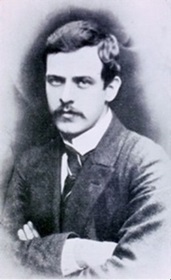 |
| fnd., with Arthur Griffith, the Celtic Literary Society for the study of Irish language, history, literature and music, Oct. 1893, acted as its chairman with a membership including John O’Leary, Frank Hugh O’Donnell, and Arthur Griffith; also edited its journal, An Seanachie; later assimilated to Cumann na nGaedheal; est. United Irishman, with Arthur Griffith as editor, 1899 - where his lectures to the Celtic Lit. Soc. were regularly printed, 1899-1901; d. 27 May 1901; his best-known poems incl. “The Men of the West”; “’Ninety Eight”, and “An tSean Bhean Bocht” and “Wrap the Green Flag Round Me”; | |
| Poems and Ballads of William Rooney (1908) appeared posthumously prefatory notices from various hands, only to be disparaged as an example of sentimental nationalist in a review by James Joyce; according to himself, his intention was to support ‘a people eager to occupy a definite and distinct place in the world’s life’, and his early death was considered by some as the loss of a beau idéal of contemporary Irish nationalism; Yeats dedicated the 1908 edition of Cathleen Ni Houlihan ‘To the Memory of William Rooney’; a br. John also participated in the Celtic Lit. Soc. photo-port from Poems, ed. by Arthur Griffith (1902). PI DIB DIH OCIL |
[]
[ top ]
Works
|
| See also |
|
|
| [ Full listings in COPAC - online; accessed 9.12.2014.] |
[ top ]
Criticism
Seamus MacManus, William Rooney (Dublin 1909); see also James Joyce’s scathing review, ‘An Irish Poet’, Daily Express (12 Dec. 1902), rep. in Ellsworth Mason & Richard Ellmann, eds., Critical Writings of James Joyce [1959] 1965, pp.84-87 [infra]; Liam Ó Maolruanaidh, 1897-1901 [le] Pádraic Óg Ó Conaire (Baile Átha Cliath: Clódhanna Teoranta 1975), ii-vii, 30pp., ill. [1 facsim., 1 port.] See also M[atthew] J. Kelly is the author of The Fenian ideal and Irish nationalism, 1882-1916 (Woodbridge 2006) [q.pp.].
The entry in the Dictionary of Irish Biography (RIA 2009) is by William Murphy [online]
See also the informative and judicious account of Rooney at Collins 22 Society [online]
[ top ]
Commentary
James Joyce, “An Irish Poet”: ‘They are illustrative of the national temper, and because they are so the writers of the introductions do not hesitate to claim for them the highest honours. But this claim cannot be allowed, unless it is supported by certain evidences of literary sincerity. For a man who writes a book cannot be excused by his good intentions, or by his moral character; he enters into a region where there is a question of the written word, and it is well that this should be borne in mind, now that the region of literature is assailed so fiercely by the enthusiast and the doctrine.’
Further: ‘And yet he may have written well if he had not suffered from one of those big words which make us so unhappy.’ (Review of Poems and Ballads; in Daily Express, 11 Dec. 1902; rep. in Critical Writings, ed. Mason & Ellmann, [1959] 1965, p.85, p.87.) Note that Arthur Griffith reprinted much of the review without comment in United Irishman, 20 Dec. 1902, adding only the word ‘Patriotism’ in brackets after Joyce’s phrase ‘one of those big words’. (CW, idem, ftn.1.)
William Murphy, Dictionary of Irish Biography (RIA 2009) - entry by William Murphy cites Joyce’s phrases, ‘a weary and foolish spirit, speaking of redemption and revenge, blaspheming against tyrants, and going forth, full of tears and curses, upon its infernal labours.’ (Kevin Barry ed., James Joyce: Occasional, Critical, and Political Writing (Oxford 2000, pp.61-64; here p.64.)
Library lore: Joyce held a copy of Poems and Ballads of William Rooney, ed., Arthur Griffith (Dublin United Irishman [1902]), in his Trieste Library. (See Richard Ellmann, The Consciousness of James Joyce, Faber, p.125 [Appendix].
Note also: Stanislaus Joyce informed his brother that the phrase ‘scrupulous meanness’ - was simply a revision of the phrase “studiously mean” which Joyce had used in a 1902 review of William Rooney’s Poems and Ballads. (Quoted in Coping with Joyce: Essays from the Copenhagen Symposium, ed., Morris Beja & Shari Benstock [1989], p.99.)
Richard Kain, Dublin in the Age of William Butler Yeats and James Joyce (Oklahoma UP 1962; Newton Abbot: David Charles 1972): ‘The now forgotten Williarn Rooney (1873-1902) was the last of these newspaper “bards,” and his posthumous Poems and Ballads was hailed by Arthur Griffith, who had joined Rooney in founding the influential weekly The United Irishman. Clearly Rooney was a man to be respected by patriots. One can imagine the antagonism aroused among such patriots by the review of the young James Joyce, just graduated from college, who found the poet “almost a master in that ‘style’ which is neither good nor bad.” The verse was described as "“a false and mean expression of a false and mean idea,” in that the author had been diverted from literature to patriotism. Even though his work might “enkindle [112] the young men of Ireland to hope and activity”, as Rooney’s admirers claimed, art, continued the reviewer, “is a stern judge.” Yet “he might have written well if he had not suffered from one of those big words which make us so unhappy” - a phrase which Joyce remembered for fifteen years, when he put it into the mouth of Stephen Dedalus in the second chapter of Ulysses.’ (pp.112-13; and see the original of Joyce’s review under Joyce, supra.)
Frank Callanan, ‘Why Joyce, the “Bohemian Aesthete”, was also a Political Controversialist’, in The Irish Times (22 Jan. 2011), Weekend Sect.‘The United Irishman, published 1899-1906, was a brilliant journalistic venture with a tiny circulation. In politics it anticipated the programme of Sinn Féin, and was implacably opposed to John Redmond’s Irish Parliamentary Party. What was distinctive in the conception of the United Irishman was that its content was not exclusively political. It engaged with the literary revival (though Griffith fell out with W. B. Yeats early on), and the paper was crammed with literary, mythological, antiquarian and historical material relating to Ireland. / The paper was a collaborative venture between Griffith, who edited it, and his contemporary William Rooney. Rooney was persuaded that political nationalism without the revival of the Irish language was meaningless, if not pernicious, and wrote prolifically on the subject in the United Irishman. Griffith loved and deferred to Rooney, without sharing his insistence on the revival of Irish. Going back to his support of Parnell in the split of 1890-91, Griffith had a serious political head. The United Irishman was a skilful composite of the divergent thinking of Griffith and Rooney. [...] The publication of Dubliners, he never forgave him the attack on Rooney. As Padraic Colum wrote, “the young man who had belittled his poems in a Unionist journal was, to Arthur Griffith, a man of sinister mind and intention.”’ (See full-text copy in RICORSO Library, “Criticism > Major Authors > Joyce”, via index, or direct.)
Matthew Kelly, ‘William Rooney and Sinn Fein’ [website article]: ‘[...] Despite O’Connell’s great crimes, Rooney acknowledged something of his achievement, which formed part of his wider argument about the condition of Irish Catholics. It is by negotiating this problem that his cultural essentialism becomes most marked. Had Grattan’s parliament survived, Rooney believed that the ‘Irish Catholic Celt’ would have become reconciled to the British connection, finding a place in what he luridly refers to as ‘the most malignant tyranny that the mind of man has conceived’. But the problem that Rooney thought characterised his imagined Grattanite Ireland (as well as the Ireland he lived in) was that getting ahead demanded that Irish Catholics abandon or compromise their nationalist - that is, separatist - convictions. Catholic emancipation was not so much a carapace for the anti-Catholic reality of the state as part of the process by which Catholics—and middle-class Catholics in particular—were tempted into abandoning their separatist convictions. Rooney does not seem to have grasped that small numbers of Irish Protestants might be similarly compromised for the same reasons. Consequently, an authentic Irish nationalism was necessarily coterminous with a specifically Catholic liberation. And although he did not share the intensity of D. P. Moran’s conviction that Catholicism was fundamentally integral to Irishness, Rooney’s association of Irish, Catholic and Celt was significant. [...]’
Further [Matthew Kelly]: ‘William Murphy rather dryly suggests that Rooney’s greatest contribution to Irish history might have been to suggest to Mark Ryan that Griffith be invited to edit the United Irishman. / There is something to be said for this iconoclastic view, but Rooney was also among that minority who had begun to shape their politics around the perception that the impact of the Union should be understood in cultural as well as political or material terms. He judged Home Rule’s popularity to be symptomatic of the degenerated, ‘transacting’ Irish culture that the Union had produced. In some respects, his politics sublimated working-class resentment of the benefits the Catholic middle classes had derived from the Union, for cultural nationalism allowed intelligent working-class Irish men and women, frustrated by their limited opportunities, access to the public sphere. As a forum for personal development, societies like the Leinster, the Celtic and the Gaelic League were empowering, allowing such men and women the opportunity for collective engagement with the pervasive questions shaping their time. [...]’ (See full text at the Collins 22 Society website - online; accessed 29.12.2014; some quotations from Rooney in this article are given infra.)
[ top ]
|
Address to Celtic Literary Society [q.d]
| There is the ideal of the land reformer which masquerades as a National Ideal, “Ireland for the Irish - the Land for the People”, blazoned on all its banners and declaimed from all platforms. There is the Home Rulers’ ideal - a parochial body meeting within the shadow of Grattan’s statue, under the fold of the Union Jack, and passing a series of harmless bills for the better government of Ireland - a body of green-livered [poss. liveried] henchmen of the British connection, with the spoils of office for their faithful stewardship. There is the ideal of the Irish Agricultural Reformer, whose soul yearneth for a millennium of practical poets and poetical dairy boys. And there are again the academic language enthusiasts who look to the resurgence of Gaelic to dissipate all our megrims. Now each one of them possesses elements of a National Ideal - but none of them can reasonably be allowed to be the Ideal. We can best realise the extent and limits of a National Ideal by endeavouring to appreciate what the citizen of any free nation would understand from the term. |
| [...] |
| Some little semblance of interest in the tongue of the Gael marked every generation before ours; but we, with our backs turned to everything native, our eyes perpetually on the parliament of the foreigner, dazed by joyous anticipation of a “Union of Hearts”, forgot everything but the shibboleth of the hour, and were gradually degenerating into mere automata, until a crash came, and in the rending of the veil we saw for the first time what was before us and paused.’ (Address to Celtic Literary Society, Jan. 1899.) |
|
[ top ]
Hanna Sheehy Skeffington ends her pamphlet British militarism as I have known it [1917] with the following remarks and a quotation from Rooney: ‘At the end of the war we hope to see a “United Europe” on the model of your own United States, where each state is free and independent [31], yet all are part of a great federation. We want Ireland to belong to this united Europe, and not to be a vassal of Great Britain, a province of the British Empire, governed without consent. Unless the United States is as whole-heartedly in favor of the freedom of Ireland as she is for the emancipation of Belgium, she cannot be true to her own principles. Her honor is involved and we look particularly to the Irish in America to remember the claims of the land of their fathers, when the day of reckoning comes. I shall conclude by quoting from William Rooney’s poem, “Dear Dark Head,” which embodies in poetic form Ireland’s life-long dream for freedom. Speaking of the men who died for Ireland, he says:
“And though their fathers' fate be theirs, shall others
With hearts as faithful still that pathway tread
Till we have set, Oh Mother Dear of Mothers,
A nation’s crown upon thy Dear, Dark Head?”’
[End; available at Internet Archive - online; accessed 01.01.2015.]
[ top ]
F. W. Bateson, ed., The Cambridge Bibliography of English Literature, Vol. III [1800-1900] (Cambridge UP 1940; rep. 1966), lists Wiliam Rooney under “Anglo-Irish Literature” (pp.1045-1067).
Rev. Patrick Walsh, ed., Songs of the Gael: A Collection of Anglo-Irish Songs [... &c.] (Dublin: Browne & Nolan 1922), selects his Ma Choleen Dhas Dhoun" [‘Thy voice, like the stream in the forest, is music and joy, / Nor distance nor time can the bliss of that moment destroy, / When I poured out my tale; your eyes’ gentle light told I'd won, / My own little beaker of honey, Ma Cholleen Dhas Dhoun’ (p.20; available at Internet Archive - online.)
Belfast Linen Hall Library holds Poems and Ballads (n.d.); Belfast Central Public Library holds Poems and Ballads (n.d.); Prose Writings (1909). University of Ulster Library (Morris Collection) holds Poems and Ballads. (United Irishman, 1908); Prose Writing (Gill c. 1909).
[ top ]
Notes
Arthur Griffith: Rooney was the friend and collaborator of Arthur Griffith, founding with his the National Literary Club which evolved into Sinn Féin, and establishing the United Irishman, which Griffith edited. His role in the development of cultural and political nationalism is detailed in F. S. L. Lyons, Ireland Since the Famine (1971), and other historical studies. His poetry is as bad as Joyce contends it to be by literary standards. See also brief remarks on him in John Kelly, ‘A Lost Play of the Abbey [by Fred Ryan], in Ariel, Vol. 1. No.3 (July 1970).
[ top ]