       |
| 1806-70 [infreq. var. MacAlise]; b. Sheares St., Cork, 2 Feb., son of Scottish soldier who became a cobbler; ed. Cork, and worked as bank clerk; began painting by taking likeness of young army officers in Cork; left bank to open studio in Patrick St. where Sir Walter Scott visited in 1825 and was sketched by him in a bookshop; saved up to go to London, 1827; ed. RA Schools, 1828; exhibited Academy, with medals, 1829, and assoc. member in 1832; |
| painted a noted portrait of Charles Dickens, now in National Gallery, London; contrib. series of portraits of lit. celebrities to Fraser’s Magazine of Town and Country (ed. Wm. Maginn, q.v.), 1830-38; employed styles of painting varying from Renaissance grandeur to Dutch intimacy; painted a fresco for Prince Consort in 1843, and enjoyed unbroken prosperity till death; noted for narrative pictures incl. literary, Biblical, and historical subjects; |
| his most notable paintings incl. “The Meeting of Wellington and Blucher” and “The Death of Nelson” in the Westminster Houses of Parliament, and “The Marriage of Strongbow and Aoife” (exhibited in NGI Dublin, 1854), and “Merry Christmas in the Baron’s Hall” (do.); refused presidency of RA and refused knighthood; d. 4 Cheyne Walk, 15 April; a group portrait by Maclise including Dickens and Thackeray is held in the Berg Collection (NYPL). DIB RAF SUTH OCIL |
[ See a small album of paintings by Maclise - as infra. ]
[ top ]
Criticism| Older |
|
| Modern |
|
|
Stereochromy: Maclise’s “Report on the Water-glass or ‘Stereochrome’ Method of Painting” (1859) - used with frescoes and based on the large-scale work of Wilhelm von Kaulbach which he witnessed at Nuremberg, makes up an Appendix to W. J. O’Driscoll’s memoir of Daniel Maclise (1871). Maclise employed it in his fresco of the meeting of Wellington and Blucher after the defeat of Napoleon at Waterloo. Stereochromy involves spraying the plaster surface with silica pre-mixed with the appropriate pigment directly on the wall and hence avoids what Maclise calls ‘much labour and anxiet’ (p.[241]). The whole text of available in page-image format at Google Books - online.]
[ top ]
Commentary
W. M. Thackeray (in Cork): ‘I never saw such a collection of bright-eyed, wild, clever, eager faces. Mr. Maclise has carried away a number of them in his memory; and the lovers of his admirable pictures will find more that on Munster countenance under a helmet in company of Macbeth, or in a slashed doublet alongside of Prince Hamlet, on in the very midst of Spain in the company of Signor Gil Blas. Gil Blas himself came from Cork, and not from Oviedo.’ In Irish Sketchbook (1842; Blackstaff, 1985), p. 84. Note, his “Scene from Gil Blas” (1839), appears as an illustration of an article on Frederick Burton, who was said to have been influenced by it.
C. B. Gibson, MRIA, The History of the County and City of Cork, Vol. 2 (London: Thomas C. Newby 1861; printed at Cork by Guy Bros.) - following an account of James Barry: ‘Cork has produced an equally great, if not greater, living artist in Mr, Daniel Maclise. His friend, Mr.Sainthill, of Nelson Place, Cork, has several of his early sketches, and among the number, two or three of Sir Walter Scott, taken on the sly, when the great novelist was in Cork. The young artist dodged himthrough the city, got a stroke at him from behind the counter of a bookseller’s shop, a second on the steps of the Imperial Hotel. The third was a regular sitting, [321] as he waited in his carriage for Miss Edgeworth, by whom he was accompanied in his tour through the South of Ireland. Perhaps the finest of his pictures, for which he received 18,000 guineas, was the marriage of Strongbow to Eva, the daughter of the Kingof Leinster. He painted some of the beautiful historical frescoes which adorn the corridors and lobbies of the Houses of Lords and Commons.’ (pp.320-21.)
W. B. Stanford, Ireland and the Classical Tradition (IAP 1976; this ed. 1984), Daniel Maclise (1806-1870), profited by presentation of 117 plaster casts of Roman models, prepared under supervision of Canova, to the Cork Society for Promoting the Fine Arts, made by the Prince Regent in 1818. [?124] Further, an etching by Maclise shows Mahoney with Maginn and other contributors to Fraser’s including Coleridge, Thackeray, Lockhart [the biographer of Scott], and Southey, in a convivial scene. [175]
[ top ]
References
Brian McKenna, Irish Literature, 1800-1875: A Guide to Information Sources (Detroit: Gale Research Co. 1978), p. 192, Maclise, A Gallery of Illustrious Characters ... accompanied by Notices Chiefly by the late William Maginn (London 1873); with sketches in prose and ports. of authors including Mrs. S. C. Hall [Sketches of Irish Character, 1829; see infra.]; also The Reliques of Father Prout ... collected ... by Oliver Yorke [pseud. for Mahoney] illustrated by Alfred Croquis [pseud. for Daniel Maclise] (London 1837).
Patrick Rafroidi, Irish Literature in English: The Romantic Period, 1789-1850 (Gerrards Cross: Colin Smythe 1980), calls him a contrib. Fraser’s Magazine and illustrator of numerous novels often under pseud. ‘Alfred Croquis’; also at least one poem, the humourous ‘Merry Xmas in the Baron’s Hall’ (Fraser’s, May 1838). Vol 1 reprints portraits of Thomas Moore, James Sheridan Knowles, and some other illustrations by Maclise.
Brian de Breffny, ed., Ireland: A Cultural Encyclopaedia (London: Thames & Hudson 1982), RA Schools, 1828; famous for literary, Biblical, and historical scenes, paintng fresco for Prnce Consort in 1843, and commissions for the Palace of Westminster; his style varied from Renaissance grandeur to Dutch intimacy, and his output includes a few very fine portraits; retained contact with Ireland, and his emotional Marriage of Strongbow and Eva (exhibited 1854, ill. detail, NGI, 148) shows nationalist feelings and a knowledge of ancient Irish civilisation. WJ O’Driscoll, Memoir of Daniel Maclise RA (1871); Richard Ormond and John Turpin , Daniel Maclise 1806-1879, Exhibition Catalogue (1972).
John Sutherland, The Longman Companion to Victorian Fiction (Longmans 1988; rep. 1989), bio-data: b. Cork, son of Scottish soldier turned shoemaker; ed. Cork, and bank clerk; a sketch of his noticed in 1825 by Sir Walter Scott; moved to London, 1827; exhib. RA, 1829; became major historical and portrait painter; influences styles of later Victorian illustrators with his contributions to Fraser’s Magazine, 1830-6; ill. some of Dickens’s Christmas stories.
Ann Cruikshank & the Knight of Glin [Desmond Fitzgerald], Irish Portraits 1600-1860 [Catalogue] (1969), which includes a romantic portrait of Sir Francis Sykes and family, in medieval clothing descending a turret stair [item 110], together with a Waterfall at St. Nighton’s, Keive, Tingtagel, Cornwall [item 111; without ill.].
Seamus Deane, gen. ed., The Field Day Anthology of Irish Writing (Derry: Field Day 1991), Vol. 2, contains Mangan’s poem “The Lovely Land” from The Nation (1849), subtitled ‘On a landscape, painted by M*****’, and referring to an unspecified painting by Daniel Maclise of Cork, famous for historical paintings, especially The Marriage of Strongbow and Aoife (1854); further, Maclise was interested in Irish antiquities and made a number of sketches of architectural remains, one of which may be the occasion of this poem [Seamus Deane, ed.]; the poem’s penultimate verse reads, ‘Shame to me, my own, my sire-land,/Not to know they soil and skies!/Shame, that through Maclise’s eyes/I first see thee, IRELAND!’ [37-38].
[ top ]
Notes
Wordsworth: Daniel Maclise’s drawing of Wordsworth for Fraser’s Magazine is reprinted in Times Literary Supplement (25 Dec. 1992); also Disraeli as a young man by Daniel Maclise (TLS, 10 March 1995), and Sir John Soane for Trader’s Magazine, rep. in TLS (8 Nov. 1996).
Aubrey de Vere, “The Irish Celt to the Irish Norman”, from Poems, cited in Lady Wilde, Ancient Legends, Mystic Charms and Superstitions of Ireland (1888), p.311, contains lines that clear reflect the mis en scene of Maclise’s historical painting of the marriage of Strongbow and Eva MacMurrough (NGI): ‘Sad Eva gazed/All round that bridal field of blood, amazed;/Spoused to new fortunes ..’.
Mrs. S. C. Hall, Sketches of Irish Character (1829), 443pp., 61 ills., by Maclise, Gilbert, Harvey, George Cruikshank, &c. [5th edn., 1854]; 1892, &c. (See Brown, Ireland in Fiction, 1919, p.125).
Nelson-o-philia: His “Death of Nelson aboard HMS Victory” is reprinted in colour in The Independent [UK] (22 October 2004), Books, p.22.
The Fraserians: Thackeray, Southey, Coleridge, Crofton Croker, Carlyle and Hogg - aka “the Ettridge Shepherd” - were ‘memorably caputred in a drawing by [...] Daniel Maclise’. (See Mary Leland, notice on Father Prout [Francis Sylvester Mahony], in “Irishwoman’s Diary”, 31 Dec. 2004, p.15.)
Blarney: A drawing of Sir Walter Scott kissing the Blarney Stone by made Maclise serves as the frontispiece [facing t.p.] in D. J. O’Donoghue’s Scott’s Tour in Ireland in 1825 (1903) - while reference is made to a portrait by Maclise in the ensuing account. ]
[ top ]
Album of Maclise
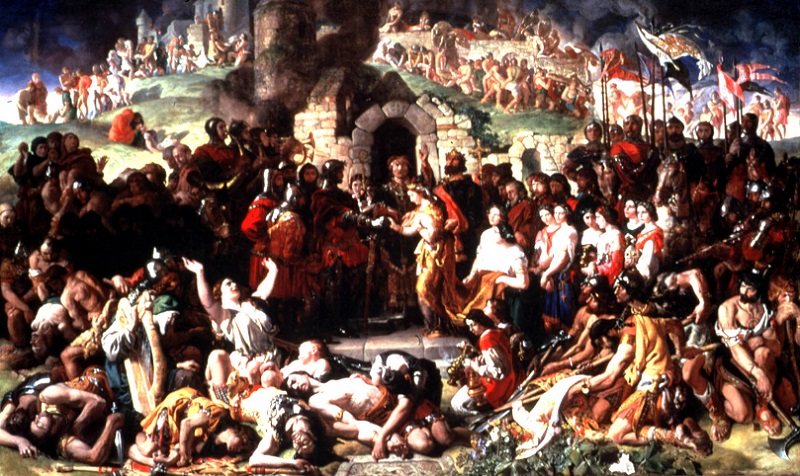 |
| Maclise’s Painting of “The Marriage of Strongbow and Aoife” |
 |
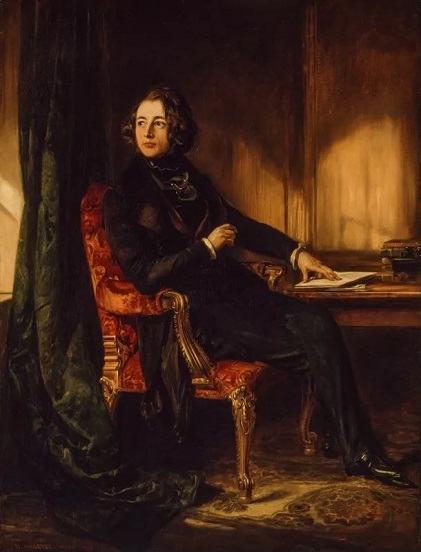 |
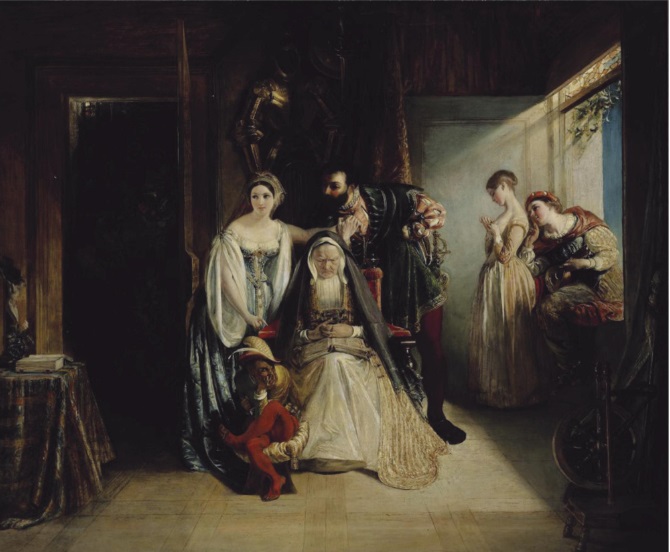
| Francis the First and Diane of Poitiers | Charles Dickens (1839) |