       |
Life
1715-1786 [var. George Edmund Howard]; b. Coleraine, Co. Derry; son of Francis Howard, an army officer, and Elizabeth [nee Jackson]; ed. at Thomas Sheridan"s school in Grafton St., Dublin, and TCD [without grad.]; apprenticed to a solicitor but joined the army; returned to Dublin and qualified as solicitor; m. isabella Parry, 1743; worked for the Castle Administration and appt. sol. for revenue of Ireland, 1746, with generous stipend; priv. pub. pamphlets on Irish finance; his plays include Almeyda, or the Rival Kings (1769), based on Hawkworth’s Almoran and Hamlet, and The Siege of Tamor (Smock Alley, April 1774), a tragedy based the Viking invasion of Ireland and its defence by Maelsheclan, prob. assisted by Henry Brooke; wrote The Female Gamester (1778), not performed; Miscellaneous Works in Prose and Verse (1782);
Howard acted as solicitor to Catholic Committee and was regarded as a Protestant champion of Catholic Emancipation [var. received a testmonial from Catholics, though a Protestant]; the Committee also subsidised the publication of one of his plays [unnamed]; wrote A Candid Appeal to the Public (Dublin 1771), and Postscript; along with George Faulkner he was made the object of satirical verses Epistle to Gorges Edmond Howard (1771) - a verse pamphlet prob. written by Robert Jephson [q.v]; given the Freedom of Dublin, 1766; sympathetically involved with Charles O’Conor [q.v.] in the ‘discovery suit’ made against O’Conor by his renegade br. Hugh. and received subvention from the Catholic committee for an unnamed play, possibly in return; d. at home, Dominick St., Dublin. ODNB PI DIW OCIL
[ top ]
Works
Miscellaneous Works in Prose and Verse (1782) [see details]. His The Siege of Tamor is incl. in Christopher Wheatley & Kevin Donovan, eds., Irish Drama of the Seventeeth and Eighteenth Centuries, 2 vols. (UK: Ganesha Publishing UK 2003).
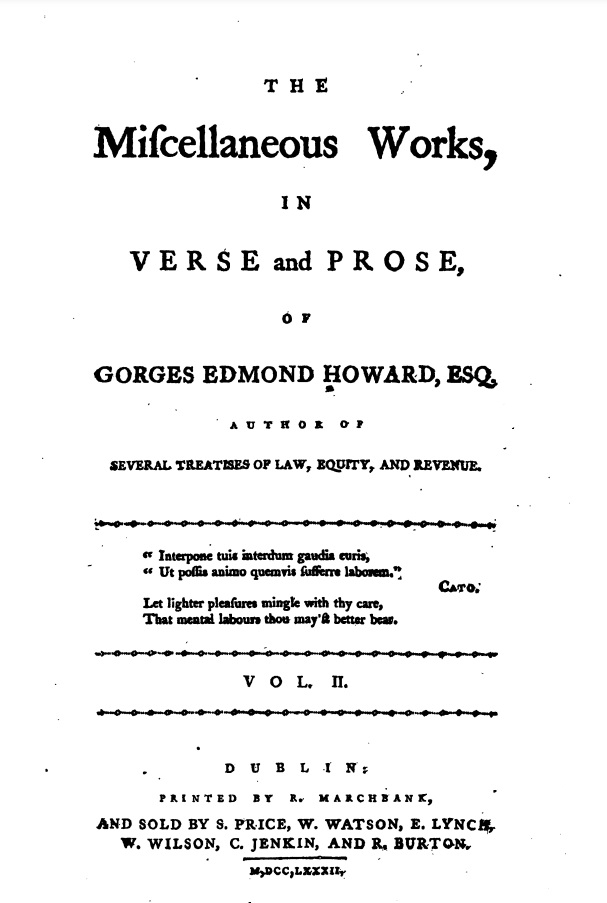
The Miscellaneous Works, in verse and prose, of Gorges Edmond Howard, Vol. 1 [of 3] (Dublin: printed by Marchbank and sold by S. Price, W. Watson, E. Lynch, W. Wilson, C. Jenkin, and R. Burton M,D,LXXXII [1782]), 373pp., front. port. [subscribers list incls. Carlisle and Buckinghamshire [both Lords Lieutenant], Viscount Lifford, Archb. of Cashel, Duke of Leinster, Earl Nugent, Lord Viscount Mount-Morres, .. Bishop of Killala and num, untitled people in alphabetical listings incl. Luke Gardiner, Sir Hercules Langrishe, several Latouches, Oliver Plunket, Esq., John Scott (Att. Gen.), Sam. Whyte (Principal of the English Grammar School, Grafton St.). Ded. letter to Earl of Carlisle, G. E. Howard. Preface in which several memoirs of the life of the author with a few of the times. [pp.vii-lx.] incl. odes and other poems [Belinda, Dorinda]; Almeyda, Siege of Tamor [Epilogue by Henry Brooke, Esq.], and The Female Gamester [plays]. [Available at Google Books - online; copy held at Univ. of Michigan; accessed 25.08.2023.
Miscellaneous Works [... &c.], Vol. 1, (Dublin: Marchbank 1782), 373pp. [end of Vol 2 at p.347] - available at Internet Archive [online] in a copy which lacks page-display but lists contents: Vol. 1 - Odes, epigrams, &c. on various occasions. Almeyda: or, The rival kings, a tragedy; The siege of Tamor, a tragedy; The female gamester, a tragedy; Vol. 2 - Apothegms and maxims for the good conduct of life, &c.; Observations and queries on the present laws of this kingdom, relative to persons of the popish religion. Some observations upon libels. Vol. 3. - A collection of the actions and sayings of great and wise men, selected from the most eminent Grecian and Roman historians; Advice to a newly-elected member of Parliament with Some thoughts upon Poynings’ law, inscribed to the Hon. William Fitzgerald, commonly called Marquis of Kildare; Some observations on the proceedings in the Dublin society, in the granting of premiums and bounties ... especially with regard to husbandry ... Poetical addresses, &c. to the author. Alteration for the last scene of the Siege of Tamor; accessed 25.08.2023. [See also .pdf version; copy in Michigan UL.]
[Note: Miscellaneous Works of Gorges Edmund Howard is not listed in COPAC.]
Reprint editions: The miscellaneous works, in verse and prose, of Gorges Edmond Howard, In three volumes. Vol. 2 of 3 (Gale ECCO 2010), 368pp., pb.; also Do., Vol. 2: Author of Several Treatises of Law, Equity, and Revenue (Classic Reprint] (Forgotten Books 2018), 373pp. [Both available in Amazon.]
Related titles
An Epistle to Gorges Edmund Howard, Esq.: with notes explanatory critical and historical by George Faulkner, Esq. and alderman [3rd edn.], (Dublin: (s.n.) 17??), 32pp., 8 [ ‘A mock correspondence in satirical verse’: DNB]; copy held in QUB [Belfast] bound with “Gast’s Letter from a clergyman”.
To all the Serious, Honest, and Well-meaning Reople of Ireland: the following queries are affectionately addressed and recommended to their serious perusal: to which is prefixed, a letter from the editor to the printer: and at the end is added, An epistle dedicatory, to Sir R-----d C---x, B----t. ([Dublin]: [n. pub.] 1754), 43 pages [half-title: Queries to the people of Ireland; signed Phil. Hib.] Attributed to John Brett, Rector of Moynalty, in NUC pre-1956; also attrib. Gorges Edmund Howard; held in num. libraries incl. TCD; Goldsmith-Kress microfilm UL] (see COPAC).
Prose works (pamphs.) available at Onlinebooks - with page images and bibl. details at Hathi Trust. —A Compendious Treatise of the rules and practice of the pleas side of the Exchequer in Ireland: as it now stands between party and party, with the rules of the said court, and an abridgment under each head of practice, of the several acts of Parliament now in force relating thereto. (Nelson, 1759). online —A Letter to the Publick on the present posture of affairs : with some quaeries humbly offered to their consideration (s.n.], 1754). .online —The Miscellaneous Works, in verse and prose (printed by R. Marchbank, and sold by S. Price, W. Watson [etc.], 1782). online —A Treatise of the Exchequer and Revenue of Ireland (printed by J.A. Husband, for E. Lynch, 1776). online —A Treatise on the Rules and practice of the equity side of the Exchequer in Ireland : with the several statutes relative thereto : as also, several adjudged cases on the practice in courts of equity, both in England and Ireland, with reasons and origin thereof, in many instances as they arose from the civil law of the Romans, or the canon and feudal laws : and a compleat index to the whole (printed by Oli. Nelson, 1760). onlne See Howard index at Online Books - online; accessed 25.08.2023.
Google Play lists Literary works Pamphlets A Compendious Treatise of the Rules and Practice of the Pleas Side of the Exchequer in Ireland: As it Now Stands Between Party and Party, with the Rules of the Said Court, and an Abridgment Under Each Head of Practice, of the Several Acts of Parliament Now in Force Relating Thereto, Vo. 2 ([O. Nelson, Skinners Row] 1759); Queries relative to several defects and grievances in some of the present laws of Ireland, and the proceedings thereon ... Third edition. With some alterations and additional queries (1763); Treatise on Exchequer and Revenue of Ireland (1776; A Second Letter to the Public on the Present Posture of Affairs (1754); Letter to the Publick on the Present Posture of Affairs with some quæries humbly offered for their consideration (1754); A Short Account of His Majesty’s Hereditary Revenue in the Kingdom of Ireland as are unappropriated; and of his private estate therein (1754); Several Special Cases of the Laws against the Further Growth of Popery in Ireland (1755); A Treatise on the Rules and Practice of the Equity Side of the Exchequer of Ireland (1760); Some Scattered Pieces upon Agriculture .. improvement of husbandry .. lately printed in “Dublin Journal” with some alterations ( [Elizabeth Lynch] 1770); A candid appeal to the Public on the Subject of the Epistle by Gorges Edmund Howard (1771); Postscript to the Candid Appeal to the Public (1771); An Epistle from Gorges Edmund Howard to George Faulkner, Esq. [ascribed in notes to Lewis Burroghes; in fact by Robt. Jephson and others] (1772); A collection of several British and Irish Acts ... relating to the trade and revenue of Ireland, in the Sessions of 1779 and 1780 with [an appendix containing] some forms of informations on the same, &c. [with] 12 tables of the duties and drawbacks on foreign wines ... calculated by R. Eaton. (1780); An Abstract and Common Place of all the Irish, British and English Statutes relative to the Revenue of Ireland and Trade connected therewith .. (1799). —Play Google - online; accessed 25.08.2023.
[ top ]
Criticism
Christopher Wheatley, Beneath Ierne’s Banners: Irish Protestant Drama of the Restoration and Eighteenth Century (Notre Dame UP 1999) [q.pp.]; see also [as infra].
[ top ]
Commentary
G. C. Duggan, The Stage Irishman (1937), p.45ff., discusses Howard’s Siege of Tamor (1773); with a prologue by Peter Seguin complaining of the absence of patriotic drama in Ireland ‘although her heroes were as bold in fight / Her swains as faithful and her nymphs as bright. ... For here alas we boast no Homer born ,/ No Shakespeare rose, an intellectual morn, / To lift our fame perennial and sublime / Above the dart of death and tooth of time ... But lo, a bard, a native bard, at last/Treads back the travels of the ages past.’ Theme is the Danish [Viking] invasion, the heroine Ernestha, dg. of Malsechlin (M’Laughlin), king of Leinster and Ireland; besieged in Tara by Turgesius; the traitors are Reli, Prince of Breffney, and Moran, Archb. of Dublin, the latter enraged because the primacy has been given to Siona. Turgesius demands Ernestha as a hostage-mistress, and twelve youths disguise as twelve virgins to fulfil the terms. Turgesius is slain by the hero Niall, who has previously rescued Ernestha in Dublin. The young hero is at first rumoured to be killed; and the play ends with betrothals of the lovers: ‘How they are favoured / Who dare for freedom and their country bleed.’ The speeches quoted express a sense of tragic loss in the Gaelic camp, and ring with the patriotic rhetoric of Grattan’s Parliament. Duggan remarks on the greater amount of studied Celtic antiquarianism in the play and commends the writer as ‘beyond question the best writer who attempted the Irish historical drama, and its obvious reflection of the political feelings of the educated Irishman of his day makes the entire play intensely interesting.’ (ibid., p.50). The influence of Macpherson is evident. ... Do we hear the reveille note of Grattan’s eloquence in the Parliament in College Green? ‘Never, never may Ierne yield / Ne’r be a vassal to a foreign yoke: / Behold the stag that loves to haunt the desert / Freed and delighted roams he there nor hears / The hunter’s wiles ..’; the citizens cry, ‘Freedom or death. Ierne shall be free.’ [Compare plot with Hibernia Freed by William Philips, q.v.]
Joseph Leerssen, Mere Irish & Fíor Ghael (Amsterdam: John Benjamins Pub. Co.: 1986), The Ossianic and gothic ‘graveyard’ influence is clearly noticeably in The Siege of Tamor (1773) by Gorge Howard. Ftn. The Author had at one time corresponded with O’Conor and worked as an attorney for the Catholic Committee (vide O’Conor to Curry, 22 Jan. 1763, in Letters, Vol. 1, p.152; O’Conor to Howard, 4 July 1763, Letters Vol. 1, pp.160-61; and also Gilbert’s History of Dublin, 1854, Vol. 2, pp.44-48. Leerssen quotes from the play (pp.38; pp.13-14 [‘Fighting for freedom, they have nobly perish’d / And liberty sheds tears upon their graves; 20; and 12), and characterises its verse-encomia of ancient Irish kings in the spirit of the modern Bolingbrokean tradition of the Patriot king as ‘Patriot, rather than loyalist, claptrap’ - e.g., O! may th’almighty arm at once o’erwhelm / This spacious isle beneath the circling main, / Its name and its memorial quite efface, / And sink it from the annals of the world, / Ere the last remnant of her free-born sons / Stretch forth their willing necks to vile subjection!’ (p.12). [429] Leerssen quotes in full Peter Seguin’s Prologue, noticed also in Kavanagh and others. The sentiments are essentially those of a Patriot antiquarian, ‘O shame! not now to feel, not now to melt / At woes, that whilom your fam’d country felt; let your swol’n breast, with kindred ardours glow! / Let your swol’n eyes, with kindred passions flow! / So shall the treasure, that alone endures, / And all the world of ancient times - be yours!’ (from Prologue, Siege of Timor, Dublin 1773, pp.iii-iv.. (Leerssen, op. cit., 1986, pp.428-30.]
See also Leerssen, Remembrance and Imagination: Patterns in the Historical and Literary Representation of Ireland in the Nineteenth Century (Cork UP/Field Day 1996): Gorges Howard’s The siege of Tamor (1773) and Francis Dobbs’s The Patriot king; or, Irish chief (1774) represent a struggle for liberty and independence and are set in the wars of the Gaelic kings against the Danes. What is more, that struggle is presented as a nationally Irish one, where the Gaelic clans become representatives of Ireland as a whole - a typical example of the appropriation of a national Irish, Gaelic-rooted past, which, in a Patriot climate, was undertaken by the urban, English-speaking theatre audiences of Dublin. The urban, Anglo-Irish audience is made to sympathize and even to identify with the cause of the Irish Gaels against the foreigners. Indeed, the cause of the Gaelic freedom fighters is delivered with the rhetoric of Grattanite Patriotism (liberty, national reconciliation, democracy); a discursive, phraseological bond is thus created between the pursuits of national liberty by the medieval Gaels and by the Enlightenment Anglo-Irish Patriots. A title like Dobbs’s The Patriot king, or Irish chief is significant in itself, as are lofty Grattanite speeches in that play, like the one where King Ceallachan refuses to ‘resign / A loyal nation to tyrannic sway’, and invokes
the flame of patriot fire
Whose purifying blaze ennobles man,
And banishes each base, each selfish thought,
Far from the breast wherein it deigns to dwell [...]
Howard’s The Siege of Tamor is even more specific in establishing a filiation between the Gaelic cause and Anglo-Irish Patriotism. His king of Dublin indirectly exhorts his future progeny (that is: the audience, the gallery which is being played to) in terms like these:
O! may th’almighty arm at once o’erwhelm
This spacious isle beneath the circling main,
Its name and its memorial quite efface,
And sink it from the annals of the world,
Ere the last remnant of her free-born sons
Stretch forth their willing necks to vile subjection!Again, the play’s Prologue uses a significant first person when it denounces the destruction of Gaelic literature ‘While gothic fires attack’d us as their prey’ Obviously the identification value is pro-Gaelic even to the point ol disavowing the English (aye, gothic) roots of the Anglo-Irish population. Accordingly the audience is exhorted to identify affectively with Gaelic Ireland, as follows:
O Shame! not now to feel, not now to melt
At woes, that whilom your fam’d country felt;
Let your swol’n breasts, with kindred ardours glow!
Let your swol’n eyes, with kindred passion flow!
[...]
Leerssen, op. cit., 1996, pp.30-31; see related extract under Francis Dobbs - as supra.
[ top]
|
[ top ]
|
||||
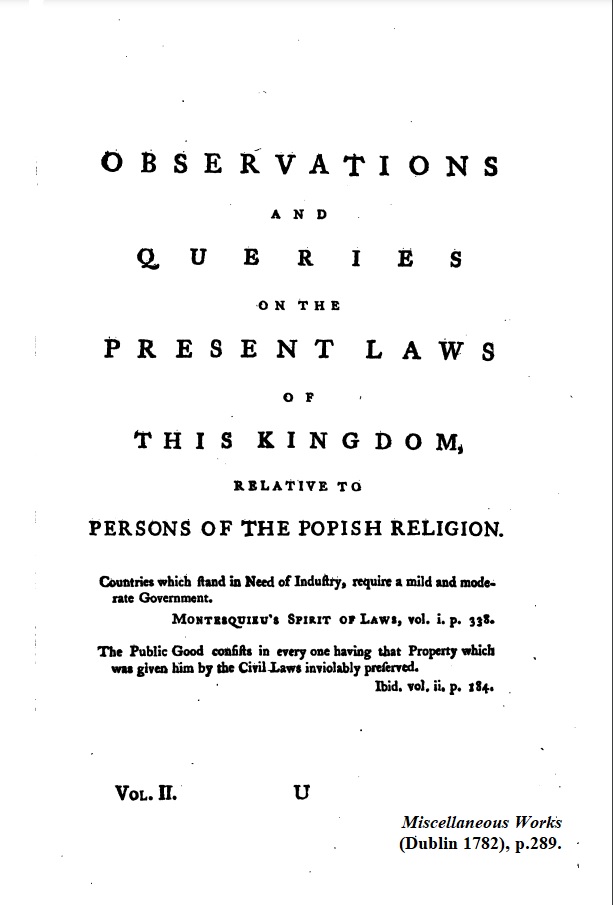
| “Observations and Queries on the Popery Laws, &c.,”, in Miscellaneous Works, Vol. 2 [1782], pp.293-313. |
| To the Reader: |
|
| Note: The pamphet is largely made up of "queries" in the manner of Bishop Berkeley, with some of his queries added at a certain point - as follows: Whether suffering persons of the Roman religion to purchase forfeited lands, wouold not be good policy, as tending to unite their interest with that of the government? (pp.298.) Howard"s queries include the following [examples]: |
|
|
| Postscript |
[...] To conclude: there is ample room in this huge code of laws, for vast relaxation, in order to give some comfort to these dispirited people, without prejudicing in the least the safety of the protestant religion, the political state, or the community in general. (p.314). |
| Note: It seems that the printings of 1761 and 1778 cited by Howard in his prefatory note to the Reader have not survived and hence this essay on the Popery (viz., Penal) Laws is the chief extant record of his policy on the matter - entirely in keeping with his known support for Catholic Emancipation - at least as regards rights of ownership. At the same time, the garbled tone of the concluding paragraph to that note suggest that he has not been entirely able to digest the events connected with the Dungannon Convention of Feb. 1782 when the Catholics were excluded from the officer ranks of the the Irish Volunteers who he refers to as that ‘glorious’ body of ‘self-raised troops’ which was apparently responsible for the defence of Ireland, and hence Britain, from French invasion. It is fudging matters to say that the Catholics were keen to join where they knew they would be admitted - in Belfast but not Armagh, nor indeed in Dungannon - and that, if excluded by Protestant prejudice, they would nevertheless cheerfully contribute to the upkeep of the troops. [For an account of the Dungannon Conventon of the Irish Volunteers - seek Wikipedia online. |
[ top ]
| “Observations upon Libels and laws relating thereto” [1761, 1788], in Miscellaneous Works, Vol. 2 (1782), |
|
| Ending: |
‘[...] But, by the fever of mind in which too many eternally art, they are inducing ruin upon ruin on us every day; by the licentiousness of the press, they are destroying its freedom; from the appetite for scandal, (which is unfortunately too predominant in mankind) they are by the numbers and frequencies of their publications, and the expense and idleness they create, destroying the infustry of the labourer. Such are their wretched politics! And so have these incendiaries reduced this once-most-honourable city, by the feurds and dissensions which they have created in it, that there is hardly an honest, prudent man to be found, who dare venture now to be a representative thereof; and shorrtly, in all likelihood, no persons of credit or character therein, or who regartds his peace and safety, will dare to be an alderman thereof; and especially, if (as is the mode at present) the very instant he is invested with the robe he is to be stigmatized, and the mob halloO’d at him. / My earnest wishes then, are, from these few hints, (for I could have said much more) to enable my fellow subjects rightly to distinguish satire from abuse; the free discussion of public measures from private calumny; and the constitutional liberty from the disgraceful licentiousness of the press. [ p.347.; End of the Second Volume.] |
| “Observations upon Libels [...]” [1761, 1788], in Miscellaneous Works, Vol. 2 (1782),pp.319-47. |
[ top ]
References
Dictionary of National Biography remarks that he was ridiculed for worthless tragedies and occasional verse but published valuable legal works. PI calls him an architect [check].
Peter Kavanagh, The Irish Theatre (1946), lists Ameyda or the Rival Kings (1769), unacted, based on Hawkworth’s Almoran and Hamlet; The Siege of Tamor (Smock Alley, Apr 1774) 1773, based on 9th c. Danish wars in Ireland, with ‘sentimental regard’ for Irish chiefs (Kavanagh); poss. with help from Henry Brooke; The Female Gamester, unacted.
W. B. Stanford, Ireland and the Classical Tradition (IAP 1976; 1984), lists includes S. W. Howard, Regulus (1744) under Irish Classical Plays [110].
British Library holds Wagstaffe, Jeoffry [Robert Jephson], The Bachelor, or Speculations of J. W. by author[s?] of epistle to Gorges Edmund Howard, Esq, 2 vols. (Dublin 1769, London 1773) [listed under Miscellaneous].
Belfast Central Public Library holds Miscellaneous Works in Verse and Prose (1782).
[ top ]
Notes
Catholic Committee: There is a letter to Howard by Charles O’Conor, regarding the latter’s circumstances in the ‘discovery suit’ - i.e., claim to the property made by a Protestant relative - brought by his younger brother Hugh; see Ward and Ward, eds., Letters (1988), with note on Howard explaining that the publication of one of his plays (unnamed) was subsidised by the Catholic Commitee (p.423; n.1).
[ top ]