       |
Life
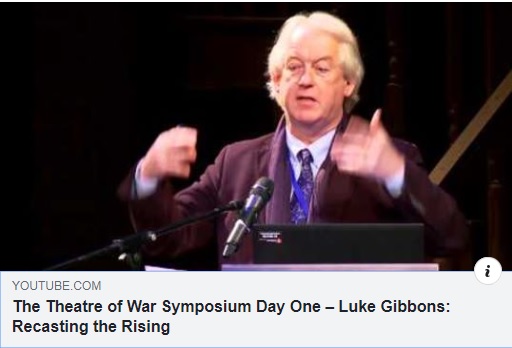
1950- ; b. Keadue, Co. Roscommon, son of Dr. Hugh Gibbons (Fianna Fáil TD for Roscommon, 1965–77; d.2007); grad. in English, Maynooth; completed PhD at Trinity College; appt. to Chair of Media Studies, DCU [Dublin City University]; appt. Professor of English and Concurrent Professor in the Department of Film, Television, and Theatre, Notre Dame Univ., South Bend, Illinois, 2000; also Assistant Director of Keough Centre for Irish Studies and Dir. of Grad. Studies, NDU; appt. Professor of Irish Literary and Cultural Studies (School of English, Drama and Media Studies), NUI Maynooth, 2010; his influential multidisciplinary works incl. Transformations in Irish Culture (1996) and Joyce’s Ghosts: Ireland, Modernism and Memory (2015) - lauched on 25 Nov. at the RIA, introduced by Prof. Joe Cleary (NUI Maynooth); served as contrib. editor to The Field Day Anthology of Irish Writing (1991), Vols. II & III; appt. member of the Board of Trustees of the International James Joyce Foundation; keynote lecturer in the Abbey Theatre 1916 Commemorative Rising series, April 2016; lives in Clontarf, Co. Dublin. |
|
[ top ]
Works| Monographs |
|
| with others |
|
| Selected Articles |
|
| [ top ] |
Note: Seán Crossan & Rod Stoneman, ed., The Quiet Man ... and Beyond: Reflections on a Classic Film, by John Ford and Ireland (Dublin: Liffey Press 2009), reprints inter al. - his article on The Quiet Man, orig. in Kevin Rockett & John Hill, Cinema and Ireland (1987), together with an essay by Hill contesting his overly-subversive reading. |
[ top ]
Bibliographical details
Edmund Burke and Ireland: Aesthetics, Politics and the Colonial Sublime (Cambridge UP 2003), 303pp. CONTENTS: List of illustrations [ix]; Preface [xi]; Introduction - Edmund Burke, Ireland, and the colonial sublime [1]; PART I: The Politics of Pain. 1. ‘This king of terrors’: Edmund Burke and the aesthetics of executions [21]; 2. ‘Philotectes’ and colonial Irland: the wounded body as national narrative [39]. PART II: Sympathy and the Sublime. 3. The sympathetic sublime: Edmund Burke, Adam Smith, and the politics of pain [83]; 4. Did Edmund Burke cause the Great Famine? Commerce, culture, and colonialism [121]. PART III: Colonialism and the Enlightenment. 5. ‘Tranquillity tinged with terror’: the sublime and agrarian insurgency [147]; 6. Burke and colonialism: the Enlightment and cultural diversity [166]; 7. ‘Subtilized savages’: Burke, progress, and primitivism. [183]; 8. ‘The return of the native’: the United IrisHmen, culture, and colonialism. [208]; Conclusion: towards a post-colonial Enlightenment [230]. Notes [230]; Index [288]. (See under Quotations [infra] and a review by Victoria Myers [infra].Joyce’s Ghosts: Ireland, Modernism and Memory (Chicago UP 2015), 288pp., ill. [32 half-tones]. CONTENTS: List of Figures; Preface; Acknowledgments. Introduction: ‘A Ghost by Absence’; 1. Text and the City: Dublin, Cultural Intimacy, and Modernity; 2. ‘Shouts in the Street’: Inner Speech, Self, and the City; 3. ‘He Says No, Your Worship’: Joyce, Free Indirect Discourse, and Vernacular Modernism; 4. ‘Ghostly Light’: Visualizing the Voice in James Joyce’s and John Huston’s ‘The Dead’; 5. ‘Pale Phantoms of Desire’: Subjectivity, Spectral Memory, and Irish Modernity; 6. ‘Spaces of Time through Times of Space’: Haunting the ‘Wandering Rocks’; 7. ‘Famished Ghosts’: Bloom, Bible Wars, and ‘U.P. UP’ in Joyce’s Dublin; 8. ‘Haunting Face’: Spectral Premonitions and the Memory of the Dead. [[available in part at Google Books - online; accessed 05.04.2021; Chap. 8: Haunting Face is given online at De Gruyter.com - online; password required.]
Reviews incl. Michael J. Griffin, review of Edmund Burke and Ireland: Aesthetics, Politics, and the Colonial Sublime, in New Hibernia Review, 8, 1 (2004) pp.150-53.
[ top ]
Commentary
Gerry Smyth, Decolonisation and Criticism: The Construction of Irish Literature (London: Pluto Press 1998): remarks, ‘Gibbons draws a distinction between coherent nationalist and fugitive nationalism, giving an account of 19th century Ireland in which the constitutional nationalism of O’Connell contended with the “dissident, insurrectionary tradition” made up of half-digested epic imagery, the rituals of agrarian secret societys and the performative aesthetics of popular ballads.’ (p.32.) ; further quotes, ‘“Celticism” […] was an attempt by a colonial power to hypostasise an alien, refractory culture in order to define it within its own controlling terms’ (‘Challenging the Canon: Revisionism and Cultural Criticism’, in Deane, ed., The Field Day Anthology of Irish Writing, 1991, Vol. III, pp.561-68, p.568.)
Patrick McGee [Louisiana State Univ.], ‘Humpty Dumpty and the Despotism of Fact: A Critique of Stephen Howe’s Ireland and Empire’, in Jouvert: A Journal of Postcolonial Studies [link]: ‘[...] Luke Gibbons, who occupies a special place in Howe’s pantheon of incompetent cultural theorists, is taken to task by Howe for making the claim that James Connolly’s historical writings “point to the cultural mediation of market forces, an awareness that economic necessity does not operate in the same way in the undeveloped periphery (particularly under colonialism) as it does in the metropolitan heartlands” (Gibbons,Dialogue, p.30). To this assertion, Howe responds, “Such arguments are, quite simply, not to be found in Connolly’s writings, but are rather projected onto them by Gibbons” (p.63). In point of fact, Gibbons quotes from Connolly’s pamphlet, “Erin’s Hope”, the relevant passages of which are reprinted along with other writings on national identity in the first of the two sections edited by Gibbons in The Field Day Anthology of Irish Writing. In the passages Gibbons refers to, Connolly focuses on the uniqueness of Irish history with respect to the survival of Clan ownership of property, which, in some cases he argues, lasted well into the seventeenth century. According to Connolly, some critics will see such a survival as “a real hindrance to progress”; but for Connolly it is a cultural fact of Irish history that explains the conflict between the English and the Irish as “the conflict between rival systems of land ownership” (The Field Day Anthology, Vol. 2, p.986). In Gibbons’s interpretation of these texts, Connolly holds the view that the forces of material progress have to adapt themselves to cultural diversity, which means, in Gibbons’s words, that “there is no universal template for modernisation or, for that matter, socialism, but rather they must engage dialogically with the precise cultural, historical and, dare one say, national conjunctures in which they find themselves” (Dialogue, p.30). This might be one explanation for why Connolly participated in the Easter Rising, which, as many critics point out, forced him to subordinate his socio-political agenda to a nationalist agenda. Perhaps Gibbons has it wrong, but he is offering an interpretation of a historical document, while Howe’s summary judgment - in support of which he offers no serious engagement with Gibbons’s references (on this issue, what I’ve quoted above is all he says) - simply presupposes that historical documents require no interpretation. They are transparent, and thus he doesn’t have to challenge Gibbons interpretation with his own.’ (n.p.; para. 8; Jouvert, Vol. 7, Iss. 2.)
[ top ]
Robert Savage [Boston College], review of Gaelic Gothic in Irish Literary Supplement (q.d.): ‘In this challenging, wide-ranging [book], Luke Gibbons explores the complexities of the gothic genre, maintaining that, though originally a literary genre known for its popular or sensational appeal, the gothic grew to become part of everyday life, “giving rise to a phantom public sphere haunted by fear, terror, and the dark side of civility.” [...] Gibbons provides a thought-provoking study that recognizes the relationship between racial theory and literary genre.’ (Quoted on Syracuse University Press website, online; accessed 23.03.2010.)
Victoria Myers, review of Edmund Burke and Ireland: Aesthetics, Politics, and the Colonial Sublime, in Studies in Romanticism (Dec. 2005): ‘Edmund Burke and Ireland joins a mounting collection of recent works on British colonialism, on Ireland, and on the political resonance of Burke’s aesthetics. Gibbons’ distinctive contribution triangulates these topics in order to lay a course through Burke’s career that will bring the arch-conservative of Reflections on the Revolution in France closer to today’s critics of colonialism and of the Enlightenment rationale for empire. Admittedly ‘read[ing] against the grain’ of Burke’s political philosophy, Gibbons seeks roads less traveled in order more effectively ‘to integrate [Burke’s] powerful aesthetic writings into his wider moral and political vision’ (15). In doing so, he expects to reveal ‘a man deeply divided against himself’ (xi). Although Burke sometimes disappears behind the various components in Gibbons’ widely reticulating argument, he finally re-emerges, an avatar of suffering Ireland.
Further [Victoria Myers, review of Edmund Burke [...], Dec. 2005): After a summary introductory chapter, Gibbons uses chapter I to lay the groundwork of his argument in a contextualized interpretation of Burke’s A Philosophical Enquiry into the Origin of our Ideas of the Sublime and Beautiful. Dovetailing with other scholars who have connected the Enquiry with Burke’s later writings on India (Uday Singh Mehta, Sara Suleri) and on the French Revolution (Tom Furniss), Gibbons finds in the sublime ‘a fraught, highly mediated response to the turbulent colonial landscape of eighteenth-century Ireland’ (23). He begins the chapter with general allusions to the execution of Fr. Nicholas Sheehy during the agrarian agitation of the Whiteboy movement in the 1760s. This agitation and the government’s brutal response alarmed and horrified Burke (as we know from his private letters), and they involved the Nagles and the Hennessys, maternal relatives and early friends of Burke’s family. Although these dramatic events during Burke’s adulthood post-dated the Enquiry, Gibbons not only analogizes Burke’s emotional reaction to his later description of sublime horror, but also argues that Burke’s Enquiry owes much to the Irish context in which he grew up and in which he began (in the 1740s) to develop his aesthetic theories.
Sarah Davison, ‘“A Terrible beauty”: Radical Irish politics and Joyce's radical art', review of James Joyce and the Irish Revolution, in Times Literary Supplement (19 Jan. 2024) ‘[... A] failure on its own terms, the Rising and its brutal aftermath nonetheless delivered a shock that stirred revolutionary ferment in Ireland and abroad. It is this radical potential that leads Luke Gibbons to define the Easter Rising as a “modern event”. / At no point in James Joyce and the Irish Revolution are the events of the Rising clearly set out. This is not a book for beginners. The level of knowledge assumed is high and the prose is marbled with quotations from the likes of Walter Benjamin, Hannah Arendt and Theodor Adorno, whose insights are swiftly sequenced to disorientating effect. Luke Gibbons’s stated aim is “to show that the Ireland that created ... Joyce’s modernist sensibility was in many respects the same culture that produced the Easter Rising and the Irish revolution”. “This is not to imagine Joyce on the barricades or to read the 1916 Proclamation through the lens of Ulysses”, Gibbons explains, but “to find innovative, even discordant narrative structures capable of doing justice to the heterogeneity of forces that went into the making of the Irish revolution”, or - to put it more simply - to illuminate the “multiple points of intersection” between the literary avant-garde and anti-colonial rebellion. The reader must be nimble to make the most of Gibbons’s erudition because there is little in the way of signposting to explain how those discordant structures and disparate “points of intersection” correlate. / Ulysses (1922) registers the shock of the Easter Rising indirectly - for instance, via references to Casement, who was also a vocal opponent of the atrocities committed in the name of empire in the Belgian Congo. Set on an ordinary day in Dublin in 1904, Joyce’s novel is permeated with an awareness of what was yet to pass and the stirrings of a consciousness at odds with the imperial world order. [...; &c.]" [available online; accessed 29.11.2024.]
[ top ]
Quotations
‘Romanticism, Realism and Irish Cinema’, in Cinema and Ireland (1987) [Chap. 7]: ‘[...] One of the main casualties in any simplistic reduction of political violence to natural or irrational forces is history. For this reason, it is interesting to contrast the recourse to nature in films such as Shake Hand with the Devil and Ryan’s Daughter with a view of communal violence which seeks to reinstate history and culture, albeit within the confines of another version of romanticism. In an early scene in the film Captain Boycott (1947), the local unit of the Fenians is shown drilling and organising clandestinely under the cover of a foreboding ruined castle. No sooner has Hugh Davin (Stewart Granger) joined the group than an argument develops as to the relative merits of peaceful methods and violence in achieving their politic ends. One of the disgruntled men voices the classic liberal opposition of language (and by extension reason and parliamentary procedures) to violence. “If you ask me we’d be a sight better off talking over our troubles with the Land League. They haven’t got guns - but they’ve got Mr Parnell.” “When we get the guns”, the rabble-musing schoolmaster McGinty (Noel Purcell) replies, “they’ll listen to something a sight more powerful.” Though Hugh castigates the men for treating a military organisation as “a debating society”, it is clear that McGinty sees violence not as the negation of language but as a more forceful, if crude form of communicaiton. As Hugh’s mother (Maureen Delaney) puts it in the preceding scene when she suspects that Hugh is going over to non-violent politics: “Your father appealed to the landlords in the language they understood. And it’s not so different today ... I’ve heard tell of ’em gathering together again - organising and drilling for a moment to strike ...”’ [Gibbons’s emphasis]. (p.232; see further remarks under Dion Boucicault, Quotations, supra.)
[ See remarks on James Joyce under Joyce > Commentary - infra. ]
Edmund Burke and Ireland: Aesthetics, Politics and the Colonial Sublime (2003): ‘The basic argument of this book is that Edmund Burke’s arsthetics take up where his politics ostensibly leave off, allowing him to negotiate some of the “deepest obligations written on the heart” (to use his own formulation) that could not always be reconciled with his official public persona as a British statesman. The concept of the sublime, which lay at the heart of his aesthetics, addressed itself primarily to the experience of fear and terror, and it is this spectre that haunted Burke’s political imagination throughout his career. This found expression primarily in his preoccupation with political terror, whether in colonial Ireland or India, or revolutionary America or France. The complexity of Burke’s theories of violence, sympathy, and pain, as outlined in his A Philosophical Enquiry into the Origin of our Ideas of the Sublime and Beautiful (1757), provided him with a sert of diagnotics tools to probe the dark side of the Enlightenment, particularly as it was used to justify colonial expansion, religious bigotry, or political repression. This is not to turn Burke - one of the emblematic figures of conservative thought - into a revolutionary where none was intended (though Mary Wollstonecraft did remark that had he lived in France, he would most likely have been a Jacobin). It is rather to argume that he was a man deeply divided against himself, a very fusion of the opposites yoked together in his concept of the sublime.’ (p.xi; see further Burke, Commentary, infra, or go to Google Books digital copy online; accessed 17.06.2010.)
‘Dialogue with the Other: a reply to Frances Mulhern’, in Radical Philosophy (Summer 1994): ‘[...] However, as Dr Johnson remarked, it is unlike the Irish to speak well of one another, and already in this expression of praise it is possible to detect the sting in the tail. While all voices are equal, one, it would seem, is less euphonious than others - `Gaelic Ireland and its rivalrous posterity’. The other three (representing historically, let it be noted, different intensities of conquest) are evidently bearers of sweetness and light: but the natives alone are fractious and unruly. It is to be expected, then, that when Mulhern comes to the sections I edited in the anthology, in which I try to complicate this picture of what it means to be on the receiving end of colonialism, his tone becomes less magnanimous. Whereas it is usual in debates on post-colonial writing to refer to subjugated or “subaltern” cultures in relation to, say, the experience of India or Algeria, Mulhern will have none of this where Ireland is concerned: for native culture over the centuries, he suggests, read “dominant local tradition”. I would like to ask: dominant over whom? Over the Protestant Ascendancy? Over the might of the British empire? We are getting very close here to the spoof on Irish revisionist history in a Dublin periodical some years ago, which suggested that it was the Landlord class who suffered excruciatingly during the Great Famine, while the peasants were having a field day, so to speak, at their expense. / Divested of its more rhetorical asides, Mulhern’s main objection to my sections in the anthology on twentieth-century cultural debates in Ireland would seem to be that they belie the traditionalist view of Irish nationalism as conservative, rural, priest-ridden, misogynist - the unholy trinity of land, nationalism and religion. [...] This turns out to be a heterogeneous and open-ended concept of Irishness which I trace in the neglected writings of, among others, the 1916 leader Thomas MacDonagh, and which distances national identity from any purifying or monocular vision.’ [Radical Philosophy online; accessed 17.11.2007.]
National identity: ‘The Hegelian standards of clarity and abstraction prescribed for political consciousness in the metropolitan centre do not exhaust all possibilities of national identity. The owl of Minerva may only fly at dusk, but Dedalus was able to wing his way through the Celtic twilight, albeit by flying close to the ground.’ (‘Allegory, History and Irish Nationalism’, in Transformations in Irish Culture, 1996, p.147.)
Nationalism denied: ‘By denying the variegated pattern of nationalism, the fissures and tensions of a disparate set of responses to colonial domination, the revisionist enterprise gave back to the most conservative strands in nationalism the unity and cohesion they found so difficult to attain on their own terms.’ (Field Day Anthology of Irish Writing, Vol. 3, p.568; cited in Edna Longley, The Living Stream: Literature and Revisionism in Ireland, Newcastle-Upon-Tyne: Bloodaxe 1994, p.41, and there called ‘the anti-anti-racist argument’.)
Compex nationalism: ‘[Joyce’s] writing was a symptom of the rebellion’. Further: ‘That Joyce’s work both drew on and helped to articulate the energies that coalesced in the Easter Rising and the struggle for Independence was apparent not only to [HG] Wells but also to many of the insurgents themselves. Much is made of the complex nature of Joyce’s engagement with Irish nationalism but little has been written on the equally complex responses of Irish nationalists to Joyce.’ (Joyce’s Ghosts: Ireland, Modernism, and Memory, Chicago UP 2015, p.xv; quoted in Claire A. Culleton, ‘The Thin Edge of the Wedge: How things start in Dubliners’ [Chap. 1], in Culleton & Ellen Schleibe, eds., Rethinking Dubliners, Palgrave 2017.)
Pristine identity: ‘[T]here is no possibility of restoring a pristine, pre-colonial identity: the lack of historical closure … is bound up with a similar incompleteness in the culture itself, so that instead of being based on narrow ideals of racial purity and exclusivism, [Irish] identity is open-ended and heterogeneous. But the important point in all of this is that the retention of the residues of conquest does not necessarily mean subscribing to the values which originally governed them.’ ([Transformations in Irish Culture, 1996] p.179; quoted in Brian Graham, ed., In Search of Ireland, 1997, ‘Ireland and Irishness’ [Introduction], p.10.)
Irish allegory: ‘Allegory in an Irish context belongs to the politics of the “unverbalised”. It is not just a poetic device, but a figural practice that infiltrates everyday experience, giving rise to an aesthetics of the actual. [.. ./ ...] For allegory to retain its critical valency, it is vital that there is an instability of reference and contestation of meaning to the point where it may not be at all clear where the figural ends, and where the literal begins.’ (Transformations in Irish Culture, 1996, p.20; cited in Gerry Smyth, Decolonisation and Criticism: The Construction of Irish Literature, Pluto Press 1998, p.33.)
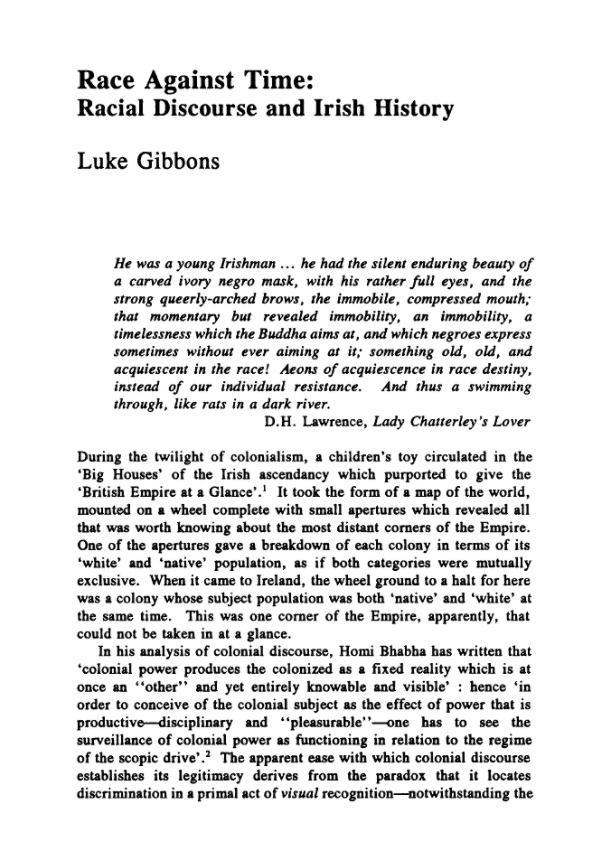
Propaganda: ‘Many of the conceptions requisitioned by nationalist propagandists in defence of Irish culture are, in fact, an extension of colonialism, rather than a repudiation of it. The racial concept of an Irish national character is a case in point. The racial mode is, moveover, the version of Irish nationalism which has passed into general academic circulation in recent years through the ‘revisionist’ writings of Conor Cruise O’Brien and F. S. L. Lyons (among others) - largely, one suspects, because it redefines even resistance within the colonial frame and thus neutralises the very idea of anti-colonial discourse.’ ( ‘Race against Time: Racial Discourse and Irish History’, in Robert Young, ed., Oxford Literary Review, 12, 1-2, 1991, p.104 [available at JSTOR online; quoted in Vincent Cheng, Joyce, Race and Empire, 1995, p.49 [continued in ftn. at 298].
|
Cf. | 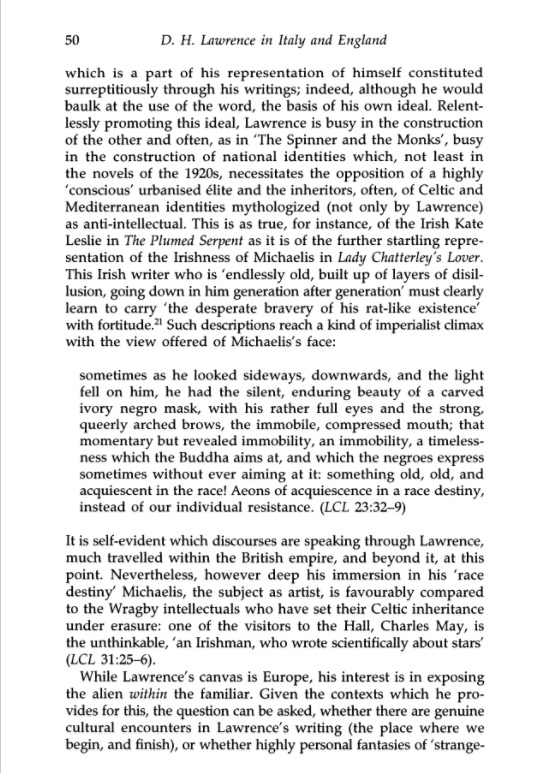
|
Note: the physiognymy in question is Michaelis’ face in Lady Chatterly’s Lover. See Fiona Becket, ‘Strangeness in D. H. Lawrence’, in D. H. Lawrence in Italy and England, ed. George Donaldson & Mara Kalnins (London: Palgrave Macmillan 1999), pp.38-51; p.50 [online]. Click images to enlarge. |
||
[ top ]
Colonial Ireland? ‘Ireland is a first-world country with a third-world memory. Though largely white, Anglophone and westernised, Ireland historically was in the paradoxical position of being a colony within Europe. [...] Considering Ireland in a postcolonial frame is not a matter of including one more culture within existing debates, but reworking the paradigms themselves. Theory itself needs to be recast from the periphery and acquire hybrid forms, bringing the plurality of voices associated with the creative energies of postcolonial cultures to bear on criticism itself.’ (‘Ireland and Colonisation Theory’, in Interventions, 1, 1, 1998, p.27; quoted in Ralph Pordzik, ‘A Postcolonial View of Ireland and the Irish Conflict in Anglo-Irish Utopian Literature since the Nineteenth Century’, in Irish Studies Review, Dec. 2001, p.332.)
‘The Quiet Man & the Big Fellow’, extract from The Quiet Man, in The Irish Times ([8 Dec.] 2001), departs from the acknowledgement addressed to ‘an IRA consultant: Ernie O’Malley’ in the credits to the 1951 film based on Maurice Walsh’s novel. Gibbons tells that Arthur Griffith travelled by mail boat to Dublin on 2 Dec. 1921 with the ‘Proposed Articles’ for the Treaty, and while Collins stayed behind for two further meetings on financial matters and caught the mail train at Euston at 8.45p.m. with Childers and Duffy[?]. When the Cambria sailed next morning with Collins, it struck a fishing boat with loss of lives on board the smaller vessel. Collins visited the survivors picked up after some hours circling in the area. John Ford was also on board the mail boat and wrote an account of it to his wife Mary, naming Collins and Griffith (the latter in error). Docking at 10.15 a.m., the journey left Collins with less than an hour to get to the cabinet meeting, called the most important in Irish history (T. P. Coogan). Ford, who was born Sean O’Feeney, went to visit his relations in Spiddal and found their homes shot up by the Black and Tans; Sean Thornton in the movie (played by Wayne) is the namesake and counterpart of the Thorntons with whom the Feeney’s shelter.
Gothic history: ‘[W]hen Irish history is being written it mgiht be better to use as a template the tropes and themes of literary Gothic than those of literary realism.’ (Quoted [no source] in J. Ardle McArdle, review of Jarlath Killeen, Gothic Ireland: Horror and the Irish Anglican Imagination in the Long Eighteenth Century, in Books Ireland, Dec. 2005, p.387.)
| Gibbons, Joyce’s Ghosts: Ireland, Modernism, and Memory (Chicago UP 2015) — |
|
‘[t]houghts seem to drift free of their mental worlds, as if the objective, third-party aspect of free indirect discourse were sufficient to endow inner life with some kind of indeterminate outer form’ (9). |
‘[W]hat is on the page is not as important as what is left out: there is a constant awareness that some “extratextual” matter is required to fill in the silences, ellipses, and “multi-storied symbolic forms” that perforate the text’ (28). |
|
|
| Bibl.: Joyce’s Ghosts - available at Chicago UP - online; accessed 07.04.2021. See also chapter-length extract from Gibbons, Joyce’s Ghosts: Ireland, Modernism, and Memory, Chicago UP 2015), with reviews by Barry McCrea and Margaret Norris - under Criticism > Major Writers > Joyce > - as attached. |
[ top ]
Notes
Praise where praise ...: His essay on the west of Ireland is called a ‘stimulating and suggestive paper’ in Terence Brown’s review of C. Curtin, M. Kelly & L. O’Dowd, eds., Culture and Ideology in Ireland (Galway UP 1984), in Crane Bag, Vol. 9, No. 1 [Contemporary Cultural Debate] (1985), pp.90-91, p.90.
Liffey banks: Eamon Kelly, reviewing Toby Corbett, Brian Friel: Decoding the Language of the Tribe (Dublin: Liffey Press 2002), writes that the Liffey Press’s “Contemporary Irish Writers & Filmmakers” Series ‘aims to examine the state of contemporary Irish culture through an analysis of its writers and filmmakers.’ Further, ‘Making a distinction between the many studies of Irish culture taken through the work of Joyce and Yeats, and the completely altered cultural landscape of contemporary Ireland, the series sets out to show how writers are not only shaped by the changing cultural landscape, but also how their works serve to influence attitude and opinions which in their turn also have a transformative effect on the culture. / Taking as their inspiration the Luke Gibbons’s view that “a people has not found its voice until it expressed itself, not only in a body of creative works but also in a body of critical works”.’ (No source; Books Ireland, April 2003, p.84.)
Ireland & Wales: Luke Gibbons was the keynote speaker at ‘Ireland and Wales: Correspondences’, a one-day interdisciplinary postgraduate symposium held at Cardiff University (Thursday 17 Sept. 2009), as part of Ireland-Wales Network’s ‘Nations and Knowledges’ symposium (18-19 Sept. 2009).
Kith & Kin: Dr. Hugh Gibbons, the father of Luke Gibbons, held the the Roscommon seat in the Dáil Eireann for Fianna Fáil TD (Dáil Éireann), 1965–1977; d. 13 Nov. 2007; another son, Brian Gibbons (b.1950), is a medical doctor the Labour Party Welsh Assembly Member for Aberavon and Welsh Govt. Minister for Health and Local Government.
[ top ]