       |
| See ... |
|
[ top ]
Works| Chief bio-critical works | ||
|
||
| For details, see under the authors treated. | ||
| Miscellaneous | ||
| Editions | ||
|
||
| Selected articles & Introductions | ||
|
||
|
||
|
[ top ]
|
||||||||||||||||||||||||||||||||||||||||||||||||||||||||||||||||||||||||||||||||||||
[ top ]
Commentary
Ellsworth Mason [letter to Ellmann]: ‘The trouble with your performances is that they have a kind of self-contained beauty of their own, and even in deepest error you have an intelligence of expression that is rare in Joycean criticism. I hereby predict that your errors about Joyce will be the last to depart from this earth. (See Joseph Kelly, ‘Stanislaus Joyce, Ellsworth Mason, and Richard Ellmann’: The Making of James Joyce’, in James Joyce Studies Annual, 3, 1992, p.112; quoted in Eric Bulson, Cambridge Companion to James Joyce, Cambridge UP 2006, p.115.)
Patrick Henchy, The National Library of Ireland, 1941-1976 - A Look Back: A Paper Read to the National Library of Ireland Society (NLI 1986): ‘Among the many readers and scholars whom it was my privilege to know and assist over the years, there is one scholar whom I will select for special mention - Richard Ellmann - but, as in the case of Sybil Le Brocquy, it is not possible to convey here an adequate picture of this outstanding scholar. He came to Ireland after the war to study the writings of Yeats, Joyce and Wilde and became a leading authority on these authors. He is best remembered for his biographies of Yeats and Joyce (Yeats: the Man and the Masks, 1949 and James Joyce, 1959). The National Library became his spiritual home, and I became his chief helper. I can recall how pleased he was when I dug out from a collection of old posters the programme for the bazaar “Araby” held in Dublin, 14-19 May, 1894. “Araby” is, of course, the title of one of Joyce’s stories in Dubliners, and here we had some proof of its factual background. I have told elsewhere of our successful trip to interview Nora Joyce’s sister, Kathleen.’ (q.p.) Henchy notes earlier: ‘I always had good relations with the Trustees and acknowledge their help and co-operation on all occasions. They were an illustrious group, and for some years included three class mates of James Joyce: Prof. Felix Hackett who was Chairman for many years, Mr. Con Curran and Mr. Justice James Murnaghan. Another contemporary of Joyce who frequented the Library was Dr. Séamus Ó Ceallaigh. Both he and Murnaghan showed a certain dislike of Joyce and made it clear that they did not wish to co-operate when on behalf of Richard Ellmann I wished to interview them.’ (p.7.)
Ann Saddlemyer, Becoming George: The Life of Mrs W. B. Yeats (OUP 2002): ‘When Ellmann returned to Ireland in June 1946 their discussions continued; George was frank in her response to his interpretations and surprisingly forthcoming about her own life. She thought he was too sceptical about A Vision, but, although she obviously reread the automatic script in order to answer some of his questions, refused to let him study the notebooks himself, with her customary dismissive phrase, “That is too personal.&146; (Ellmann in conversation with Saddlemyer, 1985; p.622.) Saddlemyer goes on to say that Mrs Yeats permitted Ellmann to photocopy MSS in his room at the Arts Club, providing him with a valise to carry them, and that he arranged for the delivery of a ton of coal to Palmerston Rd. in Nov. 1947 - when George had bronchitis, affording the Yeatses them the first warm winter in six years. Saddlemyer quotes Mrs Yeats ‘typically generous’ letter of praise when Ellmann’s study of Yeats came out (ibid., p.625.)
[ top ]
John Nash, ‘Reading Ellmann Reading Joyce’, in Nash, ed., Joyce’s Audiences (Amsterdam: Rodopi 2002): ‘Among the “facts” that appeared in the revised edition [of James Joyce, 1959, rev. 1982) and which he could have corrected had he consulted his own materials more carefully were that both Joyce and Nora were hospitalised in the summer of 1907. Joyce was never hospitalised and the Mangan lecture was never given. Ellmann’s version of Lucia’s birth is also wrong but was followed by all subsequent biographers. Ellmann [53] reports it as follows: “Some days after Joyce was hospitalized Nora’s labor began, and she too went to hospital. The baby was born on July 26 in the pauper ward, “almost on the street”, as she admitted later.’ (JJII, 262.) [Here quotes more dramatic version of same by Brenda Maddox]. Both of these versions rely on Ellmann’s 1954 interview with Francini Bruni (who, by then, was no longer a reliable witness), and strangely ignore Stanislaus’s Triestine “Book of Days” which provides an eye-witness acocunt of what happened, describing how Joyce went with Nora to the hospital on 25 July as soon as the midwife said it was time. While Stannie entertained Giorgio, Joyce helped Nora get settled. Then the two men went for dinner and then home to bed [...] next morning Joyce returned and was surprised to be told that Nora had already given birth to a baby girl at four in the morning. They decided to call her Lucia, but both he and Nora were slightly disappointed, as they had been hoping for another boy.’ (pp.53-54.) Further: “[W]e should keep in mind Ellsworth Mason’s faulting Ellmann for identifying “the plausible with the actual” and his warning him that his mistakes would be “the last to depart from this earth.” [Letter of 25 Oct. 1954 in Ellmann Collection]. (p.[56].)
[ Ftn. cites Stanislaus Joyce, Triestine “Book of Days”, 25 July 1907 [being] No. 1414 in Robert E. Scholes, The Cornell Joyce Collection: A Catalogue (Cornell UP 1961). Also cites Hugh Kenner, ‘The Impertinence of Being Definitive’, in Times Literary Supplement (17 Dec. 1982), p.1383 [on Ellmann’s revised James Joyce ].
Emer Nolan, James Joyce and Nationalism (London: Routledge 1995) - discussing Joyce’s supposedly anti-nationalist sentiments in the “Cyclops” chapter of Ulysses: ‘A critic such as Richard Ellmann is, however, quite happy to agree with Bloom, but he must therefore proceed to distinguish between the kind of parody to which the nationalists are subjected and the parody of Bloom himself. After all, Bloom’s interventions are taken up and sported with by the insistent parodic voice of the interpolations as much as those of anyone else; but for Ellmann the “positive” side of “Cyclops” must be divorced from this kind of savage parody. This point is so crucial in Ellmann’s overall understanding of Joyce that he deals with it even in his short preface to Gabler’ s edition of the text: “It is the kind of a parody that protects seriousness by immediately going aware from intensity. Love cannot be discussed without peril, but Bloom has nobly named it.”’ (In Gabler, Ulysses: Corrected Edition, 1984, p.xiii; Nolan, p.96?; see longer extract in RICORSO, Library, “Criticism, > Major Authors” > Joyce - via index or as attached. )
“First Flush”, Books Ireland (Sept. 2008), notice of Edward M. Burns, ed., A Passion for Joyce: The Letters of Hugh Kenner and Adaline Glasheen (UCD Press): ‘[...] Richard Ellmann, author of the definitive Joyce biography, is ill-regarded by both correspondents even to the extent that his interpretations are seen as per se confirming those with which he disagrees. His “careerism” and hegemony in Joyce studies are made very clear and (though Glasheen was mostly polite to him since she needed his support among publishers) the shared distaste for the man effectively cemented the Kenner friendship. An entertaining read.’ (Books Ireland, p.197; for longer extract, see under Hugh Kenner, infra.)
John McCourt, ‘After Ellmann: The State of Joycean Biography’, in A Companion to Literary Biography, ed. Richard Bradford (Wiley 2018), pp.526-45 - available at Google Books online - in variant samples, as photocopy [1] & as transcription [2].
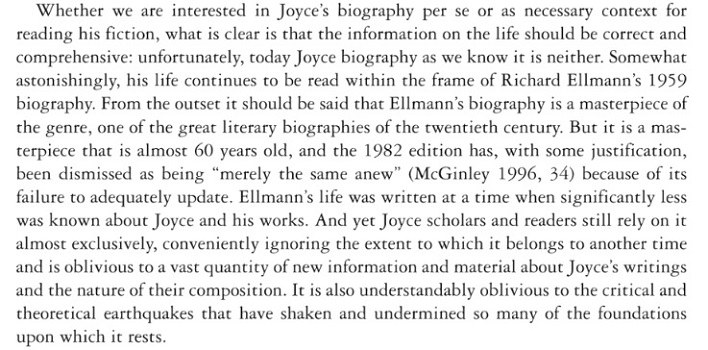 |
| —McCourt, op. cit., 2018, p.532; available at Google Books - online; accessed 25.11.2021. |
[ top ]
Quotations
For extensive quotations from Ellmann’s lives of Yeats, Joyce and Wilde, see Commentary under these authors.
Ah, Ireland!: Ellmann writes of Wilde, Yeats, Joyce and Beckett that their work shares with their island a struggle for autonomy and a disdain for outside authorities. (Quoted in Paul Hyland & Neil Sammells, eds., Irish Writing: Exile and Subversion, London: Macmillan 1991, p.xiii.)
Patricide: ‘From the Urals to Donegal the theme recurs, in Turgenev, in Samuel Butler, in Gosse. It is especially prominent in Ireland. George Moore, in his Confessions of a Young Man, blatantly proclaims his sense of liberation and relief when his father died. Synge makes an attempted patricide the theme of his Playboy of the Western World. James Joyce describes in Ulysses how Stephen Dedalus, disowning his own parent, searches for another father [...] Yeats, after handling the subject in an unpublished play written in 1884, returns to it in 1892 in a poem “The Death of Cuchulain”, turns the same story into a play in 1903, makes two translations of Oedipus Rex, the first in 1912, the second in 1927, and writes another play involving parricide, Purgatory, shortly before his death.’ (Yeats: The Man and the Masks [1988 Edn.]; quoted in Colm Tóibín, ‘W. B. Yeats: New Ways to Kill Your Father’, in New Ways to Kill Your Mother: Writers and Their Families, London: Viking 2012, pp.33-34.)
| On David Hume - in connection with the “Proteus” episode of Ulysses:— |
Hume was the master of those who do not know. Hume is not prepared to assert, as Stephen is, that the soul is the form of forms, and instead declares that questions about the soul’s essence, such as its degree of materiality, are unintelligible. Although he agrees with Aristotle, and Stephen, that memory is a source of personal identity, he insists that “all the nice and subtle questions concerning personal identity can never possibly be decided, and are to be regarded rather as grammatical than as philosophical difficulties.” [Hume, Treatise of Human Nature, ed. L. A. Selby-Bigge, Oxford 1972, p.262.] Against Stephen’s theory of persons and things having each its signature, Hume refuses to concede uninterrupted identity. |
| —Ellmann, Ulysses on the the Liffey (Faber 1973), p.93; quoted in Fran O’Rourke, Joyce, Aristotle, and Aquinas (Florida UP 2022), p.122. |
[ top ]
Notes
Modern Ireland: Ellmann believed that the modern Irish state stood in a direct line of descent from the Michael Cusacks of this world and went so far as to describe the men and women who fought for Irish independence in 1916-21 as exemplars of those traits least like the humane and liberal qualities epitomised by Bloom. (Ellmann’s wartime service in the US Navy did not, of course, count as ‘physical force’ in the pertinent sense) [BS, ‘James Joyce After Theory’ - JJIS International Symposium - Tours 2008.]
Familism? In the first sentence of James Joyce (1957), Ellmann misquotes Joyce’s account of Stephen Dedalus’s flight from the nets of language, nationality and religion as “family [... &c.]” Tellingly, because the idea of Joyce as rebel, exile and prime exponent of Western-liberal individualism has trumped the role of language in Irish cultural history at the period in question. Whether Joyce meant to refer to the Irish Language Revival movement is another question .... [BS]
Definitive Portrait?: Chester G. Anderson contributed ‘About this Text’ as a foreword (pp.ix-x) to R. B. Kershner’s edition of A Portrait of the Artist as a Young Man (Boston: Bedford Books 1993), being an account of his preparation of the definitive edition of 1964, and Richard Ellmann’s ‘veto’ on some of the corrections he suggested. (Cited in Jeri Johnson, ed. A Portrait of the Artist as a Young Man (Oxford: World Classics 2000), p.xliii.
[ top ]