       |
Life
| 1814-1845 [Thomas Osborne Davis]; b. 24 Oct. 1814 [gravestone inscription; 14 Oct., err. acc. C. G. Duffy], Mallow, Co. Cork, posthumous son of a British army surgeon (John Thomas Davis; Royal Artillery) and Mary Atkins, of Firville, Co. Cork [Cromwellian extraction with O’Sullivan Beare forebears], his father dying en route to the Peninsular War but previously in charge of the Ordnance Hospital, Islandbridge, Dublin; his mother moved the family to Dublin in 1818 and settled at Warrington Place; Davis eas educated with Catholics of his own class; moved to No. 61 [now 67] Lwr. Baggot St., 1830, where he remained afterwards; grad. TCD, BA, 16 Feb. 1836; encouraged in a patriotic view by Thomas Wallis, a TCD ‘grinder’; kept law terms in London, 1837-38, and called to the bar there, 1838; returned to Dublin and involved himself with the Historical Society [the “Hist”] of TCD, then being extra-mural; addressed the Society on the Cromwellian and Williamite periods, striking a new nationalist tone in appeals to the honour and intelligence of his audience and citing Lessing and Herder on the relation between culture and independent nationality, characterising Swift, Lucas, and Grattan as ‘mind-chieftains’; issued The Reform of the Lords, by a graduate of Dublin University (1837); | 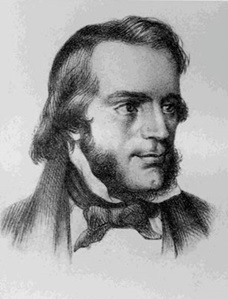 |
| attracted attention of Daniel Owen Maddyn, a life-long friend; received society medals; grad. with poor degree, 1836; lived on small inheritance; issued The Reform of the Lords, by a graduate of the Dublin University (1837), pamphlet; gave paper entitled “On the Constitutions of England and America” at the - by then reformed - Hist. (29 June 1839); gave his last paper as President of the Hist, “On the Utility of Debating Societies in Remedying the Defects of a University Education” (June 1840), in which the famous sentence ‘Gentlemen, you have a country’ and sundry apothegms [viz., ‘regenerate Ireland’; ‘patriotism is human philanthropy’; ‘the man who now avoids his citizenship has no defence but imbecility’]; sent copies of the paper to Wordsworth and Landor; contributed to the Citizen (1839-41) articles such as “Udalism and Feudalism”, a history of European land tenure with special application to Ireland, as well as “The Irish Parliament of James II” - called by Lecky the best treatment of the subject; joined Repeal Association; sub-ed., with John Blake Dillon and Charles Gavan Duffy, Dublin Morning Register, under editorship of Michael Staunton, 1840; | |
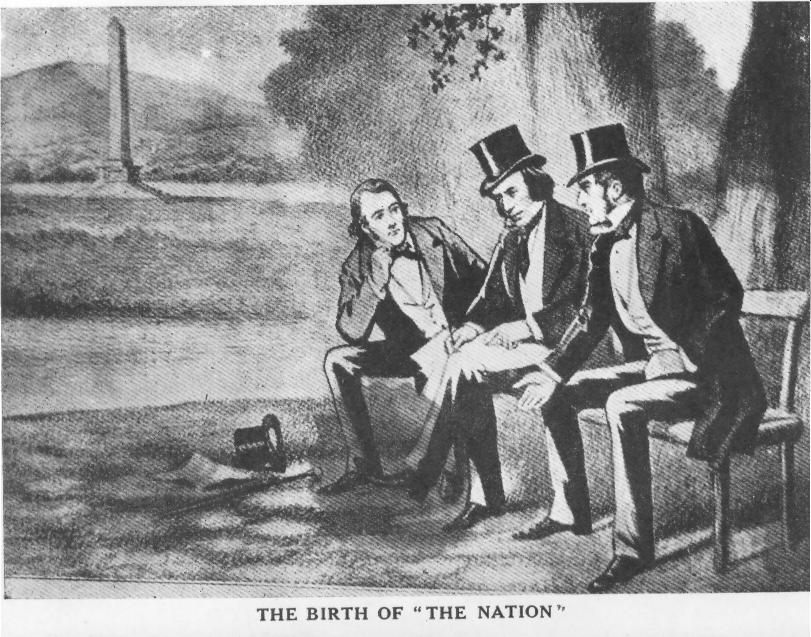
| co-fnd., with Duffy and Dillon, The Nation, first issue appearing on [Sat.] 15 Oct. 1842, over the banner ‘to create and foster public opinion, and make it racy of the soil’, initially selling at 4d. rising to 6d by 1846; Davis wrote up to 15,000 words a week in the form of articles and verses, and more than 200 reviews; his earliest printed poem printed over the pseud. “A True Celt”, appeared in the third issue; “Our National Language” pub. Nation (1 April 1843); articles on “The Patriot Parliament of 1689”, later reprinted by Charles Gavan Duffy in the New Irish Library (1893), and called by Lecky ‘by far the best and fullest account’; railed increasingly against England’s ‘tottering and cruel empire’ in prose and verse when O’Connell was imprisoned in Richmond Bridewell; established the Young Ireland party, May 1845, differing from O’Connell over the non-denominational education, which Davis consistently supported for the sake of an Ireland ‘whose peculiar curse was religious dissension’; engaged to Anne Hutton (sometimes called a ‘thwarted love affair’); d. 16 Sept. [aetat. 31], of scarlatina fever, at his home, 67 Baggot St., bur. Mount Jerome Cem., Rathfarnham - where a monument by John Hogan was erected; called by Gavan Duffy ‘the best man I have ever known’; he coined the phrase ‘moral force’ in its Irish context - disintinguishing it from physical force - though later arrograged by Patrick Pearse as a prophet of physical force republicanism; | |
| his best-known poems incl. “A Nation Once Again”; “A Song for the Irish Militia”; “The West’s Asleep”; “Fontenoy”; “Lament for the Death of Owen Roe [O’Neill]”; “Clare’s Dragoons”; “My Land”; Letters of A Protestant on Repeal, edited posthumously by Thomas Francis Meagher (1847) [var. 1846]; many items from his pamphlet collection on Irish commerce were acquired for the collection at Marsh’s Library; there is a portrait by Henry MacManus and a pencil sketch from memory by Frederick Burton (almost certainly copied from a daguerreotype of the 1840s); the modern statue on the former site of William III’s equestrian figure at College Green by Edward Delaney does not attempt a likeness; the Thomas Davis Lectures have been transmitted annually on RTÉ since 1953, followed by a printed outcome published by Mercier Press; Davis advocated a foreign policy for Ireland and the reform of House of Lords; he objected to an attempt to run a road through Newgrange; Davis lived at 67 Baggot St., Dublin. CAB ODNB JMC ODQ TAY MKA DIB DIW DIH RAF FDA OCIL WJM | |
[ top ]
Works| Contemporary publications |
|
|
| [ top ] |
| Posthumous editions |
|
| [ top ] |
Bibliographical details
Thomas Wallis, ed. & intro., National and Historical Ballads: Songs and Poems by Thomas Davis (Dublin: James Duffy 1846; reps. 1869; new & rev. edn. 1876), 254pp. CONTENTS: 1. National Ballads and Songs; 1. Miscellaneous Songs and Ballads; 3. Historical Songs and Ballads; 4. Do., 2nd ser.; 5. Miscellaneous Poems [contains “Orange and Green”, p.54; “The Banks of the Lee”, p.66; “The Welcome”, p.74; “A Nation Once Again”, p.93, &c.; also ‘Prose Extracts on Irish Nationality’.]
National and historical ballads, songs, and poems.
by Thomas Osborne Davis, A new and rev. edn. ...
Published: 1869, J. Duffy (Dublin [etc.])
Contributions: Wallis, Thomas, d. 1865- edn.
Series: Duffy’s national library
Pagination: x, [11]-254pp.
Subject: Ireland - Politics and government
Available at Internet ArchiveC
L
A
R
E
L
I
B[ Copy held in UCLA ] [Charles Gavan Duffy,] Literary and Historical Essays, by Thomas Davis (Dublin: James Duffy 1846),252pp. [epigraph:] “Tainig anam na hEirinn / A Soul Came into Ireland”, ded to John B. Dillon, ‘his dear and trusted friend and mine. The Editor.’ - i.e., C. G. Duffy]; Pref. [vii]-x [C.G.D; Christmas Eve, 1845; available at Google Books - online; accessed 14.09.2024.] CONTENTS: Dedication iii; Preface v; Study [13]; Means and Ends of Self-Education, 21;The History of Ireland [28]; Ancient Ireland [39]; Historical Monuments of Ireland [43]; Irish Antiquities [46]; The Sea Kings [54]; The Round Towers of Ireland [review of Petrie [Eccles. Arch. [1845] [62 - see copy as attached]; Ethnology of the Irish Race [80]; The Irish Brigade [89]; The Speeches of Grattan [94]; Memorials of Wexford [104]; The Valuation of Ireland [134]; The Commercial History of Ireland [147]; National Art [153]; Art Unions [162]; Illustrations of Ireland [165]; Hints for Irish Historical Paintings [169]; Our National Language [173]; O’Donovan’s Irish Grammar [183]; Institutions of Dublin [187]; Ireland’s People [Lords [Gentry [- Commonaliy [198]; The State of the Peasantry [204]; Habits and Character of the Peasantry [208]; Irish Scenery [210]; Irish Music and Poetry [216]; ABallad Poetry of Ireland [220]; A Ballad History of Ireland [231]; Repeal Reading Rooms [241; Influence of Education [246. [End.]
The Prose Writings of Thomas Davis, edited, with an introduction by T. W. Rolleston [The Scott Library, 51; Camelot Ser., ed. Ernest Rhys] (London: Walter Scott n.d. [1890]), xiv, 285pp. CONTENTS: Thomas Davis [vii-xiv; signed Dublin, 1889]; An Address delivered before the Historical Society, Dublin [1]; Udalism and Feudalism [44]. Literary and Historical Essays: Ancient Ireland [76]; Historical Monuments of Ireland [80]; Irish Antiquities [83]; THE Round Towers of Ireland [90]; The Irish Brigade [I04]; The Speeches of Grattan [I08]; Memorials of Wexford [116]; The History of To-Day [119]; The Resources of Ireland [123]; The Valuation of Ireland [130]; Commercial History of Ireland [141]; National Art [146]; Art Unions [153]; Hints For Irish Historical Paintings [155]; Our National Language [158]; Institutions of Ireland [166]; Ireland’s People, Lords, Gentry, Commonalty [174]; The State of the Peasantry [179]; Habits and Character of the Peasantry [182]; Irish Scenery [184]; Irish Music and Poetry [188]; Ballad Poetry of Ireland [192]; A Ballad History of Ireland [201]; Repeal Reading-Rooms [208]; Influences of Education [212]; Foreign Travel [217]; “The Library of Ireland” [223]; A Chronology of Ireland [228]; Political Articles: No Redress - No Inquiry [236]; The Right Road [241]; Foreign Policy and Foreign Information [245]; Moral Force [250]; Conciliation [254]; Scolding Mobs [258]; Munster Outrages [260]; A Second Year’s Work [265]; Orange And Green [270]; Academical Education [273]; Maxims and Reflections [280]
Essays Literary and Historical by Thomas Davis [?another edn.] (Dundalk: Tempest 1914). CONTENTS: ‘Udalism and Feudalism’ ([1841]), [52-90]; ‘Self-Education’ [90-96]; ‘Our National Language I’ [97-102]; ‘Our National Language II’ [102-07]; ‘Absenteeism of Irish Genius’ [108-11]; ‘National Art I’ [119-23]; ‘Irish Topography’ [129-39]; ‘Art Unions’ [140-43]; ‘The Sea Kings’ [144-51]; ‘Irish Music and Poetry’ [160-63]; ‘Irish Antiquities and Irish Savages’ [167-72]; ‘Ireland’s People’ [173-78]; ‘The Valuation of Ireland’ [179-191]; ‘Irish Scenery’ [192-96]; ‘Old Ireland’ [197-201]; ‘A Ballad History of Ireland’ [240-48]; ‘A Chronology of Ireland’ [249-55]; ‘Foreign Travel’ [207-13]; ‘The Speeches of Grattan’ [291-300]; ‘The Round Towers of Ireland’ [312-328]; ‘Institutions of Dublin’ [329-39]; ‘The State of the Peasantry’ [340-43]; ‘The Irish Brigade’ [344-48]; ‘“The Library of Ireland”’ [349-55]; ‘The Irish Peasantry’ [356-58]; ‘Wexford’ [362-65]; ‘Ballad Poetry of Ireland’ [366-76]; ‘The History of Ireland’ [381-85]; ‘Commercial History of Ireland’ [386-391.
New edition as Selections.
Thomas Davis: Selections from His Prose and Poetry, ed. & intro., T. W. Rolleston [Every Irishman’s Library] (London & Leipzig: T. Fisher Unwin 1910; Dublin: Talbot Press 1910, London: Gresham Publ. Co. 1914), x, 367pp.; Do. (N: AMS 1982), xiv, 367pp. [being a reprint of the 1914 ‘first’ Edn. with altered trim and text area - online] CONTENTS: ‘The Irish Parliament of James II’, pp.1-73; [....;] ‘Hints for Irish Historical Paintings’, pp.112-15; ‘The History of To-day’, pp.134-38; ‘The Resources of Ireland’, pp.139-45; ‘The Songs of Ireland’, pp.225-31; ‘Influences of Education’, pp.232-36; ‘No Redress - No Inquiry’, pp.257-61; ‘Foreign Policy and Foreign Information’, pp.266-70; ‘Moral Force’, pp.271-74; ‘Conciliation’, pp.275-78; ‘Scolding Mobs’, pp.279-80; ‘Munster Outrages’, pp.281-85; ‘ A Second Year’s Work’, pp.286-90; ‘Orange and Green’, pp.291-93; ‘The Right Road’, pp.[292-300] Academical Education’, pp.294-301. Poetry incls. ‘The Geraldines” (p.306-08 - as infra.) [So listed by CURIA in March 1999 [with lacunae as here.]
Do., as Thomas Davis, Selections from His Prose and Poetry, intro. by T. W. Rolleston [The Library of irish Literature] (NY: Frederick A. Stokes Company [1915]) [available at Gutenberg Project - online; Essays and Poems on cover and spine]. The digital edition has no table of contents but includes the same selection of prose and poetry as the Talbot/Unwin edition ofo 1910 above. edition Also available at RICORSO in Word through links as below:—
Intro. & Notes Irish Parl. (1689) Literary & Historical Political Articles Poems of T. D.
[ Available as text at Gutenberg Project[online] or RiCORSO [as attached]
[ top ]
Criticism
|
|
Bibliographigal details
Charles Gavan Duffy, Short Life of Thomas Davis 1840-46 [New Irish Library ser.] (London: T. Fisher Unwin Dublin: Sealy, Bryers & Walker 1895), 250pp. [+12 unnum. with notices of The Story of the Early Gaelic League, by Douglas Hyde, and A Final Edition of Young Ireland: A Fragment of irish History 1842-1846, b C. G. Duffy (with copious review notices on each)].
CONTENTS [Chaps.]: 1. The Student. 1831-38 [1]; II. The Thinker. 1839, 1840 [21]; III. The Politician. 1841, 1842 []; IV. The Journalist. 1842 [69]; V. The Recreations of a Patriot. 1843 [125]; VI. The Statesman. 1844 [162]; VII. Conflicts with O’;Connell. 1845 [180]; VIII. A New Departure. 1845 [227]; Death of Thomas Davis. 1845 [238]. (Available at Internet Archive - online.)
[ top ]
Quotations| Poetry | Prose |
“Lament for the Death of Owen Roe O’Neill: ‘“Did they dare, did they dare, to slay Owen Roe O’Neill?” / “Yes, they slew with poison him, they feared to meet with steel.” / May god wither up their hearts! may their blood cease to flow! / May they walk in living death, who poisoned Owen Roe! / … / “We thought you would not die - we were sure you would not go, / And leave us in our utmost need to Cromwell’s cruel blow - / Sheep without a shepherd, when the snow shuts out the sky - / Oh! why did you leave us, Owen? Why did you die?” [… &c.]’ (See parody by James Joyce, in Notes, infra.)
“Celts and Saxons”: ‘We hate the Saxon and the Dane, / We hate the Norman men - / We curs’d their greed for blood and gain, / We curse them now again. / yet start not, Irish born man, / If you’re to Ireland true, / we heed not blood, nor creed, nor clan - / We have no curse for you. // We have no curse for you or yours, / But Friendship’s ready grasp, / And faith to stand by you and yours, / Unto our latest gasp - / To stand by you against all foes, / Howe’er or whence they come, / With traitor’s arts, or bribes or blows, / From England, France, or Rome. // What matter that at different shrines / We pray unto one God / What matter that at different times / Our fathers won this sod / In fortune and in name we’re bound. / By stronger links than steel / And neither can be safe nor sound / But in the other’s weal. // As Nubian rocks, and Ethiop sand / Long drifting down the Nile, / Built up old Egypt’s fertile land / For many a hundred mile; / So Pagan clans to Ireland came, / And clans of Christendom, / Yet joined their wisdom and their fame / To build a nation from. // Here came the brown Phoenician, / The man of trade and toil / Here came the proud Milesian, / Ahungering for spoil; / And the Firbolg and the Cymry, / And the hard, enduring Dane, / And the iron Lords of Normandy, / With the Saxons in their train. // And oh! it were a gallant deed / To show before mankind, / How every race and every creed / Might be by love combined / Might be combined, yet not forget / The fountains whence they rose, / As, filled by many a rivulet / The stately Síonainn [Shannon] flows. // Nor would we wreak our ancient feud / On Belgian or on Dane, / Nor visit in a hostile mood / The hearths of Gaul or Spain; / But long as on our country lies / The Anglo-Norman yoke, / Their tyranny we’ll signalize, / And God’s revenge invoke. // We do not hate, we never curs’d, / Nor spoke a foeman’s word / Against a man in Ireland nurs’d, / Howe’er we thought he err’d; So start not, Irish born man, / If you’re to Ireland true, / We heed not race, nor creed, nor clan, / We’ve hearts and hands for you.’ [Available at CELT - online.]
“The West’s Asleep”: ‘When all beside a vigil keep, / The West’s asleep, the West’s asleep. / Alas! and well may Erin weep, / When Connaught lies in slumber deep. / There lake and plain smile fair and free, / ’Mid rocks - their guardian chivalry // Sing oh! let man learn liberty / From crashing wind and lashing sea. // That chainless wave and lovely land / Freedom and Nationhood demand / Be sure, the great God never plann’d, / For slumbering slaves, a home so grand. // And, long, a brave and haughty race / Honoured and sentinelled the place / Sing oh! not even their sons’ disgrace / Can quite destroy their glory’s trace. // For often, in O’Connor’s van, / To triumph dash’d each Connaught clan - / And fleet as deer the Normans ran / Through Coirrslabh Pass and Ard Rathain. / And later times saw deeds as brave; And glory guards Clanricarde’s grave - / Sing, oh! they died their land to save, / At Aughrim’s slopes and Shannon’s wave. // And if, when all a vigil keep, / The West’s asleep, the West’s asleep - / Alas! and well may Erin weep, / That Connaught lies in slumber deep. / But - hark! - some voice like thunder spake: “The West’s awake, the West’s awake” / Sing, oh! hurra! let England quake, / We’ll watch till death for Erin’s sake!’
“A Nation Once Again”: ‘When boyhood’s fire was in my blood, / I read of ancient freemen, / For Greece and Rome who bravely stood, / Three Hundred men and Three men. / And then I prayed I yet might see / Our fetters rent in twain, / And Ireland, long a province, be / A Nation once again. // And, from that time, through wildest woe, / That hope has shone, a far light; / Nor could love’s brightest summer glow / Outshine that solemn starlight: / It seemed to watch above my head / In forum, field and fane; / Its angel voice sang round my bed, / “A Nation once again.” // It whispered, too, that “freedom’s ark / And service high and holy, / Would be profaned by feelings dark, / And passions vain or lowly; / For freedom comes from God’s right hand, / And needs a godly train; / And righteous men must make our land / A Nation once again.” // So, as I grew from boy to man, / I bent me to that bidding - / My spirit of each selfish plan / And cruel passion ridding; / For, thus I hoped some day to aid - / Oh! can such hope be vain? / When my dear country shall be made / A Nation once again.’
“My Land”: ‘She is a rich and rare land, / Oh she’s a fresh and fair land; / She is a dear and rare land, / This native land of mine. // No men than hers are braver, / Her women’s hearts ne’er waver; / I’d freely die to save her, / And think my lot divine. // She’s not a dull or cold land, / No, she’s a warm and bold land, / Oh, she’s a true and old land, / This native land of mine. // Could beauty ever guard her, / And virtue still reward her, / No foe would cross her border - / No friend within it pine. // Oh, she’s a fresh and fair land, / Oh, she’s a true and rare land; / Yes she’s a rare and fair land, / This native land of mine.’
|
||||
“Song of the Volunteers of 1782”: ‘[…] Bless Harry Flood, who nobly stood / By us, through gloomy years, / Bless Charlemont, the brave and good, / The chief of the Volunteers! / The North began; the North held on / The strife for native land! / Till Ireland rose, and cow’d her foes - / God bless the Northern Land! [… &c.]’
[ top ]
“The Geraldines ”: ‘When Ginckle ’leagured Limerick, the Irish soldiers gazed / To see if in the setting sun dead Desmond’s banner blazed! / And still it is the peasant’s hope upon the Curragh’s mere, / “They live who’ll see ten thousand men with good Lord Edward here.” / So let them dream till brighter days when, not by Edward’s shade, / But by some leader true as he their lines shall be arrayed!’ (Quoted in Daithí Ó hÓgáin, The Hero in Irish Folk History, Dublin: Gill & Macmillan 1985, p.317; see also under Theobald Wolfe Tone, infra.)
| The Geraldines | |
|
The Geraldines! The Geraldines! - ’tis full a thousand years The Geraldines! The Geraldines! - ’tis true, in Strongbow’s van, These Geraldines! These Geraldines! - not long our air they breathed; Ye Geraldines! ye Geraldines! - How royally ye reigned |
Ye Geraldines! ye Geraldines! - since Silken Thomas flung True Geraldines! Brave Geraldines! - as torrents mould the earth, These Geraldines! These Geraldines! - rain wears away the rock The Geraldines! the Geraldines! - and are there any fears |
From Thomas Davis: Selections from his Prose and Poetry, ed., with an introduction by T. W. Rolleston [Every Irishman’s Library] (London & Leipzig: T. Fisher Unwin 1910; rep. Dublin: Talbot Press, 1914), p.306-08; available at CELT - online; accessed 02.02.2102. |
|
| Note: Some stanzas of the above poem appear in an article entitled “The Earls of Desmond” in Kerry Archaeological Magazine, 3, 16 (April 1916), pp.260-70 with the prefatory note: ‘Up to near the close of the last century, whilst poetry continued a more popular element in Irish life than it now forms, Thomas Davis’s lines on “The Geraldines”, of which some stanzas are given above [i.e., those including the terms venison and decline]. were familiar to a large number of people who would otherwise have known nothing as to [...’; see seq. op. cit., available at JSTOR Ireland - online] | |
[ top ]
|
||||||
[ top ]
| Poetry | Prose |
| “On the Utility of Debating Societies in Remedying the Defects of a University Education” (June 1840) |
| ‘Gentlemen, you have a country. The people among whom we were born, with whom we live, for whom, if our minds are in health, we have most sympathy, are those over whom we have power - power to make them wise, great, good. Reason points out our native land as the field of our exertion - the country of our birth, our education, of our recollections, ancestral, personal, national; the country of our loves, our friendships, our hopes; our country; the cosmopolite is unnatural, base - Patriotism is human Philanthropy.’ |
| § |
|
| § |
| ‘The people are pressing on a career certain of sweeping away every law and custom which impedes their physical comfort, though in doing so they may overthrow some of the barriers which protect their morals, and therefore guard their happiness.’ |
| § |
|
| § |
| ‘How long will you sin against patriotism? Let no one dare to call me factious for bidding you to act in union with other men, be they of what party they may, for our common country.’ |
| § |
—The foregoing all quoted in Helen E. Mulvey, Thomas Davis and Ireland: A Biographical Sketch (Washington: CUA Press 2002), pp.33-36 [Available at Google Books - online]. |
[ top ]
‘The Young Irishman of the Middle Classes’, a paper given at the TCD Historical Society, 1839; and reprinted in three instalments in The Nation (1848)*| Davis makes allusion herein to figures of Irish history and literature incl. - |
|
|
|
|
|
|
|
|
|
|
*Properly An Address Delivered Before the Historical Society, Dublin", it was his parting speech as Presidenf to the Hist. It included the minatory words:
|
| Rep. in Rolleston, The Prose Writings of Thomas Davis (London: Walter Scott 1890), “Address [... &c.]”, pp.1-43; pp.6-7 - available online; accessed 15.09.2024. |
[ top ]
The Nation, Prospectus [written by Thomas Davis]: ‘… The necessities of the country seem to demand a Journal able to aid and organise the new movements going on amongst us - to make their growth deeper, and their fruit “;more racy of the soil” - and, above all, to direct the popular mind and the sympathies of educated men of all parties to the great end of nationality. Such a Journal should be free from the quarrels, the interests, the wrongs, and even the gratitude of the past. It should be free to apply its strength where it deems best - free to praise - free to censure; unshackled by sect or party; able, Irish, and independent [...] Nationality is their first object - a nationality which will not only raise our people from their poverty, by securing to them the blessings of a domestic legislature, but inflame and purify them with a lofty and heroic love of country - a nationality of the spirit as well as the letter - a nationality which may come to be stamped upon our manners, our literature, and our deeds - a nationality which may embrace Protestant, Catholic, and Dissenter, Milesian and Cromwellian, the Irishman of a hundred generations, and the stranger who is within our gates; not a nationality which would preclude civil war, but which would establish internal union and external independence - a nationality which would be recognised by the world, and sanctified by wisdom, virtue, and time.&146; (22 July 1842; anticipating publication on 15 Oct. 1842; for longer extract - see attached.)
Ballad History of Ireland: ‘Exact dates, subtle plots, minute connections and motives rarely appear in Ballads, and for these ends the worst prose history is superior to the best ballad series; but these are not the highest ends of history. To hallow or accurse the scenes of glory and honour, or of shame and sorrow; to give to the imagination the arms, and homes, and senates, and battles of other days; to rouse, and soften, and strengthen, and enlarge us with the passions of great periods; to lead us into love of self-denial, of justice, of beauty, of valour, of generous life and proud death; and to set up in our souls the memory of great men, who shall then be as models and judges of our actions - these are the highest duties of history, and these are best taught by a Ballad History?’ (Quoted in Joep Leerssen, Remembrance and Imagination [..., &c.], Cork UP/Field Day 1996, p.150.)
Note: Leerssen stresses the exchange of Lessing’s Nacheinander for Nebeneinander [succession for side-by-side] in the ahistorical tableau effect produced and writes that "The Nation was to take up Davis’s call for such an appealing cinemascope approach, especially in the radicalized climate of the post-Famine years, following the split over the university colleges." (Idem.)
The Nation and the Famine (June 1845): In June 1845, a leading article in The Nation described England as ‘a country which filled our soul with martyrs, and our statue-book with penal laws - which, finding the persecution of the sword insufficient, created famine by an elaborate process of desolation for the avowed purpose of exterminating us.’ (South Dublin Libraries - Local Studies - online; accessed 16.09.2024.)
Irish art: ‘Make Ireland a nation and you will do more for national art than if you mortgaged your estates for pictures and turned your own halls into drawing school. Make Ireland a nation and the Irish artist will feel himself a partner in your toils, your ambition and your renown; he will be nourished upon great sights and thoughts of liberated people - he will be surrounded by men vying in nationality and worshipful of national genius. He will dedicate that genius to honour the influence that inspired it. (quoted in The Dublin Magazine, Spring 1966, with remarks, alas for Davis’s hopes! … from the cultural point of view Ireland is a disgrace. ’ (p.5).
Anglicanism/Utiliarianism: ‘Modern Anglicanism, i.e., Utilitarianism, the creed of Russell and Peel, as well as of the Radicals - this thing, call it Yankeeisrn or Englishism, which measures prosperity by exchangeable value, measures duty by gain, and limits desire to clothes, food, and respectability; this damned thing has come into Ireland under the Whigs, and equally the favourite of the “Peel” Tories.’ (Quoted in Sir Charles Gavan Duffy, Young Ireland, 1884 edn., pp.110-11; cited in D. George Boyce, Nationalism in Ireland, London: Routledge 1982, p.155; see also Richards and Cairns, supra.)
Anglos & Scots: ‘The Anglo-Irish and Scottish Ulsterman have now far too old a title to be questioned: they were a hardy race, and fought stoutly for the pleasant valleys they dwell in […] A deep enough root these planters have struck into the soil of Ulster, and it would now be ill-striving to unplant them.’ (Quoted in T. W. Moody, Thomas Davis, 1945, p.55, n.93; cited Boyce, op. cit., 1982, p.386.)
Truly colonial: ‘It was not till very lately that the part of the nation which is truly colonial, reflected that though their ancestors had been victorious, they themselves were now included in the general subjection; subduing only to be subdued, and trampled upon by Britain as a servile dependency. When therefore the Protestant began to suffer what the Catholics had suffered; when from serving as the instruments they were made themselves the objects of foreign domination, then they became conscious they had a country - Ireland. They resisted British domination, renounced colonial subserviency and […] asserted the exclusive jurisdiction of this Island.’ (Proceedings of the Society of United Irishmen of Dublin, 1792; quoted by Richard Kearney, ‘Irish Heritage in the French Revolution: The Rights of The People and The Rights of Man’, in Ireland and France, A Bountiful Friendship, Essays in Honour of Patrick Rafroidi, ed. Barbara Hayley & Christopher Murray, Gerrards Cross: Colin Smythe 1992, pp.34.)
Old brawls: ‘Surely our Protestant brethren cannot shut their eyes to the honour it would confer on them and us if we gave up old brawls and bitterness, and came together in love like Christians, in feeling like countrymen, in policy like men having common interests. Can they - ah! tell us, dear countrymen! – can you harden your hearts at the thought of looking on Irishmen joined in commerce, agriculture, art, justice, government, wealth and glory!’ (Davis, in The Nation; cited in John Neylon Molony, A Soul Came into Ireland, Thomas Davis 1814-1845 (Geography Publ. 1995)
No sandbank: ‘This country of ours is no sandbank thrown up by some recent caprice of earth. It is an ancient land, honoured in the archives of civilisation, traceable into antiquity by its piety, its valour, and its sufferings. Every great European race has sent its stream to the rivers of the Irish mind. Long wars, vast organisations, subtle codes, beacon crimes, leading virtues, and self-mighty men were here. If we live influenced by wind, and sun, and tree, and not by the passions and deeds of the past, we are a thriftless and hopeless people.’ (Cited as epigraph in Thomas J. M. Johnstone, Where the Foxglove Glows, Belfast: Quota Press 1946).
Nationality: ‘The elements of Irish nationality are not only combining - in fact, they are growing confluent in our minds. Such nationality as merits a good man’s help and wakens a true man’s ambition - such nationality as could stand against internal faction and foreign intrigue - such nationality as would make the Irish hearth happy and the Irish name illustrious, is becoming understood. It must contain and represent the races of Ireland. It must not be Celtic, it must not be Saxon - it must be Irish. The Brehon law and the maxims of Westminster, the cloudy and lightning genius of the Gael, the placid strength of the Sassanach, the marshalling insight of the Norman - a literature which shall exhibit in combination the passions and idioms of all, and which shall equally express our mind in its romantic, its religious, its forensic, and its practical tendencies - finally, a native government, which shall know and rule by the might and right of all; yet yield to the arrogance of none - these are components of such a nationality.” (Thomas Davis: Selections from His Prose and Poetry [Every Irishman’s Library], London: T. Fisher Unwin 1914, p.210f.; quoted in quoted in Norreys Jephson O’Conor, Changing Ireland: Literary Backgrounds of the Irish Free State, 1889-1922, Harvard UP 1924, p.67.)
Irish historical novels: ‘I wish to heaven someone would attempt Irish historical fiction.’ (Quoted in Malcolm Brown, The Politics of Irish Literature, From Thomas Davis to W. B. Yeats, London: Allen & Unwin 1972, p.65; see also James Cahalan, Irish Historical Novel, 1983, p.75.)
[ top ]
Navigation acts: ‘Before this generation dies, it must have made Ireland’s rivers navigable and its hundred harbours secure with beacon and pier, and thronged with seamen educated in navla schools, and familiar with every rig and every ocean. Arigna must be pierced with shafts, and Bonmahon flaming with smelting-houses. Our bogs must have become turf factories […]. Our coal must move a thousand engines, our rivers a thousand wheels. (Davis, c.1845; cited in Cormac Ó Grada, Ireland: A New Economic History, 1994 [p. edn. 1995], p.273.)
‘Our National Language’, The Nation (1 April 1843): ‘To impose another language on such a people is to send their history adrift among the accidents of translation - ‘tis to tear their identity from all places - ‘tis to substitute arbitrary signs or picturesque and suggestive names - ‘tis to cut off the entail of feeling, and separate the people from their forefathers by a deep gulf - ‘tis to corrupt their very organs, and abridge their power of expression.’ (p.304; q. source.)
‘The Language of Ireland’: ‘A people without a language of its own is only half a nation. A nation should guard its language more than its territories - ‘tis a surer barrier and more important frontier, than fortress or river. […] To lose your native tongue, and learn that of an alien, it the worst badge of conquest. To have lost entirely the national language is death. […] the fetter has worn through.’ (In Arthur Griffith, ed., Thomas Davis - The Thinker and Teacher, Dublin 1914, p.55; quoted in Breda Dunne, An Intelligent Visitor’s Guide to the Irish, Mercier 1990; also in Essays and Poems with a Centenary Memoir, Dublin: Gill & Son 1945, p.71, cited in Joseph Lynch, MA Dip., UU 2003.)
‘The Language of Ireland’ (further): ‘Nothing can make us believe that it is natural or honourable for the Irish to speak the speech of the alien, the invader, the Sasanach tyrant, and to abandon the language of our kings and heroes […] But even should the effort to save it as a national language fail, by the attempt we will rescue its old literature, and hand down to our descendants proofs that we had a language as fit for love, and war, and business and pleasure as the world ever knew, and that we had not the spirit and nationality to preserve it.’ (Op. cit., 1945, p.73; quoted in Lynch op. cit., 2003.)
‘The Language of Ireland’: ‘If an attempt were made to introduce Irish, either through the national schools or courts of law, into the eastern side of the island, it would certainly fail, and the reaction might extinguish it all together […] it is quite another thing to say, as we do, that the Irish language should be cherished, taught and esteemed and that it can be preserved and gradually extended.’ (Ibid., p.74; Lynch 2003.)
| “The Round Towers of Ireland” [review of George Petrie, Ecclesiastical Architecture of Ireland], in The Nation (q.d., 1845), rep. in Literary and Philosophical Essays of Thomas Davis, ed. C. G. Duffy (Dublin: James Duffy 1846), pp.62-79. |
|
| See full version in RICORSO Library History - as attached. |
Absenteeism: ‘There is an absenteeism of Irish mind - a draining away of Ingenuity and Learning - an emigration of the wit, wisdom and power of our land constantly going on. This results from our dependence on England, our adaption of her language and Literature.’ ( Essays and Poems with a Centenary Memoir, Dublin: Gill & Son 1945, p.119; quoted in Joseph Lynch, MA Dip., UU 2003.)
|
||||||||||||||||||||||||||||||
|
||||||||||||||||||||||||||||||
[ top ]
Reference
Oxford Dictionary of Quotations selects two lines from “The Welcome” [‘Come in the evening, come in the mornin’, / Come when you’re looked for / Come without warning.’
Justin McCarthy, ed., Irish Literature (Washington: Catholic University of America 1904) gives extracts from Davis’s ballads and poems (pp.823-31). The introductor notice reads: ‘It is impossible to describe the poignancy of regret with which the news of this premature and sudden close to the career of such bright promise was received. Extreme as were the political opinions of Davis, they were free from the least suspicion of sectarianism; and this, together with the transparent purity of his motives and his splendid talents, made him admired by men of the most opposite principles. [...; here Daniel quotes O’Connell’s generous letter to the Association on hearing of his death:] “[...] He stood for Ireland - for all Ireland - as no other man did, and it was hardly possible to distinguish the cause from his personality.”’ [Available at Internet Archive - online.]
Rev. Patrick Walsh, ed., Songs of the Gael: A Collection of Anglo-Irish Songs [... &c.] (Dublin: Browne & Nolan 1922), gives "A Song for the Irish Volunteers" - altered from Militia and so-noted, pp.10-11; available at Internet Archive - online].
Seamus Deane, gen. ed., The Field Day Anthology of Irish Writing (Derry 1991), Vol. 1: Bibl., Speeches of John Philpot Curran (Duffy 1843; edn. enlarged 1845; 1861); Literary and Historical Essays, ed. Charles Gavan Duffy (Duffy 1846); The Poems of Thomas Davis, ed. Thomas Wallis (Duffy 1846); The Life of J. P. Curran (Duffy 1846); Letters of a Protestant, on Repeal (Irish Confederation 1847); T.W. Rolleston, ed, Prose Writings of Thomas Davis (London 1890). Biog., The Field Day Anthology of Irish Writing, 1991, Vol. 1, p.1299 [as in Life, supra].
Seamus Deane, gen. ed., The Field Day Anthology of Irish Writing (Derry 1991), Vol. 2 selects “Lament for Death of Owen Roe O’Neill”; “Song of the Volunteers of 1782” [see infra, quoted by Conor Cruise O’Brien]; “Nationality”; “Celts and Saxons“, “My Grave”; “The West’s Asleep” [50-51]. No BIOG marked in Index [ital.], but notes, among most important and worst of Irish poets [Seamus Deane, ed.], [1]; in his Short Life of Thomas Davis 1840-46 (1895), Charles Gavan Duffy tells us that Davis’s aims ‘were far away from literary success. All his labours tended only to stimulate and discipline people’ … produced nearly fifty ballads a year ‘used to say that, if he had his will, the songs of the Nation would be remembered in after times, and the authors quite forgotten ..’, [2]; Mangan takes Davis’s advice to look at the new Ordnance Survey map and identify the territories referred to in the Irish poems, [30]; Duffy, in Young Ireland, A Fragment of Irish History 1840-45 (1880), ‘..nearly all that will be permanently remembered of the labours and sufferings of the men who composed it were events accomplished after the death of Davis and the apparent rout and dispersion of his friends’; Yeats and O’Leary confirm his influence, but his nationalism ineffective against famine conditions [Deane, ed.], [117-18]; Davis’s questionable idea that protective tariffs would have saved Ireland from the worst effects of free trade [ed. remark; [119]; compared to Mitchel in terms of the vision of a ‘unique Irish destiny’ in a racist, British contest, [120]; Mitchel, The Last Conquest (1861), Chap. X: ‘Before the grave had yet closed on Thomas Davis [there] began to spread awful rumours of approaching famine’ (Davis d. 16 Sept. 1845), [178]; (in Davitt), [201]; (influence on O’Leary, ‘the fountain and the origin must always be sought in Davis’, [252, 253]; (Fr. Meehan, ed. Davis [n.d.], 267n). The title of Eoin MacNeill’s “The North Began” [1913] taken from Davis’s “Song of the Volunteers”, [286]; Pearse, ‘Mitchel’s gospel is part of the testament, even as Davis’s is’ (“The Sovereign People”, pamphlet of 1916), [294]; (reference to his Protestantism implied by Rolleston, 973); ‘.. the worthy Thomas Davis, who made a great, a noble, and an epoch-making effort to turn the national spirit in the direction of literature’ (Eglinton / Ryan, Dana 1904), [976]; Davis’s essay “The Irish Language’ appeared in 2 pts. in The Nation, 1 April & 30 Dec. 1843; Eoin MacNeill quotes from it the phrase a Nation should guard its language” in his article “Our Whig Inheritance”, in Ireland Today, Nov. 1936 (ed. comments that the phrase was not the beginning of the article as MacNeill claims; [981]; for Thomas MacDonagh, Davis was one of those without the ‘Irish accent of Ferguson’ (1916), [990], a political essayists [do.], [991]; John Eglinton, ‘The De-Davisisation of Irish Literature’ [995-97; see Eglinton, infra]; (cited in Dana 1904 by Ryan as English-speaking and no worse a nationalist for it, 999); (?Canon Sheehan, 1043). See also FDA3, 748: de Valera quotes Davis in his celebrated radio speech on Patrick’s Day, 1943 (‘athletic youths … and comely maidens, &c’), ‘Our young artisans must be familiar with the arts of design and the natural sciences connected with their trade; and so of our farmers; and both should, beside, have that general information which refines and expands the mind, that knowledge of Irish history and statistics that makes it national and those accomplishments and sports which make leisure profitable and home joyous. / Our cities must be stately with sculpture, pictures and buildings, and our fields glorious with peaceful abundance … to seek it is the solemn, unavoidable duty of every Irishman (Davis, ‘Foreign Travel’, The Nation 17 Aug. 1844). ‘Bibliography of Young Ireland’ in FDA2, incl. Thomas Davis and Young Ireland: A Selected Bibliography (Dublin Stat. Off., 1945); R. G. O’Sullivan, The Young Irelanders (1944); D[enis]. Gwynn, Young Ireland and 1848 (1948); R. Davis, The Young Ireland Movement (1987); J[ohn] Hutchinson, The Dynamics of Cultural Nationalism (1987); David Lloyd, Nationalism and Minor Literature (1987). Also (TCD address of 1839), ‘The cumbrous state of our literature renders a formal study of metaphysical and moral philosophy essential.’ [FDA1]
R. F. Foster, Modern Ireland (London: Allen Lane 1988), p. 311, bio-data: b. Mallow, Co. Cork, ed. TCD, Bar 1838; Repeal Assoc., 1840; co-fnd. Nation, 1842; leader of Young Ireland, 1842-45; stood up to O’Connell over the issue of non-denominational education; ballads ‘inspired the nationalism of Mitchel and secularised that of Duffy … the purest Irish patriot … ceaseless worker on committees and societies, incl. RIA.
De Burca Books (Cat. 44, 1997) lists T. F. O’Sullivan, The Young Irelanders (1944); Do., [2nd. Edn.] Thomas Davis Centenary Edn. (1945) [Hyland Oct. 1995; 219]. Thomas Davis: Essays and Poems with a Centenary Memoir 1845 1945. With a foreword by an Taoiseach, Eamon De Valera. Illustrated. Dublin Gill, 1945. Pages, ix, 240. V.good in frayed dj. [£30].
Belfast Public Library holds 12 titles including The Patriot Parliament of 1689 (1893). MORRIS holds Essays Literary and Historical (Dundalgan Press 1914).
[ top ]
Notes
Portraits [1]: An oil portrait of Davis by Henry MacManus, formerly owned by Charles Gavan Duffy and presented by George G. Duffy [with an inscription in Irish] is now held I the Young Ireland Gallery of Aras an Uachtaráin [see Catalogue of College Historical Pictures, &c. est. Douglas Hyde, 1944). Also Davis, by Frederick Burton, pencil, head looking left and head looking right, from memory, presented by the artist in 1872 [National Gallery of Ireland] (see Anne Crookshank, Irish Portraits Exhibition [Cat.] 1965.)
Portraits (2): There is a bust of Annie Hutton (1825-53) by Christopher Moore in the National Gallery of Ireland.
A life of Tone, projected by Davis for the Library of Ireland, to be published by Duffy, was never actually written; instead Carleton supplying Parra Sastha (1845) for the same series.
Arthur Griffith spoke of Davis in the treaty debate of 1921-22 as ‘the prophet I followed throughout all my life, the man whose words and teachings I tried to translate into practices and policies’. Quoted in Michael Tierney, Daniel O’Connell 12 Centenary Essays (Dublin: Browne & Nolan 1949), p.152.
Fintan Cullen, ed., Sources in Irish Art: A Reader (Cork UP 2000), contains Edmund Burke’s Philosophical Enquiry; Samuel Madden; Lady Morgan’s Life of Salvator Rosa; David Wilke’s letter from Ireland; Thomas Davis; George Petrie; W. B. Yeats; Elizabeth Thompson, Mainie Jellet, and others.
James Joyce: The plaintiff echo, ‘Shize? I should shee! Macool, Macool, orra whyi deed ye diie? […]’, which is attributed to ‘all the hoolivans of the nation’ in James Joyce’s Finnegans Wake (1939) [Bk. I.i; p.6] echoes the line ‘Oh! why did you leave us, Owen? Why did you die?” [… &c.]’, in “Lament for the Death of Owen Roe O’Neill” by Davis. [See under Quotations, supra.]
Language question: Davis’s views on the hierarchy and commensurability of language are derived from and comparable with those of among languages regarding Herder, Fichte, Hegel, the Grimms, and Goethe; see Grattan Fryer, Romantic Literature and the European Age of Revolutions, Renaissance and Modern Studies, Vol. 8 (1964), pp.53-74 (cited in Cairns & Richards, op. cit., 1988, p.44.)
W. B. Yeats, in Poetry and Ireland (with Lionel Johnson, 1908, p. 14), cannot resist ridiculing Davis for reciting before his death ‘one of the worst of the patriotic poems of Young Ireland’. (Cited in Ian Small, ‘Yeats and Johnson on the Limitations of Patriotic Art’, Studies, Vol. LXIII, 1974, pp.379-88.)[ top ]
W. E. H. Lecky wrote to Gavan Duffy that Davis never had an opportunity to sort out his thinking into an ordered body of writing (quoted in review of Helen Mulvey, Thomas Davis and Ireland, 2002, in Books Ireland, Sept. 2003, p.196.)
Stephen Brown, SJ. ed., Poetry of Irish History (enl. edn., M. J. Brown, Talbot 1927), refers to his intention as fulfilling Davis’s scheme for a Ballad History of Ireland, quoting Davis to that effect.
Winston Churchill quoted Davis in a wartime telegram to Eamon de Valera (as recounted by John A. Murphy): ‘In December 1941 came the American entry into the war with the Japanese attach on Pearl Harbour. It was the occasion of a characteristically melodramatic telegram from Churchill to de Valera: “Now or never. ‘A Nation Once Again’. Am very ready to meet you at any time.” The evocative middle phrase was not, it now appears from a recent clarification, a flambouyant promise of unity in return for abandonment of neutrality but rather an emotional appeal to Ireland to recover its lost soul by taking the side of the angels. In any case, it was treated by de Valera as a rhetorical flourish.’ (Murphy, Ireland in the Twentieth Century, Gill & Macmillan, 1975, 1989, p.105.)
Kith & kin?: Osborne is the family name of the Earls of Leeds.
Dwelling-place: In signing his introduction to the printed copy of "An Address Deleivered Before the Historical Society, Dublin", Davis gives the his address and the date as ‘61 Baggott Street, 12th Oct. 1840’.
[ top ]