       |
| Life | |||||
1871-1957; b. 23 Fitzroy Rd., London, 29 Aug.; youngest child of John Butler Yeats and Susan Pollexfen; left permanently to be raised in Sligo from 1875 [aetat. 8], spending most of the years 1879-87 there, in the landscape which ‘made [him] a painter’; ed. privately by Miss Blythe, and after in London at Westminster, South Kensington, and Chiswick art schools; habitually drew in childhood and was further inspired by seeing Buffalo Bill Cody and his circus, seen in London; supplied with small commissions by Sarah Purser; illustrated for magazines such as Vegetarian, Judy, Paddock Life, Boy’s Own Paper, schoolbooks and racing papers, in Manchester and later in Devon, 1890-1910; m. Mary Cottenham White (“Cottie”), a fellow-student at Chiswick, Aug. 1894; settling in Darmouth, 1897; first one-man exhibition, Clifford Gallery, Haymarket, London 1897, showing chiefly Devon paintings; frequent visits to Ireland, incl. Coole Park, and walking tours with J. M. Synge; enthusiastically witnessed the unveiling of the Bart. Teeling Memoirial at Carricknagat, nr. Collooney, Co. Sligo, 1898; issued monthly Broadsheet of verse and illustrations, first with Pamela Colman Smith, whom he met in 1900, and later with Mary Cottenham Yeats, all published by Elkin Mathews; suffered the death of his mother, Susan, Jan. 1900; stopped work till Summer 1900; arranged memorial at St. John’s Church [now Cathedral], Sligo; |
|||||
prepared illustrations for Synge, Aran Islands (1907), following his ill. of Synge’s Congested Districts articles for Manchester Guardian, 1905; moved to America; several one-man shows at Clausen Gallery (NY 1904); travelled to the US to see his work there; took on William Macbeth as his agent, 1904; returned to Ireland, 1910, living first at Red Ford House, Greystones, then in Dublin; associated with the Yeats sisters, then engaged in Cuala Industries, Lwr. Churchtown Rd.; Life in the West of Ireland (1912), an illustrated book and title of a series of exhibitions including The Man from Aranmore and other works valorising the new Ireland, at one of which Patrick Pearse bought a painting; turned to oils; five works in Armory International Exhibition of Modern Art, NY, 1913, alongside with Picasso, Matisse, Cezanne, Duchamp, Picabia, &c; RHA 1915 [var. ARHA 1916, RHA 1917]: incensed by Lock-Out Strike, 1913, and painted Bachelor’s Walk: In Memory, 1915; BREF]; incensed by Lock-Out Strike, 1913; attended Pearse’s funeral oration at graveside of O’Donovan Rossa, Aug. 1914; involved in legal action surrounding Pollexfen estate; suffered nervous breakdown, 1915-16; and painted Bachelor’s Walk: In Memory, 1916, with other elegiac paintings including “Communicating with Prisoners” and “Funeral of Harry Boland” [the only record, photography being prohibited]; supported anti-Treaty side in Civil War, while living at Greystones;
took Silver Medal at the Paris Olympic Exhibition for “The Liffey Swim” (1923), in 1924 - also exhibiting “Before the Start”; formed friendship with Kokoscha, who visited Ireland in 1928-29; issued Sligo (1930), fiction-memoir; |
|||||
issued Sailing, Sailing Swiftly (1933), the title being a phrase from George Fox’s “County of Mayo”; published The Amaranthers (1936), another ‘novel’, reviewed appreciatively by Samuel Beckett; conversed much with WBY in last years, reconciling political differences [see letters to Wm. Rothstein]; decided upon repatriation of his brother’s body from Roquebrune to Drumcliffe; became Lolly’s executor at her death, Jan. 1940; joint exhibition, with William Nicholson, organised by Kenneth Clark at the National Gallery (London), 1942; issued further fiction, Ah, Well (1942) and And To You Also (1944);showed works at National Loan Exhibition, Dublin 1945; issued The Careless Flower (1947), prose; post-war arrival of Victor Waddington relieved him of necessity of selling his own work; his reputation was confirmed by a Tate Gallery exhibition of 1948; retrospective in principal American cities, 1951 [cf. Brian Breffni, Encyl. of Ireland, retrosp. exhibitions held at at Temple Newsam (Leeds), the Tate Galley of Modern Art (London), and others in Boston, Washington, San Francisco, Colorado, Toronto, Detroit, and New York, 1951/52]; devastated by the death of his wife; d. in Portobello Nursing Home, on 28 March 1957; nine experimental plays include The Silencer [n.d]; Apparitions; The Green Wave; The Old Sea Road, produced at the Abbey were, Harlequin Positions (Abbey Experimental Th., 1939); La La Noo (Abbey Experimental Th. 1942) , and In Sand (Abbey Experimental Th., 1949), and Rattle [q.d.]; received honorary degrees from TCD, NUI, and Legion of Honour; |
|||||
worked on Loughrea Cathedral of St. Brendan with Sarah Purser and Harry Clarke for Gerald O’Donovan, while Cathedral adminstrator; in a letter to Joseph Hone, he wrote, ‘No one creates [...] the artist assembles memories’ (7 March 1922); Issued to commemorate the centenary of his birth, this includes writings by Samuel Beckett, Martha Caldwell, Brian O’Doherty, Ernie O’Malley, Shotaro Oshima, Marilyn Gaddis Rose, and Terence de Vere White. It is a tribute to the profound love of life which Jack B. Yeats expressed in his work, and includes memories of the man and assessments of his work; a Centenary Gathering was published in 1971, with writings by Samuel Beckett, Ernie O’Malley, Terence de Vere White; James Sleator’s portrait of Yeats is in the Crawford Gallery, Cork. DIB DIW DIH DIL OCEL BREF OCIL |
|||||
Some Values: “Harvest Moon” was purchased at auction by Michael Smurfit for £280,000 in Sept. 1989; his “Tinker’s Encampment: The Blood of Abel” went to Smurfit for £550,000 at a de Vere (Dublin) auction in June 1994; “Farwell to Mayo” set a record when it sold for £804,500 at Sotheby’s on 16 May 1996, but was trumped by “The Wild Ones” which reached £1.2m. at Sotheby’s in 1999; “A Horseman Enters a Town at Night”, painted in 1948 and previously owned by Graham Greene, sold for £349,250 at Christie’s in Nov. 2010; his painting “A Fair Day” sold at auction for €1 million in 2011, achieving the highest figure paid for a work of art in Ireland; an exhibition incorporating a selection of the 500 cartoons he did for Punch magazine as “W Bird” between 1910 and 1948 was mounted at the National Gallery of Ireland in Winter 2012 under the title “Jack of All Trades - Yeats’s Punch Cartoons”; an uncirculated Euro coin designed by Michael Guilfoyle and depicting Jack B Yeats was issued in 2015. (See further sale prices - infra.) |
|||||
|
|||||
[ top ]
Works
|
||
|
||
| Prose | ||
|
||
| Compendium | ||
|
||
| [ top ] | ||
| Children’s Plays [for miniature theatre] | ||
|
||
| Children’s Fiction | ||
|
||
|
||
| Other Plays | ||
|
||
| Compendium | ||
|
||
| Collected & Selected | ||
|
||
| Correspondence | ||
|
||
| [ top ] | ||
| Illustrations [Irish authors]: | ||
|
[ top ]
|
| [ top ] |
Bibligraphical details
Roger McHugh, ed. & intro., Jack B. Yeats: A Centenary Gathering [... &c.] [Tower Series of Anglo-Irish Studies, III] (Dublin: Dolmen Press 1971), [2], 114p, 1 pl., ill., port. [21 cm]. CONTENTS: Terence de V. White, ‘The Personality of Jack B. Yeats’; Shotaro Oshima, ‘An Interview with Jack Butler Yeats’; Six Drawings by Jack B. Yeats for “A Lament for Art O’Leary”’; Ernie O’Malley, ‘The Paintings of Jack B. Yeats’; Samuel Beckett, ‘MacGreevy on Yeats’; Samuel Beckett, ‘Hommage à Jack B. Yeats, trans. Ruby Cohn’; Brian O’Doherty, ‘Jack B. Yeats: Promise and Regret’; Marilyn Gaddis Rose, ‘Mixed Metaphors: Jack B. Yeats’s Writings’; Martha Caldwell, ‘A Chronology of Major Personal Events, Publications, and Exhibitions’; Martha Caldwell, ‘A Bibliography of the Published Writings of Jack B. Yeats [pp.110-14].
[ top ]
CommentaryJohn B. Yeats: ‘There is a river meandering through the town of Sligo, spanned by two bridges. Beneath one of these bridges is a deep pool always full of trout. Jack told me that he has spent many hours leaning over that bridge looking into that pool and he regrets that he did not spend many more hours in that apparently unprofitable pastime. My son’s affection for Sligo comes out in one small detail. He is ever careful to preserve a certain roll and lurch in his gait, that being the mark of the Sligo man.’ (Article in Christian Science Monitor, 2 Nov. 1920; quoted in Declan J. Foley, , ed. & intro., The Only Art: Jack B. Yeats - Letters from his Father John Butler Yeats; Essays on Their Works (Dublin: Lilliput Press 2008), p.11.)
[ top ]
George Russell: ‘Jack Yeats and the little Carribean Pixie Pamela Coleman Smith, bring out a broadsheet monthly with coloured pictures. I like it. The first number has some drawing of Diarmuid and Grania and a picture of a green horse by Jack, “The Pookha”, which is splendid. The Gore-Booth girl who married the Polish Count with the unspellable name is going to settle near Dublin about summer time and as they are both clever it will help to create an art atmosphere. We might get the materials for a revolt, a new Irish Arts Club. I feel some desperate schiism or earthuaking revolution is required to wake up Dublin in art matters.’ (Letter to Sarah Purser, 5 March 1902; in Alan Denson, ed., Letters from AE, London: Abelard-Schuman 1961, pp.39.)
[ top ]
Samuel Beckett, ‘An Imaginative Work!’, Dublin Magazine (July-Sept. 1936), pp.80-81 - unsolicited review of Jack Yeats’s novel The Amaranthers, written during the composition of Murphy. Beckett praised the directness of expression (‘The artist takes things to pieces and makes new things’) and noted that Yeats avoids forcing an impression of Ireland on his material: ‘The Island is not throttled into Ireland [...] nor the City into Dublin, notwithstanding “one immigrant, in his cups, recited a long narrative poem”.’ (See John Harrington, The Irish Beckett, Syracuse UP 1991, p. 40.)
Further (‘An Imaginative Work!’, 1936): ‘The national aspects of Mr Yeats’s genius have, I think, been over-stated, and for motives not always remarkable for their aesthetic purity.’ Instead, Beckett talks about, ‘the issueless predicament of existence [...] these [Yeats’s] are characteristic notations having reference, I imagine, to processes less simple, and less delicious, than those to which the plastic vis is commonly reduced, and to a world where Tir-na-nOgue makes no more sense than Bachelor’s Walk, nor Helen than the apple-woman, nor asses than men, nor Abel’s blood than Useful’s, nor morning than night, nor inward than the outward search.’ (Disjecta, 1984, 96-97).
Further: Beckett drew attention to the stage-direction in The Old Sea Road: ‘The sky, sea and land are brighter than the people.’ (Quoted in John Purser, ‘Frisky Minds: Jack Yeats, Bishop Berkeley and a soupçon of Beckett’, in Declan J. Foley, ed. & intro., The Only Art: Jack B. Yeats - Letters from his Father John Butler Yeats - Essays on their Work, Dublin: Lilliput 2008, p.36.)
Samuel Beckett, in ‘MacGreevy on Yeats’, [review] in The Irish Times (4 Aug. 1945): ‘He [Jack Yeats] brings light, as only the great dare to bring light, to the issueless predicament of existence.
| “Hommage à Jack B. Yeats” |
‘On these fiercely immediate images that leave no place or time for comforting feats of skill. On this violence of need that unleashes the images and sends them flying beyond their horizons. On this vast inner reality where phantoms dead and alive, nature and void, all that never ends and all that never will be, unite in a single testimony, delivered once and for all’ (Quoted by Peter Quinn on Facebook, 7 April. 2016.) |
Note: Derek Mahon quotes Beckett on Jack Yeats’s paintings as ‘high solitary art uniquely self-pervaded, one with its wellhead in a hiddenmost of spirit, not be be clarified by any other light.’ (Journalism: Selected Prose 1970-1995, Gallery Press 1996, p.52.)
[ top ]
Thomas MacGreevy, in Jack B. Yeats (1945) wrote a book about the national importance of Jack Yeats that Beckett found difficult to praise, but, out of obligation, tried to do so [acc. John P. Harrington, The Irish Beckett (Syracuse 1991) [See also under MacGreevy]. Note also, MacGreevy wrote in the Irish Times (4 Aug 1945) that Yeats was ‘the painter who in his work was the consummate expression of the spirit of his own nation at one of the supreme points of its evolution’ Beckett’s review of MacGreevy’s book demurs, ‘to some also it may seem that Mr. Yeats’s importance is to be sought elsewhere than in a sympathetic treatment (how sympathetic?) of the local accident, or the local substance.’ In Les Lettres Nouvelles (April 1954), Beckett wrote an appreciation of Yeats for the Paris exhibition of his work, and later translated it for James White’s catalogue of the paintings, ‘Strangeness so entire as even to withstand the stock assimilation to holy patrimony, national and other [...] what less celt than this incomparable hand shaken by the aim it sets itself or by its own urgency? [...] Gloss? In images of such breathless immediacy as these there is no occaison, no time given, no room left, for the lenitive of comment. None in this impetus of need that scatters them loose to the beyonds in vision. None in this great inner real where phantoms quick and dead, nature and void, all tha ever that never will be, join in a single evidence for a single testimony. None in this final master which submits in trembling to the unmasterable.’ [Disjecta, Misc. Writings, 1983, p.97; all cited by Francis Doherty, ‘Watt in an Irish Frame’, Irish University Review, Autumn 1990, pp.187-203; p.200.]
Marilyn Caddis Rose, remarks that ‘Yeats, who never let anyone see him painting, was a solitary creator as a writer also. Beckett likewise. Beckett says that they did not discuss their works in progress. They sent each other their works after publication. Beckett does not recall seeing Yeats’s plays performed. Surprisingly, although the men are more than two generations apart, their writing careers nearly coincide up to Yeats’s death in 1957. The older man had been publishing random pieces since 1890, but his first piece of serious adult fiction Sligo comes in 1930, the same year as Beckett’s first publication of the poem Whoroscope. Although the work “influence” may be misleading where these two solitary companions are concerned, the likenesses between their writings are more than Irish coincidences. It is a clear case of spiritual kinship, Yeats through his writing reënforcing the impact his paintings and presence made upon his young compatriot - and always preceding him.’ (pp.68-69 in Rose, ‘Solitary Companions in Beckett and Jack B. Yeats’, Éire-Ireland, 4, 2, Summer 1969, pp. 66-80.) Further, she records Peggy Guggenheim remark concerning Beckett that he had ‘two enthusiasms besides James Joyce: Jack Yeats and Bram van Velde.’ (p.67), before herself noting that when Jack Yeats was widowed in 1947, Tom MacGreevy and Beckett were the two friends he asked back to his apartment after the funeral. (p.68.)
[ top ]
Robin Skelton, Celtic Contraries (Syracuse UP 1990), Chap. 5 - ‘The Vision of Jack B. Yeats’, pp.105-33 [partly published as an essay in The World of W. B. Yeats, Dolmen & Washington UP, 1965): ‘I was never at sea in my life’, he said, attributing the sea-influence and piratical out-look of his work solely to his friend John Masefield; rumours of lack of sympathy between brothers exaggerated; both interested in folk and supernatural matters; contrib. Cuala Press Broadsides, ed. W. B. Yeats et al.; also a monthly Broadsheet series with Pamela Colman Smith (1902-03), reflecting influence of Morrisite ideas about art for the people on the Yeatses; led to later series of 1908-50, 1935, and 1937; began oil painting consistently in 1905; at first retained heavy illustrator’s outlines; visited circuses with John Masefield and producing paintings reminiscent of Millet, though with drab, insistent colouring; always painted from memory; Life in the West of Ireland (1912), has some of his quirkishness and humour; plays for children, James Flaunty, or The Terror of the Western Seas; The Scourge of the Gulph; The Treasure of the Garden, A Play in the Old Manner, all published by Elkin Matthews [sic] as Jack’s Chap Books, with the note, ‘Stages with Prosceniums designed by the Author, Footlights, Slides, and Scenes, can be had, price 5s net each; also a story, The Bosun and the Bob-Tailed Comet; and A Little Fleet, an account of a toy boats made by himself and friends as children, all showing a ‘disturbing juxtaposition of the ebullient and the macabre’ [Skelton; cont.].
Robin Skelton (Celtic Contraries, Syracuse UP 1990) - cont.: ‘In The Scourge of the Gulph, the Captain is sent to bury the skull of a woman eaten by cannibals and is himself killed by a sailor who imagines that the box in which he buries it is full of treasure; the sailor closes the play, ‘An empty skull, a black box, a dead skipper. Have I done anything or nothing?’, a mood similar to W. B. Yeats’s in The Herne’s Egg (‘All that trouble and nothing to show for it’). [cites Ernest Marriott’s small monograph.] The Treasure &c less of a pure fantasy than James Flaunty, deals with the way in which unscrupulous ship owners made profits by the emigration trade, and refers to the specific disaster of the Maid of Galway which sank with everyone on board; the hero is Willie McGowan. Sligo (1930) is so named as a result of a suggestion from a fellow traveller in a train, a player of melodeon “chunes”, as recounted in it; its prose is ‘a helter skelter of freely associated memories, reflections, fantasies, jokes’ which Skelton finds akin with Ulysses and Finnegans Wake, as well as with At-Swim-Two-Birds, and T. H. White’s The Elephant and the Kangaroo, yet also with Sterne, in the play with chapter-titles and Swift in sardonic passages [viz ‘There are more uplifters in the world than subjects to uplift’]. All this is held together by a pseudo-autobiographical thread of narrative and reflection, as is the even more carefully slapdash and exuberant And To You Also (1944) - showing ‘a dexterity in free association, a verbal music, a capacity for pattern making that are truly astonishing’ [Skelton 112]; Yeats was ‘capable of epigram but incapable of pretension’ (idem.). [Cont.]
Robin Skelton (Celtic Contraries, Syracuse UP 1990) - cont.: ‘The Amaranthers divides in two parts; in the first, members of the club are making toy boats behind the only skyscraper on the island; in the second, James Gilfoyle finally reaches the island and befriends The Amaranthers; Gilfoyle’s adventures parody the adventure story, and resemble tales in Masefield; Swiftian passages and motifs [and an ill. frontispiece clearly allegorical of Dublin on the Liffey and the island of Ireland; ‘as in Irish epic the magical adventure often approaches farce but is countered and qualified by an underlying romantic seriousness [giving] a fundamental ambiguity of outlook [...] as in Joyce.’ [ibid. 113]. The Careless Flower (1947), at age seventy-seven; Skelton notes parallel development of Yeats’s painting and his writing, ‘It is difficult to regard the painter of The Scene Painters Rose (1927) and Sligo (1930) ass being the same man as the creator of The Dwarf of the Circus (1912), Life in the West of Ireland (1912), and A Little Fleet (1909). His plays exude a sense of destiny, making human intentions pointless. The Old Sea Road, concerns two stone-breakers and a practical joker, Ambrose Oldbury, who is in fact Death, reinforcing the theme of insubstantiality and change expounded by Nardock in The Death Terrace, who declares that ‘we are embedded in time and floating in eternity’. In The Silencer, an undated play [printed in Collected Plays and Selected Writings], Hartigan’s last speech before death (shot by thieves whom he as disappointed in their effort to use his compulsive talking as a means of distracting the policeman) expresses the thematic core of his later plays, ‘All deaths are game deaths ..’. [123]. (Cont.)
Robin Skelton (Celtic Contraries, Syracuse UP 1990) - cont.: ‘Hartigan’s spectre returns to talk to the thief Hill through the dictaphone, which the later shoots. [~In this scenario, and in the two-tramp setting of The Old Sea Road, as well as in the general doctrine of futility and exuberance, Jack Yeats’s drama resembles Samuel Beckett’s.] ‘The Silencer [...] perhaps Yeats’s most complex play and the one which presents his philosophy most explicitly; we are told not to blind ourselves to the experience of life by waiting, watching, and regretting; we are accused of failing to notice the nature of the life we live, of ignoring the eternity upon which we are afloat; we are advised to see the unity of life, how [opposites] complement each other; we are warned against self regard and self-pity [Skelton, 1990, 125]. Note: Skelton is an unremitting campaigner for the literary appreciation of Jack Yeats, whose death deprived [him] of ‘a personal friend and Ireland of a man of genius’ - viz., ‘not only Ireland’s greatest painter but also one of her most original and rewarding writers [...] a prose artist of real importance’ (Skelton, op. cit., 1990, pp.xiii, 106, & 112); Oska Kokoscha addressed him as ‘Jack Yeats, the Last of the Great Masters of the World’ (quoted in Skelton, 1990, p.114; cites paintings and plays as in “Works”, supra).
Bibl.: Skelton (Celtic Contraries, 1990) cites paintings: The Dwarfs of the Circus (1912); The Scene Painters Rose (1927); Helen (1937); The Blood of Abel (1942), a Tinkers’ encampment; The Two Travellers (1942); Grief (1951); Glory (1953), in which Rosenthal sees ‘youth, maturity, and old age all talking and rejoicing in the glory of life’; also plays: The Deathly Terrace [n.d.]; Apparitions; The Old Sea Road; and Rattle [all published under general title of Apparitions, 1933]; Harlequin’s Positions; The Silencer; La La Noo; The Green Wave, intended as a preface for In Sand [the picture is printed as no. 4 in the Cuala Press Broadsides for 1937]; In Sand [Anthony Larcson’s bequest, probably inspired by Walter Savage Landor’s poem containing the lines, ‘The soft sea-sand [...] O! what a child!/You think you’re writing upon stone!’; all the foregoing printed in Collected Plays.
[ top ]
Terence de Vere White, ‘The Other Yeats’, Martello Arts Review [Royal Hibernian Academy of Arts Special Issue] (1991), pp.53-59, speaks of Kenneth Clark’s wartime visit to Dublin and the exhibition in London he arranged for Jack B. Yeats and William Nicholson (unsuitably effete). Beckett had not yet written his review for the Irish Times [sic] of his friend MacGreevy’s book published by the Three Candles Press in which he spoke of the writing as art criticism of the highest order with the reservation that he felt ‘in quite a different way about Mr yeats’, his opinion being that the ‘national aspects of Mr Yeats’s genius’ had been overstated, and that as a painter ‘he is with the great of our time’. In the Preface to the Paris exhibition of 1954, Beckett told viewers to be silent in the presence of the marvel. White records that Yeats read Clark’s article on him in the special Irish number of Horizon, ed. Cyril Connolly, January 1942 (which was confiscated by customs because of an extract from Paddy Kavanagh’s The Old Peasant), and said ‘Always some pull-back’. Clark advanced forward from his initial statement of reservations about the many drawings Yeats did for Punch as W. Bird to a eulogy on the paintings, with the proviso that Jack Yeats reached the immediacy of ‘a direct vernacular utterance’ without the security that W. B. Yeats attain through the use of mythology. He said that Jack Yeats was not interested ‘in the mere cookery of painting’ and that he avoided reliance on ‘the tricks of the trade’. White remarks that he does not notice the compositional constants, such as the horses, the solitary figures, and the figure looking into the canvas from the left. According to White, Yeats’s world is a boys’ world, and his nudes have no hint of sensuality; his is a painters’ equivalent of R. L. Stevenson.
Terence de Vere White (‘The Other Yeats’, 1991) - cont.: Yeats’s wife, who proved to be seven years his elder at her death, regarded him as a boy; his painting of a girl in a jaunting-cart, The Westerly Wind, is however, an epiphany of the daughter he never had. His wife threatened that if she outlived him, which she did not, she would burn all his remaining paintings rather than let the Dubliners have them who never bought them in his lifetime. FURTHER, ‘Clark did not make the point that was central to MacGreevy’s analysis, that Yeats was the first major painter to identify himself with the lives of the people. [...] /Yeats was the first to put his own soul in the scene. Bachelor’s Walk. In Memory, in which a girl is shown dropping a flower where the soldiers had shot volunteers on their march home after the gun-running at Howth in 1914, was unique. Yeats spoke for the nation. In his Civil War pictures, he was asserting his sympathy for the anti-treaty forces. W. B. Yeats was a senator and on the other side. There was nothing of the courtier in Jack Yeats, nor had he his brother’s enthusiasm for pomp and ceremony. After the civil war Jack kept out of politics. Romance - what interested him - had left the scene. /.../... In later days he refused to let his work be shown abroad with other Irish painters. But he was kind as well as courteous, quietly charitable, and gently sardonic, sometimes running on in conversation flyly as in his short novels that are strangely akin to Beckett’s, sometimes the soul of simple common sense. /... He walked like an old salt on deck when the sea is rolling. [End.]
Peter Costello, The Heart Grown Brutal: The Irish Revolution in Literature from Parnell to the Death of Yeats (1977), pp.277-80; comments on Yeats’s paintings incl. Communcating with the Prisoners (1924), The Funeral of Harry Boland (1922), and quotes Hilary Pyle’s biography on Yeats’s Republicanism: ‘Jack Yeats’s patriotism was intense and of a deeply idealistic nature. To him the Free Staters were middle-class, while the Republicans represented all that was noble and free. His patriotism had nothing to do with war or with the practicalities of the situation, but was rather a dedication to perfect life, whithout blmish, where no man was subject to another.’ (Pyle, Jack Yeats, 1970, p.119; Costello, p.278.)
[ top ]
Hilary Pyle, review of Jack B. Yeats, Modern Painters: Quarterly Journal of the Fine Arts, 4, 2 (Summer 1991), pp.90-91: orig. Arnolifini Exhibition., Bristol, then Whitechapel London, then Netherlands at the Hague; first non-commercial exhibition since his death apart from NY in 1960; ‘reviewers of his first exhibition at the Clifford Gallery (Haymarket) in 1897, praised his gift for drawing and handling colour, and his intuitive understanding of human character, The Artist deeming his water-colours to be “as fresh and humorous as Irish wit”’ (what made the Irish critics less enthusiastic!); showed in 1897 and 1899; moved permanently to Ireland from him house in Devon after Independence; alternate shows in Dublin and London, and other places. no objection, despite his nationalism, to being represented as British; showed at internat. Exhibition at Carnegie Inst. in Pittsburgh; regarded by Sir Kenneth Clark, with Nicholson and Sickert, as leading exponent of advanced trends on the edge of continental Europe; lie the original group of artists that Roger Fry brought together for his historic exhibition in 1910 Yeats can be defined best, in European terms, by that vague term “post-impressionist”. He benefited from the spontaneity and naturalism of impressionism, and always aimed to express a “living” quality in his work. More and more he became committed to the search for the “emotional significance that lies in things”, and while preserving his originality, and adhering to no particular school, gathered into his style those elements of symbolism, surrealism, and expressionism with which he felt an affinity. His genius was quickly realised. Yeats in his own country enjoyed the peculiar honour only accorded to great artists of whatever nationality in that he was claimed by the Academy as well as by followers of the avant-garde. [...] At the same time, curiously, he is revered as a modern master: artists still speak of his masterly expression by dint of a single line, or of his singular use of colour. This seductive colour could be his downfall on the rare occasions when he ignored the basic structure of a painting and depended on colour to carry his idea through. However, in the main, Yeats was methodical in his approach, basing all his imagery around the immediate - rather than the planned - view, as introduced by the Impressionists.’ [Cont.]
Hilary Pyle, review of Jack B. Yeats, Modern Painters (1991) - cont.: ‘Most Yeats lovers will single out a late landscape for preference, because of its mystical rather than its mythical quality [...] Yeats himself [...] preferred the work he executed from round 1925. At that time he rejected his brother’s comment that his painting was now “great”, and said that he regarded himself as the first “living” artist in the world. He had been running with is head loose for a few years, he told the critic Walter Blaikie Murdoch, “and my work is as I wish it to be”. [After the Devon emphasis of his Clifford show] he turned to Ireland, and employed the embracing title of “Life in the West of Ireland”. using every kind of medium from stencil to stylised print design, from fluid water-colour to cloisonné oil, he staged in each exhibition what a similar artist today might call an installation. The installations gave him the freedom to examine every aspect of an Ireland emerging from a rural repression to modern self-government, with an ironic yet compassionate viewpoint, which could modulate its tone through images which may seem slight when considered outside their original context/The shows were received with eagerness by the political and literary intelligentsia, as well as by fellow artists. Enthusiasm was due in part to the climate of the times, in anticipation of the longed for Home Rule. Contemporary Irish critics found the informality of the collections of sketches, and their satire of the status quo, disturbing; but, in terms of artistic development, these small pictures, for their experiments in technique and subject matter (the best of them the Irish equivalent of drawings by Degas and Lautrec), are essential to the understanding of the late paintings. Yeats, who prepared for water-colours by noting figures and first thoughts as he went around, and studied different aspects of some single landscape in his diary sketchbooks, continued to return to this early sketchbooks through his long life, often repeating from memory the subject of his early drawings, which were translated into metaphorical or spiritualised themes in their late manifestations.’ [Cont.]
Hilary Pyle, review of Jack B. Yeats, Modern Painters (1991) - cont.: ‘[...] “The great good these post-Impressionists and futurists will do will be that they will knock the handcuffs off all the painters”, he told his father soon after Roger Fry’s second exhibition in London. he himself claimed at every stage of his career to be content with painting from life ...Through his family Yeats was unavoidably caught up I the contemporary literary movement, At two periods of his life, early and late, Yeats seems to have concentrated on writing, producing six unusual works of prose during the ‘’30s, as well as several plays. The ‘30 also say some of his strongest oil allegories emerging, though, compared with other decades, his painting output was modest. Like Picasso, however, he was imbued with an enormous energy after he passed his seventieth birthday, and began to paint at an enormous rate, completely 50 to 80 canvases or panels each year. Perhaps the death of two members of his remarkable family, his brother William .. in 1939, and his sister Elizabeth of the Cuala Press in 1940, gave him a new sense of urgency. These numerous late paintings, measuring ore than half of his total pigment oeuvre of over one thousand works, differ from each other in heights of emotion or significance of image; but there are few failures. For their originality they have no equal. [...] Together the 45 works [in the Late Paintings section] give an uplifting - if necessarily brief - survey of the way Yeats developed from the first time he could say “my work is as I wish it to be”.
[ top ]
Jeanne Sheehy, review of Bruce Arnold, Jack Yeats, in Times Literary Supplement, 20 Nov. 1998), p.19; remarks on heavy reliance on work already done on family members devoted to arts by William Murphy, Gifford Lewis, and Hilary Pyle, here inadequately acknowledged; censures dearth of reference to his education and of information on the artistic attainments of Cottie; commends latter chapters (16 onwards) dealing with artistic life in Dublin during 1930s and 40s; registers disappointment at failure to deal adequately with the visual; cites Arnold’s contention that Yeats’s influences included Randoloph Caldecott, Phil May, William Nicholson, et al., and complains that this insight is ‘not backed up by the kind of analysis and comparison that would lend it weight’, deploring lack of illustration; Arnold refutes the notion that his late style ‘just happened’ but ‘never seems to get to grips with the problem’ of influence (viz., Oskar Kokoschka); considers that a new comprehensive and imaginative biography would give life to him and to his painting.
Fintan O’Toole, ‘The oddly public life of Jack B Yeats’, on “Jack of All Trades - Yeats’s Punch Cartoons” at NGI in Winter 2012, in The Irish Timees (1 Dec. 2012), Weekend - “Culture Shock” [his column]: ‘[...] Jack Yeats was also involved in another constructed identity – the Irishness that his brother was so busily, and so brilliantly, inventing. / William and his collaborators devised an Irishness that was everything England was not: rural instead of urban, peasant instead of industrial, ancient instead of modern, romantic instead of utilitarian. Jack’s images, from his illustrations for Synge’s Playboy of the Western World to his great paintings of horses in mystical landscapes, largely cohere with this vision. His nationalist contemporaries liked to imagine Yeats as a “Gaelic” or “Celtic” artist. But an awful lot was left over. The W Bird cartoons are not “Irish” at all. They’re about things that are either “English” or merely contemporary: the foibles of the class system, the strangeness of new technologies, a dock strike, female fashions, votes for women, tariff reform. Yeats as Bird has permission to be topical, irreverent, absurd. He puts his finger on coming developments like television. He eviscerates social pretensions in a way that seems as pointed now as it ever did. One wonderful cartoon, showing upper-class guests at a grand hotel being given the “experience” of a whaling vessel, is entitled “Freak hospitality is still extremely fashionable” – a mordant comment on the appetite of the wealthy for endless sensations. A cartoon of a wine merchant dictating copy for his pretentious catalogue – “a bizarre wine with camaraderie but not of the extreme left” – would sit comfortably in the New Yorker today.’ (Available at The Irish Times - online; accessed 26.12.2012.)
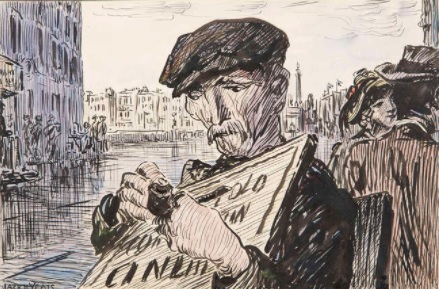
| Sotheby’s auction notice on “The Sandwich Board Man” (Auction of 26 Sept. 2018) - estimated price €20,000 - €30,000. | ||
|
||
|
||
Róisín Kennedy, August 2018; Sothebys - online; accessed 28.02.2021. |
[ top ]
References
Publisher’s notices included in list appended to pop. edn. of St. John Ervine, Mrs. Martin’s Man, 1915 [prev. 1914]), viz., Life in the West of Ireland, drawn and painted by Jack B. Yeats, large 8vo., cloth, gilt, 5/- net; baords, 2/6 net., sepcial edn. with original Sketch on fly leaf, limited to 150 signed copies, 21/-; with notices: ‘Mr Yeats is one of the happiest interpreters of contemporary Ireland. He is at once imaginative and fanciful, humorous and realistic. Like synge, he loves wildness and he loves actuality. … His colour … seems to us to communicate the wonder and joy of the Ireland of our own times with a richness denied to any other artist. … We have here a very treasury of humorous and grotesque aspects of the life - not the domestic life, but the open air and holiday life - of the people of the West of Ireland. (Daily News and Leader). ‘One of the most Irish of Irish books we have come across for years. … all the familiar sights in rural Ireland drawn by an artist who has an eye for humour and character not surpassed, if it is indeed equalled, by any other artist living in these islands. (The Irish Homestead.)
Robert Hogan, ed., Dictionary of Irish Literature (1979), entry on Jack B. Yeats by Nora [A.] McGuinness: Ireland foremost modern painter; he wrote his own epitaph, ‘I have travelled all my life without a ticket / ..When we are asked about it all in the end, / we who travel without tickets, we can say / with that vanity which takes the place of / self-confidence, even though we went without/tickets we never were commuters’ (printed in Terence de Vere White, A Fretful Midge). Note additional indexed references to other entries, viz, contributed to the Bell; contributed three drawings to each number of A Broadside (1908-1915), issued by the Cuala Press, with eighty-four numbers [later series in 1935, and 1937, each twelve parts, were illustrated by several other artists]. Jack B Yeats’s Cuala Press designs reprinted in 1969 reorganisation under Liam Miller; illustrated numbers of The Dublin Magazine (1923-58); his friend John Masefield arranged a commission from the Manchester Guardian for Synge and Jack Yeats to do a series of articles on the Congested Districts, in 1905.
University of Ulster Library holds Ah[,] Well; And To You Also (1974); The Charmed Life (1974); Collected Plays (1971); G. Birmingham, Irishmen All (1913); Synge, Aran Islands (1904); The Careless Flower (1947); Selected Writings (1991); W. B. Yeats, Synge and the Ireland of His Times ([1911; fac. 1970]); Arnolfini Catalogue Of Late Paintings (1991); Hilary Pyle, Jack B. Yeats (1971, 1988); Pyle, Jack B Yeats In The National Gallery Of Ireland (1986); Thomas McGreevy, Jack B Yeats [JORD]; Roger McHugh, ed. Jack B Yeats, A Centenary Gathering, Samuel Beckett, et al. (1971); La La Noo (1971).
[ top ]
Notes
La La Noo, performed 1942, seven women, in a pub are talking about death (‘I would hate to see any man die ..’). They are drenched when the go to the bus, and return. After their clothes are dry, the Stranger offer to drive them to the bus, but he crashes the lorry and dies. The Landlord is left with the body. [Skelton, though it seems at first sight to be a presentation of the theme that death lies in wait for all [...] it is a portrait of a questioning, fearful, speculative mankind.’]. In Sand, Anthony Larcson dies with a last wish to be commemorated by a young girl writing in sand, ‘Tony, we have good thought for you still’; she does so far and wide; the island, under the influence of its Governor and a Visitor, is planning to become a republic, but the declaration is deferred during the tourist season. Meanwhile, a young couple are writing Larcson’s mesage in the sand, knowing only that it is good luck to do so. Yeats seems to argue against politic fanaticism, ‘Larcson’s joke has worked; he has managed by means of his words to prevent the island losing its innocence and turning into the ruthless modern society he disliked and accused’ (Skelton, op. cit., 1990, p.133.)
Emblems: details of Jack Yeats’s paintings have been used to illustrate numerous book covers including works by James Joyce (Penguin Dubliners), Flann O’Brien (Penguin At-Swim-Two-Birds), historical novels by Eilis Dillon and Terence Brown’s Ireland: A Social and Cultural history (1979), and even the Dublin telephone book (1991).
Fox’s poem: The title of Yeats’s novel Sailing, Sailing Swiftly (1933) is a phrase from George Fox’s “County of Mayo” whose authorship was professed by Samuel Ferguson.
Banners: One of the banners designed by Jack B. Yeats and his wife and embroiderd by Dun Emer Guild, showing St Colum Cille (Columba) writing, his bookmark in the form of a Celtic cross, is ill. in BREF, 143, with an entry on Loughrea Cathedral.
C. Palles: Ernest Rhys, The Great Cockney Tragedy (1891); note port. of Christopher Palles, chalk, by Jack B. Yeats; Anne Crookshank, Irish Portraits Exhibition (Belfast: Ulster Museum 1965).
Sale price (1) “Farwell to Mayo” set a record and inaugurated the Irish painting boom when it sold for £804,500 at Sotheby’s on 16th May 1996. The painting has previously been purchased in 1942 by Laurence Olivier for his wife Vivien Leigh, who apparently felt that it was reminiscent of scenes in Gone With the Wind in which she starred as Scarlett O’Hara in 1939. (See Robert O’Byrne, ‘Irish Art - Then and Now’ [Fine Art & Antiques], in The Irish Times, 15 Aug. 2009, p.17.)
Sale price (2) “The Minister”, Jack B. Yeats’ oil painting [sic], used to illustrate Irishmen All by George Birmingham, was expected to make £35,000 stg. at Christie’s of London [auction house] in March (Irish Times, 1 Feb 1992.) Also, “Come on the Dawn” by Jack Butler Yeats, auctioned at Sothebys 18 May 2001, made £157,500.
Sale price (3) “The Coachman”, part of Yeats’s his Irish circus series, purchased for less than £10 by one Emelia Otto on a short trip to Sligo, was spotted at an auction notice by Sean Crean of Celtic Arts, Long Island, and purchased in Stewartsville, Pennsylvania, for $160,000, a fraction of its real value estimated at €1.5 million. Crean, a native of Roscommon, was assisted with the purchase by another Roscommonman. (Report in Sunday Times, 28 April 2002.)
Sale price (4): “The Nimrod of the Railway Line” sold at Christie’s auction in August 2003 for £251,650 [E350,800], equalling the price fetched by a canvas of Sir John Lavery on the same occasion. (See Irish Times, 17 Aug. 2003.)
Sale price (5): Watercolours of the brothers Young John and Michael and sold by auction at Keys Fine Art dealers, Norfolk, for £18,500 (7 Nov. 2008); first exhibited in Dublin 1905, and acquired there by Jack Geoghegan, an important supporter of Yeats; retained by him until 1952 and subsequently kept in a drawer until rediscovered in 2008; included as ills. in Hilary Pyle Jack B. Yeats: His Watercolours, Drawings and Pastels although not seen by her at the time. (The Irish Times, 7 Nov. 2008.)
Sale price (6) “The Shadow in the Street” (1932), by Jack Yeats, depicting self accompanied by his wife Cottie, standing on O’Connell St., facing the viewer, an oil painting of 9.5 by 14.25 was offered at an estimated €50-70,000 in Whyte’s Exceptional Irish Art Sale, 28 Nov. 2011, at RDS, Clyde Halls, Anglesea Rd., Dublin (The Irish Times, 26 Nov. 2011.)
[ top ]
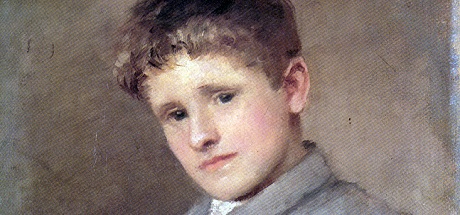
Portraits (1): Childhood portrait by John Butler Yeats; oil portrait by John B Yeats [National Gallery of Ireland], and portrait in oil by Estelle Solomons, 1922, purchased Sligo Museum in 1962 (see Hilary Pyle, Estella Solomons: Patriot Portraits, 1966). Also self-portrait in chalk [NGI]
Portraits (2): portrait in chalk by Seán O’Sullivan [NGI] shows a head & shoulders (Encyclopaedia of Ireland, 1968, p.336 [fig. 410]; full-length self-portrait, in studio, c.1920 [NGI]; see Brian De Breffny, ed., Cultural Encyc. of Ireland, 1983, p.251.
“W Bird” of Punch: an exhibition incorporating a selection of the 500 cartoons which Jack Yeats contributed to Punch magazine as “W Bird” between 1910 and 1948 was mounted at the National Gallery of Ireland in Winter 2012 under the title “Jack of All Trades - Yeats’s Punch Cartoons”.
[ top ]