       |
Life
1865-1923 [bapt. Frederick Herbert Trench]; b. Avonmore, Co. Cork; ed Haileybury and Keble College, Oxford; elected fellow of All Souls’ College; appt. examiner to Board of Education, 1891-1909; publ. Deirdre Wed and )ther Poems (1901; see note ) and New Poems, containing “Apollo and the Seaman” (1907) which was performed by the Dramatic Symphony under the direction of Thomas Beecham in a setting by Joseph Holbrooke (1878-1958; viz., Opus 5); other poems set to music by Arnold Bax [q.v.] and Mildred Lund Tyson;
appt. Haymarket Th. Artistic Director, 1909-11, in collaboration with Thomas Evelyn Scott-Ellis (8th Baron Howard de Walden) with whom he staged The Blue Bird (Maeterlinck) in 1909, and The Pretenders (Ibsen) in 1913; also staged King Lear; moved to Florence in 1911 and worked on better British-Italian relations during WWI; ; published Ode from Italy in time of War (1915); also a four-act play, Napoleon (1919), which was produced by the Stage Society; d. Boulogne-sur-Mer; his Collected Works appeared posthum. in 1924. ODNB PI JMC NCBE DIB OCIL [WIKI]
|
[ top ]
Works| Poetry |
|
| See also musical works by Joseph Charles Holbrook - held in Nat. Lib. Scotland. |
I Heard a Soldier - the words by Herbert Trench [Op. 29, No. 2](London & NY 1908) |
| Collected |
|
| Translations (from Dmitry Merezhkovsky) |
|
[ top ]
Criticism
Abel Chevalley, Herbert Trench, Poète Anglais, 1865-1923, notice sur sa vie et ses oeuvres [...]. Avec texte et traduction de son poème “La Bataille de la Marne”. (Paris & Londres 1925), 53pp., ill., port. [8°].
Commentary
Sean Lucy, ‘The Poetry of Austin Clarke’, in The Canadian Journal of Irish Studies, 9, 1 (June 1983), pp.5-21: ‘The voice of Herbert Trench, whose Deirdre Wed had a profound influence on the early Clarke, and on this his first poem [The Vengeance of Fionn]. It seems to me that Trench’s poem is better than that of Clarke, but leaving that aside, if one reads Trench’s landscape and weather passages it is abundantly clear who it was who taught Clarke to make such verse as this [quotes “With the evening time / they saw a tide of sunlight, rising, surge / Through gloomy loughs ...”]’ (p.6.)
See also ‘Herbert Trench’s Deirdre Wedded (1901): Neglect Merited’, in Éire-Ireland, 13:2 (Summer 1978),
[ top ]
References
D. J. O’Donoghue, Poets of Ireland (Dublin: Hodges Figgis 1912) , lists Deirdre Wed and other Poems (Lon. 1900), New Poems (1907), Lyrics and Narratives (1911); represented in Brooke and Rolleston’s Treasury of Irish Poetry (1900).
Justin McCarthy, ed., Irish Literature (Washington: University of America 1904): listed has Herbert Trench (1865- ); b. Avonmore, Middleton, Co. Cork; Irish on mother’s side (Allings, Sealys and Corrs), as well as father’s family; open fellowship, All Souls, Oxford, 1899; examiner Education Office, Whitehall; Deirdre Wed & Other Poems in 1900 [sic]; gives selection from Part III of Deirdre Wed (Naois speaks): ‘O to see once more / Thee dance alone in this divine resort / Of wings and quietness; where noe but rains / Visit the leaf-pelted lattice - noe o’er peers / And none the self-delightful measure hear / That thy soul moces to, quit of mortal ears [.. ..] For what need of strings / To waft her blood who is herself the Tune, / herself the heart of her own melody / Art come from the Land of Ever Young?’; also ‘Schiehallion’, and ‘Maurya’s Song’, from DW & Other Poems (NY: John Lane).
John Cooke, ed., Dublin Book of Irish Verse 1728-1909 (Dublin: Hodges, Figgis 1909), lists as Herbert Trench; no bio-dates; selects “from Deirdre Wedded” [‘And Deirdre the exquisite virgin pale as the coat of swans / Took the flame of love in her heart at the time of dew / And clad her in ragged wool from a coffer of bronze / And walked in the chill of the night, for her soul was new.’); “Maurya’s Song” (‘Rushes that grow by the black water / When will I see you more?’).
Oxford Dictionary of Quotations, listing as Herbert Trench; bio-dates 1865-1923; selects, ‘But when Night is on the hills, and the great Voices / Roll in from Sea / By starlight and by candlelight and dreamlight / She comes to me.’; also ‘Come let us make love deathless, thou and I’; and ‘O dreamy gloomy, friendly Trees’ (from various poems).
[ top ]
Quotations| Deirdre Wed (1910) | |
| [...] | |
| II: “Voice of Fintan - out of the First Century” | |
O Sightless and rare-singing brotherhood! Fabulous, |
And on the hill-side, where that rampart old Dips lowest to the lakeward, Deirdre stood, Hearing from distant ridges the faint bleat Of lambs perturb the dusk—bleats shivering out Like wool from thorns—there the young Deirdre stood, Even she whose climbing beauty pales the world, Looking far off on hills whence she was come. Mountains that lift the holiness of Fire! Fortitudes, ye that take the brunt of fate! Send her across the bog a little cloud Full of the ancient savours, full of peace, And for its drops she will hold up her heart, O ye that stand in heaven, far removed! She ask’d aloud, Wherefore were greens so bare That but an hour ago shook with the thud Of racers and of hurlers? Was it late? The wrinkled nurse replied, Had the child eyes? Back from a hosting and a desperate prey For corn and mares and rustless brass and beeves Naois, with the rest of Usnach’s sons, Had come. She had seen him weary go but now Heavily up the steep through the king’s hedge. Now on the hill-top while the woman spoke So chanced it. Hanging on the young man’s lips The hosts sway’d round him, and above the press Connachar, glittering all in torques of gold And writhen armlets, listen’d from the mound Of judgment, by the doom-oak at his door. His beak’d helm took the sunset, but he held His flint-red eyes in shadow and averse. And when before him, dark as a young pine, Unmoved the son of Usnach had told all; How half his folk had perish’d in the task By plague or battle, and how poor a spoil Was driven home, the king cried, Paragon! We must go griddle cakes in honey for him, Bring lavers of pale gold to wash off blood So precious to us; since for many moons This champion had forsworn the face of softness And stretch’d his hungers to the sleety rock, Call in the smile of women to unlatch From his grim ribs the iron:—Faugh! Away! Let Usnach’s sons take out again that night Their broken clans, their piteous cattle thence; Defeated men should see his gates no more. |
| [...] | |
| V: Voice of Fintan - again, out of the First Century | |
Let my lips finish what my lips began.— Then spoke Naois, keeping back his wrath, |
Because no man shall deem me noble still,— Over the mist like wool |
Notes
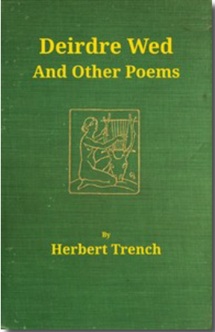
Deirdre Wed (London: Methuen 1901) is rendered as Deirdre Wedded in the Encyc. Brit. (1922 Edn.) entry on F. H. Trench [online] - as also in Herbert V. Fackler’s article, ‘Herbert Trench’s Deirdre Wedded (1901): Neglect Merited’, in Éire-Ireland, 13:2 (Summer 1978) - but appears as Deirdre Wed and Other Poems in COPAC/Discover [catalogue - online] and in the conclusive digital image of the front cover and title at Gutenberg Project [online].
[ top ]