       |
Life
| 1623-87; b. 26 May, at Romsey, Hampshire; went to sea, deserted ship, entered Jesuit Coll., Caen; studied Utrecht and Amsterdam, and matriculated at Leiden, 1644; studied at Paris, friend of Hobbes; Doct. in physics, Brasenose Coll., Oxford, 1649; also Gresham Professor of Music, London; professor of anatomy, Brasenose Coll., Oxon, 1651 - after famous case in which he resuscitated one Anne Green, ‘a poore wench that had ben [sic] hanged for felonie’ [acc. John Aubrey; var. murder; survived her own hanging]; Petty came to Ireland 1652 as physician gen. of parliamentary army; he served as surveyor gen. with control of forfeited lands, having offered to take the place of Benjamin Worseley, whose inefficiency appalled him; thereafter prepared the first large-scale attempt at scientific survey, known as the Down Survey [William Petty’s Down Survey], 1649-54 [Hiberniae Delineatio, 1654], so called because of the laying down of measures; sec. to Henry Cromwell; returned to Oxford, 1659, but was repudiated by Brasenose; won a seat at West Looe for the Parliamentarians, 1659; later acquiesced in Restoration and was knighted, 1662; he was an original member of the Royal Society, incorporated in that year, 1662; influenced by Hobbes’s theory of society as a peaceful confederation of wealth-producers and Bacon’s scientific method based on mathematics; issued Treatise of Taxes and Contributions (1662), outlining the revenue system of modern times with provisions made within the budget for the old, orphans and the infirm; |
| Petty gained an estate of 30,000 acres [120 km2] in Kerry under Acts of Settlement and Explanation [i.e., Cromwellian grants], and resided on them, 1676-85; he largely retained them after the Restoration though faced with accusations of bribery and breach of trust; he estimated the strength of Dublin defences and proposed refortification (‘not only the said city itself but also his Majesties government in church and state would thereby be secured against foreign invasion and domestic rebellion’), 1681; elected Fellow of the Royal Society [FRS] became a fnd.-member and first President of Dublin Philosophical Society, 1683; he served in Irish Parliament and as Admiralty Judge; drew up his ‘Down Survey’ - supposedly directed from an office at Crow St., Dublin - which was declared the official reference for land disputes in Ireland; issued [Petty’s] General Mapp of Ireland (Hiberniae delineatio, 1685; fol. Wing P1928), engraved in Amsterdam and printed in London, showing 12 Irish miles/inch; favoured administrative reform and sought to include Catholics in the political system, envisaging a future union of Ireland and England; his ingenious inventions included the unsuccessful ‘double-Bottom’d ship’ or catamaran - a prototype of which foundered on a return journey from Oporto, 1664; his Political Arithmetic (1690) is a founding work of economic statistics, tracing the source of wealth to land and labour, refuting contemporary notions of national decay; Petty believed that the rent of land gives the standard for the natural rate of interest and his use of nature in this context is taken as a justification of rental earning and a reputation of Aristotle’s strictures on usury; |
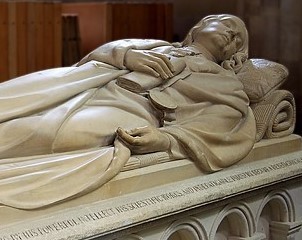
| m. Elizabeth Waller, with whom three children (Charles, 2nd baron; Henry, 1st Marquess; Anne, m. Thomas Fitzmaurice of Kerry); Petty lived in [N.] Gt. George’s St.], Dublin, with a pew in St. Bride’s; d. London 1687, bur. in Romsey Abbey - where a plaque and portrait-monument [marble were erected by the 3rd marquess (Henry Petty-Fitzmaurice) reading: ‘A true patriot and a sound philosopher who, by his powerful intellect, his scientific works and indefatigable industry, became a benefactor to his family and an ornament to his country’; his maps and notes for the Down Survey were destroyed by fire in Dublin Castle in 1711; a map by Petty was incl. in Sir Richard Cox, History of Ireland (2 vols., 1689); his grandson Sir William Petty, Marquis of Landsdowne and Earl of Shelburne, became Prime Minister of England, 1782-83 - the title and name having been assumed by the material line (Fitzmaurice) and thus hyphenated [Fitzmaurice-Petty]; a second cousin John [Petty] became surveyor-gen. of Ireland, 1662; a collection of his printed works is kept at Brasenose College; there is a bibliography by Geoffrey Keynes (1971); OCEL FDA OCIL |
|
[ Click image to enlarge ]
[ top ]
Works| General works |
|
| Literary |
|
| Works on Ireland |
|
| Cartography |
|
|
| Contemporary & early editions |
|
| Modern editions |
|
[ top ]
Bibliographical details
Charles H[enry] Hull, ed., The Economic Writings of Sir William Petty: together with the Observations upon the bills of mortality / more probably by Captain John Graunt, 2 vols. Cambridge UP 1899); and Do. [rep. in Economic Classics ser.] (NY: A. M. Kelley 1963-64), ill. [frontis. facsims. orig. title-ages, tabs.; 2 fold., 22 cm.; Vol. I, xci, 313pp.; Vol. II, [2]pp. of pls., [315]-700pp. [See 1899 edn. - online.]CONTENTS: Vol. I] Introduction: Petty’s life; Graunt’s life; The authorship of the Observations upon the Bills of Mortality; Petty’s letters and other manuscripts; Petty’s economic writings; Graunt and the science of statistics; On the Bills of Mortality; A treatise of taxes and contributions (London 1662); Verbum sapienti [1664] (London . V: 1691); The political anatomy of Ireland [1672] (London 1691); Political Arithmetick [1676] (London 1690).
Vol. 2] Natural and political observations upon the Bills of Mortality (London 1676); Sir William Petty’s Quantulumcunque concerning money, [1682] (London 1695); Another essay in political arithmetick concerning the growth of the city of London [1682] (London 1683); Observations upon the Dublin-Bills of Mortality 1681, and the state of that city (London 16s86); Further observations upon the Dublin-Bills: or, accompts of the houses, hearths, baptisms, and burials in that city (London 1686); Two essays in political arithmetick, concerning the people, housing, hospitals &c. of London and Paris (London 1687); Observations upon the cities of London and Rome, London (1687); Five essays in political arithmetick (London 1687); A treatise of Ireland (1687).
Hiberniae delineatio [rep. of 1st edn.], intro. by J. H. Andrews (Shannon, Ireland: Irish University Press [1969]), 1 portfolio ([2] l., 36 maps - part fold.), 54 cm. Accompanied by facsim. of undated 1st edn., London, of “Geographical description of ye kingdom of Ireland,” by W. Petty and Fr[ancis] Lamb (32pp.; 15 x 22 cm.), and “Introduction to Hiberniae delineatio ... and Geographical description of ye kingdom of Ireland,” by J. H. Andrews (26 p. 22 cm.) in pocket facs. of 1st edn. (Dublin 1685); Introd. includes bibliography (pp.21-23) Cover label: Hiberniae delineatio quoad hactenus licuit, perfectissima studio Guilielmi Petty, Eqtis. Aurati, and Geographical description of ye kingdom of Ireland. [&c.]
Terence Hutchinson, ed., The Collected Works of William Petty (London: Routledge 1997), CONTENTS - Vol. I: Economic Writings - Volume One [1899] c.440pp. [incl. new introduction]. Vol. II: Economic Writings - Volume Two [1899] 400pp., Vol. III: The Petty Papers - Volume One [1927] 322pp. Vol. IV: The Petty Papers - Volume Two [1927] 328pp. Vol V: The Petty-Soutwell Correspondence, 1676-1687 [1928] 380pp.; Vol. VI: The History of the Survey of Ireland, Commonly Called the Down Survey [1851] 458pp. Vol. VII: The Life of Sir William Petty 1623-1687 [1895], E. Fitzmaurice, 340pp. Vol. VIII: Sir William Petty - Critical Responses [1997] ed. by Terence Hutchison, 150pp.
Bibl. note: Num. titles can be found in COPAC and related catalogues relating with the 1st Marquis (1737-1805) - incl. A Letter to the Earl of Shelburne, &c. &c. &c. from a noble Earl of the Kingdom of Ireland [i.e. C. Coote, Earl of Bellamont] upon the subject of final explanation respecting the legislative rights of Ireland [2nd edn.] (London 1783). Still others are identified with the Marquis but precluded by dates of publication prior to his birth from any proper reference to him. (See COPAC > William Petty - online; accessed 07.01.2014.)
|
[ top ]
Criticism| Irish commentary |
|
See also T. W. Moody, F.X. Martin & Francis Byrne, eds., New History of Ireland III (Oxford: OUP 1976), and Moody with W. E. Vaughan, eds., A New History of Ireland, VI (q.d.); Thomas Healy and Jonathan Sawday, ‘;“Cheap and Common Animals”: The English Anatomy of Ireland in The Seventeenth Century’, in Literature and the English War (Cambridge UP 1990). |
| General |
|
| Bibliography |
|
[ top ]
Commentary
John Aubrey (Brief Lives) wrote of him after a supper meeting, ‘In my life having never known such a Genius [...], followed by an account of his career, and comments: ‘there were not in the whole world his equal for a superintendent of Manufacturs, & improvement of Trade; or for to govern a Plantation: If I were a Prince, I should make him my second Counselor at least [...]’; cited in Muriel McCarthy and Caroline Sherwood-Smith, Hibernia Resurgens, Marsh’s Library (1994).
Wilson Lloyd Bevan, Sir William Petty: A Study in English Economic Literature (American Economic Association 1894): Bevan seeks to identify Petty as an influence on Adam Smith of Wealth of Nations fam (who notoriously denied merit to his predecessors) and compares some passages from each, viz.—
|
||
| Further, (on the location of Petty’s MSS) | ||
In Lownde’s Bibliographical Manual it is asserted that several of the Petty manuscripts are to be found in the Bodleian Library. This is evidently a mistake, for the Bodleian contains only a few letters catalogued in the Aubrey and Pepys collection. After a careful search I failed to discover any other manuscript remains. The British Museum contains manuscript copies of the Political Anatomy of Ireland, and of the Essays in Political Arithmetic, two unprinted tracts in defense of the Cromwellian settlement of Ireland, some short papers of no great importance, and a few letters. A list of these manuscripts is given in Ayscough’s Catalogue, p. 884, and in the Catalogue of Additional Manuscripts, p. 1137. |
||
Thorpe’s Sale Catalogue (London 1837) contains a notice of a manuscript volume of the correspondence between Petty and Sir Robert Southwell. Extensive extracts covering several pages are given. In Notes and Queries, 2d series, viii, 130, mention is made of a collection of letters by Petty, advertised for sale in a catalogue of M. A. Cooper’s library, Dublin, 1831. In whose hands these two important volumes at present are there is little prospect of discovering. Aubrey reports (iii, 488) that after Petty’s death he saw in his closet a great many tractatiuniculi, among others “An essay to know and judge the value of lands,” and an autobiography in Latin. À. Wood, in his notice on Petty (Athenae Oxonienses, pt. iv, 215,) mentions an autobiography of Petty, which he had heard of, but had not seen. (Bevan, op. cit., 1894, p.12.) |
||
| Available at Wikisources - online; accessed 15.09.2023; see the full-text of Chapter VI: “Petty’;s relation to Contemporary England and His Place in Economic Literature”; - as attached. | ||
| Note that Bevan’s essay incorporates links to texts by Petty about others in Wikisouce including Petty’s Quantulumcunque: Concerning Money (1682) [online]. |
D. A. Chart (Story of Dublin) relatess: ‘The astrologers and miracle-workers of Dublin gravitated to this neighbourhood [i.e., Nicholas Without]. One of the earliest was a Father Finachty, who held great popular assemblies, where, by prayers and exorcisms, he effected, or was thought to effect, some marvellous cures. His proceedings and his eventual overthrow are described by his co-religionist, the Franciscan Father Walsh, who was frankly sceptical of the whole business. While Finachty was in the monk’s lodging [219] off Nicholas Street, Sir William Petty, an eminent physician and a Protestant, came with the design of testing his miraculous powers. If Finachty could cure his short sight he would profess himself a Catholic. The priest accepted the offer, so tempting to one of his cloth. But in the quiet room and before the small, uncongenial audience, he failed completely. Petty then wagered one hundred pounds he would cure as many sick as Finachty out of a given number. A public trial was arranged, but the challenged party evaded the contest by retiring to Connaught, where his practices were forbidden by his own archbishop.’ (Story of Dublin [Medieval Towns], London: Dent 1907, pp.219-20.)
[ top ]
| Thomas Piketty, Capital in the Twentieth-First Century [French, 2013], trans. Arthur Goldhammer (Harvard UP 2014) |
| Around 1700, several isolated estimates appeared in Britain and France (apparently independently of one another). I am speaking primarily of the work of William Petty (1664) and Gregory King (1696) for England and Pierre le Pesant, sieur de Boisguillebert 1695), and Sébastien le Prestre de Vauban (1707) for France. Their work focused on both the national stock of capital and the annual flow of national income. One of their primary objectives was to calculate the total value of land, by far the most important source of wealth in the agrarian societies of the day, and then to relate the quantity of landed wealth to the level of agricultural output and land rents. It is worth noting that these authors often had a political objective in in mind generally having to do with modernisation of the tax system. By calculating the nation’s income and wealth, they hoped to show the sovereign that it would be possible to raise tax receipts considerably while keeping tax rates relatively low, provided all property and goods produced were subjecte to taxation and everyone was required to pay, including landlords of both aristocratic and common descent. This object is obvious in Vauban’s Projet de dime royyale (Plan for a Royal Tithe), but it is just as clear in the works of Boisguillebert and King (though less so in Petty’s writing). (Picketty, p.56.) |
Note that Piketty takes it for granted that the rate of return on land remains constant over long historical periods between 4 and 5% of capital capital value. |
Douglas Hyde, Literary History of Ireland (1901 edn.), remarks that Sir William Petty, writing in 1672, has an interesting passage on the people of Wexford and of Fingal, and quotes: ‘The language of Ireland is like that of the North of Scotland, in many things like the Welsh and Manques, but in Ireland the Fingallians [on coast some miles north of Dublin] speak neither English, Irish, nor Welsh, and the people of Wexford, though they speak in a language different from English, Welsh, and Irish, yet it is not the same with that of the Fingallians near Dublin. Both these sorts of people are honest and laborious members of the kingdom.’ Petty’s strictures upon the Irish language, of which he was utterly ignorant, and which he ludicrously asserts ‘to have few words’ need not here be noticed. He appears to show, however, that the Irish had already begun to borrow some words from English, and expressed many of the ‘names of artificial things’ in ‘the language of their conquerors by altering the terminations and language only.’ (Hyde, op. cit., p.618.)
William J. Maguire, Irish Literary Figures (1945): ‘[In] his Political Anatomy of Ireland (1670, published anon. 1672), he [Petty] estimate the population at that time as rather over a million, of whom more than half were very poor, dwelling in wretched cabins, sleeping on straw, and living, as a rule on milk and potatoes. Wages were low, but necessaries were so cheap that a family of six persons could live on about £16 a year. Many were well educated. French was not unknown, and the Latin tongue was ‘very frequent amongst the poorest Irish, and chiefly in Kerry.’ (Maguire, op. cit., p.14).
Estyn Evans, Irish Folk Ways (Routledge & Kegan Paul 1957): Detailed surveys and censuses were prepared for the Ulster plantations of the early seventeenth century, but it was left to Sir William Petty ( 162587) to make the most celebrated and exhaustive study of the island. His Political Anatomy of Ireland, in reality a human and economic geography, only serves to remind us what was lost when the maps and notes of his larger Down Survey perished in a fire in Dublin Castle in 1711. Petty aimed at a comprehensive survey which would form the basis of a reconstructed Ireland. One of his proposals, perhaps the most original of all the varied suggestions for solving ‘the Irish problem’, was to import a further 200.000 English settlers so as to bring the total English population to half a million, and then to remove the 20,000 unmarried Irish girls and marry them off’one in every English parish’, replacing them by 20,000 English girls to be married to Irishmen. In this way the Irish language, food, clothing and customs would be replaced by English modes. (The Political Anatomy of Ireland, 1691, p.30.) Petty’s scientific approach was devoid of sentiment and left him without sympathy for the Irish past. Other seventeenth-century writers, however, interested themselves in the ancient forts and towers, and Sir James Ware, who published his Irish Antiquities in 1654, also collected Irish manuscripts. This antiquarianism was continued by the brothers Molyneux,whose essays were the first of countless misguided speculations on Danish Mounts and Round Towers.’ (p.7.)
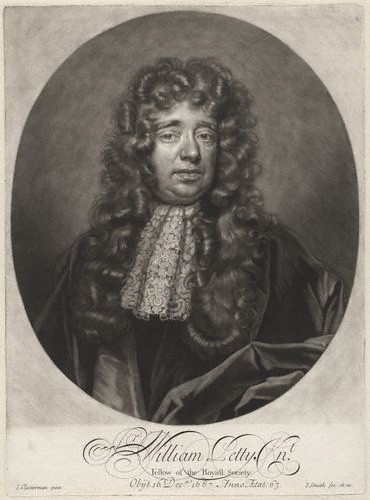
Geoffrey Keynes, Kt., A Bibliography of Sir William Petty FRS and of Observations on the Bills of Mortality by John Graunt FRS (OUP 1971), 103pp.; port. mezzotint after painting by Closterman at Bowood; Petty, ob. 16 Dec. 1687.; ded. to George Mercer Nairne Petty-Fitzmaurice, 8th Marquis of Lansdowne. The Introduction cites Petty’s work as cartographer, Hiberniae Delineatio, 1685, and remarks that perfect copies are very hard to find; his economic writings edited for Cambridge UP in 1899 by Professor Charles Henry Hull of Cornell University. Other titles cited are: The History of the Survey of Ireland, not printed until 1851 and among his MSS at Bowood; Reflections upon Things and persons in Ireland (1660), as showing his vigorous and amusing pen; Two Essays in Political Arithmatick (1687); and Essay Concerning the Multiplication of Mankind (1686) - copies of both being held in Marx’s library. Petty’s papers and works here number 63 items.
J. H. Andrews, History of the Ordnance Map (Dublin: Ordnance Survey Office [Stationary Office] 1974), notes Strafford Survey of the 1630s, the first Irish survey; William Petty’s Down Survey, 1649-54, the best known; need for modern survey recognised in regard to equal imposition of cess (tax) for roads and bridges on townlands; British admiralty pressed for maps when sloop was wrecked on uncharted sandbank off Wexford in 1822; a report prepared by a committee centred on Thomas Spring Rice [Mounteagle] led to authorisation of survey at scale of six inches to one mile; Lieutenant Col. Thomas Colby appointed 22 June 1824, creating Irish Ordnance Survey; occupied Mountjoy House in the Phoenix Park; assisted by Lieut. William Drummond, and inventor; Richard Griffin, the Irish engineer, appointed to effect valuation and delimiting of townlands for an equitable tax system; liaised with Colby, espec. after 1835 when Colby ordered that leading fences should appear; Lieut. Thomas Aishew Larcom, RE, made effort in 1830 to broaden terms of survey to include details of history, commerce, geology, and natural history; Ordnance survey office divided at 1922; when started in the 1820s, the survey employed some 2,100 people, locals as well as military, slogging the country; Petty’s General Mapp of Ireland, 1685, engraved in Amsterdam and printed in London; employs measure of 12 Irish miles to an inch. Note: this source poss. W.A. Seymour, A History of the Ordnance Survey, with contribs. by J. H. Andrews [ed al.] (Folkestone: Dawson 1980), xiv, 394pp, ill. [28pp. pls. maps & plans].
Joseph Leerssen, Mere Irish & Fíor Ghael (Amsterdam 1986), Sir William Petty’s remarks in his Political Anatomy of Ireland (1672), on ‘The Inconvenience of Not-Union’, and canvassing for a Union of Ireland and Great Britain, as follows, ‘It is absurd that Englishmen born, sent over into Ireland by commission of their own King, and there sacrificing their lives for the King’s interest, and succeeding in his service, should therefore be accounted aliens, foreigners, and also enemies, such as were the Irish before Henry the Seventh’s time [...] It is absurd that the inhabitants of Ireland, naturally and necessarily bound to obey their Sovereign, should not be permitted to know who, or what the same is, i.e., whether the parliament of England or that of Ireland; and in what case the one, and in what the other. Which uncertainty is or may be made a pretence for any disobedience.’ [340-41]
Maureen Wall, Catholic Ireland in the 18th c., ed. Gerard O’Brien (1989), Sir William Petty, ‘Nor is it to be denied but that in Ireland, where the said Roman religion is not authorised, there the professors thereof have a great part of the trade.’ (‘Essays in political arithmetic’, in Tracts relating chiefly to Ireland, Dublin 1769, p.229.) Petty quotes as further instances of the rule Jews and Christians among the Turks, Jews and non-Papist merchant-strangers in Venice, Naples, Leghorn, Genoa, and Lisbon. (p.228).
Conor Cruise O’Brien, The Great Melody (1992), William Petty (1612-87), founder of the Shelburne family fortunes, acquired enormous wealth and vast estates in Co. Kerry through services to Cromwell. Lord Shelburne, the premier in 1782, recorded his own self-esteem in his Memoirs, cited in Fitzmaurice, Shelburne, vol. I, ‘Good-breeding within my own family, which made part of the feudal system, but out of it nothing but those uncultivated undisciplined manners which make all Irish society so justly odious all over England.’ [235]
Kevin Whelan, ‘Reading the Ruins: The Presence of Absence in the Irish Landscape’, in Surveying Ireland’s Past: Multidisciplinary Essays in Honour of Anngret Simms, ed. Howard B. Clarke, et al. (Dublin: Geography Publications 2004) - remarks: ‘Ruins in the colonial imagination summoned up the sheer military and economic effort required to subdue the country as well as the need to reconstruct its landscape on more acceptable lines. This frequently began with a cartographic survey. [28] These maps ignored the earlier landscape, often being devoid of content within the legal, proprietorial boundaries. Here we can see the transition to the new language and landscape of fact which reached its apogee with William Petty (1623-1687).[29] Petty’s political arithmetic (the origins of what we now call economics) was itself a deliberate response to the upheavals consequent on the Reformation: he sought to rescue ‘facts’ from the murderous anarchy of theological disputation, which threatened to rip Britain apart in the mid seventeenth century. By elevating ‘facts’ generated by mathematical protocols over the partisan wrangling of theologians and politicians, Petty sought a new common ground of reason. Facts, separated from and prior to any theory of value, were stripped of any attachment to language and text-based contexts of knowledge. Petty also therefore advocated the ‘plain’ style, shorn of rhetorical excess and promoting transparency through brevity. This would produce a language of reason, not of passion, based on observation and measurement, not feeling. Thus facts would be divested of narrative, of any intimacy or rootedness in culture: they would become the domain of expertise rather than of experience, the outward sign of an inner instrumental reason, eminently suited to ‘reasons of state.’ ‘Knowledge is power’ in the words of Francis Bacon, whose Great Instauration inaugurates these new protocols.
Viewed in this light, Petty’s cartographic innovations - based on mathematical mensuration, precise instrumentation, bureaucratic efficiency - can also be seen as an effort to strip the inherited Irish landscape of meaning and narrative. Its depiction as a transparent plane, reducible to numbers, prefigure efforts to reduce its existing culture and inhabitants to a similar transparency. Petty advocated genocide as necessary to a new beginning: his maps, devoid of inner narrative and with the native presence erased, are of a piece with that project.
Whelan, op. cit., q.p.; see full text - as attached.
[ top ]
References
Margaret Drabble, The Oxford Companion to English Literature (OUP 1986), remarks that he ‘traces source of wealth to land.’
Dictionary of National Biography, published economic treatises, 1662-90, in which he rejected old ‘prohibitory’ system and showed the error of supporters of the ‘mercantile’ system in regarding the abundance of precious metals as the standard of prosperity; analysed the sources of wealth as being labour and land.
Seamus Deane, gen. ed., The Field Day Anthology of Irish Writing (Derry: Field Day 1991), Vol. 1, selects Political Anatomy of Ireland (1672, publ. 1691), the best known account of Ireland in the reign of Charles II [864]. E.g., Chap. V, ‘Of the future Settlement of Ireland, Prorogation of Rebellions, and its Union with England’, ‘There is at this Day no Monument or real Argument that, when the Irish were first invaded, they had any Stone-Housing at all, any Money, any Foreign Trade, nor any Learning but the Legend of the Saints, Psalters, Missals, Rituals, &c viz. nor Geometry, Astronomy, Anatomy, Architecture, Enginery [sic], Painting, Carving, nor any kind of Manufacture, nor the least use of Navigation; or the Art Military. ... the Irish will not easily rebel again, I believe from the memory of their former Successes, especially of the last ... and withal from the consideration of the following particulars [he lists 1-6] 1. That the British Protestants and Church have three Fourths of all the Lands; five Sixths of all the Housing; nine tenths of all the Housing in wall’d Towns and Places of Strength, two Thirds of the Foreign Trade. That 6 of 8 of all the Irish live in a brutish, nasty Condition, as in Cabins, with neither chimney, Door, Stairs, nor Window, feeding chiefly upon Milk and Potatoes, whereby their Spirits are not dispos’d to War. And that although there be in Ireland 8 Papists for 3 others; yet there are far more Soldiers, and Soldier-like Men of this latter and lesser Number, than of the former’ [cf. Swift, ‘one man in his shirt, &c.’] [865]. BIBL 955, & COMM, refs. to Moody and Martin, A New History of Ireland, vols. III and IV. Chief works incl. Reflections upon Some Persons and Things in Ireland (Lon. 1660). Political Arithmetic (Lon. 1690), and The Pol. Anatomy of Ireland (1691); see also Sir Thomas Larcom, History of the Down Survey (Dublin Irish Archaeol. Soc. 1851).
Seamus Deane, gen. ed., The Field Day Anthology of Irish Writing (Derry: Field Day 1991), Vol. 1 - cont.: Sir William Petty’s experiments with a double-keeled boat or catamaran in Dublin Bay in 1684 ended in disaster - this fact cited in connection with Swift’s poem Verse Said to be Written on the Union [‘...our vessel with a double Keel / ... The Pilot knew not how to guide. / So tossing Faction will o’erwhelm / Our crazy double-bottom’d Realm.’ [FDA1, p.477, n5.] Also remarks at 387n [ed. note to Modest Proposal, ‘for cold and calculating assessment of Ireland’s population, see Petty’s Treatise on Ireland, 1687’ (SEARCH bibl.; poss. ed. of Anatomy issued in year of his death)]; 855 [Petty’s ‘Down Survey’ and Anatomy the most discriminating response to the new situation, Ireland mapped and analysed so that it might be incorporated the more efficiently to the new scheme of things; Petty, like many others after him, supported a moderate line towards the Catholics of Ireland because he recognised the advantages that would be gain from their conciliation and the equally great disadvantages, that their hostility might create; yet his writings like those of Richard Cox, are generally free from any hint of such emollient policy; if there was to be conciliation, it would be thinkable only after a harsh and well-organised campaign of dispossession, eds., Carpenter, Deane, McCormack]; 858 [MacCurtin, O’Conor, Nary, aligned against Petty, Cox; same eds.]; 967 [Dublin Philosophical Society founded 1683 by William Molyneux and Petty, encouraging Dublin academics and churchmen to turn their minds to experimental or natural philosophy; weekly papers on aspects of the new learning; climate, geography, and geology of Ireland considered, and scientific and technological topics including transport; bibl, see K. T. Hoppen, The Common Scientist in the 17th century: A Study of the Dublin Philosophical Society 1683-1708 (Routledge KP 1970)]; 1073n [McCormack, ed., writes, ‘The “Protestant interest” was a phrase used in the late seventeenth c. and throughout the eighteenth, to indicate without ambiguity the connection between economic interest and social formation. Its definition can be traced back at least to William Petty, and its displacement now by the ‘protestant ascendancy’ [sic] enacts the process of concealment inherent in all ideological constructs’]; BIOG, 955 [as supra]. Note also, The Field Day Anthology of Irish Writing (Derry: Field Day 1991), Vol. 3, notes that Ronan Sheehan’s “Paradise” (1991; here pp.1107-21), concerns concerns Anne Greene [sic] and Petty William Petty [‘two portraits of William Petty survive. ... [&c.]’].
Roy Foster, Modern Ireland (London: Allen Lane 1988), p.106: bio-note records that he came to Ireland as Physician General, 1652; undertook the ‘Down Survey,’ 1652; acquiesced in Restoration and knighted, 1662; father of political economy, his most notable tract being The Political Anatomy of Ireland (written 1672, published 1691) describing land, people, and politics, and analysing potential resources, in favour of Legislative Union to preserve industry in Ireland from a hostile English parliament; fnd. Dublin Philosophical Society, 1683.
Libraries
Marsh’s Library, Dublin, holds a a copy of Hibernia delineata lacking engraved title-page and port.; prob. collated from separate sheets by owner.Belfast Public Library holds Political Survey of Ireland (1719); Reflections upon some Persons and Things in Ireland (1790).
The University of Ulster (Morris Collection) holds The Petty Papers, some unpublished writings ..., 2 vols. (1927). Belfast Linen Hall holds Political Anatomy of Ireland (1691); other eds. 1719, 1899.
Hyland Books (Cat. 214) list Lord Edmond Fitzmaurice, The Life of Sir William Petty 1623-1687 (1895), maps and ports. [£85]; Hyland Cat. 224) lists another copy with map, lacking 2 ports. See also W. H. Hardinge, Observations on an Unpublished Essay on Ireland by Sir W. Petty, A.D. 1687 (Trans. RIA [offprint] 1866], 17pp. in Hyland (Cat. 220; 1995).
[ top ]
| In The Wild Irish Girl (1806), Lady Morgan makes Fr. John say, in defence of the Irish peasant: “The laziness of the Irish,” says Sir William Petty, “seems rather to proceed from want of employment, and encouragement to work, than the constitution of their bodies.” (Letter XXVI.) |
Remittance men: ‘[T]o remit so many great sums out of Ireland into England, when all Trade between the said two Kingdoms is prohibited, must be very chargeable; for now the goods which go out of Ireland, in order to furnish the said Sums in England, must for example go into the Barbadoes, and there be sold for Sugars, which, brought into England, are sold for Money to pay there what Ireland owes. Which way being so long, tedious and hazardous, must necessarily so raise the exchange of Money as we have seen fifteen per cent frequently given, Anno 1671 and Anno 1672. Altho in truth, exchange can never be naturally more than the Land and Water-carriage of Money between the two kingdoms, and the ensurance of the same upon the way, if the Money be alike in both places .’ (Political Anatomy, pp. 71-72; quoted by George O’Brien, Economic history of Ireland int eh Seventeenth Century, pp. 207-08; cited in Joseph Johnston, Bishop Berkeley’s Querist in Historical Perspective, Dundalk: Dundalgan Press, 1970.)
[ top ]
Notes
Sir William Fitzmaurice Petty (1737-1805) - 1st Marquis of Landsdowne, 2nd Earl of Shelburne, Prime Minister of England, July 1782-April 1783. Grandson of Thomas Fitzmaurice, earl of Kerry, who married the daughter of the elder Sir William Petty - hence great-grandson of Sir William Petty (d.1687). On the death of the latter’s sons, the first earls of Shelburne, the estates passed to his nephew John Fitzmaurice (Earldom of Shelburne, 1753), who took the additional name of Petty in 1751. (See Fact Index Webpage, online [accessed 05.10.2008].)
Oxmanstown Hospital: Sir William Petty contributed £20 to the construction of the Hospital at Oxmantown - as recorded in Narrative and an Accompt Concerning the Hospital at Oxmantown-Green, Dublin, containing the sums of money [...] subscribed [...] together with the hopeful beginnings of Gifts towards future annual maintenance ([1671; rep. by Charles Lucas] (Dublin: Esdall 1749).
Sir William Petty (1737-1805) - II: John Mitchel quotes Lord Shelburne’s his response to Lord Portland’s intimation of a Bill in Westminster enjoining that Ireland will share the expense of army protection: ‘I have lived in the most anxious expectation of some such measure offering itself ... No matter who has the merit, let the two kingdoms be one, which can only be by Ireland now acknowledging the superintending power and supremacy to be where nature has placed it, in precise and unambiguous terms.’ (See Mitchel, History of Ireland, p.147, quoted in Rosamund Jacob, The Rise of the United Irishmen 1791-94 (1927, p.33.)
Petty/Pety: It is somewhere noticed that the spelling of Petty’s name on his gravestonee is Pety.
[ top ]