       |
Life
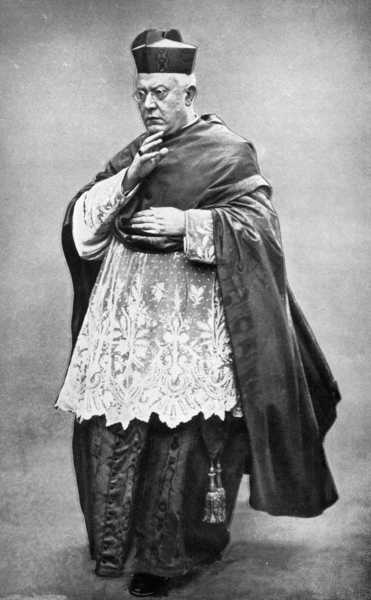
| 1840-1924; b. 1 Oct., Carrigart, Co. Donegal, 1 Oct. 1840; ed. hedge school, private school at Buncrana, and Maynooth, 1857-65; ord. Dec. 1866, and appt. Prof. Dogmatic Theology at Irish College, Paris, also 1866; appt. curate of Glenswilly, 1874; Dean and Prof. of Irish Maynooth, 1876; ord. bishop of Raphoe, 20 July 1879, distributing large amounts to famine-stricken farmers through collections in America; embarked on afforestation scheme around Glenswilly; co-adjutor to Dr. Daniel McGettigan, and then his successor as Archbishop of Armagh, 3 Dec. 1887; |
| elev. to Cardinal and appt. Cardinal-Priest of S. Maria della Pace, 16 Jan. 1893; raised famine funds in US, 1880; raised £50,000 for completion of Armagh Cathedral; opposed Plan of Campaign; denounced Parnell after divorce; supported Gaelic League and attacked Intermediate Education Board for failure to support Irish; opposed Conscription; opposed Sinn Féin physical-force Independence movement; denounced Auxiliaries and official reprisals; received letter from Pope Benedict XV (27 April 1921), counciling impartiality and exhorting the English as well as the Irish to ‘abandon violence and treat of some means of mutual agreement’; |
| led the Hierarchy in responding that British repression must first cease; accepted Treaty; involved in peace negotiations (‘feelers’) with A W Cope, Asst. Under-Sec.; protested against the Partition of Ireland; appealed for an end to the Civil War; wrote a letter to the Irish government recommending liberation of all republicans not indicted for crimes, and counselling abandonment of hunger-strike as a weapon by Republicans, 19 Nov. 1923; d. Armagh, 19 Nov. 1925; there is an oil portrait by Sir John Lavery. DIB DIH |
[ top ]
| Cardinal Logue and the Terror in Ireland:The Pastoral Letter of His Eminence Cardinal Logue, read in the Churches on November 28th, 1920 | ||
|
||
|
Logue speaks of a letter received from a Belgian prelate sympathising with the Irish which he circulated after some reflection to all the bishops. The pastoral continues: ‘[...] The tragedies of last Sunday have oppressed me with a deep sense of sadness of a feeling akin to despair [...] every man and woman in Ireland, who retains a spark of Christian feeling or even the instincts of human[ity] deplores, detests and condemns the deliberate cold-blooded murders of Sunday morning [...]. ‘I believe, moreover that every right-thinking Christian equally deplores and condemns the general, indiscriminate massacre of innocent and inoffensive victims which was perpetrated by the forces of the Crown in Croke Park on Sunday evening. If a balance was struck between the deeds of the morning and those of the evening, I believe that it should be given against the forces of the [recto] Crown. They are bound by their office to protect not to destroy the people, especially those who are within their rights and innocent of any offence.’ He goes on to complain of the descent of lorries of armed men on Ardee and the sack and firing of Balbriggan: ‘This proceeding looks very like provocation, and an attempt to carry the war into a part of the country hitherto comparatively peaceful.’ [End.] |
|
| [ The original is a 2-sided pamphlet in bold-face, published by The Peace with Ireland Council, 30 Queen Anne’s Chambers, Westminster, SW1, and printed by Wightman & Co., Regency St., uniformly with Robert Lynd, “Who Began It?: The Truth about the Murders in Ireland” [1919]; both held in O’Brien Collection as item 17. [Examined at NLI by BS, 10.08.2006.] | ||
[ top ]
Criticism
John Privilege, Michael Logue and the Catholic Church in Ireland, 1879-1925 (Manchester UP 2009), 230pp. [reviewed by Gerard Moran in Irish Studies Review, 18, 2 (2010), pp.236-38].
References
Seamus Deane, gen. ed., The Field Day Anthology of Irish Writing (Derry: Field Day 1991), Vol. 2, reference in Frederick Ryan’s remarks on the Gaelic League (Dana, 1904), and ftn., archbishop of Armagh and primate of All-Ireland, 1887-1924, a conservative in social politics, strong supporter of Gaelic League, but strong critic of Sinn Féin during War of Independence, 998; ‘when Cardinal Logue was a young curate in Ballybofey, he was the cordial friend of the Rev. Mr. Steele, a Presbyterian minister who preached on alternate Sundays in Irish.’ (Aodh de Blacam, 1934) [FDA2, 1015].
Website: For career dates, see the Catholic Hierarchy’ biographies of bishops, online. [Corrig.: death-date given recte as 19 Nov in Boylan, Dictionary of Irish Biography, 2nd Edn. 1988.]
Quotations
Irish language: ‘Wherever Irish is spoken, the people are pure and innocent’ (in An Claidheamh Soluis, 17 Meitheamh, 1899, p.216; quoted in Aodán MacPóilin, ‘“Spiritual Beyond the Ways of Men”: Images of the Gael’, in Irish Review, 16, p.19.
‘The Lesson of History’, [chap. in] State of Ireland (Cork: Mercier 1977): ‘Until repression ceases, and the right of Ireland to choose her own form of government is recognised, there is no prospect that peace will reign amongst us, or that the reconciliation which His Holiness so ardently desires will be accomplished.’ (Letter of Hierarchy to Pope Benedict XV, 21 June 1921, in response to His of 27 April; quoted in Jermiah Newman, Bishop of Limerick (pp.65-66).
Note that Newman comments, ‘To me, at least, it would appear that the present state of affairs in Northern Ireland is not too unlike that described in this quotation. And if what the Bishop said then was valid, it still retains that validity. ... one feels in one’s bones that the ultimate destiny of Ireland is unity, whether on a federal or some other acceptable basis. ... the ultimate basis for peace in Ireland, is some clear and genuine indication on the part of britain, that as soon as it is at all feasible - however long that may take - she shall leave Irishmen to look after themselves.’ (p.67.)
[ top ]
W. B. Yeats: Logue condemned Yeats’s The Countess Cathleen on the basis of Frank Hugh O’Donnell’s pamphlet, Souls for Sale, and without seeing it (see Yeats’s Autobiographies, p. 414; also 506 and 566). In O’Donnell’s subsequent pamphlet, Stage-Irish or Pseudo-Celt (1904), the author quotes the episode in Countess Kathleen where Father John is killed by the devils disguised as merchants -
O’Donnell writes: ‘This was one of the extracts on which Cardinal Logue founded his indignant condemnation of the Yeatsite production. To the Irish Catholic, to the cultivated Protestant, it will probably appear that a more offensive and disgusting outrage on the Catholic’s veneration for the priestly mission can hardly be imagined.’ (p.15; |
|
| Available at Internet Archive - online; see further under Frank Hugh O’Donnell [q.v.].' |
James Joyce: In Stephen Hero (pub. 1944), his manuscript autobiographical novel, Joyce cites Cardinal Logue along with Terence Bellow MacManus as poles in the contradictory Catholic-nationalist ideology of the students at Royal University of Ireland (latter NUI).
Portrait: There is a portrait of Michael Logue by Sir John Lavery; see Anne Crookshank, Irish Portraits Exhibition (Ulster Mus. 1965).
[ top ]