|
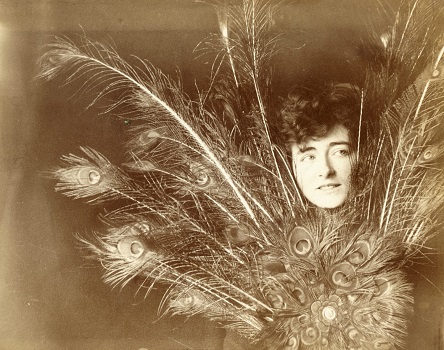
Eileen Gray
      
Life
1878-1976; b. 9 Aug., Brownswood, her family home nr. Enniscorthy, Co. Wexford; youngest of five children and dg. Evelyn Pounden, a baroness desc. from 1st Earl of Moray; ed. at home by a governess; studied in Dresden; passed part of childhood in London; studied art at London’s Slade School of Fine Art, being one of first women to be admitted; eloped with James Maclaren Smith, a painter, facing disapproval of her family; divorced, but visited Smith in Italy afterward; moved to Paris, 1902, and made it her permanent home in 1907;
studied under Japanese lacquer master Seizo Sugawaral became established as a leading designer of lacquered screens and decorative panels; gained recognition with the four-panel lacquered screen, Le Destin, purchased by couterier and collector Jacques Doucet, 1913-14; drove an ambulance in World War I and learnt to fly; feature article about her work in Vogue, 1917; commissioned to redecorate the Levy apartment at rue de Lota, 1919; feted by Harper’s Bazaar as ‘thoroughly modern’; advocated revolutionary design during 1920s and 1930s; opened the Jean Désert gallery shop in rue du Faubourg Saint-Honoré; entered discreet relationship with nightclub singer Marisa Damia;
worked closely Le Corbusier and others; Jean Badovici and Jan Wils published feature on her in special issue of newspaper Wendingen (Holland), 1924; resided for 7 decades in a four-roomed apartment on rue Bonaparte where she was cared for by her maid Louise Dany; travelled to S. France with Badovici; purchased at Roquebrune, Cap Martin; built ‘E-1027’, a domestic masterpiece of modernism, 1926-29; later designed ‘Tempa a Pailla’ for herself at Chemin de Belvessasa, Castellar, 1932-1934; continued designing furniture and architecture in post-war period; rediscovered by art-world in 1972 when ‘Le Destin’, a 4-panel lacquer screen of 1913, sold for 170.000 Frs. at auction in Hôtel Drouot, Paris; feature articles ensued;
d. 31 Oct., bur. Père Lachaise cemetery (her remains now lying in a communal ossuary); her work shown in Museum of Modern Art (New York), the Centre Georges Pompidou (Paris), and the National Museum of Ireland/Collins Barracks in Dublin.
[ top ]
|
|
|
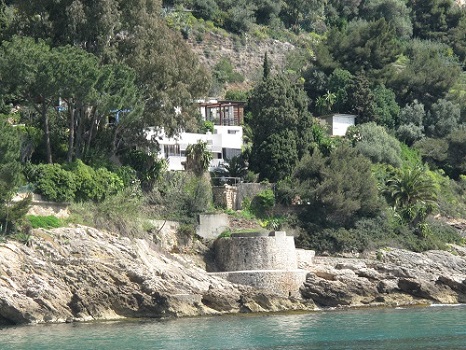
Eileen Gray and E-1027 (Roque-brun) - from Eileen O’Reilly, review, in Irish Independent (1 Jan. 2107).
|
[ top ]
Criticism
- Philippe Garnier, Eileen Gray: Design and Architecture, 1878-1976 [Big art series; English, German and French Edition] (Taschen 1994), 160pp.
- François Baudot, Eileen Gray [Design Memoir] (London: Thames & Hudson 1998), 80pp.
- Caroline Constant, Eileen Gray (London: Phaidon 2000), 256pp. ill.
- Carmen Espegel, Eileen Gray [Objects and Furniture Design By Architects Series] (Ediciones Poligrafa 2013), 128pp.
- Peter Adam, Eileen Gray: Her Life and Her Work. The Ultimate Biography (Schirmer Mosel 2014), 360pp.
- Jennifer Goff, author of Eileen Gray: Her Work and Her World (IAP 2015), 416pp. [Barnes & Noble in USA].
- Ed Cloe Pitiot, Eileen Gray: Une architecture de l’intime / Intimate Architecture ([Paris:] Hyx Editions 2017), 64pp. [in French].
|
[ top ]
Commentary
|
Patricia O’Reily, ‘the Colourful Life of Eileen Gray’, in Independent [.ie] (1 Jan. 2015.)
|
|
[...]
Gray (1878-1976) was an Irish designer, architect, lacquer worker, photographer, sculptor and painter. Although she considered herself Irish to her core, she spent more than six decades of her adult life in France, dividing her time between Paris and the Côte d’Azur.
She was born and raised in Enniscorthy, Co Wexford, the youngest of five children. It was an unconventional family and evidence conflicts as to whether she’d a happy childhood. She was home-educated with a governess and spent a short time studying in Dresden. Her mother was Evelyn Pounden, descended from the first Earl of Moray, who inherited the title of baroness.
Eileen caused a scandal by eloping with James Maclaren Smith, a middle-class painter. When the marriage broke up, James returned to Italy to paint, and Eileen was a regular visitor. She studied art at London’s Slade School of Fine Art, gravitated to Paris and in 1907 made it her permanent home.
She first gained artistic recognition in 1913-14 with the four-panel lacquered screen, Le Destin, purchased by couturier and fine art collector Jacques Doucet. In 1919 she was commissioned to redecorate the Levy apartment at rue de Lota. This gave Eileen her first opportunity at interior design. At the time, Harper’s Bazaar wrote: "Her style is thoroughly modern..."
By 1922 the world was Gray’s oyster. She was in a discreet relationship with nightclub singer Marisa Damia and had opened the Jean Désert gallery shop in rue du Faubourg Saint-Honoré, stocking her furniture, furnishings and carpets, and displaying her painterly and graphic skills as well as artwork by various artists. The shop became the meeting place for the beau monde of the time and was frequented by Rothschilds, the Maharaja of Indore, the Duchess de Clermont-Tonnerre, Nancy Cunard and writers James Joyce and Ezra Pound. The Chicago Tribune described it as an "adventure: an experience with the unheard of, a sojourn into the never-before-seen".
When she became interested in architecture, she learned technical drawing from Russian-born Polish architect Adrienne Gorska. She studied and worked on several projects with her mentor, Romanian architect Jean Badovici, before creating E.1027, her villa overlooking the sea at Roquebrune in the south of France, "a masterpiece of 20th century architecture".
Goff dispels the myth that E.1027 was collaborative, "significantly all of the extant plans are solely in Gray’s hand". When completed, Gray gifted it to Badovici with whom she was having an affair.
While Eileen Gray is associated with many different properties, her most important is the iconic E.1027 (1926-1929). Her home in Paris was a four-roomed apartment on rue Bonaparte where she was cared for by her maid Louise Dany for most of the seven decades she lived there. During their affair in the early 1920s, Damia and Gray met at her holiday home at Samois-sur-Seine. Goff describes Tempe à Pailla at Castellar, completed in 1935, as "reflective of Eileen Gray’s preference for minimalism".
There was a small apartment on the Quai Suffren in St Tropez and her last home, Lou Pérou near St Tropez, was developed over several decades.
Never conventional and always with a streak of adventure, Gray was a complex mixture who travelled extensively. She was one of the first women in Paris to get a driving licence, drove an ambulance during World War I, took flying lessons, was successful in the male-orientated world of international design and architecture, was dressed by couturiers such as Lanvin and Poiret, and drew scenario and character sketches for Ballet Animaux.
Hers was a life richly artistic. She met the great names of the time, such as Picasso, Miro, Frida Kahlo, Rodin, Joyce, though, as Goff explains, "her debilitating shyness thwarted many opportunities to expand on these friendships..."
This treasure of a 500-plus page book is a forensic, project-by-project exploration of Gray’s creative process which she documented comprehensively and her personal life, which she fought to keep private. It is richly illustrated with photographs and drawings.
There is a wealth of endnotes at the end of each chapter and a comprehensive ’List of Illustrations’ and ’Bibliography’ at the back. Dr Goff’s Irish-published book is a welcome addition to the pantheon of internationally-published books on Eileen Gray.
|
| Patricia O’Reilly, Irish Independent, 1 Jan. 2015; available olnine; accessed 25 Nov. 2917. |
[ top ]
Notes
E-1027: The name of the house in Roquebrune was derived by an alpha-numerical game from the names of Eileen Gray and Jean Badovici, as follows: E for Eileen, 10 for Jean (10th letter), 2 for Badovici (2nd letter) and 7 for Gray (7th letter).
[ top ]
|