       |
Life
| 1809-98 [“The Grand Old Man”] b. Liverpool; MP Newark, 1832; opposed Irish Church Temporalities Bill approp[riation] clause, 1833; submitted articles to Dublin University Magazine in 1834; The State and Its Relations with the Church (1838); m. Catherine Glynne, dg. of Sir Stephen Glynne of Hawarden Castle, an old Whig family; commenced work with London prostitutes, 1840; appt. Chief Sec. of Ireland, 1841; resigned over Maynooth grant issue, 1845; Colonial Sec., 1845-46; his sis. Helen restrained by Lunacy Commission, and converted to Catholicism, 1846; founded Church Penitentiary Association for the Reclamation of Fallen Women, 1848; Chancellor, 1852-5; 1859-66, 1873-74, and 1880-82; Liberal P.M. 1868-74, 80-85, 1886, and 1892-94; a firm believer in a personal Homer and ‘a solid nucleus of fact in his account of the Trojan war’; infuriated supporters of the Union in the American Civil War by suggesting that it looked as though Jefferson Davis would create a nation; |
| converted to pacification of Ireland through reform, Dec. 1868 - purportedly when axing down a tree on his estate at Hawarden [var. Hawarthen]; disestablished the Church of Ireland, 1869; brought forward two land Acts, 1870 (giving a tenant an interest in his holding but not yet fixity of tenure) and 1881 (awarding fixity of tenure and reducing rents by twenty percent); Gladstone presided over the Welsh National Eisteddfod at Mold, 91 Aug. 1873; Compensation and Coercion Acts, 1880-82; introduced coercion acts in response to Phoenix Park murders - Lord Cavendish being the second son of the seventh Duke of Devonshire, and Gladstone’s his nephew-by-marriage [to Lucy] Caroline Lyttleton, dg. of the 4th Baron Lyttelton, her mother being the younger sister of Gladstone’s wife Catherine [m. Lord Frederick Cavendish, 1864]; reading Burke in Matthew Arnold’s edition of Irish Affairs (1881), ‘nearly every day’ in late 1885 and 1886; |
| resigned PM-ship, June 1885, being replaced by Lord Salisbury; Gladstone’s son Herbert makes it know that his father was committed to Home Rule, Dec. 1885 (a disclosure known as the ‘Hawarden kite’); estab. the so-called “Union of Hearts” between the Liberals and Irish Parliamentary Party [IPP]; formed his third ministry, Jan. 1886; drafted the First Home Rule Bill, giving internal control to Ireland with continuing links to Britain; Home Rule defeated in the House on account of divisions in his own party, 1886; failed to pass the Land Purchase Bill, 1886; called a national election, and lost to the Conservatives; Liberal-IPP alliance collapses in face of Parnell scandal; formed his fourth and last ministry in 1891, introducing the ‘Newcastle Programme” of reform, incl. Home Rule; succeeded in getting his second Home Rule Bill through the Hose of Commons, to be defeated overwhelmingly in House of Lords, 1893; refused to accept increased Naval estimates, and resigned March retiring to to Hawarden, 1894; founded St. Deinol’s ;Library, Hawarden, 1894; protested in a Liverpool speech against Turkish massacre of Armenians; d. 19 May 1898, of cancer of the palate, at Hawarden; |
| Dublin Corporation refused a site for a commemorative statue in spite of remonstrations of Sir Charles Gavan Duffy; his favourite journalist was W. T. Stead, the campaigning editor of the Northern Echo; The Gladstone Diaries, ed. Michael Foot & H. F. G. Mathew (Oxford 1968-82), shed light on his preoccupation with rescuing prostitutes and his habit of self-flagellation; an orthodox enthusiast for the Church of England, he backed admission of Jews and non-believers to Parliament; Benjamin Disraeli said that he ‘had not one redeeming defect’. OCEL ODQ DIH FDA |
[ top ]
Works| Irish affairs |
|
| General |
|
| Edited papers |
|
[ top ]
Criticism
|
See also J. L. Myers, Homer and His Critics (1958). |
[ top ]
| Seamus Deane, in Celtic Revivals (1985), speaks of Gladstone’s advocacy of consolidation and concession as a ‘version of killing Home Rule by Kindness ... an old Burkean policy adopted more than a century too late.’ ( p.25.) |
| Conor Cruise O’Brien calls Gladstone the greatest English statesman of the nineteenth century (Intro., Cresset Edn., Burke’s Irish Affairs, 1988). |
Charles Gavan Duffy remonstrated at the refusal of the Dublin Corporation to raise a statue for Parnell, under pressure from Parnellite newspapers: ‘[…] if there had been no Gladstone, the Irish Church would still be established, the Irish Land System would still be unreformed, and the Irish franchise would still be a mockery of popular representation … and A Home Rule Bill ... would not have passed the House of Commons.’ (Westminster Gazette, cited in Cyril Pearl, The Three Lives of C. G. Duffy, q.d., p.228; quoted on Gladstone page of Web of English History online; accessed 10.07.2010.)
[ top ]
Philip Magnus: Gladstone: A Biography (London, John Murray, 1954), summarising Gladstone’s argument in The State and its Relations to the Church (1838): ‘the State possessed a conscience and had a duty to distinguish between truth and error in religion. Doctrinal differences were, therefore, matters of great importance. The Established Church was the conscience of the English state, and that State was bound to give an active, informed, consistent, and exclusive financial and general support to the Anglican religion which was of the purest and most direct Apostolic descent.’ (p.35; quoted on A Web of English History website; accessed 09.07.2010.)
Edward Grierson, The"Imperial Dream: British Commonwealth and Empire 1775-1969 (Newton Abbot: Victorian"Book Club 1973): ‘Of course we can see"now that Gladstone was right and that between 1886 and 1894 a great opportunity"was missed of knocking Irish heads together before they had wholly parted"company. The fateful division we are still witnessing, with its terrible legacy"of bloodshed, was then only in the making and might have been checked by a"generous gift to Ireland of what even Ulstermen had for centuries been"demanding - the right to run their own affairs. Ireland was a special and"peculiar problem, the nearest home and in a sense the farthest away, quite"different from other imperial problems. The failure of the British people to"recognise the nature of the need - and it was largely a selfish and headstrong"refusal to face facts - not only denied the vast majority of Irishmen the Home"Rule which was due to them, but it encouraged those revolutionary elements that"looked back for inspiration to Wolfe Tone and the rebellion of 1798 - elements"which rejected Home Rule as completely as they rejected Union with the hated “Saxons.”’ (p.192.)
Andrew Adonis, ‘Marx’s Critique of Gladstone - Gladstone’s Refutation by Example’, critical article, in Times Literary Supplement (9 Feb. 1996), pp.12-13; incl. references to biographies and also recent articles by Roy Jenkins and Colin Mathew, whose 14 vol. edition of Gladstone’s correspondence appeared recently; cites extensive comments of Marx on Gladstone, such as his characterisation of the latter as the victim of a dreary obligation to work himself daily into a ‘state of mind’ yclept “earnestness”’. performer of a dreary task; in response to Gladstone’s budget of 1853, Marx wrote: ‘There exists, perhaps, no greater humbug than the so-called finance ... The public understanding is quite bamboozled by these detestable stock-jobbing details’; on Gladstone’s eloquence in 1855, he wrote, ‘Polished blandness, empty profundity, unction not without poisonous ingredients, the velvet paw not without the claws, scholastic distinctions both grandiose and petty, quaestiones and quaestiuniculae (minor questions), the entire arsenal of improbabilism with its casuistic scruples and unscrupulous reservations, its hesitating motives and motivated hesitations, its humble pretensions of superiority, virtuous intrigue, intricate simplicity, Byzantium and Liverpool’.
[ top ]
| Michael Partridge, Gladstone (London: Rouledge 2003). |
|
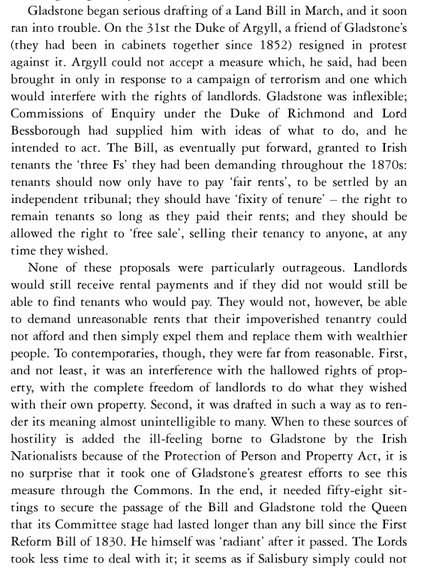 ([...]; p.192.) ([...]; p.192.) |
| —available at Google Books - online. |
[ top ]
Margaret Kelleher, ‘Prose Writing and Drama in English; 1830-1890 [...]’, in Cambridge History of Irish Literature, ed. Kelleher & Philip O’Leary (Cambridge UP 2006), Vol. 1 [Chap. 11]: ‘The inscriptions to [...] land [i.e., Land War] novels often record their political ambition: the first edition of Doreen (1894) by English author “Edna Lyall” (Ada Bayley) was dedicated to Prime Minister William Gladstone; Hester Sigerson’s A Ruined Race (1889) was dedicated to Mrs Gladstone. In his 1892 work Special Aspects of the Irish Question, Gladstone expressed his gratitude to the young Emily Lawless for her novel Hurrish, which, in his view, conveyed “not as an abstract proposition, but as a living reality, the estrangement of the people of Ireland from the law”.’ (Kelleher, p.481; citing Gladstone, Special Aspects of the Irish Question: A Series of Reflections in and since 1886 [1892]; London: The Daily Chronicle 1912, p.151.)
[ top ]
Quotations
The Irish Land League: ‘It is perfectly true that these gentlemen wish to march through rapine to disintegration and dismemberment of the Empire, and, I am sorry to say, even to the placing of different parts of the Empire in direct hostility with one, the other.’ Also, ‘All the world over, I will back the masses against the classes’ (from various speeches). See also Queen Victoria on Gladestone: ‘He speaks to me as if I was a public meeting’ (recounted by G. W. E. Russell in Collections and Recollections, Chp. XIV; all the foregoing in Oxford Dict. of Quotations, 1949 Edn.)
Safe Leaders: ‘Even the Irish Nationalists may perceive that those marked out by leisure, wealth and station, for attention to public duties, and for the exercise of influence, may become in no small degree, the national and effective, and safe leaders of the people.’ (Quoted by Paul Bew, writing on Parnell, in Fortnightly Review, Oct. 1991, p. 19. Bew remarks that Gladstone is here rehearsing the themes of J. A. Froude’s famous 1876 lecture, On the Uses of the Landed Gentry.)
The Irish Question: Gladstone told the Commons on 6 April 1893 that the ‘Irish Question’ was ‘leading to the utter destruction of the mind of Parliament, to the great enfeelbling and impeding of its proper work’ (Hansard, H.C. Debates, 4th ser., Vol. 10, col.1597; quoted in Robert Kee, The Green Flag, London: Weidenfeld & Nicolson 1972, p.4.)
[ top ]
References
Seamus Deane, gen. ed., The Field Day Anthology of Irish Writing (Derry: Field Day 1991), Vol. 2: notes and remarks at 197n, 276, 305, 306, 308, 310, 311, 313, 315, 317-35 passim, 342-48 passim, 356, 424, 475, 476, 506, 985, 1021, 1067n, 1069, 1213n; largely connected with the Parnell Split. Persuaded by Sir William Harcourt to repudiate Parnell; Harcourt, leader of Liberals, 1896-98; and chancellor of the exchequer at various times (ftns 411, 319, [not indexed]).
[ top
Library Catalogues
Booksellers & Catalogues: W. E. H. Gladstone, MP, Vaticanism An Answer to Reproofs & Replies (London 1875) [Library Herbert Bell], W. E. Gladstone, The Irish Question (1st ed., 1886), 58pp [Carty 1070]; Frederic Harrison, Mr Gladstone! – or Anarchy! (1996) [Carty 1104; Hyland 214, 220]; also The Irish Question (1886), 58pp. [Carty 1070; Hyland 220, 1995]; W. E. G[ladstone], Historical Catechism Concerning Ireland and Her Church (1885) [printed in Ballymena; Hyland 220]; Lord Eversley, Gladstone and Ireland: The Irish Parliament 1850-1894 [1st edn.] (1912); Justin McCarthy, The Story of Gladstone’s Life (Toronto 1898); John Morley, The Life of William Ewart Gladstone, 2 vols. (1905), viii, 1026; viii, 948, ports. Also, Thomas E. Webb, Ipse Dixit: or the Gladstonian Settlement of Ireland [2nd edn.] (1886) [attrib. to Thomas Maguire as Carty 1289] [Hyland 224, Dec. 1996]
Belfast Public Library holds 8 Irish-related works incl. The Irish Question (1886); A Speech on the Irish Church (1869); The Treatment of Irish Members and the Irish Political Prisoners, A Speech (1888).
[ top ]
Notes
William Allingham: A. P. Graves writes: ‘Lionel Johnson [in Treasury, ed. Rolleston and Brooke] has not done him justice in the matter of his assistance to the Irish cause if, as seems almost certain, Lawrence Bloomfield first fired Gladstone’s imagination upon the Irish Land Question.’ (Graves, Irish Literature and Musical Studies, 1913, p. 80.)
G. B. Shaw, O’Flaherty, V.C.: SIR PEARCE [rising and planting himself firmly behind the garden seat]. Well [...] O’Flaherty, [... e]ven if your mother’s political sympathies are really what you represent them to be, I should think that her gratitude to Gladstone ought to cure her of such disloyal prejudices. O’FLAHERTY [over his shoulder]. She says Gladstone was an Irishman, Sir. What call would he have to meddle with Ireland as he did if he wasn ‘t? (See full text in Irish Classics Library, infra.)
Oscar Wilde wrote to Gladstone: ‘I, and all who have Celtic blood in their veins, must ever honour and revere [one] to whom our country is deeply indebted’; ‘[and who] will lead us to the grandest and justest political victory of this age’ (Letters, pp.218. 219.)
J. H. Whyte, Interpreting Northern Ireland (OUP 1991), writes: James Loughlin sees Ulster politicians of the period as having expressed no contractarian ideas and a ‘high degree of ideological and emotional commitment to Britain and [to] what they say was British values and traditions.’ (Gladstone, Home Rule and the Ulster Question, 1882-93, 1986, p.156.) There was a counterchallenged by Jackson (1989) who finds his sample untypical and considers the Ulster commitment to Britain more qualified than Loughlin imagines. (Whyte, pp.128-29.)
Daniel O’Connell: Gladstone acknowledged the formative influence of O’Connell in the 1880s. (See Gladstone in debate, 16 April 1883, in Hansard 3rd ser., CCLXXVIII, pp.1190-91, and W. E. H. Gladstone, ‘Daniel O’Connell’, in The Nineteenth Century, XXV, 1889.)
“Grand Old Man”: The nick-name G.O.M., was coined by Lord Rosebery, and features in Finnegans Wake by James Joyce (1939).
Lady Lucy Cavendish: née Lucy Caroline Lyttelton - b. 5 Sept. 1841; 2nd dg. of George William, 4th Lord Lyttelton, and his first wife, Mary, née Glynne - who was the younger sister of Gladstone’s wife, Catherine [Aunty “Pussy”]; one of many children of his first marriage, with more by the second; brought up with her brothers and sisters on the Lyttelton estate at Hagley, Stourbridge, Worcestershire; became Maid of Honour to Queen Victoria, 1863 - where her grandmother, Sarah Spencer [Lady Lyttelton], had been in charge of the Royal Schoolrooms at Court between 1842-50 and was highly regarded by the Queen and Prince Albert. Lucy Lucy became engaged to Lord Frederick Cavendish, and son of the 7th Duke of Devonshire and the younger brother of Lord Hartington, April 1864; m. married in Westminster Abbey, June 7th 1864. [...]
| [cont.] |
|
| (See “Rooms of our Own”, Lucy Cavendish College, Cambridge - online; accessed 27.07.2015.) |
| [Further:] After her husband’s death, she served as President of the Yorkshire Ladies Council of Education from 1883 to 1912, declining the post of Mistress of Girton College, Cambridge, in 1884; later a member of the Royal Commission on Secondary Education and founding member of the Council of the Girls’ Public Day School Company, founded by her father; received honorary DLL at the inauguration of the University of Leeds for ‘notable service to the cause of education’, 1904. Died 22 April 1925. Buried with her husband at Edensor, nr. Chatsworth. Lucy Cavendish College was established at Cambridge in the 1960s. (See Wikipedia, Lucy Cavendish - online; accessed 27.07.2015.) |
[ top ]