       |
Life
| 1818-1874 [J. H. Foley]; b. 24 May, on Montgomery St., Dublin; son of Jesse Foley and Eliza Schrowder Byrne, the step-daughter of Benjamin Schrowder, a sculptor who worked on Gandon’s Custom House; taught carving by Schrowder and later trained under John Smith at the RDS Arts School from aetat. 13; received awards for drawing and modelling; moved to London, where he joined his brother Edward, 1834; studied at RA and won large Silver Medal; tutored by Westmacott (RA Prof.); influenced by works of Canova and Flaxman; exhibited Death of Abel at Royal Academy from 1839; made statues of Hampden and Seldon for [St Stephen’s] Westminster Hall, 1847; estab. studio and home at Osnaburgh St., London, and joined by two sisters after death of his mother; elected A.R.A, 1849 and M.R.A. 1858; executed statues of Oliver Goldsmith [1861] and Edmund Burke for TCD [1868]; other works incl. equestrian figures of Sir James Outram in Calcutta [Kalkuti] and Viscount Hugh Gough in Phoenix Park, Dublin, 1878 [var 1880] - freq. attacked and eventually destroyed by nationalists in 1959]; |
‘Many of his most beautiful sculptures are in London, but Dublin possesses all his casts, as well as his Burke and Goldsmith, his O’Connell and Lord Gough, and Cork his Father Mathew.’ (D. J. O’Donoghue, Poets of Ireland, 1912.) |
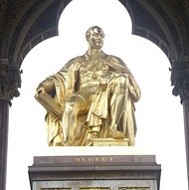
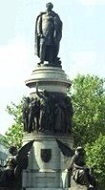
| also Lord [Earl] Carlisle (GWF Howard), Chf. Sec., later Viceroy of Ireland ( 1855-58; 1859-64; obiit.), and and Master of Order of St. Patrick (erected 1870); figures of Prince Consort and of Egeria for Albert Memorial, London; a statue of Henry Grattan, now in College Green; also Prince Albert, supported by artisans, National Museum, Dublin; many portrait busts and church monuments incl. those of Lord Canning, Lord Clyde, John Stuart Mill and Charles Barry, Stonewall Jackson and Sir Benjamin Lee Guinness; several statues for Royal College of Physicians, Dublin, 1867; commissioned to make O’Connell Monument in Dublin, finished figures on the plinth [c.1870]; other figures completed by his assistant Brock; died following attack of pleuritic effusion, 6 Aug., at his new home, The Priory, Hampstead, on 27 Aug. 1874; bur. St. Paul’s Cathedral, London. BREF DIB DIH |
|
|
[ top ]
Works
W. C. Monkhouse, The Work of John Henry Foley (London 1975); J. Turpin, ‘John Henry Foley 1818-1874’, in Irish Times ( 2 April 1974). See also Anne Crookshank, ‘Irish Sculpture’, in Apollo 84 (1966) and H[oman] Potterton, The O’Connell Monument (Ballycotton 1973).
Criticism
Sarah Atkinson, John Henry Foley (Dublin 1882); William C[osmo] Monkhouse, The Works of John Henry Foley ... Sculptor with critical and illustrative notes by W.C.M. (London: Virtue, Spalding, & Co. 1875), vii, [1], 67, [1]p., 15 pls. [engravings], fol., and Do. [mocrofiche vers.] (Chadwyck-Healey Ltd. [1995]); Ronan Sheehan, Foley’s Asia (1999) [infra].
Commentary
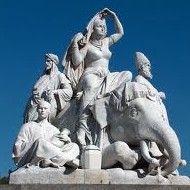
Ronan Sheehan, Foley’s Asia (1999), gives account of the imperial background of his most celebrated portraits including centrally the figure of Asia on the base of the Albert Memorial (Hyde Park, London). Also gives biographical details (Chap. 12): step-grandfather Benjamin Schrowder of Winchelsea worked on Gandon’s Custom House and remained on living at 6 Montgomery St., now Foley St.; wife and children bur. in St. George’s, Temple St. [Hardwicke Place]; credits Schrowder with river-gods on Liffey bridges [?usually ascribed to Edward Smyth]; m. Mrs Byrne whose dg. m. Jesse Foley, a glassblower from Winchester and later grocer in Mecklenberg St. [Sean MacDermott St.]; Edward, a son, learned carving from Benjamin before being apprenticed to John Smith of RDS School; gives account of his childhood wanderings in Dublin; first saw repro. of Leochares’ Apollo Belvedere in RDS in St. Stephen’s Day 1830 and decided to commit himself seriously to sculpture; read The Vicar of Wakefield, Young’s Night Thoughts and Hervey’s meditations; suffered destruction of a competition model by an envious companion and produced a superior one the following day, having laboured by candle-light in the Art School overnight; moved to London, March 1834, and sculpted The Death of Abel winning a ten-year studentship at Academy in London; suffered attack of jaundice that impaired his complexion for life; exhibited Death of Abel and Innocence at RA, 1839; exhibited Ino and Bacchus, 1840; The Death of Lear, 1841; The Homeless Wanderer, 1842; figures of John Hampden and Seldon, 1847; settled at Osnaburgh St., London; death of his mother Eliza in Dublin; carved The Mother; The Elder Brother from Comus; Viscount Hardinge, displayed outside Burlington Hse. before departure for India; received two visits from Queen Victoria in his studio; taught himself to play the flute; designed memorial for Wellington but was beaten to the commission by Baron Marochetti, 1854; contracted pleurisy astride the clay figure of Asia, modelling the bust; apprentices Tenniswood and Brock; last statue was DAniel O’Connell.
[ top ]
References
Brian de Breffny, Ireland: A Cultural Encyclopaedia (London: Thames & Hudson): lived in London from date of removal there; won Westminster Palace competitions, 1844, and many govt. commissions; known for commemorative statues of ‘heroic dead’; examples in England, Ireland, and India, showing ability to conjure up spirited conception of each subject in a characteristic pose; Prince Albert and the Asia group on the Albert Memorial. Bibl., B. Read, ‘John Henry Foley’, The Connoisseur, clxxxvi (1974), pp.262-71; J. Turpin, ‘The Career and Achievements of J. H. Foley’, Dublin Historical Record, xxxii, nos. 2 & 3 (1979), includes catalogue.
W. B. Stanford, Ireland and the Classical Tradition (IAP 1976; this ed. 1984), J. H. Foley, b. Dublin 1818, ed. Art School of RDS, and RA London, his tutor being Westmacott, RA Prof. of Sculpture; influenced by Canova and Flaxman; the O’Connell monument one of his most elaborate designs; his early work resembles late classical art. [121]
Anne Cruikshank & the Knight of Glin [Desmond Fitzgerald], Irish Portraits 1600-1860 [Catalogue] (1969), p.89, cites W. C. Monkhouse, The Works of John Henry Foley (London 1875).
Notes
Portraits: There is a portrait of J. H. Foley by Thomas Mogford (see Anne Crookshank, Ulster Mus. 1965).
[ top ]