       |
Life
fl.1578; English engraver with Sir Henry Sidney on campaigns against Earl of Tyrone (Hugh O’Neill) 1570s; author of the verse topography, Image of Ireland, a poem with a discoverie of woodkarne (1581), of which only one intact copy exists. ODNB OCIL
[ top ]
Works
The Image of Ireland with a Discoverie of the Wood-karne (London 1578); rep. with notes by Sir Walter Scott (Edinburgh 1883) [ltd. edn., 286 copies; prev. published by Scott himself in his edn. of Lord Sumer’s Tracts (London 1809)]; D. B. Quinn, intro. and transliteration, with foreword by John Gamble and preface by Liam Miller, The Image of Ireland, with a Discoverie of Woodkarne [facs. of Edinburgh edn. of 1883] (Belfast: Blackstaff 1985), [ltd. edn.] 316pp.
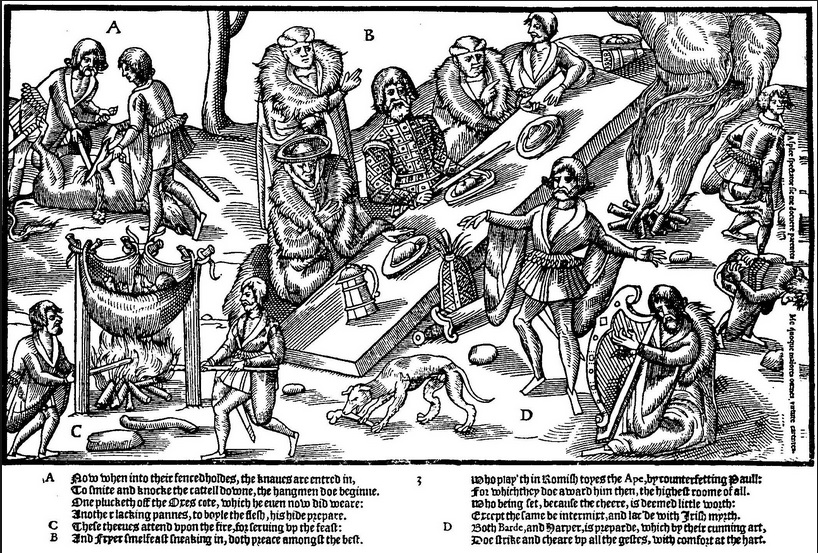 |
| An Irish Banquet (Farting Entertainment) |
—See larger album of plates from Images of Ireland - as attached. |
[ top ]
Criticism
Vincent P. Carey, ‘John Dericke’s Image of Ireland, Sir Henry Sidney, and the Massacre at Mullaghmast, 1578’, in Irish Historical Studies, Vol XXXI, No. 123 (May 1999), q.pp.; see also Russell K. Alspach, Irish Poetry from the English Invasion to 1798 (Philadelphia: Pennsylvania UP [1943] 1959), p.34.
Commentary
Joep Leerssen, Mere Irish and Fíor-Ghael (Amsterdam: Rodopi 1986): ‘John Derricke, a long and vengeful
rhyming tract on raids of Irish soldiers (kernes) on the Pale’, in Image of Ireland, with a discoverie of wood karne (London 1578).
R. F. Foster, Modern Ireland (1988), p.32: perhaps employed making Great Privy Seal of Ireland, 1557; His Image (1578) [note var.] divided into allegorical and historical sections, ded. to Sir Philip Sidney whose father, Sir Henry, is the hero; unflattering but veracious pictures of the native Irish, called ‘woodkerne’ not intended as [a] reflection on Irish nobility and gentry loyal to the Queen (pref. epistle).
[ top ]
Quotations
Description of an Irish Feast: ‘Now when their guts be full, / Then comes the pastime in. / The Bard and Harper melody Unto them doth begin. / This Bard he doth report /The noble conquests done, / And eke in rhymes shows forth at large / Their glory thereby won. / Thus he at random runneth, / He pricks the rebels on, / And shows by such external deeds, / Their honour lies upon; / And more to stir them up, / To prosecute their ill, / What great renown their fathers got, / They show by rhyming skill. / And they most gladsome are / To hear of parent’s name, / As how by spoiling honest men / They won such endless fame. / Wherefore like graceless grafts, / Sprung from a wicked tree, / They grow through daily exercise / To all iniquity. / And more t’augment the flame / And rancour of their heart, / The Friar of his counsel vile / To rebels doth impart. / Affirming that it is / An almost deed to God / To make the English subjects taste / The Irish rebels’ rod. / To spoil, to kill, to burn, / The Friar’s counsel is, / And for the doing of the same, / He warrants heavenly bliss.’
The Discovery of the Irish Nymphs, their pleasures, pastimes, and accustomable usages, wherein daily they are occupied, are figuratively expressed. The nymphs of sundry matrons, I: Have heard do there resort, / As time and fit occasion serve / To use for their disport. / Some for to shade them from the heat, / And some an other thing: / According as the rain doth fall, / So do the flowers spring. / One doth rejoice to spend the day / In playing barley-break; / Another doth (I mean no harm) / As great a comfort take. / This nymph doth joy to scud along / The wood and riverside; / But she in snorting in a bush / Receiv ‘th as great a pride. / These do invite the murmuring brooks, / These dive and rise again, / And bathing in their sweet delights / So long they do remain, / Till Cupid toll ‘th his sacring-bell / To enter other rites. / Ah, would revive a man half dead / To see those naked sprites! [...] We know by good experience, / It is a dangerous thing / For one into his naked bed / A poisoning toad to bring; / Or else a deadly crocodile / Whenas he goeth to rest, / To lead with him, and as his mate / To place next to his breast. / The mischief thereof certainly / Is this that doth ensue / Even nothing but sudden death / To careless persons due. / Then since the harm is manifest, / Consent with willing mind, / To rid your hands from such a sort / For cat will after kind, / And be not witched evermore / With their eternal sight— / For why should men of the English Pale / In such a crew delight?’
[ top ]
References
University of Ulster Library (Morris Collection) holds Image of Ireland, with a Discoverie of Woodkarne (Edin: Black 1883) 144pp.
Website: There is a page on the Norton website undert the heading “Island Nations: Forging and Contesting Identities” [link].
[ top ]