       |
Life
| 1808-70 [Michael William Balfe or Michael W. Balfe; in Italy, Guglielmo Balfe;] b. 15 May 1808, at 10, Pitt St., Dublin - renamed Balfe St. in 1917; son of dancing master in Dublin and b. Wexford; early recognised as a child prodigy, he studied music with James Barton and William Rooke (1794-1847) [var. O’Rourke], with fellow-student Richard M. Levey, violinist (and later a founder of the Royal Irish Academy of Music [RIAM]; Balfe possessed a good baritone voice and played the violin, with which he made his debut in the Rotunda Concert Rooms on 30 May 1817 [aet. 9]; his first composition “The Lover’s Mistake” was published by Isaac Willis of Westmoreland St. in 1822; suffered death of his father [aetat. 40], Jan. 1823; moved to London, 1823, and worked there under Charles Edward Horn [son of Karl], keeping himself and his mother by playing the violin in the Drury Lane orchestra under management of Tom Cooke (also from Dublin), from 1824; discovered by a Count Mazzara, who took him to Rome, 1825, studying under Filippo Galli; met and worked with Luigi Cherubini in Paris, 1825; Italy and studied with Ferdinando Paer (1771-1839) and later with Vincenzo Federici (1764-1827) in Milan - where he was commissioned to compose a Ballo Pantomimo at the Teatro Cannobiana (Il Naufragio, 1825); |
| returned to Paris, 1827, and met Gioachino Rossini, for whom he sang the role of Figaro in Il barbiere di Siviglia [The Barber of Seville] at Théâtre des Italiens, in 1828, after singing instruction from Giulio Bordognion Rossini’s request; returned to Italy, late 1828, and sang in concert in Milan, before moving to Bologna - where he was elected to the Academy after the composition of a sinfonia, 1829; invited to Palermo, Sicily, by the director of the Teatro Carolino, composed his first opera I rivale di se stessi at the manager’s request and sang in others including Bellini’s operaLa straniera (1829; Pavia 1831); also Un avvertimento ai gelosi(1833); and Enrico IV al passo della Marna; travelled to Milan, where he met Lina Roser, a Hungarian singer engaged for season 1820-31; m. 1831; performed with her in operas by Bellini, Donizetti, Rossini, et al. in Venice, Milan, Trieste, Bergamo, Mantua, Parma, Turin, Pavia, and other Italian cities; debuted at La Scala (Milan) opposite Maria Malibran, the Parisian mezzo-soprano, playing Rossini’s Otello (1834); encouraged by her to compose, and even planned operas (‘Hamlet” and “The Hunchback”); |
| he returned to London, 1835 and wrote operas for Drury Lane including The Siege of Rochelle (Th. Royal, 29 Oct. 1835), commissioned by Alfred Bunn (1796-1860), the lessee of the Royal Theatre [Drury Lane], to great success; employed Maria Malibran in the lead role of his next opera The Maid of Artois (Drury Lane, 27 May 1836) - which incls. the aria “The Light of Other Days” - promising the role in a letter signed ‘Billy Balfe the h’Irish potato h’eater’; Malibran dies in Manchester, Sept. 1836 - from injuries in a horse-riding accident [aetat. 28]; Balfe sang Papageno in first English performance of The Magic Flute (1838) and with Le Puits d’amour (1843) he began a series of French opera; composed his Falstaff, in the Italian style and based Shakespeare’s Merry Wives of Windsor (19 July, at Her Majesty’s [Royal] Theatre, 1838), to an Italian libretto by Manfredo Maggioni, with parts played by the visiting Italians singers Luigi Lablache [title-role], Giulia Grisi, Antonio Tamburini and Giovanni-Battista Rubini; |
| Balfe came to Dublin in Nov. 1838 at the invitation of John W. Calcraft, manager of the Theatre Royal in Dublin (Hawkins St.), joining the English opera troupe then on tour in Ireland; enjoyed a ‘guinea’ banquet in his honour, Dec. 1838 - and gave a full speech of thanks; revisited Dublin with his wife in 1839, and several times thereafter; back in London, Balfe created the English Opera Company in 1841, opening with Keolanthe and prove unsuccessful; went bankrupt after six months and swore off operatic management from the stage; moved to Paris and wrote Puits d’Amour (1843), a great success - establishing his reputation above any other British composers of opera; he was best-known for The Bohemian Girl (Drury Lane, 27 Nov. 1843), to a libretto - incl. the song “I Dreamt I Dwelt in Marble Halls” - famously used by James Joyce in “Clay” (Dubliners, 1914); his L’Étoile De Seville (Paris Opera, Dec. 1845), played for 15 nights in the premier Parisian theatre; Balfe returned to London as manager of Her Majesty’s Theatre (called The Italian Opera), 1846-52; he conducted Jenny Lind in her first performances and otherwise both in London and Dublin; |
| Balfe introduced Verdi’s operas in England with Nabuco (1847) and took the baton from Verdi himself after two performances of I Masnadieri (also 1847); he travelled to Vienna to direct his own Die Zigeunerin [The Bohemian Girl] in 1846 with great success; a special concert to raise money in Irish Famine victims was conducted at Her Majesty’s Theatre in 1847, raising £2,000; his other noted operas of this period incl.Sicilian Bride (Drury Lane, 1852) and The Rose of Castile (1857) with a libretto by Edmund Falconer [q.v.] - the first of several collaborations; Balfe produced new accompaniments to Moore’s Melodies; he visited Petersburg, Vienna, and cities of Italy in his later career; bought Rowney Abbey, an estate in Hertfordshire and effectively retired, 1864; a last work, The Knight of the Leopard, based on a novel by Sir Walter Scott, remained unfinished at his death; d. 20 Oct. 1870 at home, of bronchial asthma complicated by pneumonia; his wife Lina survived him until 1888; both are buried in Kensal Green Cemetery, London; |
| there is a commem. plaque in Westminster Abbey and a stained-glass window in St. Patrick’s Cathedral, Dublin, as well as statue in the foyer of Drury Lane Theatre; a marble bust was commissioned from Sir Thomas Farrell by the Balfe Memorial Committee and presented to NGI; his dg. Victorie sang successfully in Dublin, London, Paris, Turin, Milan and Madrid; The Rose of Castile was revived for the opening of the Wexford Opera Festival in Oct. 1951; Balfe is a recurrent point of reference in Joyce’s works [see infra]; his oeuvres contains more than 250 songs incl. “Killarney”, “Come Into the Garden Maud”, “The Arrow and the Song” and the duet “Excelsior”; George Bernard Shaw compared the Bohemian-Girl school of music to ‘a jerry-built suburban square.’ ODNB DIB DIH BREF FDA OCIL |
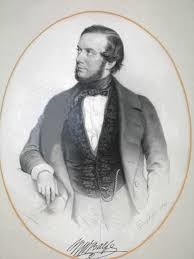 |
| Michael Balfe |
[ top ]
Works| Operatic works | ||
|
|
|
| Adaptations | ||
|
||
[ top ]
Criticism| Studies |
|
| Articles |
|
See also Nicholas Temperley, ed., Music in Britain: The Romantic Age 1800-1914 (London: Athlone Press 1981) ; Eric Walter White, The History of English Opera (London: Faber & Faber 1983; and studies by H. J. St. Leger, and W. J. Lawrence; T. J. Walsh, Opera in Dublin 1798-1820 (New York, 1993); also sundry remarks in Irish Book Lover, Vol. 3. |
| Highly recommended: |
|
[ top ]
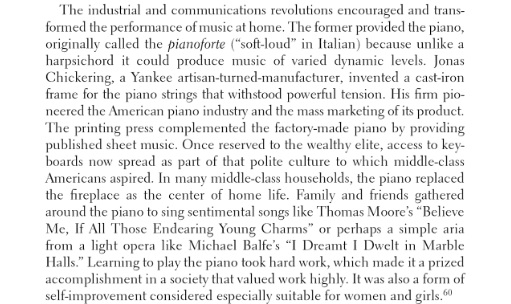
Daniel Victor Howe, What God Hath Wrought: The Transformation of America, 1815-1848 (OUP 2007) - incls. remarks:
|
||
| GBS on Balfe: |
|
| See Music in the Works of James Joyce > “Balfe and Bunn” - online [accessed 08.05.2017]. |
[ top ]
j[ top ]
| “Killarney” - A Ballad from Innisfallen by Michael Balfe; words by Edmund Falconer: | ||
|
||
|
[ top ]
References
Dictionary of National Biography [ODNB] relates that Balfe went to London with Count Mazzara [err.], and studied under C. E. Horn at Drury Lane Theatre; studied in France and Italy with Cherubini, Paer and others; engaged by Rossini and by Glossop, mgr. of La Scala; returned to London in 1833 [sic for 1835?]; wrote The Siege of Rochelle, produced at Drury Lane in 1835 with great success; other works include The Maid of Artois, Catherine Grey, Joan of Arc, Falstaff, The Merry Wives of Windsor and Diadeste; engaged in Dublin in 1838 and toured Ireland with his operas; founded own company in London with Keolanthe as the first production; produced Le Puits d’Amour in Paris, 1843; also in 1843, his famous Bohemian Girl (Drury Lane, 27 Nov. 1843), after a ballet by St. George, taken in turn from an original story in Cervantes; many decorations and honours in Europe, and a tablet in Westminster Cathedral; remarks, ‘[H]is brilliancy and fertility of imagination entitle him to a position beside Berlini, Rossini and Aube’, in spite of the intellectual
deficit of his operas.
Ann Stewart, ed., Diary (National Gallery of Ireland 1986) remarks that he supported his mother on his father’s death by playing violin in Drury Lane, aged 16; a Russian count [Mazzara], moved by his resemblance to a lost son, brought him to Italy; was chosen by Rossini to sing Figaro in The Barber of Seville in Paris; fnd. the unsuccessful English Opera Company in London.
Seamus Deane, gen. ed., The Field Day Anthology of Irish Writing (Derry: Field Day 1991), Vol. 2, remarks that Moore’s Melodies had to compete with songs from the three genuine operettas that became such an integral part of Dublin musical life by the turn of the century, The Bohemian Girl (1843) by Balfe, The Lily of Killarney (1862) by [Sir] Julius Benedict (1804-85), and Maritana (1845) by William Vincent Wallace (1814-65). Balfe’s “I dreamt I dwelt in marble halls”, Benedict’s “The Moon has raised her lamp above”, and Wallace’s “Yes, let me like a soldier fall” and “There is a flower that bloometh” became, with Moore’s songs, part of the standard repertoire of those ubiquitous Irish tenors [in] a specifically middle-class musical world (Deane, ed.; p.4).
A Balfe website is maintained by Basil Walsh (Palm Beach, Florida), author of Catherine Hayes: The Hibernian Prima Donna (IAP 2000), at BritishandIrishworld.com [link].
[ top ]
Notes
Balfe in cinema: The Bohemian Girl was adapted to film in England in 1922 with Ivor Novello and Gladys George in the leading roles. Ellen Terry also made a rare cinema appearance. There is a Youtube copy of the surviving remnant with a plot-summary of the whole - online [accessed 08.05.21017].
Note: A ‘comic version’ of the operetta was also produced by Laurel and Hardy in 1936 - complete with choral music [see online]
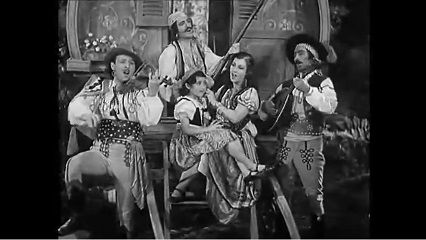 |
| The Bohemian Girl (Hal Roach, 1936) with Stan Laurel, Oliver Hardy and Thelma Todd - with full music sound-track. [ To view in new window, click on image or here. ] |
| Note: the aria “I Dreamt ...” is sung by Jaqueline Wells at 47:30. |
[ top ]
Bohemian boy: Balfe appears in Bohemian dress in a portrait in chalk and charcoal by John Wood in the National Gallery of Ireland. There is a window dedicated to his memory in St. Patrick’s Cathedral, Dublin, showing Erin leaning on a harp together with a bust from a portrait supplied by his wife and inscribed ‘The most celebrated, genial and beloved of Irish musicians ...[&c.]’ A marble bust by Sir Thomas Farrell (1827-1900) was commissioned by the Balfe Memorial Committee and presented to National Gallery of Ireland (1879) [See Ann Cruikshank and the Knight of Glin, Irish Portraits 1600-1860, 1969, p.89].
Brian de Breffny: A cover to selections from The Bohemian Girl arranged as ‘duet for two ladies voices’ [sic] is reprinted in Brian de Breffny, Cultural Encyclopaedia of Ireland, p.161, which also copies an engraving by Auguste Husfener.
Canon Sheehan: “I Dreamt I Dwelt in Marble Halls” is sung by the Curate and the narrator in Canon Patrick Sheehan’s My New Curate (1900), whereas Fr. Dan Hanrahan condemns it as ‘operatic rubbish [not] genuine Irish music, with the right lilt and the right sentiment.’ (Cited in The Field Day Anthology of Irish Writing, 1991, Vol. 2, p.1044.)
Joyce Connection: In James Joyce’s short story “Eveline” in Dubliners, the heroine is taken to see The Bohemian Girl by her sailor Frank. Maria sings the aria “I Dreamt I Dwelt in Marble Halls” from the second act in “Clay” - causing Joe to feel very moved (i.e., drunk) and to say, ‘there was no time like the long ago, and no music for him like poor old Balfe’ - while one of the musical Miss Morkans in “The Dead” (Dubliners), is said, improbably, to have been trained by Balfe. The Last Rose of Castile is the subject of a pun in Ulysses [viz., ‘rows of cast steel’ = railway track], while Balfe is also mentioned in the “Sirens” episode, and later in Finnegans Wake where reference is made to ‘a balfy bit ov old Jo Robidson’ (p.199) - where ‘balfy’ combining ‘lovely and of Balfe-like’.
Willa Cathers: The American writer published a story called “The Bohemian Girl” in which a son, Nils, runs away with a girl called Clara, the daughter of a bar-owner. His younger brother sets off on a train journey some years later with the intention of visiting the couple in Bergen [?New Jersey] but returns to his mother’s home to find that she has been milking the cows rather than hire a boy in his absence - leading to a reconciliation. The story was published in McClure’s Magazine in 1912. Any connection with Balfe’s opera is tenous to the point of nullity.
Margaret Sheridan sings “I dream I dwelt in marble halls” - along with arias from other operas and songs, in Rich and Rare: The Voice of Margaret Sheridan (CD 199?). Content: Manon Lescaut. Tu tu amore (8:19) ; La bohème. Si, mi chiamano Mimi (4:35) ; Madama Butterfly. Ancora un passo (3:38); Bimba dagli occhi miei (8:21); Un bel di vedremo (3:01); E questo (4:10), Puccini, Otello. Gia nella notte denza (8:52); Ave Maria (4:30). Verdi, Andrea Chénier. Vicino a te; La nostra morte Giordano (6:34). Irish songs. Come back to Erin / Claribel (2:45); Believe me if all those endearing young charms / Moore (3:09); I dreamt I dwelt in marble halls / Balfe (3:36); The lovers curse / Hughes (2:51); The sorrow thy young days shaded? (2:58); Rich and rare (3:22) / Moore.
Enya sings “I Dreamt I Dwell” in her Grammy-winning album Shepherd Moons (1991) - available on Youtube -
[ top ]