|







Life
1953- [Francis]; b. Buncrana, Co. Donegal, son of a bread-van driver who lost his job during McGuinness’s teens; after his ed. Carndonagh College, and UCD; postgraduate work in Middle English; witnessed premier of Brian Friel’s The Gentle Island (Olympia, Nov. 1971) - the first professional production he had ever seen, and which he later revived at the Peacock (Dec. 1988); contrib. Cyphers and Irish Press ‘New Irish Writing’ from 1974; temp. lect. at NUU (Coleraine, Co. Derry), where he taught linguistics and directed plays, 1977-79; formed life-long friendship with Phil Tilling lect. in Med. English - later to be his archivist; saw Patrick Mason’s production of Shakespeare’s A Winter’s Tale in Dublin (‘big impact ... gave me an understanding of the visual power of theatre’) directed Alan Ayckbourn’s Bedroom Farce; appt. lect. in Old and Middle English, UCD, 1979-80; held temp. lectureship in English, New University of Ulster [NUU], 1980, where he established a life-long friendship with Phil Tilling, lect. in Mediaeval English; wrote
The Glass God for Platform Group Theatre (Lourdes Hall, Sean MacDermott Street, Dublin, 1982); returned to Dublin and appt. lecturer in English, St. Patrick’s College, Maynooth [NUI], 1984; impressed by Brian Friel’s Faith Healer (1979); wrote The Factory Girls for the Galway playwrights’ workshop (Peacock [Abbey] 1982); |
his next play Friends was rejected by Field Day, re-worked as Carthaginians, dealing with aftermath of ‘Bloody Sunday’ in Derry [29 January 1972], originally to have been produced by Field Day, but premiered instead at Dublin Theatre Festival (Peacock 1988); Borderlands, commissioned by the TEAM educational theatre group (1984), and toured in schools and colleges of North-east and midlands; Observe the Sons of Ulster Marching Towards the Somme (Abbey 1985), a study of the Ulster 36th at the Somme and at home, depicting the tensions of Ulster loyalism from the inside, with a homosexual narrator-survivor, Piper, speaking of a band of Ulster Volunteers and their need for love; BBC radio production; successful premiers in Canada and American; unplayed in USA: revived Abbey 1995; wrote Ladybag, a two-hander farce (1985) |
wrote The Gatherers (Lombard St. Studios 1985), for TEAM, divides action between the Eucharistic Congress, Dublin 1932, and Papal visit, 1979; Innocence (Gate Theatre 1986), on a period in the life of the Caravaggio, set in 1606 (for which he wrote the programme notes); translations-versions include Ibsen’s Rosmersholm (English National Theatre 1987); trans. Lorca’s Yerma (Peacock [Abbey Th.] 1987); Peer Gynt (Gate Th., 1988), revived at Royal National Th. [Olivier in-the-round] (dir. Conall Morrison, Nov 2000); Three Sisters (Gate Th. 1990); also The Threepenny Opera (Gate Th., 1991), after John Gay; Mary and Lizzie ([The Pit] Barbican / RSC 1989), on the Irish sisters who lived with Engels in Manchester, figured as vehicles for the exploration of a new, migrant subjectivity in place of the homely female stereotype of Irish tradition; and The Breadman (Gate 1990); Feed the Money and Keep Them Coming, a monologue in reaction to IRA bombing of Enniskillen, November 1987; |
issued Times In It (1988), containing the one-act plays Bride of the Bag Man; Flesh and Blood, a study of Alzheimer’s disease; and Keep Them Coming, a farce; revived Friel’s The Gentle Island, acting as director (Peacock Th., Dec. 1988); trans. Lorca’s House of Bernarda Alba (Lyric Th., Belfast, 1991); Someone Who’ll Watch Over Me (1992), based on Brian Keenan’s An Evil Cradling (1992), with chars. Michael and Edward [rep. John McCarthy] and an American as hostages of the Hasbollah; premier Hampstead Theatre, July 1992; produced by Noel Pearson at the Vaudeville Theatre, West End; moved to Booth Theatre, Broadway, where it was a long-running succcess; awarded Independent on Sunday Play of the Year and nominated for Olivier Award; wrote The Stronger (Project Arts Co., Bewley’s Cafe, 1993), a contest of female wills based on Strindberg; trans. Chekhov’s Uncle Vanya (Guildhall, Derry; Tricycle Th., London, 1995); |
| wrote Bird Sanctuary (1993), a comedy of manners (prem. London, 20 Nov. 1997); also television plays, Scout (1987) and The Hen House (1989); trans. Ibsen’s Rosmersholm (National Th., London, 1987); he wrote Mary and Lizzie (RSC, 1989) about Engel’s involvement with the Irish Burns sisters on reading of the title-characters in Edmund Wilson’s To the Finland Station; issued Booterstown (1994), a poetry collection; Member of Board of Abbey and Aosdána member; lives on Booterstown Ave., Co. Dublin; Irish-American Literary Prize 1992; his Sons of Ulster, dir. Patrick Mason, received standing ovations at Theatre de l’Odéon, Paris, during l’Imaginaire Irlandais, May 1996 (trans. Alexandra Poulain and Joseph Long); he wrote Mutabilitie premiered Royal National Th. (RNT/Cottesloe, London, Nov. 1997), dir. Trevor Nunn, with Aisling O’Sullivan as the File and Diana Hardcastle as Elizabeth I; later played at the Samuel Beckett Centre, TCD (Aug.-Sept. 2000), with Jude Sweeney as Shakespeare; wrote filmscript for Dancing at Lughnasa (1998); trans. Alexander Ostrovsky’s The Storm (1998); trans. Ibsen’s Hedda Gabler (Richmond Th., London 1994; Roundabout Theatre, Broadway, 1994); Observe the Sons of Ulster produced by the Abbey Theatre at the Théâtre de l’Odéon, 1996 - along with J. M. Synge’s The Well of the Saints as part of l’Imaginaire irlandais, 1996; |
his new play Dolly West’s Kitchen (Abbey Th., 2000), set in Donegal during WWII preparations for D-Day landings, and depicting a conflict between British army-man, two GIs, and local nationalists; premiered at Dublin Theatre Festival before moving to Old Vic., West End (May-Aug. 2000), where it enjoyed a successful run; trans. Strindberg’s Miss Julie (Royal Haymarket, London, 2002); his translation-play Orestes’ Elektra staged at Project Arts, Dublin (17 Aug. 2002); trans. Chekhov’s The Wild Duck (Abbey 2003); The Gates of Gold (2002), a commemoration of Michéal MacLiammóir and Hilton Edwards as abriel and Conrad, set in Harcourt Tce. at the death-bed of the former; issued The Stone Jug (2003), being 60 sonnets on ‘the man I am not with’; a translation of Hecuba Donmar Warehouse, London), 9 Sept. 2004; Speaking Like Magpies (Swan Th., Stratford-upon-Avon, Dec. 2005), based on the Gunpowder Plot at the 400th anniversary; |
issued a version of Daphne Du Maurier’s Rebecca (2005) and trans. Racine’s Phaedra (2006); issued trans. of The Caucasian Chalk Circle [Olivier in-the-round] (Nat. Th., London 2007), dir. Simon McBurney; trans. Ibsen Ghosts (Old Vic. 2007); also There Came A Gypsy Riding (Almeida Th., London, 2007); writer-in-residence at UCD, in 2007; issued Dulse (2008), a new poetry collection; with Di Trevis, London Cries (Irondale Th., NY 2008), music and drama; trans. Ibsen’s The Masterbuilder (NY Irish Rep. Th., NY 2008); gave Distinguished Lecture tat Irish Studies Seminars, Malet [Senate] House, Univ. of London, April 2009; wrote Greta Garbo Comes To Donegal (Tricycle Th., London 2010); his version of Ibsen’s Gabriel John Borkman, dir. James Macdonald, with Fiona Shaw, Alan Richman, Lindsay Duncan, and John Kavanagh playing, premiered at the Abbey Th. as part of Ulster Bank Dublin Theatre Festival, 2010; also Baglady revived (Focus, Aug. 2010); Gabriel John Borkman transferred to the Harvey Th. of Brooklyn Academy of Music, Jan. 2011; a new play, The Hanging Gardens (Abbey Th. 2013), concerns a writer and his last illness; published Arimathea (2013), a novel with numerous narrators set in rural Donegal, where an Italian painter arrives in 1950 to paint the Stations of the Cross; issued a second novel, The Woodcutter and His Family (2017) - based on Joyce in Zürich in 1939. DIL FDA OCIL |
| [Clear the Stage (1998) is an 40-min. documentary on McGuinness directed by Margot Harkin which deals chiefly with Observe the Sons of Ulster Marching Towards the Somme and its companion piece Carthaginians, a response to Bloody Sunday in Derry (29 Jan. 1972). Those terviewed include McGuinness, David Ervine (PUP), Trevor Nunn (Dir. of Nat. Theatre, London), Brian Keenan (the former Beirut hostage and model for a character in Someone Who’ll Watch Over Me, and singer Marianne Faithful. Available at IFI Archive - online. |
[ top ]
|
 |
| RTÉ (Dublin) |
| RTÉ citation | ||
|
| Faber lists ... | ||||||||||
|
||||||||||
[ top ]
Works| Plays |
|
[ See Frank McGuinness Page in Doollee - online ] |
| Plays (editions) |
|
| [ top ] |
| Collected Plays |
|
| Reprints |
|
| Film scripts |
|
| Poetry |
|
| Fiction |
|
| [ top ] |
| Miscellaneous |
|
[ top ]
“In Loving Memory”, Photography by Amelia Stein, poetry by Frank McGuinness [‘There was an old woman who lived in a shoe / With so many children, so many children / They hauled the old woman out / from her shoe, / Her children were weeping // They tore out their tongues, the old / woman’s too / And so many children, so many children // There was an old woman who / looked at a shoe, / Her six million children, what did they do?’ (Limerick City Gallery of Art, 1989.)
Note: a collection of photos by Amelia Stein from Ireland and Israel on the theme of grave culture and the similar and dissimilar ways that different cultures make memorial gestures to their departed, at Butler Gallery. The catalogue is in prayer-book format, with photo-images occasionally juxtaposed by short poems from McGuinness, and prefaced by a short introduction by Patrick T. Murphy. (Butler Gallery, Kilkenny, 17 March-20 April 1990)
[ top ]
Criticism
|
See also Joseph Long [interview with McGuinness], in Amid Our Troubles: Irish Versions of Greek Tragedy, ed. Marianne McDonald, & J. Michael Walton, with an introduction by Declan Kiberd (London: Methuen 2002). |
Bibliographical details
Kenneth Nally, ‘Celebrating Confusion’: The Theatre of Frank McGuinness (Cambridge Scholars Publishing 2009), x, 300pp. Acknowledgements [ix]; Introduction: Of Mutability- Narratives of Difference [1]; 1. Deregulating the Family Unit - symbolising Inclusiveness: “The Bread Man”; Dolly West’s Kitchen; The Bird Sanctuary [1]; 2. ‘Three hundred years is too long to be still considered a planter: The imaginative unity of Sons of Ulster’ [67]; 3. The diversity of the ‘Homosexual Temperament’ - Innocence; Gates of Gold [101]; 4. ‘The bravest men sometimes behave like women’ - gender and intertextuality in Carthaginians and Someone Who’ll Watch over Me [139]; 5. ‘The silence which history fails to penetrate: Reconfiguring the narratives of memory, fiction and history - Mutabilitie; Factory Girls; Baglady; Mary & Lizzie] [189]; Conclusion: The shared genetics of McGuinness’s Plays [225]. Note: Nally lectures at University College, Galway.
[ top ]
|
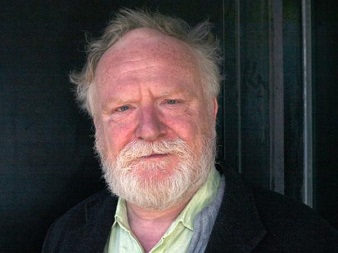 |
| Photo by Eric Luke (cropped) | The Telegraph (UK) |
Eileen Battersby, reviewing Someone Who’ll Watch Over Me at the Abbey in Fortnight (May 1993), [q.p.], dislikes Sean MacGinley’s crude, unsophisticated Edward [...] hyper-talkative and uncouth [...] no pauses, no silences ... function[ing] at an unconvincingly frantic pace.’ Further: ‘While McGuinness’s previous play, The Bread Man, collapsed under the sheer weight of over-writing, this one fails by its reluctance to pursue the unexpected emotional dimension and more natural expressions of “what are we doing here?”’. [Cf. the opposite view under Brian Keenan.
John Keyes, reviewing Uncle Vanya in Fortnight (March 1995), comments on the lack of ambiguity in the treatment of the dialogue and insists, ‘Chekov [sic Field Day] is not Irish - a fact which seems to drive Irish writers to dementia, and the similarities which they purport to find between Irish and Russian fin-de-siècle society are spurious and extremely difficult to sustain.’
[Paddy Woodworth,] ‘Abbey festival play well received’, Irish Times (21 Aug. 1995), [q.p.] notes a discussion of Abbey revival of Observe the Sons of Ulster (Edinburgh Festival 1995), on BBC2’s ‘Edinburgh Nights’ (Mon. 21 Aug. 1995), and that McGuinness participated with Martin Lynch in a Guardian discussion on ‘Writing after the Ceasefires’, Edinburgh (Sat. 16 Aug. 1995).
[ top ]
Enda Longley reviewing Uncle Vanya in the Field Day production in Derry Guild Hall (March 1995), with programme notes by Tom Kilroy marked with disapprobation what she called ‘the usual line’ in explaining the Irish obsession with Chekhov’s play: ‘A provincial culture rooted in land ownership. A familial structure that is so elastic that it can hold all sorts of strays and visitors and drop-ins in painful intimacy. All that talkativeness, tea-drinking, and dreaming [...]’ - this, she says, misreads Irish conditions in 1890 and also Chekhov. (See Times Literary Supplement, 10 March 1995.)
Elizabeth B. Cullingford, ‘British Romans and Irish Carthaginians: Anticolonial Metaphor in Heaney, Friel and McGuinness, in PMLA (March 1996), pp.222-36, a free-ranging enquiry into the historical origins and contemporary use of the Scythian-Phoenician typology of Irishness; includes the remarks, ‘Remembering the abandoned Dido rather than the successful Aeneas and his colonising grandson Brutus, McGuinness invokes alternative mythical origins that avoid the Troy-Rome-London axis.’ (p.223); ‘McGuinness maintains that for the Troubles to end, the dead must be buried unavenged, though not forgotten. Elegy, the “feminine” keen, must be performed by both men and women. Altering both Vergil and Purcell, McGuinness outdoes Tate as Dido escapes the graveyard and his textually ordained fate.’ (p.235.)
Elizabeth B. Cullingford, ‘There’s Many a Good Heart Beats under a Khaki Tunic’ (2001), cites Kevin Nolan’s Irish Times contemporary review of Dolly Wests’ Kitchen: ‘“[T]he author wants to compare the loyalties and enmities in the dinner part with the loyalties and enmeites of the parties engaged in, or neutral in the world war. Here he falls into a logical fallacy which is ultimately lethal to his drama. Sexual love or hate is not comparable to love or hate of country, so that to compare [...] the resolution of sexual relationshps with the end of the war is merely sentimental.” if this assertion were correct, we might have to conclude that much of the Irish drama we have looked at is “merely sentimental”. I would reject this conclusion, along with the implied denigration of sentiment as a political and theatrical force. When Benedict Anderson categorises nationalism with kinship and religion he indicates that love of one’s country is closer to passion than to intellectual allegiance. That familiar analogy between sexuality and national that McGuinness uses to structure his play does not depend on a “logical fallacy” and it is inherent in the Irish dramatic tradition.’ (Ireland’s Other: Gender and Ethnicity in Irish Literature and Popular Culture, Cork UP 2001, p.72.)
Claire Gleitman, ‘ “Like Father, Like Son”: Someone Who’ll Watch Over Me and the Geopolitical Family Drama’, Éire-Ireland, 31, 1 & 2 (Spring / Summer 1996), states that Someone Who’ll Watch Over Me ‘bears an unmistakable resemblance to Waiting for Godot, as Frank Rich pointed out in a peevish review of the New York production: “Not even Beckett”, wrote Rich, “always succeeded in keeping plays about boredom from being boring. And Mr. McGuinness, if a charming writer in spurts, is no Beckett.”’ (p.78); she writes further that ‘The three men whom McGuinness has chained to a wall are among the dramatist’s richest characterizations to date. At the same time, and paradoxically, they tread perilously close to caricature.’ (p.88).
[ top ]
[Stuart Freedman], ‘The Trouble with Shakespeare’: London Telegraph [q.d.; 1997], interview with Frank McGuinness, with photo-port. Quotes McGuinness’s remarks on Mutabilitie quoted: ‘He [Shakespeare] is the epitome of English culture and he’s the great connector between Protestant England and catholic England because he has those two wires fused in his theatre. So I thought, what if he comes to Ireland and meets some Gaelic poets like the File while they are all in this tremendous crisis?’; ‘I have worked on the play for 12 years and there have been times when the despair has been overwhelming. So much emotion had been invested in the ceasefire that things can never be the same again. The bomb that broke the ceasefire at Canary Wharf was a devastating day. / I finished the play before the second ceasefire so we are still living in a dangerous time and a very decisive time. There are stark choices being presented to the whole island and it’s time for a very direct dialogue. We have to get together and find a solution. And we can’t avoid the fact that that is as much our responsibility as it was for Spenser and the File.’; also, ‘I’ve always been intrigued by this exotic world across the border. We used to speculate about how free the Protestant girls were, you know? One of the most shocking things if you go through the Irish educational system is that you’re taught nothing about Protestantism and it’s the same for the Protestant schools in the North. How can you ever be at ease with your neighbours if you know nothing about them?’; ‘I think Ibsen is the great Protestant playwright. His plays lay bare the painful path of solitary self-examination that Protstantism demands and which makes it a much more disturbed world than people think.’; ‘If you pursue a policy of absolutes, or of revenge, you end up dying, spiritually or physically, and I really wanted to challenge that arrogance and smugness and also to point out the depth of the relationship between us.’
Eamonn Jordan, The Feast of Famine: The Plays of Frank McGuinness (Berne: Lang 1997): ‘In Observe [… &c.], the writer sets out not to deny his characters their history, but o make them question the realtionship between identity, repetition, sacrifice and the mythological security and significance of the past.’ (op. cit., pp.xviii-ix.) Further [writing on Someone ], remarks that McGuinness offers us a drama in which‘each character rescues and is rescued, and in doing so [he] not only deconstructs the concept of the heroic but he also facilitates a broader sense of the humane, where the weak are strong and the strong unafraid to be weak and receptive of another’s kindness.’ (p.185.)
C. L. Dallat, notices Frank McGuinness, Dolly West’s Kitchen (Old Vic), in Times Literary Supplement (2 June 2000): title-char. unmarried and unhurried, dg. of doctor in southern Irish town; returns in flight from Mussolini’s Italy; visited by Alex Redding, her former lover now working as interpreter for US forces stationed in N. Ireland, and by two GI’ss (one, James O’Brien, an Irish American, the other Italo-American Marco Delavicario, a homosexual), brought back home from the local by her mother Rima (played by Pauline Flanagan); also a ranting son, Justin, commissioned in the Irish army and guarding Lough Swilly (played by Michael Colgan); Anna, the Wests’ maid; Marco and Justin become lovers; ends with Dolly agreeing marry Alec and help rebuild “England” in spite of her historical distaste for that country; concludes with remarks: ‘If McGuinness occasionally slips into neutral with gags and stage-Irishisms ill-matched to this respectable household, he none the less engages and entertains while successfully challenging simplistic views of 1930s sexuality and his country’s inability to distinguish good from evil’, and compares the ‘the struggle of warring nations’ with ‘the complexity of personal relationships’ in the play, concluding that the ending is ‘an anthem to peace rather than to militarism, emphasis[ing] simply and topically how patriotism - in Ireland, England, the United States, or Germany - has been used to serve greater and lesser ends.’ (p.21.)
C. L. Dallat, review of Speaking Like Magpies Swan Th., Stratford-upon-Avon), in Times Literary Supplement 9 Dec. 2005), p.18: ‘When the head of England’s Jesuits, Henry Gamet, is tortured to reveal the names of his fellow Catholic Gunpowder-plotters in Frank McGuinness’s Speaking Like Magpies, his stance (on a chair, in a grubby shift, outstretched arms trailing wires) manages to suggest not just the Roman Empire’s execution of the Christ Garnet serves, but more recent images of abuse in the Middle East. This is the one point at which the director, Rupert Goold, makes overt the similarities between seventeenth-century and contemporary attitudes to “foreign” religions, seditious clerics and amateur bomb-makers. For the most part, McGuinness’s play keeps in focus the specific conflict which helped forge Britain’s peculiar compromise between Scots-Calvinist democratic instincts and French-Catholic absolutism when James I turned his back on England’s recusant families. [...]’ (For full text, see infra.)
[ top ]
Alice Oswald, review of The Sea with No Ships (2000), in Times Literary Supplement (12 May 2000), p.26, styles the collection mostly dramatic monologues; reviewers considers him not be in control of the ‘under-meanings of the rhythms’; quotes “Mrs MacDermottroe”: ‘Why am I talking like this? Have you slipped / whisky into my coffey? I wouldn’t put it past you. / Jesus, I’ve done it myself when I wasn’t looking.’ Further, ‘They are always plural, the catacombs. / As if one did not die alone. // How comforting. Do you remember us / Visiting them, that crying child? ... Do you remember his name? Years ago. / He’d nearly be a grown man now. // Was he spoilt, beyond ruin or repair? / There are reasons for not believing so.’ Reviewer speaks of flatness of these perfectly honest and unpretentious poems and conducts an interrogation of the relationship between poetry and drama, suggesting in one place that McGuinness, ‘a playwright based in Dublin’, is guided in his artistic decisions by ‘the need to differ from Yeats’ [sic].
Nelson Pressley, ‘Raising the Curtain on Modern Ireland’, in Washington Post (Sunday 22 Oct. 2000), notices Frank McGuinness, Barbaric Comedies, adapted from Ramon Maria le Valle-Inclan, an epic trilogy written between 1907 and 1922 and acc. the critic ‘excruciating, but in all the wrong ways’. (p.G9.)
Fintan O’Toole, review for Frank McGuinness, Gates of Gold (Gate Th.), in The Irish Times (2 May 2002) [Weekend], p.2. MacLiammoir and Edwards figured as Gabriel and Conrad; set in Harcourt Terrace; O’Toole writes, ‘By the end of the evening’s 95 minutes, you feel the great actor’s ghost is still hovering over the stage he inhabited so often, smirking triumphantly at having seen off yet another attempt to upstage him’ but speaks of the strength of McGuinness’s writing showing in ‘the courage to leap into the emotional dark of real lives and to imagine a gay relationship without sentimentality.’
Terence Brown, review of Hiroko Mikami, Frank McGuinness and his Theatre of Paradox, in The Irish Times24 August 2002), remarks that ‘Mikami’s fascination with symbolic action and ritual meanintgs makes her assume theatre audiences in the West can absorb more than they can (so I think she exaggerates the success of the play Mary and Lizzie, 1989), but her insights are nonetheless valuable, coming form one who has engaged sensitivesly with a culture she found strange and even off-putting.’ (Weekend, p.8.)
Chris Morash, ‘Life and Works and Acidents’, review of Helene Heusner Lojek, Contexts for Frank McGuinness’s DramaCUA), in Times Literary Supplement21 Jan. 2005), p.18, includes reference to the death of Barbara Hayley, former Professor of English at Maynooth: ‘In Someone Who’ll Watch Over Me, the character Michael describes simply, painfully, his wife’s death: “She was driving to work. It was the month of May. I wasn’t with her. I was revising an article at home. I answered the phoneand the university told me she was unconscious, at the scene of the accident. I knew.” When I first heard this in performance, I had a hunch that McGuinness was writing indirectly about a mutual friend of ours who had died in a car accident. I never mentioned this hunch to anyone; but Lojek confirms it in a paragraph that casually includes half a dozen similar insights into the sources of the plays, whether deeply personal, allusively literary, or more generally social.’
Heinz Kosok, ‘The Easter Rising versus the Battle of the Somme: Irish Plays about the First World War as Documents of the Post-colonial Condition’, in Munira H. Mutran & Laura P. Z. Izarra, eds., Irish Studies in Brazil Sao Paolo: Associação Editorial Humanitas 2005), on Irish plays about World War I: ‘Technically, most of them utilise the perspective of the memory play where the last eye-witnesses of the War are about to die, taking the experience of the War with them into oblivion. The most successful of these plays is McGuinness’s Observe the Sons of Ulster Marching Towards the Somme which centres on one Kenneth Pyper, the last survivor who [94] as an old man is haunted by memories of the War and in vain tries to understand them. His attitude throughout the play reflects a petrified myth of loyalty and devotion which has led to the self-engendered isolation of today’s Ulster Unionists. According to McGuinness, it results from the experience of the First World War. Mirrored in Pyper’s consciousness, McGuinness shows the fate of eight Ulstermen from different regional and social backgrounds seven of whom are killed on the Somme. Significantly, their devotion to an abstract, romanticised image of Ulster leads them into extinction, which, combined with the incomprehension of the lonely survivor, is a bitter verdict on present-day Ulster Unionism.’ (pp.94-95.)
[ top ]
Christina Hunt Mahony, ‘Frank McGuinness: master of a novel form’, review of Arimathea by Frank McGuinness, in The Irish Times (Sat. 9 Nov. 2013): ‘The story is first told from the perspective of Euni, the pubescent daughter of the lodging house to which a recently arrived Italian painter, Gianni Cuma, has come. He is there at the behest of the parish priest, Fr O’Hagen, to paint the Stations of the Cross in the local church. The painter, with his brown skin and artistic habits that defy expectations in small-town Donegal, is a mystery to the girl. / Euni is somewhat cowed but not without a degree of boldness and insight in the face of this intruder and his strange ways. Nor does Gianni kowtow to local expectations of decorum, leaving a trail of paint-stained clothes at the end of each week for his landlady, and taking early and solitary woodland walks. / The chapters that follow are related in turn by each of Euni’s parents: her mother, Margaret, who is uneasily expecting her fourth child; and her father, Malachy, a blacksmith slowly becoming redundant in the town. More chapters are given over to Fr O’Hagen, prime mover in the plot; the local vicar, Columba Sewell, and his beautiful niece Martha. Finally, we read Gianni’s own story. It is a baroque family tale tinged with myth and filled with period intrigue and timeless tragedy.
With each chapter McGuinness’s storytellers add a subtle layer of complexity, laced with artistic and religious allusion, but also with sexual secrets. Gianni, nicknamed Giotto, was once the favoured youngest son of a large family, and at first he was encouraged to become an artist. Later the child is mistakenly credited with miraculous power, and spends his life being either venerated or scorned, with little comfort in between. Gianni’s unearthly physical beauty makes him the object of desire of both men and women, yet he has remained peculiarly alone.’(See full-text copy in RICORSO Library, “Criticism > Reviews”, via index, or as attached.)
[ top ]
| ‘Did you intend that we should keep seeing ghosts?’ (1996, p.7; quoted in Maureen Ruprecht Fadem, The Literature of Northern Ireland Spectral Borderlands (Palgrave 2015), p.64. |
Observe the Sons of Ulster Marching to the Somme (1985), Piper’s opening soliloquy: ‘Those with me were heroes because they died without complaint for what they believed in. They taught me by the very depth of their belief, to believe. To believe in you. what sense could you make of their sacrifice? I at least continued their work in this province. The freedom of faith they fought and died for would be maintained. There would be, and there will be no surrender. The sons of Ulster will rise and lay their enemy low, as they did at the Boyne, as they did at the Somme, against any invader who will trespass on to their homeland. Fenians claim a Cuchullian [sic for Cuchulainn] as their ancestor, but he is ours, for they lay low for centuries and wept in their sorrow, but we took up arms and fought against an ocean. An ocean of blood. His blood is our inheritance. Not theirs. Sinn Fein? Ourselves alone. It is we, the Protestant people, who have always stood alone. We have stood alone and triumphed, for we are God’s chosen.’ (p.10; quoted in Ulrich Schneider, ‘Staging History in Contemporary Anglo-Irish Drama: Brian Friel & Frank McGuinness’, The Crows Behind the Plough: History and Violence in Anglo-Irish Poetry and Drama, ed. Geert Lernout, Amsterdam: Rodopi 1991, pp.93-94.)
Observe the Sons of Ulster [... &c.] (1985) - Crawford: ‘I am a soldier that risks his neck for no cause other than the men he’s fighting with.’ (p.48.) Anderson: ‘The whole of Ulster will be lost. We’re not making the sacrifice. Jesus, you’ve seen this war. We are the sacrifice. We’re all going mad. Some of us, like Pyper, were mad before going. Others are getting that way, look at Moore. He won’t be back. He’ll be in a home for the rest of his life. Where I’ll be too. Crawford’s turning into a machine and I’m going lunatic.’ (p.51.)
Observe the Sons of Ulster [... &c.] (1985) - It’s too late to tell us what we’re fighting for. We know here we are. We know what we’ve to do. We know what we are doing it for. […] we joined up willingly for that reason. Everyone of us, except you [Pyper]. You’ve learned that at long last […] You won’t save us, you won’t save yourself, imagining things […] This is the last battle, we’re going out to die.’ (p.74.)
Observe the Sons of Ulster [... &c.] (1985) [Pyper’s final speech]: ‘If you are a just and merciful God, show your mercy this day. Save us. Save our country. Destroy our enemies at home and on this field of battle. Let this day at the Somme be as glorious in the memory of Ulster as that day at the Boyne, when you scattered our enemies. Spare us, I love - . Observe the sons of Ulster marching towards the Somme. I love their lives. I love my own life. I love my home. I love my Ulster. Ulster. Ulster. Ulster. Ulster Ulster. Ulster. Ulster. Ulster.’ (q.p.)
Mutabilitie (The File [poet] to Shakespeare): ’We must lift the odour of Edmund Spenser. Outwit him,William, my papist, my pupil, my Englishman.’
Wrong Irishman: Review of An Evil Cradling (1992), by Brian Keenan, in The Irish Times (26 Sept. 1992): ‘If his captors wished to see how a Westerner cold cope with their torture, then they had really picked the wrong Irishman in Brian Keenan, for he defied them [...] a mighty achievement by a magnificent writer’.
[ top ]
Irish Identity: ‘A Sense of Irish Identity’ (Guardian, 5 Sept. 1994), Frank McGuinness takes issue with Fintan O’Toole’s contention that the Abbey has lost the power it once possessed [previous week in this journal], ‘if there’s one thing on which we [McGuinness and Garry Hynes] passionately agree, it is on the survival of the Abbey and the Peacock as Ireland’s National Theatre ... the permanent company consists of some of the finest actors in the country ... young writers, it pays them well ... It is now imperative that the Abbey sees itself creating a school of writing, an imaginative collectivity, gathering the conflicting visions from every part of the island. There are many more visions to disturb and obsess than that between north and south. it is the work of a national theatre to record national diversity and not even its harshest critics could accuse the Abbey of such evasion ... [compares with use of national repertoire in UK] here I’m ashamed to admit it, that ain’t the case. ... The Irish have never been known for their good opinion of their neighbours or themselves, but the desire to be rid of the national institution for the only art form that Ireland has made a sustained, world-wide contribution to, betrays something deeper than concern over poor box-office or the level of Arts Council funding. It smack of a lack of self-determination, a deliberate avoidance of self-knowledge at an historical time when these qualities are crucial for any changed understanding of ourselves, ourselves alone, ourselves together. ... The country that lets its theatre die has not got much going for it. So, the struggle continues.’ (p.10); ‘We claimed we would die for each other in battle. To fulfil that claim we marched into the battle that killed us all. That is not loyalty. That is not love. that is hate. Deepest hate. Hate for one’s self. We wished ourselves to die and in doing so we let others die to satisfy our bloodlust. That lust we inherited. The true curse of Adam.’ (p.12); ‘We’re not making a sacrifice .... We are the sacrifice.’ (p.51); ‘Belfast will be lost in this war. The whole of Ulster will be lost.’ (p.51.)
Interview: Joseph Long, ‘New Voices in Irish Theatre: An Interview with Frank McGuinness’, in Études irlandaises, n°24-1 (1999). pp,9-19; |
| [ For full-text copy of this interview - see the attached in a separate window with details of internet access to its Source. ] |
[...] Frank McGuinness: It’s part of the pleasure of putting plays on in England that you do not give the English audience what they believe they’re going to get when they go to an Irish play. Even with Someone Who’ll Watch Over Me, which was very successful, even there I think they were quite taken aback by something I personally do believe in, which is a very deep love of the English language, going right back to Old English, and the celebration of it and of their literature. Again, that didn’t give them what they wanted, but they liked that image of themselves. They don’t like the image of themselves in Mary and Lizzie and in Mutabilitie. I ’m not in the business of, all the time, flattering them. Joseph Long: You mentioned Peer Gynt, which was a strong influence on Mary and Lizzie, a formal influence at any rate. Peer Gynt is one of a number of adaptations you’ve done. There is a whole part of your work, in the late eighties, which was translations or adaptations of European plays (8). You see this as an intrinsic part of your own writing, not just a service of translation. Frank McGuinness: Absolutely. It’s also a liberation. Irish literature has always been far too much defined in terms of its relationship with English literature. It’s been a part of the taming of the Irish by the English to do that. But in fact if you look at our major authors of this century, Os’Casey has much more in common with Brecht than he would with any other playwright, particularly in English. Joyce and Beckett looked to the continent. Joyce was deeply in touch with Dante and the Greeks, and Beckett with both French and Italian literature. I remain at home and try to make these great European playwrights part of our vocabulary. That is definitely a cultural ambition. But the private ambition is there too, which is to learn more about writing plays, really. Because these authors, Ibsen more than anybody, and Lorca, Strindberg, Chekhov, they teach you more about your craft. We are dealing with an art form, unapologetically dealing with an art form, and we need to know more about it. A painter has to go and look at [16] other traditions, you have to go and look at other theatres and know at least what you’re rejecting. Joseph Long: So it’s partly an apprenticeship to your own craft ... Frank McGuinness: Absolutely. Joseph Long: ... and then there is the wider agenda that both Tom Kilroy and Brian Friel seem to be pursuing, consciously pursuing, through the eighties and which has to do with giving an Irish voice to these plays, which were certainly not written in English, but which have been, in a way, appropriated and are treated in Britain almost as part of the canon of British theatre, of a British theatre tradition, Chekhov and Ibsen especially. Both Kilroy and Friel have been quite explicit about their ambition to reclaim these authors from that anglicised tradition, to restate them in an Irish voice. That was part of your ambition too, wasn’t it? Frank McGuinness: That is certainly the case for Three Sisters and for Peer Gynt. But what is significant is that I am now being invited by companies outside Ireland to do versions. And I do them as I hear them, and they do them as they want to speak them. That was the case with The Caucasian Chalk Circle, with Brecht, which was a multi-cultural cast ... [...] |
| See full-text copy - as attached. |
[ top ]
Booterstown (1994): ‘I like the sound of people laughing. / It has healed my troubled soul. / And my soul is staging a comeback / To say what it is I like to see. / Look at the landscape that is my life / In this foreign country that is Ireland / Where I am green and I am happy; / I am the blue guide to Ireland.’
Innocence (1986): ‘Its violence I was prepared for ... but his tenderness, his gentle power, shook me into something else.’ (McGuinness, writing of Caravaggio in his Programme Note to Innocence; cited in Riana O’Dwyer, in Geert Lernout, ed. [Op. Cit .], 1991, p.109.
Courage: I have always admired courage that comes from cowardice. I think that my great theme is “moral cowardice”.’ (quoted in Eamonn Jordan, The Feast of Famine: The Plays of Frank McGuinness, Lang 1997, p.ix.)
[ top ]
| “The Woodcutter and His Family” (Brandon/The O’Brien Press 2017) - An Extract |
| [Source: Available at RTE - online; accessed 26.09.2017] |
|
| Chapter One - Son - Archie - Zurich, Switzerland |
On the day I was born my father set himself the task of learning to lip-read. Why a man so prodigiously talented in the acquisition of the earth’s languages should undertake such a challenge has always and ever baffled me. Perhaps it baffled himself. Who can say? |
| For copy in separate window - click here. |
|
‘Don’t worry, Be Abbey’, discussion of National Theatre at the Abbey on its 90th birthday (Dublin, Dec. 1994). McGuinness’s contribution is printed in Fortnight 336 (Feb. 1995): ‘I wish it crisis. I wish it continuing crisis, because crisis is at the root of all creativity and the Abbey thrives on crisis, on attack, on dispute [...] I hope it won’t do co-productions’; commends courage of Patrick Mason and Gary Hynes; quotes ‘the great words of Brian Friel [from Translations ], “confusion is not an ignoble condition.”’
Oscar Wilde: ‘Whatever is written can be published, and whatever is published is performed. De Profundis is not the meditation of the penitent at prayer. It is the act of a penitent as performer. It is a histrionic defiance of the histrionic judgement passed against Wilde at his trial, a theatrical explosion to break the silence that his prison sentence demanded: it is a play.’ (Frank McGuinness, ‘The Spirit of Play in De Profundis ’, in Jerusha McCormack, Wilde the Irishman, 1997, p.141; cites in Neil Sammells, contrib. to Princess Grace Irish Library Conference, 1998; with comment, ‘Such a reading not only prevents us from accepting that the ‘penitent’ Wilde of De Profundis is in some sense the authentic Wilde - cornered, finally, in the misery of the prison-cell.’)
[ top ]
Rimbaud: reviewing Graham Robb, Rimbaud, in The Irish Times (14 Oct. 2000), McGuinness writes: ‘Something went terribly wrong with the education of Arthur Rimbaud [...].’ Further, ‘In this complex, subtle, witty biography Graham Robb dares to disbelieve everything I revere about Rimbaud. This book drove me back to his poetry, in prose and verse, so that I could argue against the cold eye he casts on the career of a poet I’ve adored since I stumbled through the first stages of my literacy in the French language. His love of the poetry is critical, domineering and ruthless. His role model as biographer is Rimbaud’s terrible mother. A savage Jansenist, she effectively destroyed her son as surely as she destroyed her marriage. It seems to be Robb’s mission to forgive her, becayse that lack of love led to an absent father and the poems, at their greatest, Robb reads as charts to locate the man who was a “missing person who never existed”. […] the most troubled reading of Rimbaud’s life yet recorded, but to its credit, it is also the funniest.’; and later, ‘a terrific book [in which] the waste, the wonder of an extraordinary man are deeply felt.’
“Fists”: ‘I’d love to see you lose your temper / and go hell for leather against a man, / who crossed you in a poker game you played, / for no more reason than you felt like it. / How would your hands contract into fists, square / and domiciled in the suburbs of towns / where no woman’s safe, where buffalo stray / through streets that smell of a frightened boy’s wit? / Wit saved him often from the bullies’ blows, / it made him laugh - he could see through their clothes. / Naked and gentle, they were not transformed. / As nature intended, yellow as corn, / they did not embrace, they stood far apart, / sensing blood in the game of spades and hearts. (From The Stone Jug, reprinted in The Guardian, 17 Jan. 17 2004 [online].)
[ See extract from The Woodcutter and His Family (2017) - as attached. ]
[ top ]
References
Katie Donovan, A. N, Jeffares, & Brendan Kennelly, eds., Ireland’s Women (Dublin: Gill & Macmillan 1994), extract from Factory Girls (Monarch Line 1982), reprinted by permission of Lemon Unna & Durbridge, Ltd. [here Monach].
Seamus Deane, gen. ed., The Field Day Anthology of Irish Writing (Derry: Field Day 1991), Vol. 3, selects Observe the Sons of Ulster Marching Towards the Somme [1265-73]; 1307, BIOG incls. err., b. 1956, confirmed as such by McGuinness. Criticism, as supra.
[ top ]
Notes
The Factory Girls (1982): The Factory Girls tells the story of five women facing the threat of redundancy, who stage a lock-in in a shirt factory in Co. Donegal. As their protest continues the woman learn more about each other and themselves as they explore their anger, courage and compassion. (See Doollee online; accessed 05.04.2010.)
Borderlands (1984): Borderlands explores Southern attitudes to Northern Ireland and attitudes of young people in the North. Four young men from Derry, two Catholics and two Protestants, decide to bury their religious differences and go on a charity walk. On their first day across the border, they prepare to pitch their tent in the Republic. (See Doollee online; accessed 05.04.2010.)
Gatherers (1985): Gatherers is set in the Phoenix Park in 1932, during the Eucharistic Congress, and in 1979, during the Papal visit. Generations meet and pass, each member telling their story. Their lives give personal shape to the destiny of their country, its beliefs and bigotries, its loves and losses, its fears and hates. (See Doollee online; accessed 05.04.2010.)
Observe the Sons of Ulster Marching Off to War (1985): This play follows the experience of eight men who volunteer to serve in the 36th (Ulster) Division at the beginning of the First World War. It reaches a climax at the start of the terrible battle of the Somme on July 1, 1916, the actual anniversary of the battle of the Boyne in 1690. The Somme, where the Ulster Division suffered heavy casualties, has, like the Boyne, come to have a sacred place in the Loyalist Protestant mind. It marks the Union sealed with blood. It stands for the ultimate test of Ulster’s loyalty; a blood-sacrifice to match any made by Irish nationalists.
Carthaginians (1988): In a burial ground seven Derry people wait for the miracle to happen, namely that the dead will rise. Through the play they tell their stories, which are also the stories of their ruined city, its sorrows, its comedy and its history. (See Doollee online; accessed 05.04.2010.)
Mary and Lizzie (1989): Mary and Lizzie Burns, two Irish women, embark on a theatrical, musical and visual journey through the play, encountering a magical priest, their dead mother, the Queen of England, Frederick Engels and Karl Marx amongst others.
[ top ]
The Breadman (1990): The Breadman tells the story of the Sinner Courtney, a middle-aged man who has temporarily gone off the rails in an attempt to come to terms with his relationship with his now dead father, a breadman who delivered bread around a small town in County Donegal all his life. As his antics become more and more unusual, his immediate and extended family become increasingly embarrassed and disapproving of Courtney’s behaviour. (See Doollee online; accessed 05.04.2010.)
Mutabilitie (1997): Set in Ireland in the 16th century, Mutabilitie explores the area where myth meets and transforms reality and where the harshness of life is transmuted into hope by the chance meeting of a poet and a playwright; at the end of the play Spenser’s child counter-factually escapes burning in Kilcolman Castle. (See Doollee online; also review by Nichilis de Jongh, on This Is London online; both accessed 05.04.2010.)
Dolly West’s Kitchen (1999): As World War II rages in Europe, in Donegal there is another war closer to home. In Dolly West’s Kitchen, her family has its own conflicts to face as their lives are transformed with the arrival of allied troops across the border in Derry. War changes everything - its tragedies, its survivals and the history of the West family will be changed forever. (See Doollee online; accessed 05.04.2010.)
Gates of Gold (2002): Inspired by the lives of Hilton Edwards and Michéal MacLiammóir, the two founders of The Gate Theatre, Gates of Gold is about a marriage, a theatre starting and a life ending. The play explores the magic of theatre and the imagination, and addresses questions of sexuality, gender confusion and human mortality. (See Doollee online; accessed 05.04.2010.)
There Came A Gypsy Riding (2007): The McKenna family convenes at a remote West of Ireland holiday home to mark the twenty-first birthday of their late son Gene. Eccentric cousin Bridget appears along the causeway, inviting herself for birthday cake and conversation, and ready to expose a family secret. Even Margaret, the unstoppable mother, and Leo, the calm father, can’t hold things together in the face of an unexpected visit from the past.
Lady From The Sea (2008): Trapped in an unhappy marriage, Ellida is consumed by her longing for the sea. But the startling arrival of a stranger forces her to confront both the past and a desire for freedom that could destroy her. (See Doollee online; accessed 05.04.2010.)
[ top ]
London Cries (Irondale Th., NY 2008) - written with Di Trevis, London Cries is about the power of music - how it sustains people through hardship. From the crumbling walls and recesses of an old London theatre the ghosts of yester-year step forth to share with us their lives, their loves, and the lilting melodies of a bygone Victorian era. Drawn from first-hand accounts of the traders and prostitutes, the sewer-men and flower-girls, the criminals and con men who hacked a precarious living from the streets of the metropolis, London Cries speaks to us in words and music of the suffering but also the joys of London life as it was really lived (Press Release; see Doollee online; accessed 05.04.2010.)
| Note that Di Trevis also directed Harold Pinter’s adaptation of Marcel Proust’s Remembrance of Things Past (Nat. Th., Cottesloe, Nov. 2000; Olivier, Feb. 2001 - see National Theatre online.) |
Greta Garbo Comes to Donegal (2010): Greta Garbo came to Donegal in - and nothing is ever the same after. Ireland is on the verge of violent change, two couples are on the verge of ending, a woman tries to save her family, a girl tries to save her future. Above it all but in the midst of things, determining what happens next, is the loveliest and loneliest of all women, the great Garbo. But when the gods arrive, they can cause havoc, not least to themselves, as the divine Greta learns. (See Doollee online; accessed 05.04.2010.)
Armethea (2013): It is 1950. Donegal. A land apart. Derry city is only fourteen miles away but far beyond daily reach. Into this community comes Gianni, also called Giotto at his birth. A painter from Arrezzo in Italy, he has been commissioned to paint the Stations of the Cross. The young Italian comes with his dark skin, his unusual habits, but also his solitude and his own peculiar personal history. He is a major source of fascination for the entire community. A book of close observation, sharp wit, linguistic dexterity - and of deep sympathy for ordinary, everyday humanity. (Goodreads; accessed 26.09.2017),
Programme notes for Someone to Look Over Me (Abbey, April 1993) states that McGuinness’s translation of Lorca’s Yerma was staged at the Abbey (?not Peacock) 1987.
Get to the pint: Frank McGuinness reads extracts from The Bird Sanctuary, a new play, at Guinness’s 3rd Writers’ Lunch. The play which he calls ‘a light comedy [...] full of magic, murder and madness - just a celebration of Irish family solidarity’, was written specifically with the actress Geraldine McEwan in mind. See The Irish Times [q.d.].
[ top ]